
Market Report · July 31, 2026

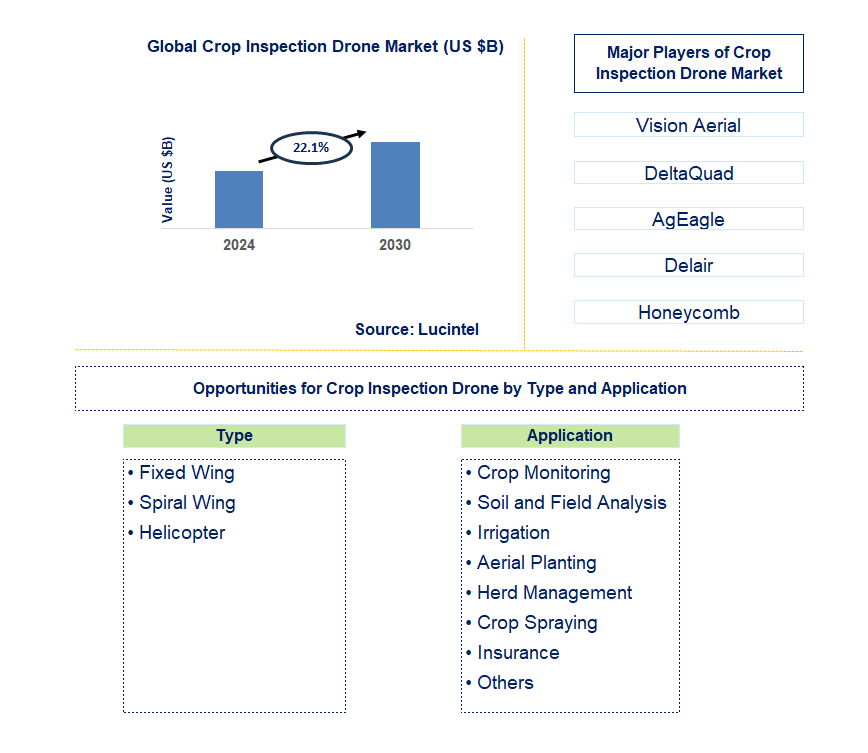
Key data points: The growth forecast = 22.1% annually for the next 6 years. Scroll below to get more insights. This market report covers trends, opportunities, and forecasts in the global crop inspection drone market to 2030 by type (fixed wing, spiral wing, and helicopter), application (crop monitoring, soil and field analysis, irrigation, aerial planting, herd management, crop spraying, insurance, and others), and region (North America, Europe, Asia Pacific, and the Rest of the World)
We'll send your sample report shortly.
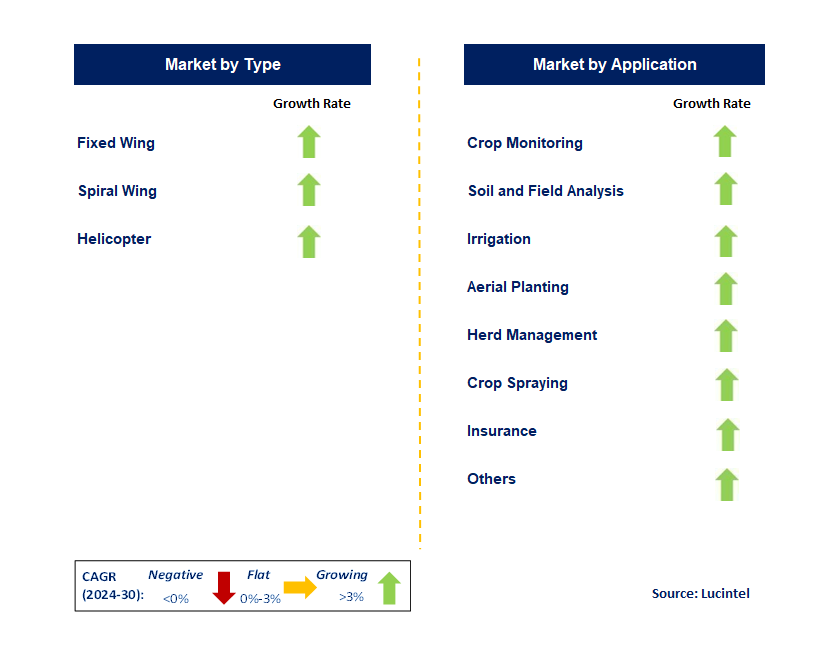
• Lucintel forecasts that, within the type category, fixed wing is expected to witness the highest growth over the forecast period.
• Within the application category, crop monitoring is expected to witness the highest growth.
• In terms of regions, APAC is expected to witness the highest growth over the forecast period. A more than 150-page report is developed to help in your business decisions.
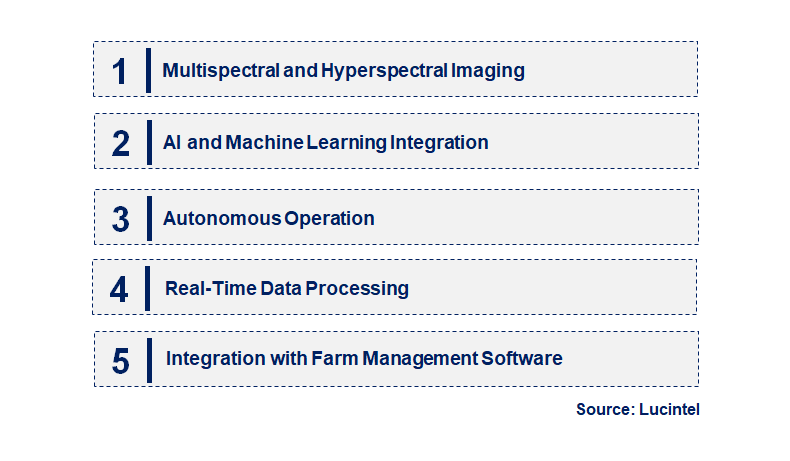
• Multispectral and Hyperspectral Imaging: Drones equipped with multispectral and hyperspectral cameras are becoming more common, allowing for detailed analysis of crop health and soil conditions.
• AI and Machine Learning Integration: Advanced AI and machine learning algorithms are being integrated into drone systems for real-time data analysis and predictive analytics, enhancing decision-making.
• Autonomous Operation: There is an increased focus on autonomous drones that can perform complex inspections and data collection tasks without human intervention, improving efficiency.
• Real-Time Data Processing: Enhanced capabilities for real-time data processing and transmission enable farmers to make timely decisions based on current crop conditions.
• Integration with Farm Management Software: Drones are increasingly being integrated with farm management software for seamless data integration and improved precision in farming practices. Emerging trends such as multispectral imaging and AI integration are driving innovation in the crop inspection drone market, enhancing precision and efficiency in agriculture.
• Technological Advancements: The introduction of drones with high-resolution cameras, multispectral sensors, and advanced imaging technologies is enabling detailed crop and soil analysis.
• Regulatory Support: Governments worldwide are updating regulations to support the use of drones in agriculture, facilitating their integration into farming practices.
• Partnerships and Collaborations: Increased collaboration between drone manufacturers, agricultural technology companies, and research institutions is driving the development and deployment of advanced solutions.
• Enhanced Data Analytics: The development of sophisticated data analytics tools integrated with drones is enabling real-time monitoring and predictive insights into crop health.
• Cost Reductions: Decreasing costs of drone technology and components are making it more accessible for small and medium-sized farms.
• Pilot Programs and Trials: The implementation of pilot programs and trials is helping demonstrate the effectiveness of drone technology in various agricultural applications.
• Market Expansion: The expansion of the drone market into new regions and agricultural sectors, driven by increasing awareness and demand for precision farming solutions, is accelerating growth. Recent developments in the crop inspection drone market highlight advancements in technology and increased support for adoption, driving growth and innovation in agriculture.
• Precision Agriculture: There are opportunities to deploy drones for precision agriculture, including crop monitoring, soil analysis, and input optimization, to enhance farming efficiency.
• Integration with IoT: There is potential to integrate drones with Internet of Things (IoT) devices for improved data collection, real-time monitoring, and automated decision-making.
• Expansion into Developing Markets: There is growth potential in developing regions where modern agricultural practices are being introduced, offering new market opportunities.
• Technological Innovations: Continued innovation in drone technology, such as enhanced sensors and autonomous systems, is creating new applications and capabilities.
• Partnerships with AgTech Companies: Opportunities exist for collaborations between drone manufacturers and agricultural technology firms to develop tailored solutions for specific farming needs.
• Government Incentives: Leveraging government incentives and subsidies for adopting drone technology in agriculture is fostering market growth and adoption.
• Diversification of Applications: Expanding drone applications beyond crop inspection to include livestock monitoring, water management, and environmental monitoring presents further opportunities. Strategic growth opportunities in the crop inspection drone market include leveraging technological innovations and expanding into developing markets to drive further adoption and application.
• Technological Advancements: Continuous improvements in drone technology, including high-resolution cameras and advanced sensors, drive market growth by enhancing crop inspection capabilities.
• Increased Demand for Precision Agriculture: Growing emphasis on precision agriculture to optimize yields and reduce input costs fuels demand for drones in crop monitoring and management.
• Cost Efficiency: Drones provide cost-effective solutions for crop inspections compared to traditional methods, offering significant savings and operational efficiencies.
• Government Support and Incentives: Supportive government policies and incentives for adopting drone technology in agriculture promote market expansion and innovation.
• Enhanced Data Analytics: Advanced data analytics tools integrated with drones offer valuable insights into crop health and soil conditions, improving decision-making and farm management. Challenges in the crop inspection drone market are:
• Regulatory and Compliance Issues: Navigating complex regulations and ensuring compliance with safety standards can be challenging for drone operators and manufacturers.
• Technical Limitations: Issues related to drone performance, such as battery life, payload capacity, and weather limitations, need to be addressed to improve effectiveness.
• High Initial Costs: The initial investment in drone technology and related software can be high, potentially limiting adoption among small and medium-sized farms.
• Data Privacy and Security Concerns: Ensuring data privacy and security, especially when handling sensitive agricultural data, poses challenges for drone operators. The crop inspection drone market is driven by technological advancements and increased demand for precision agriculture but faces challenges related to regulation, technical limitations, and market competition.
• Vision Aerial
• DeltaQuad
• AgEagle
• Delair
• Honeycomb
• PrecisionHawk
• Parrot
• Fixed Wing
• Spiral Wing
• Helicopter
• Crop Monitoring
• Soil and Field Analysis
• Irrigation
• Aerial Planting
• Herd Management
• Crop Spraying
• Insurance
• Others
• North America
• Europe
• Asia Pacific
• The Rest of the World
• USA: In the USA, the crop inspection drone market has witnessed substantial growth with advancements in drone technology and agricultural practices. Major agricultural tech companies, such as Trimble and DJI, have introduced drones equipped with high-resolution multispectral cameras and AI-driven analytics to monitor crop health, detect diseases, and optimize yields. The USDA and other agricultural bodies are actively supporting the adoption of drones through grants and pilot programs. Recent developments also include integration with farm management software, allowing farmers to use drone data for precision farming and real-time decision-making, enhancing productivity and sustainability.
• China: China is rapidly advancing its crop inspection drone market, driven by the need to enhance agricultural efficiency and address food security concerns. Chinese companies, such as DJI and XAG, are developing drones equipped with high-resolution cameras and multispectral sensors for precision agriculture. Recent developments include drones with autonomous flight capabilities and integrated data analytics for monitoring crop health and optimizing inputs. The Chinese government is actively promoting the use of drones in agriculture through subsidies and supportive policies, aiming to modernize farming practices and increase productivity across the country.
• India: In India, the crop inspection drone market is gaining momentum with the push toward modernizing agriculture and improving food security. Indian agricultural technology companies are deploying drones equipped with multispectral imaging and AI for monitoring crop health, soil conditions, and irrigation needs. Recent developments include collaborations between tech firms and government agencies to pilot drone-based solutions in various regions. The Indian government has introduced schemes to encourage the adoption of drone technology in agriculture, aiming to enhance productivity, reduce manual labor, and address challenges related to crop management and monitoring.
• Japan: Japan's crop inspection drone market is evolving with a focus on precision farming and technological integration. Japanese companies are developing drones with advanced imaging and sensing capabilities to monitor crop health, detect anomalies, and optimize resource use. Recent advancements include the integration of drones with AI and machine learning algorithms for predictive analytics and real-time decision support. The Japanese government is supporting these innovations through research initiatives and subsidies, promoting the adoption of drones in agriculture to improve efficiency and sustainability in the country's agricultural sector.


• Vision Aerial
• DeltaQuad
• AgEagle
• Delair
• Honeycomb
• PrecisionHawk
• Parrot Q5. Which crop inspection drone market segment will be the largest in future? Answer: Lucintel forecasts that fixed wing is expected to witness the highest growth over the forecast period. Q6. In crop inspection drone market, which region is expected to be the largest in next 5 years? Answer: APAC is expected to witness the highest growth over the forecast period. Q.7 Do we receive customization in this report? Answer: Yes, Lucintel provides 10% customization without any additional cost.


Choose a license that fits your team. Instant PDF delivery.
Prices exclude taxes. Instant delivery. Custom licensing available on request.
Market Report · July 31, 2026
Market Report · July 31, 2026
Market Report · July 31, 2026
Trusted partner for strategic intelligence and business growth


Receive a complimentary market analysis tailored to your industry. Our analysts will identify key growth opportunities and competitive dynamics specific to your business.

Market size, growth rate, and key trend analysis for your specific sector.

Top competitor positioning and market share analysis.

Strategic recommendations backed by data-driven insights.
Get curated market intelligence and competitive moves straight to your inbox.
By subscribing, you agree to receive our monthly insights. Unsubscribe anytime.
Receive a complimentary market analysis tailored to your industry. Our analysts will identify key growth opportunities and competitive dynamics specific to your business.
Market size, growth rate, and key trend analysis for your specific sector.
Top competitor positioning and market share analysis.
Strategic recommendations backed by data-driven insights.
Get curated market intelligence, emerging trends, and competitive moves straight to your inbox each month.
By subscribing, you agree to receive our monthly insights. Unsubscribe anytime.
We'll send your sample report shortly.