
Market Report · May 18, 2026

This market report covers trends, opportunities, and forecasts in the global crop harvesting robots market to 2031 by technology (computer vision and image recognition, artificial intelligence (ai) and machine learning, robotic arms and gripping systems, autonomous navigation and gps systems, and sensors and actuators for harvesting precision), application (fruit & vegetable harvesting robots and grain harvesting robots), and region (North America, Europe, Asia Pacific, and the Rest of the World)
We'll send your sample report shortly.
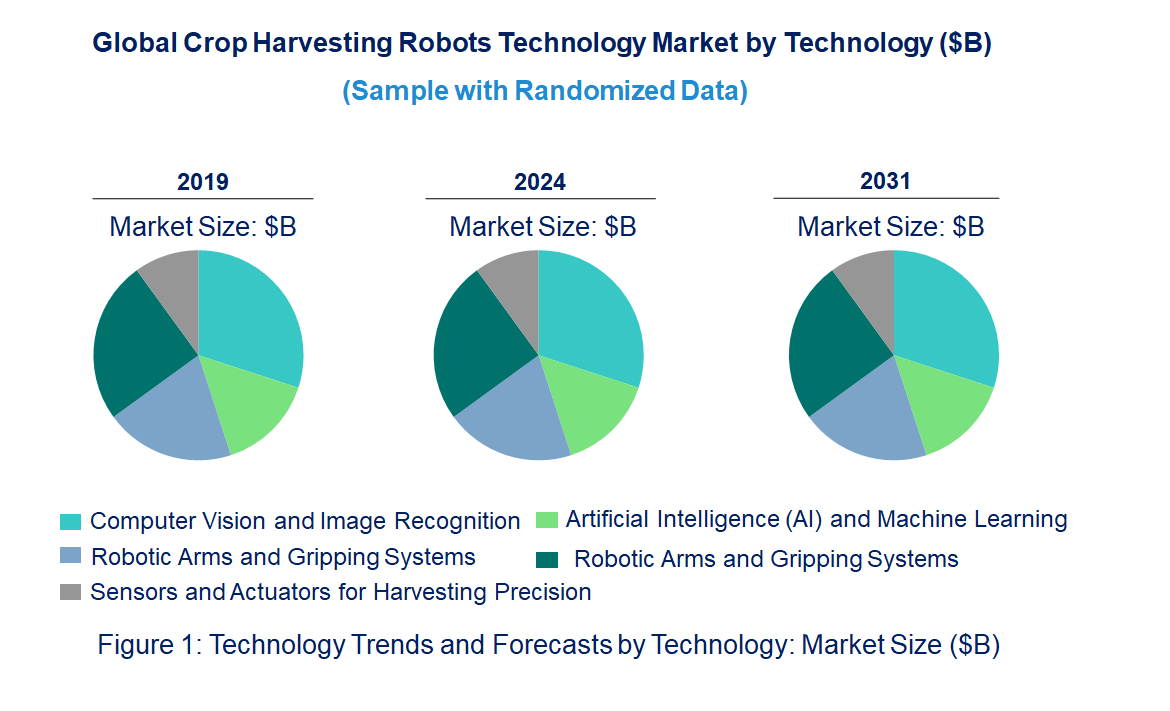
![Crop Harvesting Robots Market Trend and Forecast by Application [Value from 2018 to 2030]:](https://lucintel.com/images/Crop-Harvesting-Robots-Technology-Market-Segment.png "Crop Harvesting Robots Market Trend and Forecast by Application [Value from 2018 to 2030]:")
• Increased Integration of AI and Machine Learning: AI and machine learning are becoming essential in crop harvesting robots, allowing them to adapt to various environmental conditions and make real-time decisions. By continuously learning from past harvests, these robots can improve accuracy in detecting crop ripeness, handling, and harvesting efficiency, significantly enhancing productivity and reducing human error.
• Advancements in Soft Robotics for Gentle Handling: Soft robotics technology is increasingly being used to create more flexible grippers and arms for robots. This innovation allows harvesting robots to handle delicate crops such as fruits and vegetables without causing damage, ensuring that the produce remains intact for market use. The soft, adaptable nature of these robots allows them to work with a variety of crops, improving harvesting precision.
• Deployment of Autonomous Navigation Systems: Autonomous navigation systems, including GPS and LIDAR, are being integrated into crop harvesting robots to enhance their ability to operate independently in unstructured fields. These systems enable robots to navigate complex terrain, avoid obstacles, and carry out harvesting tasks without human intervention, leading to more efficient and cost-effective farming practices.
• Sensor Technology for Harvesting Precision: The use of advanced sensors, such as force sensors, cameras, and environmental sensors, is increasing in harvesting robots. These sensors help robots accurately assess crop conditions, determine ripeness, and handle crops with precision. By improving the robots' ability to make data-driven decisions, sensors enhance the quality of harvested crops and reduce waste.
• Focus on Multi-Crop Harvesting Capabilities: Crop harvesting robots are now being designed to handle multiple types of crops within the same system. This versatility enables farmers to use a single robot across various types of fields, reducing costs and increasing operational flexibility. Multi-crop harvesting robots can adapt to different harvesting methods, making them more valuable for diversified farming operations. These emerging trends are reshaping the crop harvesting robots market by driving advancements in AI, sensor technology, soft robotics, autonomous systems, and multi-crop capabilities. These innovations are improving the efficiency, accuracy, and sustainability of farming practices, making crop harvesting more automated, cost-effective, and scalable. As technology continues to evolve, crop harvesting robots will play an increasingly crucial role in the future of agriculture.
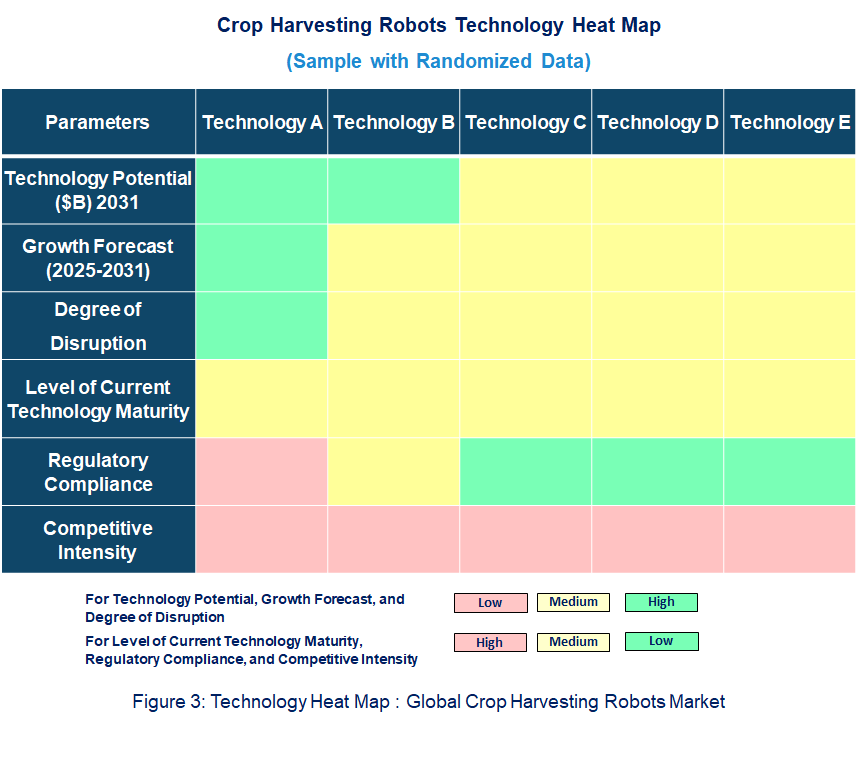
• Potential in Technology: The technology potential of crop harvesting robots is significant, offering transformative benefits to the agriculture industry. These robots can significantly reduce labor costs, increase harvesting efficiency, and enhance precision, all while improving sustainability in farming. By automating the harvesting process, crop harvesting robots help address labor shortages, minimize crop waste, and optimize yield quality. They also integrate cutting-edge technologies like AI, machine learning, robotics, and sensors to enhance decision-making, enabling them to adapt to various crops and field conditions.
• Degree of Disruption: The degree of disruption is high, as crop harvesting robots have the potential to replace traditional manual labor, which is one of the most labor-intensive tasks in agriculture. They can also reduce reliance on chemicals by precisely identifying and harvesting ripe crops, contributing to sustainability goals. However, the disruption comes with challenges, including high initial costs and integration complexities.
• Current Technology Maturity Level: The current maturity of the technology is moderate to advanced, with various prototypes and pilot projects proving the technology's viability. However, widespread adoption is still in progress, with farmers needing to overcome financial and technological barriers.
• Regulatory Compliance: Regulatory compliance is critical, as these systems must adhere to agricultural safety standards, environmental regulations, and data privacy laws. Ensuring the ethical use of AI and robotics, particularly in food production, will also be an important regulatory consideration.
• AgJunction: AgJunction has developed cutting-edge autonomous navigation and control systems that allow crop harvesting robots to efficiently navigate through fields with minimal human intervention. Their technology integrates GPS, precision guidance, and automation software, enabling robots to perform tasks with increased accuracy and reduced labor dependency. This advancement enhances efficiency and ensures better use of farming resources.
• Agrobot: Agrobot has made significant strides in using computer vision and machine learning for fruit-picking robots. Their technology allows robots to identify ripe fruits and selectively harvest them without causing damage. Agrobot's robots are designed to handle delicate crops like strawberries, reducing the need for manual labor while improving harvesting speed and quality, which has a direct impact on both productivity and cost savings for farmers.
• Energid Technologies: Energid Technologies has been at the forefront of developing advanced robotics software that enhances the dexterity and flexibility of crop harvesting robots. Their software solutions help robotic arms adapt to different types of crops and harvesting conditions, improving precision and efficiency. This development allows for a broader application of robotics in the agricultural sector, accommodating various crops and fields.
• Harvest CROO Robotics: Harvest CROO Robotics has introduced a fully autonomous strawberry harvesting robot capable of picking strawberries efficiently in open fields. Their robot uses vision systems and robotic arms to selectively harvest ripe fruit, improving the speed and accuracy of harvesting while reducing reliance on seasonal labor. This innovation has the potential to revolutionize strawberry farming by reducing labor costs and increasing operational efficiency. These developments reflect how these key players are pushing the boundaries of automation in agriculture, improving the efficiency, sustainability, and profitability of crop harvesting. The technologies are enhancing precision, reducing waste, and addressing labor shortages in the industry.
• Labor Shortages in Agriculture: The agricultural sector faces a severe shortage of labor, especially for repetitive tasks like harvesting. Crop harvesting robots offer a viable solution by automating this labor-intensive process. This trend enables farmers to reduce reliance on human labor, thus addressing workforce issues and ensuring consistent productivity.
• Technological Advancements in AI and Robotics: Rapid advancements in AI, machine learning, and robotics are driving the development of more autonomous, intelligent harvesting robots. These systems can now make decisions in real-time, improving the efficiency of harvests and reducing crop damage. This technological evolution allows for the automation of various complex harvesting tasks, enhancing productivity.
• Increased Demand for Precision Agriculture: With the growing focus on sustainability and efficiency, precision agriculture is becoming more important. Crop harvesting robots equipped with sensors and computer vision can perform highly accurate tasks, minimizing waste and ensuring that only ripe crops are harvested. This precision enhances crop yield quality while reducing resource consumption.
• Cost Reduction and Improved Efficiency: Automation in harvesting can significantly reduce operational costs by reducing the need for manual labor and improving operational efficiency. As the technology matures, economies of scale and lower production costs are expected to make crop harvesting robots more affordable, enabling broader adoption, especially among smaller farms.
• Sustainability and Environmental Benefits: Automation leads to less chemical use and waste, contributing to more sustainable farming practices. Harvesting robots with advanced sensors can minimize the need for pesticides and fertilizers, thus reducing environmental impacts. This aligns with the growing push for sustainable agriculture and organic farming. These growth opportunities are reshaping the crop harvesting robots technology market by addressing key challenges like labor shortages and the need for efficiency and sustainability. As the technology becomes more affordable and sophisticated, its adoption is expected to grow, transforming the agricultural industry and improving productivity, sustainability, and profitability.
• Agjunction
• Agrobot
• Energid Technologies
• Harvest Croo Robotics
• Muddy Machines Ltd.
• Naio Technologies
• Technology Readiness: Computer vision and image recognition is at with high competitiveness and moderate regulatory oversight; it is key for visual crop detection and grading. AI and machine learning are also highly competitive, with data use regulations; they support adaptive harvesting decisions and yield prediction. Robotic arms and gripping systems are facing intense competition in design innovation and safety compliance, used for fruit and vegetable harvesting. Autonomous navigation and GPS systems are moderately competitive and must comply with machine safety and field use standards, crucial for field mobility and fleet management. Sensors and actuators for harvesting precision are with fragmented competition and moderate regulatory needs; they enable tactile sensing and motion control. Each technology contributes uniquely to the automation, efficiency, and scalability of crop harvesting.
• Competitive Intensity and Regulatory Compliance of Technologies: In crop harvesting robots the computer vision and AI face high competitive intensity, driven by rapid innovation, startup activity, and demand for AI-powered agritech solutions. Robotic arms and gripping systems are also competitive, with firms racing to balance cost, durability, and crop sensitivity. Autonomous navigation and GPS Systems have moderate intensity, with key players leveraging existing robotics and automotive tech. Sensors and actuators are a highly fragmented market, with competition in both hardware and integration services. Regulatory compliance varies: AI and vision systems face data privacy and AI ethics scrutiny. Robotic arms must meet mechanical safety and ISO standards. Autonomous navigation systems are subject to liability and field safety regulations. Sensor systems must comply with environmental standards and electromagnetic compatibility. Overall, compliance is manageable but increasingly complex with system integration and autonomy.
• Disruption Potential of Technologies for Crop Harvesting Robots: Computer vision and image recognition has high disruption potential by enabling accurate fruit detection and ripeness assessment, reducing crop waste. Artificial intelligence (AI) and machine learning further disrupt by optimizing decision-making, adapting to crop types, and improving efficiency over time. Robotic arms and gripping systems offer strong potential by replacing manual labor with precise, gentle harvesting mechanisms that reduce damage. Autonomous navigation and GPS systems are pivotal for scalability and operational efficiency, allowing robots to function in large, complex fields. Sensors and Actuators for harvesting precision provide real-time data and precise movement control, critical for delicate crop handling. Together, these technologies redefine labor requirements, yield optimization, and harvesting speed. AI and computer vision are key to intelligence and adaptability. Robotic arms and sensors directly influence physical interaction and precision. GPS and autonomy enable system-wide mobility. Disruption is highest where integration creates autonomous, scalable harvesting ecosystems.
• Computer Vision and Image Recognition
• Artificial Intelligence (AI) and Machine Learning
• Robotic Arms and Gripping Systems
• Autonomous Navigation and GPS Systems
• Sensors and Actuators for Harvesting Precision
• Fruit & Vegetable Harvesting Robots
• Grain Harvesting Robots
• North America
• Europe
• Asia Pacific
• The Rest of the World
• Latest Developments and Innovations in the Crop Harvesting Robots Technologies
• Companies / Ecosystems
• Strategic Opportunities by Technology Type


Choose a license that fits your team. Instant PDF delivery.
Prices exclude taxes. Instant delivery. Custom licensing available on request.
Market Report · May 18, 2026
Market Report · May 18, 2026
Market Report · May 18, 2026
Trusted partner for strategic intelligence and business growth


Receive a complimentary market analysis tailored to your industry. Our analysts will identify key growth opportunities and competitive dynamics specific to your business.

Market size, growth rate, and key trend analysis for your specific sector.

Top competitor positioning and market share analysis.

Strategic recommendations backed by data-driven insights.
Get curated market intelligence and competitive moves straight to your inbox.
By subscribing, you agree to receive our monthly insights. Unsubscribe anytime.
Receive a complimentary market analysis tailored to your industry. Our analysts will identify key growth opportunities and competitive dynamics specific to your business.
Market size, growth rate, and key trend analysis for your specific sector.
Top competitor positioning and market share analysis.
Strategic recommendations backed by data-driven insights.
Get curated market intelligence, emerging trends, and competitive moves straight to your inbox each month.
By subscribing, you agree to receive our monthly insights. Unsubscribe anytime.
We'll send your sample report shortly.