
Market Report · July 16, 2026

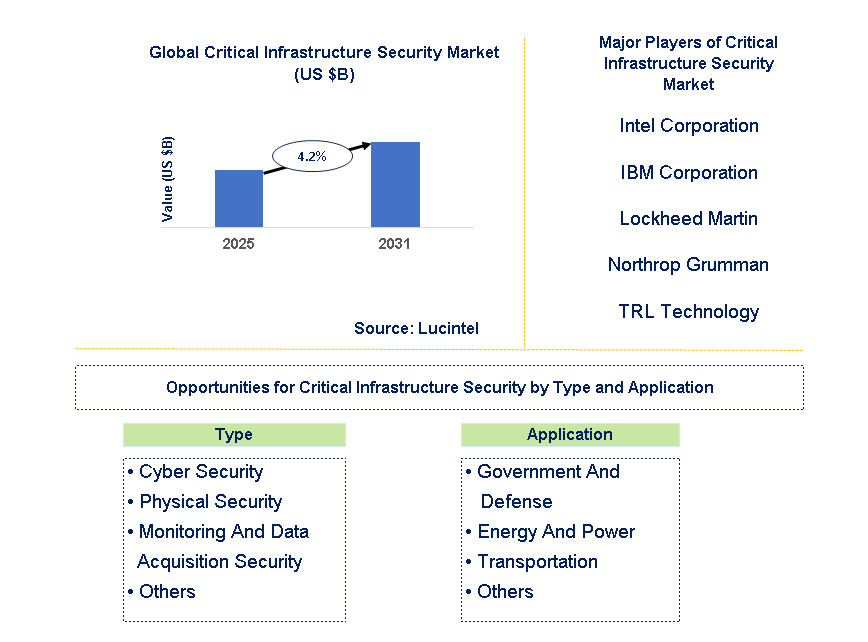
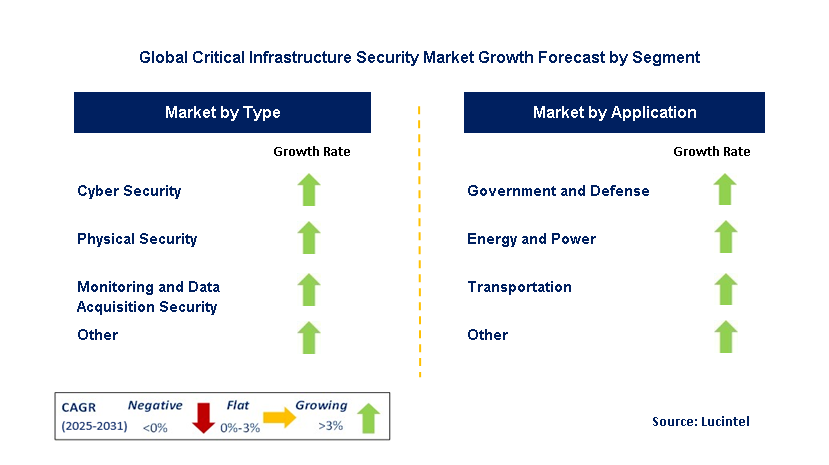
Key data points: The growth forecast = 4.2% annually for the next 7 years. Scroll below to get more insights. This market report covers Trends, opportunity and forecast in critical infrastructure security market to 2031 by type (cyber security, physical security, monitoring and data acquisition security, and other), application (government and defense, energy and power, transportation, and other), and region (North America, Europe, Asia Pacific, and the Rest of the World)
We'll send your sample report shortly.
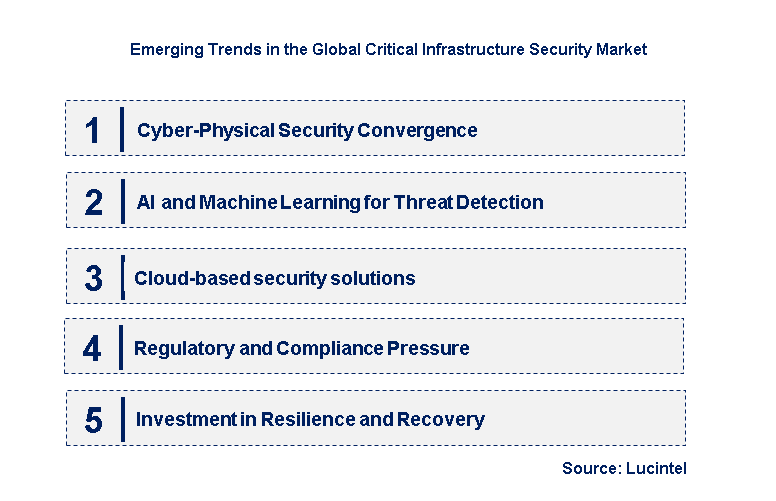
• Cyber-Physical Security Convergence: One of the emerging trends in the evolution of critical infrastructure security is toward convergence of cyber and physical security systems. With the increasing interconnection of critical infrastructure through digital technologies, vulnerabilities in one domain can quickly spill over to other domains. This convergence is integrating traditional security systems with advanced cyber defense technologies, such as AI, IoT sensors, and real-time monitoring systems. The integration of both physical and cyber defenses can help organizations provide a more holistic form of protection for critical infrastructure against a variety of emerging threats.
• AI and Machine Learning for Threat Detection: Artificial intelligence and machine learning are increasingly becoming an integral part of critical infrastructure security. These technologies are currently being utilized for real-time anomaly detection, potential cyber-attack predictions, and automation of threat responses by processing humongous volumes of data. AI-powered systems can also enhance decision-making power through patterns and vulnerabilities identification of infrastructure, hence strengthening defenses and allowing for quicker mitigation of threats. This is changing the way organizations approach critical infrastructure protection-they're being more proactive and more effective in security measures.
• Cloud-based security solutions: The trend of cloud computing in infrastructure creates an impact in increased deployment of cloud-based security solutions for critical infrastructure. These platforms could provide scalability, flexibility, and even centralized control to monitor and protect infrastructure. They allow organizations to address cybersecurity risks through threat assessments and real-time response across geographically dispersed assets while lowering costs and operational overhead. With organizations shifting to the cloud, there will be a tremendous increase in the demand for cloud-native security solutions in energy, transportation, and healthcare sectors.
• Regulatory and Compliance Pressure: As cyber-attacks on critical infrastructure increase, governments and regulatory bodies around the world are imposing stricter security standards. In the U.S., initiatives like the Cybersecurity and Infrastructure Security Agency (CISA) and the National Institute of Standards and Technology (NIST) are setting clear cybersecurity requirements for sectors like energy, transportation, and utilities. Compliance with these regulations is becoming a priority for organizations, prompting investment in security frameworks, audits, and certifications to mitigate risks and avoid legal penalties. This is improving the security and resilience of infrastructure environments worldwide.
• Investment in Resilience and Recovery: Investment in infrastructure resilience and recovery solutions, supporting quick recovery from cyber or physical attacks, picks up where there is a need to renew infrastructure. Organizations are paying more attention to business continuation and disaster recovery plans and resilient infrastructure systems, capable of remaining in operation with organizations even when there is a breach or disaster. Investments in backup power systems, redundant communication networks, and automated failover systems are on the rise, especially in sectors like energy and telecommunications. The focus on resilience is becoming essential to ensure critical infrastructure continues to function in the face of evolving threats. These trends are shaping the critical infrastructure security market, pushing companies and governments to adopt more integrated, intelligent, and resilient security systems for protecting various threats to vital infrastructure.
• Government Initiatives for Cybersecurity: Various governments, including the U.S. and India, are introducing policies and frameworks that strengthen cybersecurity protections for critical infrastructure. This ranges from legislation in Germany's case, such as the IT Security Act, which mandates strict security protocols for energy, transportation, and healthcare, to India's National Cybersecurity Policy. These are leading organizations to increase investment in cybersecurity technologies and frameworks to comply with regulations and avoid the growing threat of cybercrime.
• Emphasis on Supply Chain Security: Supply chain attacks are on the rise, and third-party vendors are now coming under the broad umbrella of critical infrastructure security. Protecting a supply chain against cyber-attacks and physical disruption is a matter of utmost concern for critical sectors such as energy, manufacturing, and IT. It has therefore seen the growth of investment in supply chain security through the real-time monitoring of operations, conducting vendor risk assessments, and employing multi-layered security measures to protect the critical infrastructure.
• Advanced Encryption Technologies: Advanced encryption technologies are being adopted by organizations to protect critical infrastructure from cyber-attacks. These ensure that sensitive data, including operational and communications data, is encrypted both in transit and at rest. As infrastructure becomes more connected and digital, the adoption of encryption technologies is critical to preventing data breaches and ensuring the security of critical systems in sectors like energy, healthcare, and telecommunications.
• AI-Driven Security Operations: AI and machine learning are being implemented in critical infrastructures' security operations for the automation of detection and response to threats. For example, AI security systems can be deployed to monitor and analyze data from IoT sensors, cameras, and network devices in real-time to identify potential security breaches or vulnerabilities. The AI system then increases the speed of response, minimizes human error, and hence increases the overall resilience of critical infrastructure.
• Inter-Sector Cooperation in Cyber Security: Public-private partnerships and inter-sector cooperation are emerging in strong preference with the sophistication of cyber threats. Threat intelligence, best practices, and resources among governments, business community, and cybersecurity providers are being shared effectively to confront this problem. Inter-sector cooperation is very much necessary for protecting critical infrastructure sectors from emerging cyber threats. Joint initiatives are paving the way for strong security frameworks and threat intelligence networks that are gearing organizations toward responding to security challenges more effectively. These are major drivers in the critical infrastructure security market that deeply affect growth in terms of innovation, compliance of regulations, and better sectoral collaboration to ensure resilience and protection of such crucial infrastructures.
• Energy Sector Security: The energy sector is facing heightened cyber threats particularly against power grids and energy distribution systems, therefore, there exists a strong need for advanced security solutions. Opportunities exist in the development of AI-driven monitoring systems, smart grid technologies, and threat detection platforms that can protect energy infrastructure from both cyber-attacks and physical threats. With the increased integration of renewable energy sources into the grid, more security solutions are required to stabilize and build resilience.
• Transportation and Smart Cities Security: With smart cities and increasingly interconnected transportation, the need to protect critical infrastructures such as public transit, traffic management systems, and even autonomous vehicles raises security concerns. This creates tremendous growth opportunities for cybersecurity companies by offering integrated solutions for securing transport networks from cyberattacks and other physical threats. IoT-based security systems and real-time monitoring platforms will be under increased investment.
• Healthcare Infrastructure Protection: The healthcare sector, by way of more digital health technologies and connected devices, harbors a good amount of growth prospects in infrastructure security. Hospitals and healthcare providers are at a higher risk of cyber-attacks that target sensitive patient data and medical devices. So, cybersecurity solutions providing more sophisticated threat detection, encryption, and safe data storage are very much in need to protect the healthcare infrastructure from attacks both cyber and physical.
• Telecommunications Infrastructure Security: Telecommunications infrastructure has become almost the indispensable lifeline for modern economies. The importance of telecom infrastructure security has also increased accordingly. Opportunities now exist in securing 5G networks, data centers, and wireless communication systems from cyber threats. Companies have taken to solutions that enable real-time monitoring, threat intelligence sharing, and network resilience to protect critical telecommunications infrastructure from integrity and availability failures.
• Water and Utility Sector Security: The protection of water systems and utilities is increasingly important as both cyber and physical threats to water supplies, waste management, and other critical utility services rise. Security providers are focusing on offering IoT-based solutions, real-time monitoring systems, and risk mitigation strategies to protect water utilities from disruptions. As the sector undergoes digital transformation, the demand for infrastructure security solutions will continue to grow. These strategic growth opportunities profile an evolving critical infrastructure security market and the need for advanced technologies to protect a growing array of cyber and physical threats against essential services.
• Intel Corporation
• IBM Corporation
• Lockheed Martin Corporation
• Northrop Grumman Corporation
• TRL Technology
• BAE System Plc
• General Dynamic Corporation
• Honeywell International
• Boeing
• Raytheon Company
• Cyber Security
• Physical Security
• Monitoring And Data Acquisition Security
• Other
• Government And Defense
• Energy And Power
• Transportation
• Other
• North America
• Europe
• Asia Pacific
• The Rest of the World
• United States: In the United States, protecting the nation's critical infrastructure, especially with escalating cyber threats, is a critical focus. A number of programs have been set up by the U.S. government, for example, in the form of the Cybersecurity and Infrastructure Security Agency (CISA), aimed at making its infrastructure more resilient. Advanced detection systems and tighter cybersecurity protocols will be required for energy grids, water supplies, and transportation systems. Critical sectors are embracing public-private partnerships more as they take to AI-based cybersecurity, automation, and cloud-based services, in critical areas like power, health care, and finance for maintaining the integrity of the data and smooth operations without losing integrity.
• China: China is aggressively investing in securing critical infrastructures in a day and age with a boom of cyberattacks coupled with tremendous advances in technologies. The government has accorded infrastructure protection as a national agenda, including laws and directives like the "Cybersecurity Law of the People's Republic of China." There is now emphasis on safeguarding energy grids, telecommunication, and transport systems from a cyber and even physical attack. Advanced technologies like big data, AI, and facial recognition are being implemented by Chinese authorities in security. In addition, China focuses on developing indigenous cybersecurity technologies to avoid foreign technology providers and secure the digital ecosystem of the country against potential vulnerabilities.
• Germany: Germany is interested in enhancing critical infrastructure security, with a focus on energy, transportation, and communication systems. Germany, being the largest economy in Europe, has a well-thought-out strategy of integrating cyber and physical security measures to protect critical infrastructure from various threats. The government has prioritized the protection of energy grids in the face of rising cyber-attacks and has introduced laws like the IT Security Act to enforce cybersecurity requirements. Germany is also investing in smart grid technology, AI, and predictive analytics to detect and prevent real-time threats to its vital infrastructure systems.
• India: Critical Infrastructure protection has received a lot of attention in India with rapid digitalization happening there. The Indian government is working to secure sectors like energy, transportation, and financial services. The most recent developments are about the establishment of the National Critical Information Infrastructure Protection Centre (NCIIPC) to protect India's critical information systems. It is developing new cybersecurity defenses that include advanced encryption, AI-based threat detection, and improved partnership between the public and private sectors to safeguard important infrastructure from both cyber and physical threats as more digital infrastructure increases the risk of cyber-attacks.
• Japan: Japan has taken tremendous steps in strengthening its critical infrastructure security, especially against natural disasters and the rising threat of cyber-attacks. The country is famous for its technological advancements and has incorporated cybersecurity measures into its critical sectors, such as energy, transportation, and healthcare. Japan's government has implemented policies to enhance infrastructure resilience, including the development of disaster-resistant technologies and advanced AI-driven security solutions. Furthermore, Japan is investing in advanced cybersecurity frameworks and operational continuity measures to protect against attacks on critical infrastructure, particularly in light of the country’s growing reliance on digital technologies and global interconnectedness.


• Intel Corporation
• IBM Corporation
• Lockheed Martin Corporation
• Northrop Grumman Corporation
• TRL Technology
• BAE System Plc
• General Dynamic Corporation
• Honeywell International
• Boeing
• Raytheon Company Q5. Which critical infrastructure security market segment will be the largest in future? Answer: Lucintel forecasts that, within the type category cyber security is expected to witness the highest growth over the forecast period. Q6. In critical infrastructure security market, which region is expected to be the largest in next 5 years? Answer: In terms of region, APAC is expected to witness the highest growth over the forecast period. Q7. Do we receive customization in this report? Answer: Yes, Lucintel provides 10% customization without any additional cost.


Choose a license that fits your team. Instant PDF delivery.
Prices exclude taxes. Instant delivery. Custom licensing available on request.
Market Report · July 16, 2026
Market Report · May 18, 2026
Market Report · May 18, 2026
Trusted partner for strategic intelligence and business growth


Receive a complimentary market analysis tailored to your industry. Our analysts will identify key growth opportunities and competitive dynamics specific to your business.

Market size, growth rate, and key trend analysis for your specific sector.

Top competitor positioning and market share analysis.

Strategic recommendations backed by data-driven insights.
Get curated market intelligence and competitive moves straight to your inbox.
By subscribing, you agree to receive our monthly insights. Unsubscribe anytime.
Receive a complimentary market analysis tailored to your industry. Our analysts will identify key growth opportunities and competitive dynamics specific to your business.
Market size, growth rate, and key trend analysis for your specific sector.
Top competitor positioning and market share analysis.
Strategic recommendations backed by data-driven insights.
Get curated market intelligence, emerging trends, and competitive moves straight to your inbox each month.
By subscribing, you agree to receive our monthly insights. Unsubscribe anytime.
We'll send your sample report shortly.