
Market Report · July 15, 2026

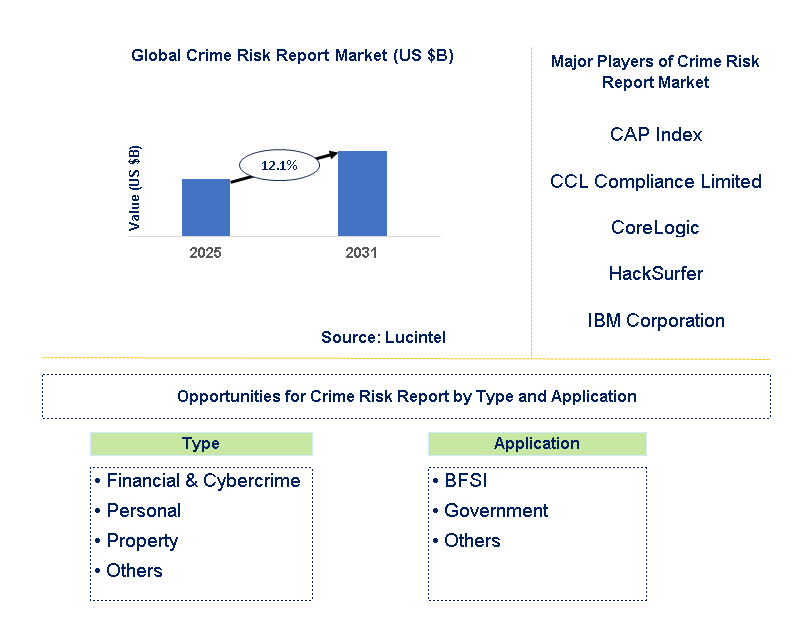
Key data points: The growth forecast = 12.1% annually for the next 7 years. Scroll below to get more insights. This market report covers trends, opportunities and forecasts in crime risk report market to 2031 by type (financial & cybercrime, personal, property, and others), application (BFSI, government, and others), and region (North America, Europe, Asia Pacific, and the Rest of the World)
We'll send your sample report shortly.
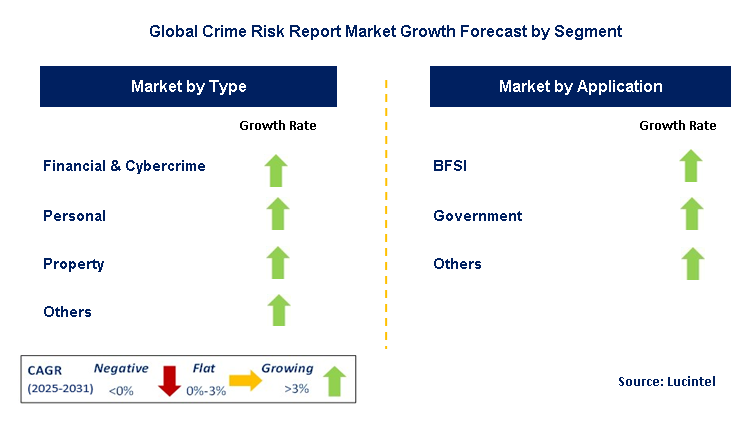
• Lucintel forecasts that, within the type category, financial & cybercrime is expected to witness the highest growth over the forecast period.
• Within the application category, BFSI is expected to witness higher growth.
• In terms of region, North America is expected to witness the highest growth over the forecast period. Gain valuable insights for your business decisions with our comprehensive 150+ page report. Sample figures with some insights are shown below.
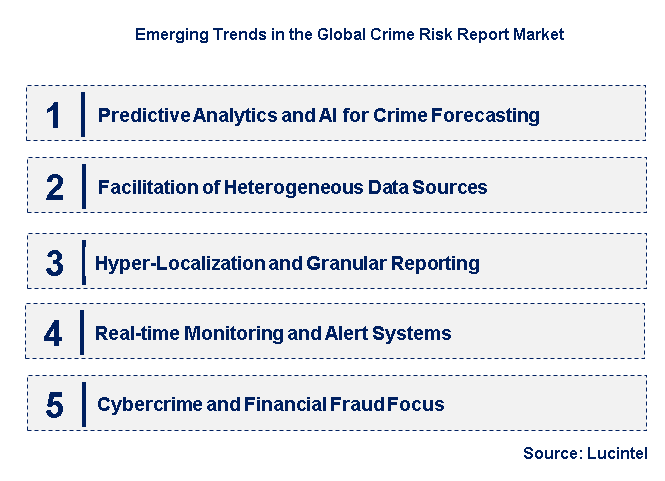
• Predictive Analytics and AI for Crime Forecasting: This trend involves leveraging artificial intelligence and machine learning algorithms to analyze historical crime data, socioeconomic indicators, environmental factors, and even real-time public sentiment to predict future crime hotspots and types. The impact is a shift from reactive security measures to proactive prevention strategies. This enables police, enterprises, and citizens to better allocate resources, augment security levels in exposed points, and predict possible threats before they become real crimes, resulting in a drastic decrease in crime cases.
• Facilitation of Heterogeneous Data Sources: Crime risk reports are now more and more drawing information from a broad spectrum of sources outside of conventional police records, like social media, financial transactions, geospatial information systems (GIS), dark web intelligence, and even IoT devices. The effect is a more rounded and complete picture of crime risks. This luxuriant fabric of data allows for more precise and subtle risk analyses, uncovering concealed patterns and nascent threats that would elude analyses based on single-source data. It delivers a more distinct image of both local and worldwide criminal topographies.
• Hyper-Localization and Granular Reporting: There is an increasing need for crime risk reports that provide very localized and granular information, frequently down to street or property address level, versus merely broad neighborhood or city-wide statistics. This includes thorough breakdowns by crime category, time of day, and particular demographics. The effect is very targeted risk estimation for real estate investments, personal safety planning, and focused security deployments. This degree of precision enables stakeholders to make extremely informed decisions on the basis of precise geographical risk profiles.
• Real-time Monitoring and Alert Systems: Aside from static reports, the industry is gravitating towards offering real-time monitoring and alert systems that inform users of rising crime threats or events in particular locations. This entails ongoing data ingestion and instant reporting of important information. The effect is heightened situational awareness and swift response capacity. To firms, this translates into real-time alerts for probable dangers to their property or staff, whereas to individuals, it provides advance notice of travel or residential safety.
• Cybercrime and Financial Fraud Focus: As economies are increasingly digitally transformed, there is a growing emphasis on expert crime risk reports that address cybercrime (e.g., data breaches, phishing, ransomware) and financial fraud (e.g., money laundering, identity theft, illicit finance) specifically. The effect is a timely solution for financial institutions, e-commerce companies, and individuals to safeguard digital assets and transactions. These expert reports offer intelligence on emerging digital risks, enabling organizations to adopt effective cybersecurity controls and adhere to anti-money laundering guidelines. These new trends are essentially transforming the crime risk report market in a way that is making it smarter, more dynamic, and actionable. They are turning crime risk analysis into a forward-looking, predictive science, rather than a backward-looking activity, and allowing for more efficient prevention measures and the creation of a safer environment for businesses, governments, and citizens alike.
• Integration of Advanced Analytics and AI: One major advancement is the in-depth integration of sophisticated analytics such as artificial intelligence and machine learning into the generation of crime risk reports. AI-based algorithms process massive amounts of data, detect sophisticated patterns, and predict future crime patterns more accurately. The effect is more predictive and proactive crime risk profiling. This enables businesses, citizens, and law enforcement to predict threats, optimize resource allocation, and adopt preventive measures rather than just responding to events.
• Increase in Data Sources and Granularity: Recent advances include adding a broad range of data sources in addition to historic crime statistics, for example, sentiment from social media, urban planning information, economic signals, and even feeds on public safety in real time. Reporting granularity has also gone up, with reporting to street level now being possible. The effect is a richer and more detailed picture of crime risk, enabling highly localized and pinpoint assessments. This gives a finer description of safety at individual locations, essential in real estate, insurance, and personal safety.
• Emphasis on Cybercrime and Financial Fraud Risk: With the growing menace of cybercrime and financial fraud, there has been a noteworthy advancement in specialized crime risk reports in these domains. These reports provide information on vulnerabilities, typical attack vectors, and sectoral fraud trends. The effect is increased security for financial institutions, organizations, and individuals against online threats. Such specialized information aids in creating high-level cybersecurity frameworks, enhancing fraud detection mechanisms, and compliance with changing financial regulations.
• Development of Cloud-Based Platforms and Real-time Alerts: The move to cloud-based solutions for providing crime risk reports is a significant advance, with improved accessibility, scalability, and live updates. Integrated alert mechanisms within many platforms are also able to notify users of notable changes in crime risk in their selected areas of interest. The effect is instant access to essential safety data, with the capability to respond to developing threats in quick time. This improves situational awareness among urban planners, security staff, and residents, leading to a safer environment.
• Application-Specific Reports and Customization: Current trends indicate an increasing trend toward highly tailored and application-specific crime risk reports. For example, reports for real estate developers could emphasize property crime rates, whereas those for insurance firms could highlight financial fraud or natural disaster-related crime. The result is reports most directly applicable to the particular needs and decision-making activities of multiple stakeholders. This specificity boosts the utility and usefulness of crime risk reports in many industries. These recent innovations collectively revolutionize the crime risk report industry by making it smarter, more thorough, responsive, and personalized to individual user requirements. They are arming people, enterprises, and public authorities with greater insights and capabilities to know, predict, and counter crime risks in today's increasingly complex world.
• Real estate and property development: One large strategic expansion area is offering detailed crime risk reports to the real estate and property development communities. This entails comprehensive studies of crime rates, trends, and particular types of incidents for residential areas, commercial properties, and potential new development sites. The effect is better-informed investment choices, increased property values, and enhanced safety for residents and businesses. Developers and investors can avoid risks from high-crime locations and more effectively market properties based on authentic safety information.
• Insurance Underwriting and Risk Assessment: Widening uses of crime risk reports in the insurance sector, specifically for underwriting property, business, and cyber insurance policies, have good growth potential. These reports enable insurers to better measure clients' risk exposure from geographic crime data, historical incident trends, and imminent threats. The effect is more accurate risk profiling, equitable premium pricing, and lower fraudulent claims. It allows insurers to make informed decisions based on data, which will increase profitability and serve policyholders better.
• Financial Services and Anti-Money Laundering (AML): There is vast growth potential in creating crime risk reports for the financial services industry, where the emphasis is on detection and prevention of financial fraud, money laundering, and illicit finance risks. This encompasses transaction monitoring, client due diligence, and risk scoring of new financial products or services. The effect is greater regulatory compliance, lower financial loss from fraud, and greater integrity in the financial system. These reports assist institutions in dealing with intricate regulatory schemes and safeguarding against high-tech financial crime.
• Government and Public Safety Planning: One strategic priority is offering crime risk reports to government agencies to inform public safety planning, law enforcement resource allocation, and city policy making. This involves determining hot spots of crime, analyzing patterns of crime, and assessing the effectiveness of crime prevention programs. The effect is more effective deployment of police resources, targeted intervention programs, and evidence-based policy-making that actually enhances community safety and well-being.
• Individual Safety and Relocation Services: Creating accessible crime risk reports for consumers, particularly those relocating for individual or business purposes, is an emerging market. The reports can give comprehensive information about the safety of prospective residential neighborhoods, school zones, or travel destinations. The effect is educated personal safety choices, lower anxiety, and increased quality of life. This enables consumers to opt for environments that suit their safety choices and bypass high-risk locations. These strategic opportunity growth areas are deeply influencing the crime risk report market by broadening its applications and enhancing its utility across a wide range of industries and individual requirements. By targeting these areas, market participants can utilize sophisticated analytics to provide greatly valuable, actionable information, thus enhancing the market's role as an indispensable part of contemporary risk management and security planning.
• CAP Index
• CCL Compliance Limited
• CoreLogic
• HackSurfer
• IBM Corporation
• Intelligent Direct
• Location
• PwC
• Pinkerton Consulting & Investigations
• Silva Consultants
• Financial & Cybercrime
• Personal
• Property
• Others
• BFSI
• Government
• Others
• North America
• Europe
• Asia Pacific
• The Rest of the World
• United States: The US market for crime risk reports is advanced, fueled by robust demand from real estate, banking, and government markets. Recent trends involve global proliferation of AI-based solutions for financial crime detection, advanced data integration from heterogeneous sources, and the spread of cloud-based platforms for real-time risk assessment. There is also heightened emphasis on predictive analytics to forecast patterns of crime and growing demands for in-depth reporting of property crimes and cyber threats, especially in metropolitan areas.
• China: China's crime risk report industry is growing fast, driven by the country's widespread digital payment system and rising fears of financial and cybercrime. Recent trends include tighter enforcement actions and fresh orders from authorities to tackle cross-regional financial fraud. There is expanding focus on using big data and artificial intelligence in crime prevention, especially against illegal fundraising and internet scams. Challenges persist over sharing and standardizing data across jurisdictions, though.
• Germany: Germany's crime risk report market is dominated by a high focus on compliance with regulation and the prevention of financial crime. Recent trends point towards a high level of efforts aimed at combating money laundering and human trafficking, with a special push for the analysis of data as well as inter-agency cooperation. The market is experiencing a rise in demand for solutions which are capable of analyzing intricate corporate structures in order to detect financial flows of illicit nature, coupled with strict data privacy rules such as GDPR.
• India: India's crime risk report industry is also growing at a fast pace, fueled by rising digitalization, urbanization, and awareness of cyber and financial frauds. Key developments during the period include the passing of new criminal legislation and the Reserve Bank of India's updated fraud risk management guidelines for regulated institutions. Demand is on the rise for AI-driven analytics to counter generative AI-based frauds, cryptocurrency frauds, and QR code tampering, with huge investment in sophisticated security measures by firms.
• Japan: Japan's crime risk report market is changing, driven by a recent increase in total crime statistics, such as cybercrimes and sophisticated fraud. Trends reflect more emphasis on examining data associated with organized crime groups and the black market. There is an emerging demand for data-rich reports on property crime, and a focus on preventing human trafficking and managing financial crime threats, with governments and companies looking to utilize sophisticated analytics for improved prevention and response.


• CAP Index
• CCL Compliance Limited
• CoreLogic
• HackSurfer
• IBM Corporation
• Intelligent Direct
• Location
• PwC
• Pinkerton Consulting & Investigations
• Silva Consultants Q5. Which crime risk report market segment will be the largest in future? Answer: Lucintel forecasts that, within the type category, financial & cybercrime is expected to witness the highest growth over the forecast period. Q6. In crime risk report market, which region is expected to be the largest in next 5 years? Answer: In terms of region, North America is expected to witness the highest growth over the forecast period. Q7. Do we receive customization in this report? Answer: Yes, Lucintel provides 10% customization without any additional cost.


Choose a license that fits your team. Instant PDF delivery.
Prices exclude taxes. Instant delivery. Custom licensing available on request.
Market Report · July 15, 2026
Market Report · June 26, 2026
Market Report · June 24, 2026
Trusted partner for strategic intelligence and business growth


Receive a complimentary market analysis tailored to your industry. Our analysts will identify key growth opportunities and competitive dynamics specific to your business.

Market size, growth rate, and key trend analysis for your specific sector.

Top competitor positioning and market share analysis.

Strategic recommendations backed by data-driven insights.
Get curated market intelligence and competitive moves straight to your inbox.
By subscribing, you agree to receive our monthly insights. Unsubscribe anytime.
Receive a complimentary market analysis tailored to your industry. Our analysts will identify key growth opportunities and competitive dynamics specific to your business.
Market size, growth rate, and key trend analysis for your specific sector.
Top competitor positioning and market share analysis.
Strategic recommendations backed by data-driven insights.
Get curated market intelligence, emerging trends, and competitive moves straight to your inbox each month.
By subscribing, you agree to receive our monthly insights. Unsubscribe anytime.
We'll send your sample report shortly.