
Market Report · July 15, 2026

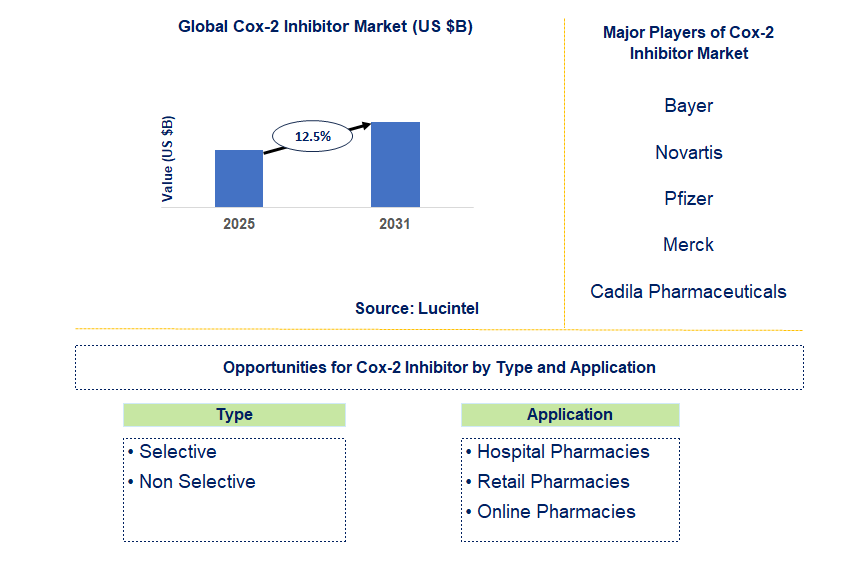
Key data points: The growth forecast = 12.5% annually for the next 7 years. Scroll below to get more insights. This market report covers trends, opportunities and forecasts in cox-2 inhibitor market to 2031 by type (selective and non selective), application (hospital pharmacies, retail pharmacies, and online pharmacies), and region (North America, Europe, Asia Pacific, and the Rest of the World)
We'll send your sample report shortly.
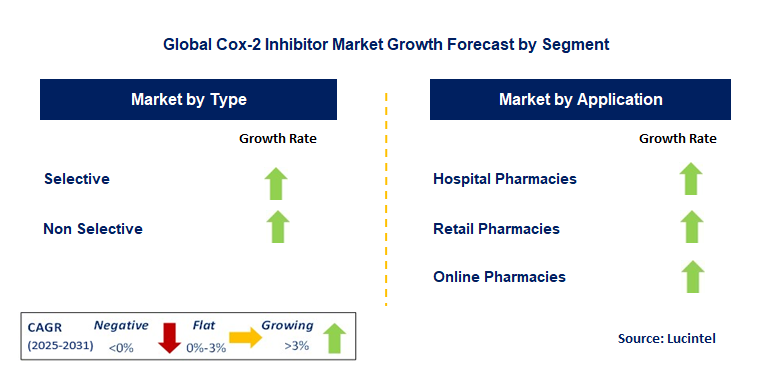
• Lucintel forecasts that, within the type category, selective is expected to witness higher growth over the forecast period.
• Within the application category, online pharmacy is expected to witness the highest growth.
• In terms of region, APAC is expected to witness the highest growth over the forecast period. Gain valuable insights for your business decisions with our comprehensive 150+ page report. Sample figures with some insights are shown below.
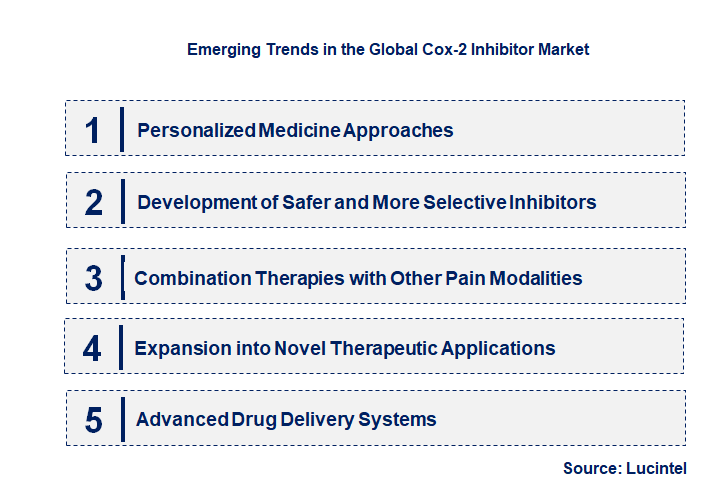
• Personalized Medicine Approaches: There's an emerging trend towards personalized medicine in COX-2 inhibitor prescribing. This involves utilizing genetic markers and patient profiles to predict individual responses and potential side effects, allowing for more tailored treatment regimens to maximize efficacy and minimize risks, particularly cardiovascular ones.
• Development of Safer and More Selective Inhibitors: Research and development efforts are increasingly focused on designing next-generation COX-2 inhibitors with improved safety profiles. This trend aims to create molecules that maintain high selectivity for COX-2 while mitigating cardiovascular or renal side effects, addressing the historical challenges associated with the class.
• Combination Therapies with Other Pain Modalities: An emerging trend is the use of COX-2 inhibitors in combination with other pain management strategies. This includes co-prescription with analgesics, neuropathic pain medications, or non-pharmacological interventions, aiming for synergistic effects to achieve better pain control with potentially lower doses of each drug.
• Expansion into Novel Therapeutic Applications: Beyond traditional inflammatory conditions, there's growing interest in exploring new therapeutic applications for COX-2 inhibitors. This trend includes investigating their potential in areas like cancer prevention and treatment, certain neurological disorders, and other conditions where inflammation plays a significant role, diversifying their market.
• Advanced Drug Delivery Systems: The development of novel drug delivery systems for COX-2 inhibitors is an emerging trend. This includes slow-release formulations, transdermal patches, or targeted delivery mechanisms aimed at improving bioavailability, reducing dosing frequency, and potentially minimizing systemic side effects, thereby enhancing patient compliance and safety. These emerging trends are fundamentally reshaping the COX-2 inhibitor market by pushing for more precise, safer, and versatile therapeutic options. They are driving innovation in drug design, prescribing practices, and therapeutic applications, ultimately aiming to optimize the risk-benefit profile and expand the utility of COX-2 inhibitors for a broader range of patients and conditions.
• Focus on Cardiovascular Safety Studies: A major recent development is the continued emphasis on rigorous post-marketing surveillance and clinical studies to better understand the cardiovascular risk profile of existing COX-2 inhibitors, particularly Celecoxib. This ensures prescribers have comprehensive data for informed decision-making and patient risk stratification.
• Exploration of Repurposing Existing Drugs: There's an increasing trend in researching the repurposing of existing COX-2 inhibitors for novel indications beyond traditional pain and inflammation. This includes exploring their potential in oncology (e.g., colorectal cancer prevention) and neurodegenerative diseases, leveraging their anti-inflammatory properties for new therapeutic avenues.
• Development of Topical and Injectable Formulations: Recent advancements include the development and approval of alternative formulations, such as topical gels or injectable solutions for COX-2 inhibitors (e.g., bupivacaine/meloxicam combination for postoperative pain). These aim to provide localized pain relief, potentially reducing systemic side effects and improving patient convenience.
• Increased Generic Penetration: The market has seen a continued rise in the availability and adoption of generic versions of COX-2 inhibitors, particularly celecoxib. This increases accessibility and affordability for patients, driving down overall costs and making these drugs more widely available in various healthcare systems.
• Enhanced Regulatory Scrutiny and Guidelines: Regulatory bodies globally continue to issue updated guidelines and recommendations for the safe and appropriate use of COX-2 inhibitors. This ensures a balanced approach, emphasizing the importance of patient selection, dose optimization, and monitoring, to minimize potential adverse effects and promote rational prescribing. These recent developments are significantly impacting the COX-2 inhibitor market by fostering a more cautious yet innovative approach to their use. They are leading to a deeper understanding of their risk-benefit profile, expanding their therapeutic potential, improving delivery methods, and ensuring broader, yet safer, access to these essential pain management drugs.
• Osteoarthritis Management: With the aging global population, osteoarthritis remains a primary application. Strategic growth involves promoting COX-2 inhibitors for long-term pain and inflammation control in OA patients, emphasizing their gastrointestinal safety profile compared to traditional NSAIDs, and supporting patient adherence for chronic management.
• Rheumatoid Arthritis Treatment: RA is a chronic autoimmune inflammatory disease requiring consistent pain relief and inflammation reduction. Opportunities lie in positioning COX-2 inhibitors as a valuable component of multimodal RA treatment regimens, particularly for symptom management, while considering their use alongside disease-modifying antirheumatic drugs (DMARDs).
• Acute Postoperative Pain: The demand for effective and safe pain control post-surgery offers significant growth. Strategic opportunities include utilizing injectable or fast-acting COX-2 inhibitors for managing acute postoperative pain, potentially reducing opioid reliance and improving patient recovery with their anti-inflammatory and analgesic properties.
• Dysmenorrhea Management: COX-2 inhibitors are effective for menstrual pain. Growth opportunities involve highlighting their efficacy in managing dysmenorrhea, especially for patients who experience significant pain or gastrointestinal discomfort with non-selective NSAIDs, promoting them as a preferred option for this common condition.
• Targeting Chronic Low Back Pain: Chronic low back pain affects a large population globally. Strategic growth can be achieved by emphasizing the role of COX-2 inhibitors in the long-term management of chronic low back pain, particularly where an inflammatory component is identified, and integrating them into comprehensive pain management plans. These strategic growth opportunities are profoundly impacting the COX-2 inhibitor market by reinforcing their vital role in managing specific pain and inflammatory conditions where their selective action provides distinct advantages. They are driving targeted marketing, clinical education, and potential new formulations to address unmet needs in these prevalent applications.
• Bayer
• Novartis
• Pfizer
• Merck
• Cadila Pharmaceuticals
• Selective
• Non Selective
• Hospital Pharmacies
• Retail Pharmacies
• Online Pharmacies
• North America
• Europe
• Asia Pacific
• The Rest of the World
• United States: The U.S. market continues to be dominated by Celecoxib (Celebrex), which remains the only selective COX-2 inhibitor widely available. Recent developments focus on managing the long-term safety profile, with ongoing post-marketing surveillance and research into personalized medicine approaches to minimize cardiovascular risks for patients.
• China: China's market for COX-2 inhibitors is expanding due to a rising prevalence of inflammatory conditions and growing healthcare expenditure. Developments include increased domestic production of generic versions, efforts to improve drug accessibility, and a focus on balancing efficacy with safety guidelines for widespread use across its large population.
• Germany: Germany’s market emphasizes a cautious approach to COX-2 inhibitors, prioritizing patient safety and evidence-based medicine. Recent developments involve rigorous post-marketing surveillance, a focus on appropriate prescribing practices to mitigate cardiovascular risks, and continued research into the precise patient populations benefiting most from these drugs.
• India: India's COX-2 inhibitor market is experiencing significant growth, driven by the increasing incidence of musculoskeletal disorders and rising awareness of pain management. Developments include the availability of multiple generic formulations, a focus on affordability, and efforts to educate healthcare professionals on the appropriate use and potential risks of these medications.
• Japan: Japan's market for COX-2 inhibitors is characterized by a strong emphasis on precision and patient safety. Recent developments include careful monitoring of cardiovascular side effects, research into unique patient responses, and a steady demand for selective COX-2 inhibitors for chronic pain conditions within its aging population.


• Bayer
• Novartis
• Pfizer
• Merck
• Cadila Pharmaceuticals Q5. Which cox-2 inhibitor market segment will be the largest in future? Answer: Lucintel forecasts that, within the type category, selective is expected to witness higher growth over the forecast period. Q6. In cox-2 inhibitor market, which region is expected to be the largest in next 5 years? Answer: In terms of region, APAC is expected to witness the highest growth over the forecast period. Q7. Do we receive customization in this report? Answer: Yes, Lucintel provides 10% customization without any additional cost.


Choose a license that fits your team. Instant PDF delivery.
Prices exclude taxes. Instant delivery. Custom licensing available on request.
Market Report · July 15, 2026
Market Report · May 18, 2026
Market Report · May 18, 2026
Trusted partner for strategic intelligence and business growth


Receive a complimentary market analysis tailored to your industry. Our analysts will identify key growth opportunities and competitive dynamics specific to your business.

Market size, growth rate, and key trend analysis for your specific sector.

Top competitor positioning and market share analysis.

Strategic recommendations backed by data-driven insights.
Get curated market intelligence and competitive moves straight to your inbox.
By subscribing, you agree to receive our monthly insights. Unsubscribe anytime.
Receive a complimentary market analysis tailored to your industry. Our analysts will identify key growth opportunities and competitive dynamics specific to your business.
Market size, growth rate, and key trend analysis for your specific sector.
Top competitor positioning and market share analysis.
Strategic recommendations backed by data-driven insights.
Get curated market intelligence, emerging trends, and competitive moves straight to your inbox each month.
By subscribing, you agree to receive our monthly insights. Unsubscribe anytime.
We'll send your sample report shortly.