
Market Report · July 15, 2026

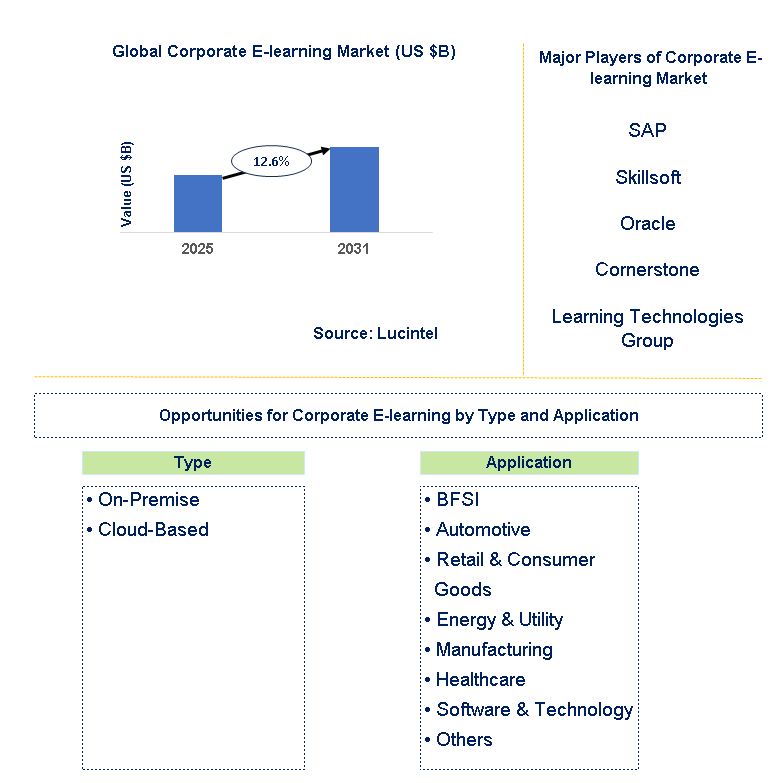
Key data points: The growth forecast = 12.6% annually for the next 7 years. Scroll below to get more insights. This market report covers trends, opportunities and forecasts in corporate E-learning market to 2031 by type (on-premise and cloud-based), application (BFSI, automotive, retail & consumer goods, energy & utility, manufacturing, healthcare, software & technology, and others), and region (North America, Europe, Asia Pacific, and the Rest of the World)
We'll send your sample report shortly.
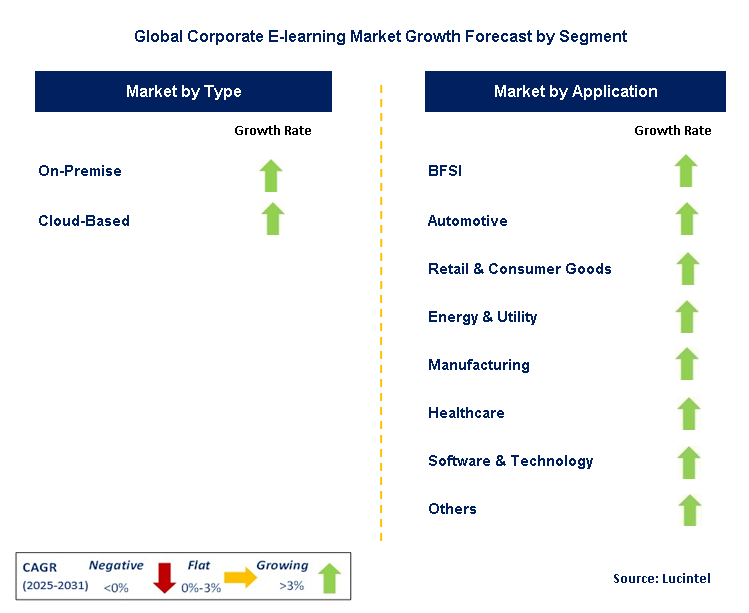
• Lucintel forecasts that, within the type category, cloud-based is expected to witness higher growth over the forecast period.
• Within the application category, software & technology is expected to witness the highest growth.
• In terms of region, APAC is expected to witness the highest growth over the forecast period. Gain valuable insights for your business decisions with our comprehensive 150+ page report. Sample figures with some insights are shown below.
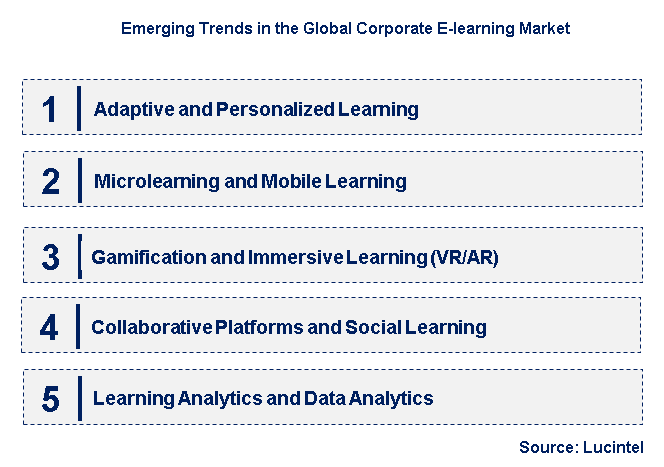
• Adaptive and Personalized Learning: The trend encompasses adapting learning styles and content to the specific needs, interests, and proficiency of individual learners. With the help of machine learning and artificial intelligence, e-learning solutions can review performance data to suggest particular modules, modify difficulty levels, and offer relevant feedback. This way, employees get targeted training that fills their specific skill gaps, maximizing learning productivity and engagement. It goes beyond generic training to build a very personalized learning experience for every employee.
• Microlearning and Mobile Learning: Microlearning presents training content in short, bite-sized packages, usually a few minutes in length, dedicated to one learning objective. Mobile learning facilitates access to such packages and other learning content on tablets and smartphones, so employees can learn anywhere, anytime. This trend provides convenience for the hectic lifestyles of today's professionals, encouraging ongoing learning by incorporating it naturally into everyday lifestyles. It improves learning retention by having concentrated, regular interactions and rendering learning very convenient on the move.
• Gamification and Immersive Learning (VR/AR): Gamification involves the application of game-like features like points, badges, leaderboards, and challenges within e-learning to enhance motivation and engagement. Immersive learning via virtual reality and augmented reality presents highly realistic and interactive training simulations. Employees may rehearse intricate procedures or simulate real-world conditions in a secure environment, facilitating practical skills and decision-making. These technologies become more experiential, memorable, and engaging, with greater retention and application of learned concepts.
• Collaborative Platforms and Social Learning: This trend focuses on learning by interacting and collaborating with peers, mentors, and teachers. corporate E-learning sites are using more and more features such as discussion forums, collaborative projects, peer review mechanisms, and virtual classrooms. This creates a community of learners, facilitates knowledge sharing, and enables employees to learn from one another's experiences and insights. It goes beyond solitary consumption of material to provide a more interactive and collaborative learning experience.
• Learning Analytics and Data Analytics: The trend here is the gathering, examination, and reporting of data related to learner progress, participation, and performance. Learning analytics offers valuable insights into the impact of e-learning programs, indicates where learners are struggling, and optimizes content and delivery approaches. Organizations are able to use this information to evaluate the return on investment for their training, make informed decisions to enhance learning, and tailor future learning. It supports continuous improvement and business strategy alignment of e-learning. These new trends are collectively redefining the corporate E-learning space by individualizing learning, making it engaging, accessible, and data-driven. They are abandoning classic, passive paradigms of learning and migrating towards dynamic, interactive, and highly potent approaches. This shift allows organizations to create a culture of constant learning, equip employees with skill sets that matter, and accelerate business performance through better human capital development.
• Transition to Cloud-Based Learning Management Systems: Widespread usage of cloud-based Learning Management Systems, or LMS, has transformed corporate training delivery and management. Cloud-based solutions provide unmatched scalability, accessibility, and affordability, removing the high costs of on-premise infrastructure. This innovation enables businesses of all sizes to roll out comprehensive e-learning programs rapidly, allowing employees to access training materials at any time, any place, and on any device. It has also democratized access to sophisticated learning tools, allowing for thorough training to be made available to global workforces.
• Greater Focus on Skill-Based Training and Upskilling/Reskilling: Triggered by disruptive technology at a fast pace and changing job requirements, there is greater focus on skill-based training. Companies are spending highly on e-learning solutions aimed at upskilling existing employees for new tasks and reskilling them for completely new jobs. This growth is important for ensuring a competitive talent pool, filling skill gaps, and business adaptability in a rapidly changing economic environment. E-learning solutions provide the flexibility and focused content required for these imperative development programs.
• Artificial Intelligence and Machine Learning Integration: The integration of artificial intelligence and machine learning is revolutionizing e-learning by providing tailored and adaptive learning experiences. These technologies scan learner data to find areas of strength and weakness, suggest personalized content, and give smart feedback. This opens up more effective and efficient learning results since content is directly targeted to individual requirements. AI-driven chatbots and virtual assistants also increase assistance and guidance to learners, making the whole process more engaging.
• Expansion of Immersive Technologies such as VR and AR in Training: Virtual reality and augmented reality are increasingly being embedded in corporate E-learning, providing highly experiential and immersive training environments. This evolution enables employees to reproduce real-world situations, rehearse sophisticated procedures, and work with virtual objects in a secure and controlled environment. Especially useful for high-risk sectors or for building technical competencies, VR and AR training are more engaging, better retained, and allow learners to practice by hand, which is hard or expensive to match in conventional training settings.
• Growth of Mobile Learning and Microlearning Models: Widespread use of smartphones and the hectic pace of contemporary work have driven the growth of mobile learning and microlearning. This innovation consists of presenting training materials in bite-sized, easy-to-consume modules available on mobile devices. It accommodates the preference for just-in-time learning so employees can quickly absorb information on the go or during breaks. Microlearning and mobile learning enhance retention of knowledge and make constant learning an integral part of the daily work process, embedding a culture of continuous development. These innovations are essentially transforming the corporate E-learning industry by making training accessible, personalized, interactive, and in sync with the changing requirements of enterprises. They allow organizations to develop a more qualified and resilient workforce, enhance productivity, and respond strategically to changes in industries. The market is moving towards advanced, technology-based solutions that emphasize the learner experience and measurable results.
• Compliance and Regulatory Training: It is one of the most important application segments where e-learning delivers considerable value. Businesses across sectors, especially finance, healthcare, and manufacturing, are subject to stringent regulatory demands that require constant training of employees. E-learning solutions provide a uniform, auditable, and cost-efficient means to administer necessary compliance training, making all employees current on new policies and regulations. This application reduces legal liabilities, enforces ethical behavior, and assists organizations in upholding a solid reputation.
• IT Training and Technical Skills Development: As technology is changing rapidly, the need for current technical skills is critical. E-learning creates a tremendous opportunity for growth in offering specialized IT training such as programming languages, software applications, cybersecurity, and cloud computing. Being able to learn new skills and certifications at their convenience is the strength of e-learning, and that's very important in order to remain relevant in the rapidly evolving tech world. This usage has a direct influence on innovation and operational effectiveness.
• Product and Sales Training: Successful sales teams are essential for business expansion, and e-learning provides a great platform for ongoing sales and product training. These involve training sales staff on new features of products, sales processes, customer relationship management, and industry trends. E-learning facilitates uniform messaging across worldwide sales staff and offers interactive scenarios to rehearse sales pitches. This usage results in enhanced sales performance, accelerated product adoption, and an informed sales force.
• Leadership and Management Development: It is important to foster good leadership and management skills for organizational success. E-learning offers a scalable and flexible answer to leadership development programs, addressing strategy planning, team management, communication, and decision-making. Aspiring and existing leaders can build their competencies through online courses, simulations, and virtual coaching. The application has a direct impact on employee engagement, productivity, and the organizational culture overall.
• Onboarding and Employee Induction: Successful onboarding plays an important role in the process of induction and setting new hires up to succeed. E-learning provides a structured and cost-effective approach to the delivery of in-depth induction courses, including company culture, policies, procedures, and basic job-specific training. This use saves time and money historically spent on traditional in-person onboarding, providing a uniform experience for all new hires whether they are near or far. It assists in the process of expediting productivity and enhancing new hire retention levels. These application-based strategic growth opportunities are having a profound effect on the corporate E-learning industry by clarifying the varied and critical functions of e-learning in contemporary business. They highlight the widening of the market from mere training to an extension as a strategic talent management tool, as well as for compliance, performance improvement, and business innovation. By responding to these particular application requirements, e-learning vendors can gain considerable market share and make a tangible contribution to organizational performance.
• SAP
• Skillsoft
• Oracle
• Cornerstone
• Learning Technologies Group
• Infor
• Docebo
• Articulate
• Blackboard
• SAI Global
• On-Premise
• Cloud-Based
• BFSI
• Automotive
• Retail & Consumer Goods
• Energy & Utility
• Manufacturing
• Healthcare
• Software & Technology
• Others
• North America
• Europe
• Asia Pacific
• The Rest of the World
• United States: The US corporate learning market for e-learning is growing strongly, driven by pervasive digital transformation projects and a high focus on workforce development. There has been a significant increase in demand for AI-driven learning platforms, adaptive learning solutions, and immersive learning such as virtual reality and augmented reality training. They are making more investments in microlearning modules and customized learning pathways to address diverse employee requirements and learning patterns for greater engagement and knowledge retention.
• China: China's corporate E-learning industry is rapidly expanding, driven by the government's impetus for digital learning and the massive number of businesses looking to upgrade employee skills. Mobile learning is a prevailing trend, where high adoption of learning applications and platforms on smartphones can be seen. Blended learning methods, which involve mixing online modules with conventional in-person training, and gamification, used to increase learner engagement and motivation, are also given much attention.
• Germany: The German corporate E-learning market is dominated by a high emphasis on high-quality content, data protection, and adherence to strict data protection laws. Demand for niche e-learning solutions for industry-specific applications, especially manufacturing, engineering, and healthcare, is on the rise. Businesses increasingly embed e-learning in their overall digital strategy, with a focus on ongoing professional development and skill upgrading through modular and flexible online training.
• India: India's corporate E-learning industry is experiencing explosive growth, fuelled by a large pool of young talent, growing internet penetration, and heightened awareness of the need for continuous learning. Cost-effective learning solutions and mobile-first content are among the drivers. There is an acute need for upskilling in new-age skill areas like artificial intelligence, data science, and digital marketing, and there are many companies using e-learning to address skill gaps and improve employee employability.
• Japan: The Japanese market for corporate E-learning is gradually growing, with an emphasis on efficiency, accessibility, and the incorporation of e-learning in conventional corporate training. Cloud-based learning management systems and bite-sized learning materials are becoming increasingly popular, as they can easily be taken in the form of short breaks. Corporates are using e-learning to fill specific skill gaps, induce continuous learning, and facilitate the shift to digital workplaces.


• SAP
• Skillsoft
• Oracle
• Cornerstone
• Learning Technologies Group
• Infor
• Docebo
• Articulate
• Blackboard
• SAI Global Q5. Which corporate E-learning market segment will be the largest in future? Answer: Lucintel forecasts that, within the type category, cloud-based is expected to witness higher growth over the forecast period. Q6. In corporate E-learning market, which region is expected to be the largest in next 5 years? Answer: In terms of region, APAC is expected to witness the highest growth over the forecast period. Q7. Do we receive customization in this report? Answer: Yes, Lucintel provides 10% customization without any additional cost.


Choose a license that fits your team. Instant PDF delivery.
Prices exclude taxes. Instant delivery. Custom licensing available on request.
Market Report · July 15, 2026
Market Report · June 26, 2026
Market Report · June 24, 2026
Trusted partner for strategic intelligence and business growth


Receive a complimentary market analysis tailored to your industry. Our analysts will identify key growth opportunities and competitive dynamics specific to your business.

Market size, growth rate, and key trend analysis for your specific sector.

Top competitor positioning and market share analysis.

Strategic recommendations backed by data-driven insights.
Get curated market intelligence and competitive moves straight to your inbox.
By subscribing, you agree to receive our monthly insights. Unsubscribe anytime.
Receive a complimentary market analysis tailored to your industry. Our analysts will identify key growth opportunities and competitive dynamics specific to your business.
Market size, growth rate, and key trend analysis for your specific sector.
Top competitor positioning and market share analysis.
Strategic recommendations backed by data-driven insights.
Get curated market intelligence, emerging trends, and competitive moves straight to your inbox each month.
By subscribing, you agree to receive our monthly insights. Unsubscribe anytime.
We'll send your sample report shortly.