
Market Report · July 15, 2026

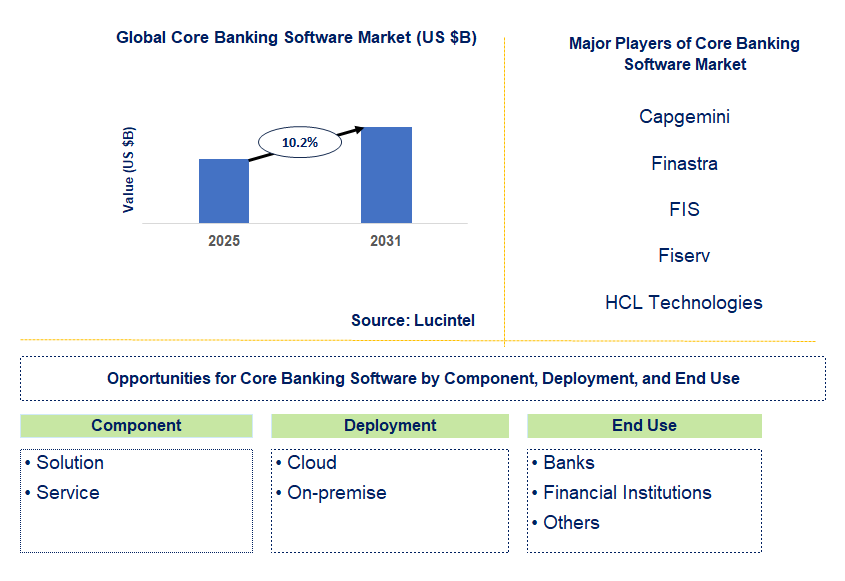
Key data points: The growth forecast = 10.2% annually for the next 7 years. Scroll below to get more insights. This market report covers trends, opportunities and forecasts in core banking software market to 2031 by component (solution and service), deployment (cloud and on-premise), end use (banks, financial institutions, and others), and region (North America, Europe, Asia Pacific, and the Rest of the World)
We'll send your sample report shortly.
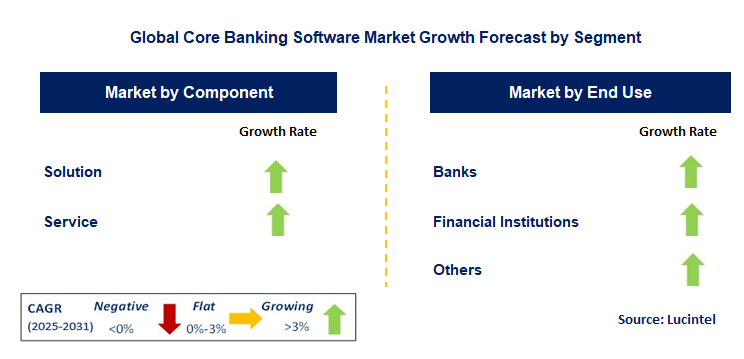
• Lucintel forecasts that, within the component category, service is expected to witness higher growth over the forecast period.
• Within the end use category, bank is expected to witness higher growth.
• In terms of region, APAC is expected to witness the highest growth over the forecast period. Gain valuable insights for your business decisions with our comprehensive 150+ page report. Sample figures with some insights are shown below.
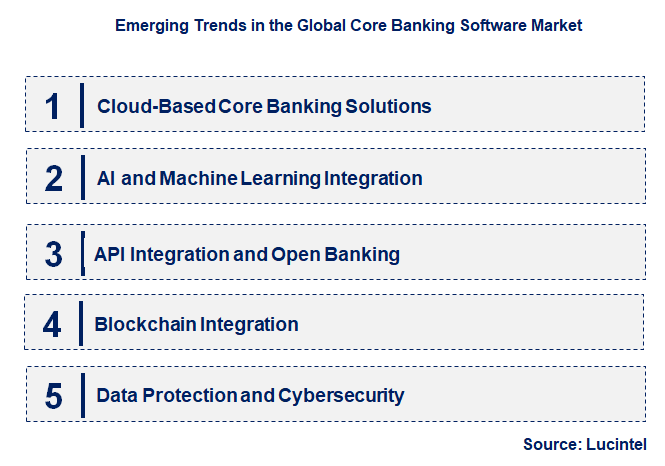
• Cloud-Based Core Banking Solutions: Cloud computing has emerged as a leading trend in the core banking software market, providing flexibility, scalability, and cost savings. By shifting CBS to the cloud, banks can minimize the requirement for expensive on-premises infrastructure, enable easier updates, and have quicker access to new features and innovations. The trend also allows banks to deliver more customized services, as cloud solutions can seamlessly integrate third-party apps and deliver real-time data insights to enable better decision-making processes.
• AI and Machine Learning Integration: Artificial intelligence and machine learning are being more and more integrated into fundamental banking software to offer a better customer experience and improve operational efficiency. Solutions based on AI enable banks to review enormous quantities of data in real-time, enabling them to deliver customized financial services and enhance fraud prevention. Machine learning algorithms are utilized to make projections about customer behavior, automate tasks, and streamline financial products for maximizing them, thus enabling banks to understand customer requirements more effectively and keep pace with market trends.
• API Integration and Open Banking: The efforts towards open banking, with the support of regulatory systems such as PSD2 in Europe, have heavily influenced core banking software development. Open banking enables banks to offer more innovative and personalized financial products and services through allowing third-party developers access to banking data through APIs. This is influencing the development of new financial products and services, encouraging increased competition, and improving cooperation among banks, fintech companies, and other service providers.
• Blockchain Integration: Blockchain technology is proving to be a revolutionary tool in the core banking software market, particularly in sectors such as payments and data security. Blockchain's decentralized and immutable structure provides increased security and transparency in transaction processing, minimizing fraud threats. Banks are increasingly adopting blockchain in their CBS platforms to enhance cross-border payment systems, minimize transaction costs, and increase the overall efficiency of banking operations.
• Data Protection and Cybersecurity: As cyber-attacks have evolved, there has been an increased need for effective cybersecurity processes in core banking software. Banks are investing heavily in sophisticated security technologies such as encryption, multi-factor authentication, and biometrics to secure customers' sensitive data and thwart fraud. The increased use of digital banking services also demands more secure processes to guard transactions' integrity and defend against cyber-attacks. The core banking software market is in the midst of a significant change fueled by primary emerging trends like the usage of cloud computing, AI integration, open banking, blockchain technology, and increased cybersecurity solutions. These trends not only enhance operational efficiency and security but also reorient customer experiences and allow banks to provide more individualized, flexible, and seamless services. As technology advances, the core banking software market is likely to grow further, allowing financial institutions to stay competitive and address changing needs of an increasingly digital-first customer base.
• Cloud-Based Core Banking Solutions Adoption: Cloud-based core banking solutions have been adopted extensively in recent years by banks that seek to lower IT infrastructure costs and enhance operating flexibility. Cloud computing enables banks to scale their offerings more easily, add new technologies, and enhance disaster recovery. Through the adoption of cloud-based CBS, banks can also provide an even more agile platform for innovation, allowing quicker response to evolving customer needs and market environments.
• Artificial Intelligence Integration for Improved Services: Core banking software is slowly integrating artificial intelligence to enhance services like customized banking, fraud prevention, and automated regular tasks. AI-based tools continuously scan customers' data in real-time to provide customized financial products and services. AI-based chatbots and virtual assistants are also enabling banks to provide improved customer care, lowering operating expenses while improving the overall customer experience.
• Emergence of Open Banking Platforms: The transition towards open banking has fueled the creation of more open and cooperative core banking software. Open banking platforms allow third-party developers to build innovative financial products and services by tapping into banking information through secure APIs. This trend is giving rise to a new generation of innovation in the financial services industry, allowing banks to provide more personalized, customer-focused solutions and promoting competition in the market.
• Blockchain for Secure Transactions: Blockchain technology is taking a strong position in the core banking software sector, especially in cross-border transactions, data protection, and fraud management. With the use of blockchain's distributed ledger technology, banks can enhance transparency and minimize costs, thus making banking services more secure and efficient. Integrating this is likely to grow as more banks seek the advantage of blockchain for secure and instantaneous transactions.
• Focus on Cybersecurity and Regulatory Compliance: With the banking industry becoming increasingly digital, the security and privacy of customer information have become a priority. Banks are spending more on sophisticated cybersecurity solutions to safeguard sensitive data and meet regulations such as GDPR and PSD2. Core banking software vendors are integrating strong security features, including encryption, multi-factor authentication, and real-time fraud detection systems, to cater to these emerging concerns. Recent trends in the core banking software market indicate increasing emphasis on digital transformation due to developments in cloud technology, AI, and blockchain. Banks are in growing numbers implementing these technologies to achieve operational efficiency, better customer service, and competitiveness. Open banking legislation, real-time data handling, and the trend of digital banking are transforming the sector. Such advancements are not just allowing banks to automate their procedures but also providing new revenue channels and new avenues for increased cooperation between fintech firms and traditional financial institutions.
• Cloud Computing Solutions: The transition to cloud computing in core banking software is a huge growth opportunity. Scalable, flexible, and affordable solutions in cloud-based CBS platforms enable banks to minimize infrastructure expenses and promote operational efficiency. Banks are also able to easily implement new technologies, merge third-party applications, and deliver a smoother customer experience using the cloud.
• Artificial Intelligence and Automation: AI and automation are transforming core banking software by automating processes, improving customer service, and facilitating personalized banking. Banks are employing AI to analyze customer information and forecast needs, allowing them to provide more customized financial products and services. Automation is also assisting banks in lowering operational expenses and enhancing efficiency, making this a growth area of prime importance.
• Fintech Partnerships: Fintech partnerships are driving enormous growth prospects in the core banking software market. Banks can provide innovative products like digital wallets, peer-to-peer payments, and customized investment products by partnering with fintech companies. Through such partnerships, banks can remain competitive by tapping into fintech innovations and providing more customer-oriented and diversified solutions.
• Open Banking Platform Expansion: Open banking is fueling the creation of more adaptable, cooperative core banking software. Through offering third-party developers access to bank data through secure APIs, open banking platforms allow banks to provide more customized financial services and increase competition. The trend will continue to expand as more nations implement open banking rules, opening new revenue streams for banks.
• Cybersecurity and Regulatory Compliance: As digital banking expands, so does the demand for strong cybersecurity and regulatory compliance. Banks are spending on advanced security functionalities to safeguard customer information and align with regulations such as GDPR and PSD2. Core banking software vendors with excellent cybersecurity offerings and assisting banks in understanding regulatory environments will keep experiencing high demand. Strategic growth opportunities in the core banking software market are plentiful, and the most significant areas include cloud computing, AI, open banking, fintech partnerships, and cybersecurity. If banks prioritize these growth opportunities, they can drive customer experiences, lower operational expenses, and remain competitive in a fast-changing digital environment. With growing acceptance of sophisticated technologies, banks are able to serve their customers more effectively and move into new markets. As such opportunities continue to define the market, they will be pivotal in driving future growth and innovation in the core banking software market.
• Capgemini
• Finastra
• FIS
• Fiserv
• HCL Technologies
• Infosys
• Jack Henry & Associates
• Oracle Corporation
• Temenos Group
• Unisys
• Solution
• Service
• Cloud
• On-premise
• North America
• Europe
• Asia Pacific
• The Rest of the World
• United States: In the US, the core banking software industry is experiencing quick adoption of cloud-based solutions that enable banks to scale their businesses more effectively and minimize operational costs. Major companies such as Finastra and FIS are creating solutions incorporating artificial intelligence (AI) and machine learning (ML) to improve decision-making processes and customer experience. The impetus towards online banking has caused the incorporation of sophisticated features like omnichannel capabilities and API-based platforms, enabling smooth interoperability between banks and third-party vendors. This shift is keeping U.S. banks competitive in a rapidly digitalizing market.
• China: China's core banking software market is growing strongly, with both traditional banks and fintech firms fueling innovations. Large Chinese banks are also investing heavily in CBS solutions that are integrated with mobile payment systems, digital wallets, and other fintech services. The government initiative towards digitalization and the swift expansion of the digital economy are key drivers for the adoption of cutting-edge CBS platforms. China's CBS solutions focus on great scalability, security, and capability to process enormous numbers of transactions, which is essential in order to support the nation's expanding e-commerce and mobile payment sectors.
• Germany: In Germany, the core banking software market is significantly impacted by the regulations of the European Union, specifically PSD2, that require open access to customers' banking information. German banks are prioritizing the consolidation of open banking platforms and adherence to stringent data privacy laws. Cloud computing is also on the rise, as banks look to upgrade their infrastructure and simplify operations. With a high focus on security and data protection, Germany is leading the way in creating CBS solutions that are compliant with regulatory requirements as well as the changing needs of consumers in the digital age.
• India: India's core banking software market is witnessing a growing demand, fueled by the fast-paced digitalization of the banking industry. Government policies such as the Pradhan Mantri Jan Dhan Yojana (PMJDY) and implementation of the Goods and Services Tax (GST) have opened up avenues for banks to implement more sophisticated CBS platforms. These platforms are facilitating financial inclusion by making banking products and services more accessible to rural and under-served communities. As digital wallets and mobile banking become increasingly popular, CBS solutions are becoming more mobile-first to take advantage of the increasing demand for financial services on the move.
• Japan: Japan's core banking software market is changing as banks are upgrading their systems to accommodate an aging society and growing demand for digital offerings. CBS solutions in Japan are becoming more oriented around automation and artificial intelligence to help automate tasks and prevent errors. As Japan is moving towards cashless payments and digital currency, core banking software is now being integrated with blockchain and cryptocurrency platforms. Furthermore, there is increased focus on strengthening cybersecurity practices to safeguard confidential financial information, particularly in light of increasing cyber-attacks on the financial sector.


• Capgemini
• Finastra
• FIS
• Fiserv
• HCL Technologies
• Infosys
• Jack Henry & Associates
• Oracle Corporation
• Temenos Group
• Unisys Q5. Which core banking software market segment will be the largest in future? Answer: Lucintel forecasts that, within the component category, service is expected to witness higher growth over the forecast period. Q6. In core banking software market, which region is expected to be the largest in next 5 years? Answer: In terms of region, APAC is expected to witness the highest growth over the forecast period. Q7. Do we receive customization in this report? Answer: Yes, Lucintel provides 10% customization without any additional cost.


Choose a license that fits your team. Instant PDF delivery.
Prices exclude taxes. Instant delivery. Custom licensing available on request.
Market Report · July 15, 2026
Market Report · June 26, 2026
Market Report · June 24, 2026
Trusted partner for strategic intelligence and business growth


Receive a complimentary market analysis tailored to your industry. Our analysts will identify key growth opportunities and competitive dynamics specific to your business.

Market size, growth rate, and key trend analysis for your specific sector.

Top competitor positioning and market share analysis.

Strategic recommendations backed by data-driven insights.
Get curated market intelligence and competitive moves straight to your inbox.
By subscribing, you agree to receive our monthly insights. Unsubscribe anytime.
Receive a complimentary market analysis tailored to your industry. Our analysts will identify key growth opportunities and competitive dynamics specific to your business.
Market size, growth rate, and key trend analysis for your specific sector.
Top competitor positioning and market share analysis.
Strategic recommendations backed by data-driven insights.
Get curated market intelligence, emerging trends, and competitive moves straight to your inbox each month.
By subscribing, you agree to receive our monthly insights. Unsubscribe anytime.
We'll send your sample report shortly.