
Market Report · July 16, 2026

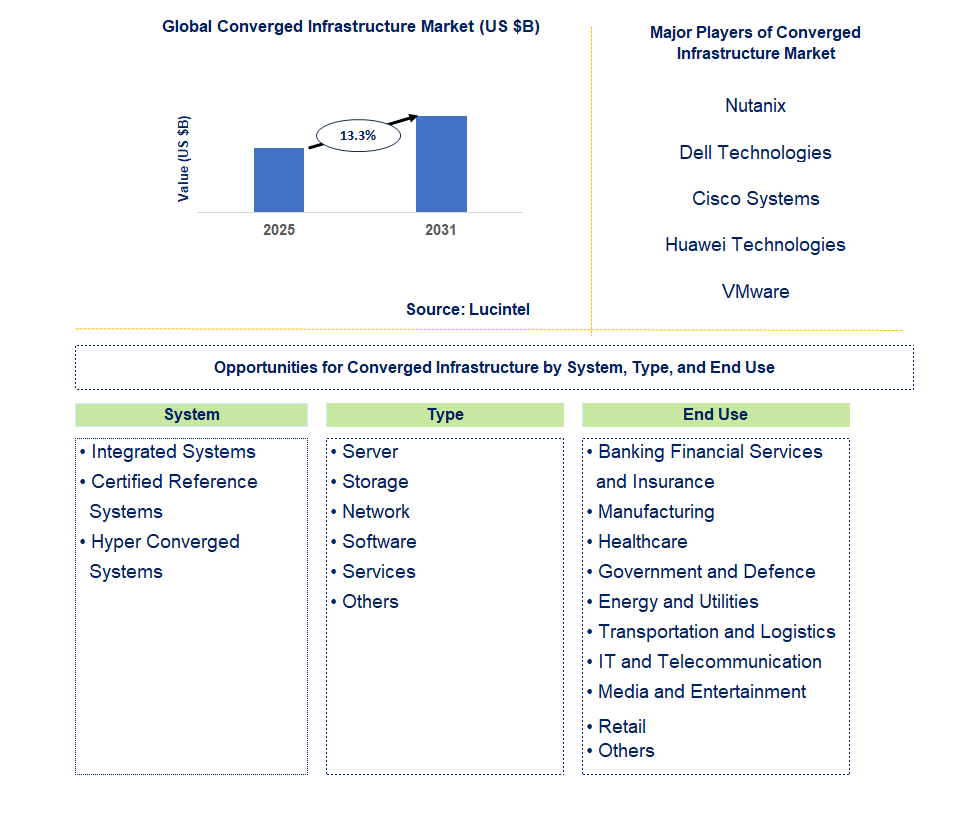
Key data points: The growth forecast = 13.3% annually for the next 7 years. Scroll below to get more insights. This market report covers Trends, opportunity and forecast in converged infrastructure market to 2031 by system (integrated systems, certified reference systems, and hyper converged systems), type (server, storage, network, software, services, and others), end use (banking financial services and insurance, manufacturing, healthcare, government and defence, energy and utilities, transportation and logistics, it and telecommunication, media and entertainment, retail, and others), and region (North America, Europe, Asia Pacific, and the Rest of the World)
We'll send your sample report shortly.
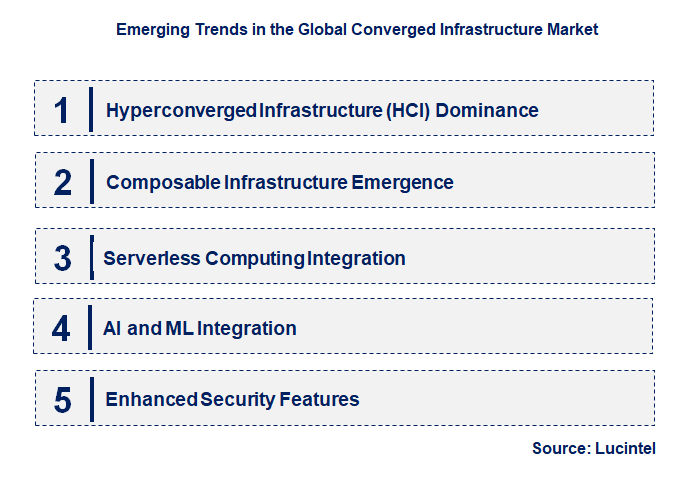
• Hyperconverged Infrastructure (HCI) Dominance: HCI simplifies IT infrastructure by integrating compute, storage, networking, and virtualization resources into a single platform. This approach offers ease of deployment, scalability, and centralized management, making it attractive to businesses of all sizes. HCI solutions are increasingly being adopted for various workloads, including virtual desktop infrastructure (VDI), databases, and enterprise applications. The continued growth of HCI is driven by its ability to deliver a cloud-like experience on-premises, enabling organizations to improve agility and reduce IT costs.
• Composable Infrastructure Emergence: Composable infrastructure takes the principles of HCI a step further by allowing for the dynamic allocation and recomposition of IT resources. This approach enables organizations to create a highly flexible and adaptable infrastructure tailored to specific workload requirements. Composable infrastructure utilizes a software-defined approach to manage and orchestrate resources, allowing for automated provisioning and scaling. This trend is gaining traction as businesses seek to optimize resource utilization and improve IT agility.
• Serverless Computing Integration: Serverless computing, also known as Function-as-a-Service (FaaS), is a cloud-native computing model where the cloud provider manages the underlying infrastructure, allowing developers to focus solely on writing and deploying code. Integrating serverless computing with CI can further enhance agility and scalability. Organizations can streamline application development and deployment processes by leveraging serverless technologies within a CI environment, enabling faster time-to-market for new products and services.
• AI and ML Integration: Integrating AI and ML into CI platforms enables new levels of automation and optimization. AI-powered tools can analyze infrastructure performance data to identify bottlenecks, predict potential issues, and automate remediation tasks. ML algorithms can be used to optimize resource allocation, improve energy efficiency, and enhance security. This trend drives the development of intelligent infrastructure solutions that can self-manage and adapt to changing business needs.
• Enhanced Security Features: With the increasing sophistication of cyber threats, security has become a critical consideration for CI deployments. Vendors are incorporating advanced security features into their CI offerings, including integrated firewalls, intrusion detection and prevention systems, and data encryption capabilities. Furthermore, they are focusing on implementing security best practices and compliance frameworks to protect sensitive data. This trend is driven by the need to mitigate security risks and ensure business continuity. These trends collectively reshape the CI market, pushing it towards a more software-defined, automated, and intelligent infrastructure. The focus is on delivering solutions that offer greater agility, scalability, and cost-effectiveness, enabling organizations to accelerate their digital transformation journeys. As businesses increasingly rely on data-driven insights and cloud-native technologies, CI is evolving to provide the foundation for modern IT environments.
• Advancements in HCI: Hyperconverged infrastructure continues to be a dominant force in the CI market. Recent developments include enhanced performance, improved scalability, and increased automation capabilities. Vendors are also focusing on simplifying management and operations, making HCI even more accessible to businesses of all sizes. The impact of these advancements is that HCI is becoming the preferred choice for a wide range of workloads, from general-purpose applications to mission-critical systems.
• Rise of Composable Infrastructure: Composable infrastructure is emerging as a key trend, offering a more flexible and dynamic approach to resource management. This approach enables organizations to compose and recompose IT resources on demand, tailoring the infrastructure to specific workload requirements. The impact of composable infrastructure is that it allows for greater resource optimization, improved agility, and reduced IT costs.
• Hybrid Cloud Integration: Hybrid cloud has become a critical strategy for many organizations, and CI solutions are evolving to integrate seamlessly with public cloud services. Vendors offer integrated platforms connecting on-premises infrastructure with cloud environments, enabling consistent management and data mobility. This development allows businesses to leverage the benefits of both on-premises and cloud infrastructure, creating a more flexible and scalable IT environment.
• Enhanced Security Features: Security remains a top priority for organizations, and CI vendors are incorporating advanced security features into their offerings. These include integrated firewalls, intrusion detection and prevention systems, data encryption, and secure boot capabilities. The impact of enhanced security is that it helps organizations protect their data and infrastructure from evolving cyber threats, ensuring business continuity and compliance.
• AI and ML Integration: Integrating artificial intelligence and machine learning into CI solutions enables new levels of automation and intelligence. AI-powered tools can analyze infrastructure performance data, predict potential issues, and automate remediation tasks. ML algorithms can be used to optimize resource allocation and improve energy efficiency. The impact of AI and ML is that they lead to more efficient and self-managing infrastructure, reducing operational costs and improving performance. These developments collectively transform the CI market, driving it towards a more software-defined, automated, and intelligent infrastructure. The focus is on delivering solutions that offer greater agility, scalability, and cost-effectiveness, enabling organizations to accelerate their digital transformation journeys. As businesses increasingly rely on data-driven insights and cloud-native technologies, CI is evolving to provide the foundation for modern IT environments.
• Cloud-Native Applications: The rise of cloud-native applications, built on microservices and container technologies, creates a significant growth opportunity for CI. CI platforms can provide the ideal foundation for deploying and managing these applications, offering scalability, flexibility, and automation. The impact is faster application development cycles, improved resource utilization, and enhanced agility for organizations embracing cloud-native architectures.
• Edge Computing Deployments: The growth of edge computing, driven by IoT and other data-intensive applications, presents a significant opportunity for CI. Compact and ruggedized CI solutions are well-suited for deployment at the network's edge, providing local processing power and reducing latency. The impact enables real-time data analysis, improved operational efficiency, and support for new edge-based applications and services.
• AI/ML Workloads: Artificial intelligence and machine learning workloads require significant computing power and specialized hardware. CI platforms can provide the necessary infrastructure to support these demanding applications, including GPUs and high-performance networking. The impact is accelerating AI/ML initiatives, enabling faster model training, and facilitating the development of intelligent applications and services.
• High-Performance Computing (HPC): High-performance computing applications, such as scientific simulations and financial modeling, require massive computing resources. CI solutions can be configured to deliver the performance and scalability needed for HPC workloads. The impact enables faster scientific discoveries, improved research and development, and enhanced computational capabilities for organizations in various industries.
• Disaster Recovery and Business Continuity: Ensuring business continuity and disaster recovery is critical for all organizations. CI platforms can simplify the deployment and management of disaster recovery solutions, providing integrated backup, replication, and recovery capabilities. The impact is improved resilience, reduced downtime, and enhanced business continuity in the event of a disaster. These growth opportunities significantly impact the CI market, driving innovation and specialization. Vendors are developing purpose-built CI solutions optimized for specific applications, addressing the unique requirements of each workload. As businesses embrace digital transformation and adopt new technologies, the CI market is poised for continued growth and evolution.
• Nutanix
• Dell Technologies
• Cisco Systems
• Huawei Technologies
• VMware
• Hewlett Packard Enterprise Development
• Microsoft
• IBM Corporation
• Fujitsu Limited
• DataCore Software
• Integrated Systems
• Certified Reference Systems
• Hyper Converged Systems
• Server
• Storage
• Network
• Software
• Services
• Others
• North America
• Europe
• Asia Pacific
• The Rest of the World
• United States: The US is a mature market with high adoption of CI and HCI. Recent trends include a focus on hybrid cloud solutions, with vendors offering integrated platforms that seamlessly connect on-premises infrastructure with public cloud services. There is also a growing emphasis on security, with vendors incorporating advanced security features into their CI and HCI offerings. Additionally, the rise of edge computing is driving demand for smaller, more compact CI and HCI solutions that can be deployed at the network's edge.
• China: China is a rapidly growing CI and HCI market driven by the country's massive digital transformation initiatives. Domestic vendors like Huawei are gaining prominence, offering competitive solutions tailored to the needs of Chinese businesses. The market is characterized by strong government support for technology innovation and a focus on local production. Recent developments include increased investment in research and development, leading to the emergence of innovative HCI solutions with advanced features.
• Germany: Germany is a technologically advanced market focusing on data privacy and security. The demand for CI and HCI is driven by the country's large industrial sector, which is undergoing rapid digitalization. German businesses are increasingly adopting hybrid cloud strategies, seeking to balance the benefits of public cloud with the security and control of on-premises infrastructure. Recent developments include a growing emphasis on automation and orchestration tools to simplify the management of CI and HCI deployments.
• India: India is a high-growth CI and HCI market driven by the country's rapidly expanding IT sector and increasing adoption of digital technologies. The market is characterized by many small and medium-sized businesses (SMBs) increasingly adopting HCI solutions to simplify their IT infrastructure. Recent developments include increased focus on affordability, with vendors offering cost-effective CI and HCI solutions tailored to the needs of SMBs.
• Japan: Japan is a mature market with a strong focus on reliability and quality. The demand for CI and HCI is driven by the country's large enterprise sector, which is increasingly adopting cloud computing and virtualization technologies. Japanese businesses are known for their meticulous approach to IT infrastructure, placing a high value on stability and security. Recent developments include a growing interest in software-defined infrastructure (SDI), which enables greater flexibility and automation in managing CI and HCI deployments.


• Nutanix
• Dell Technologies
• Cisco Systems
• Huawei Technologies
• VMware
• Hewlett Packard Enterprise Development
• Microsoft
• IBM Corporation
• Fujitsu Limited
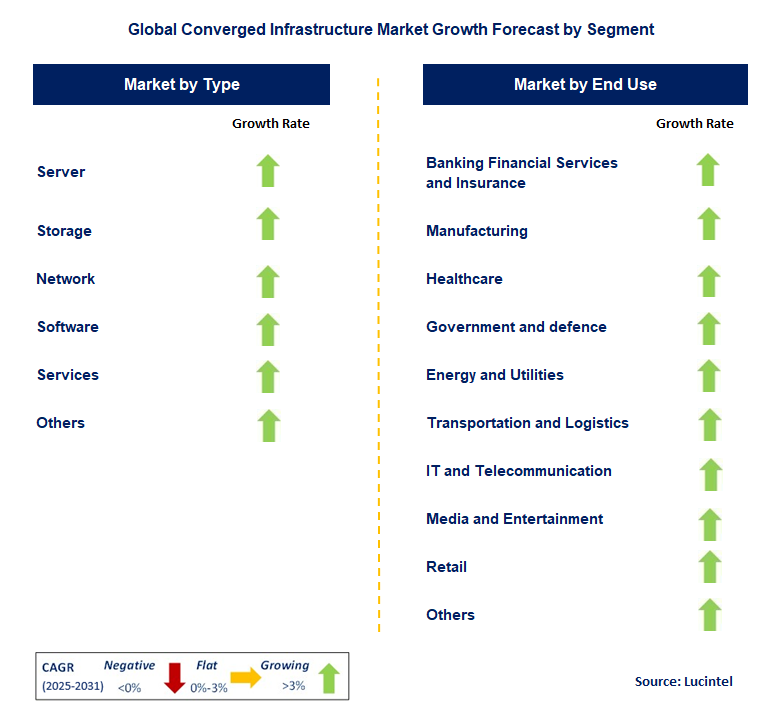
• DataCore Software Q5. Which converged infrastructure market segment will be the largest in future? Answer: Lucintel forecasts that the integrated system is expected to witness the highest growth over the forecast period. Q6. In converged infrastructure market, which region is expected to be the largest in next 5 years? Answer: APAC is expected to witness the highest growth over the forecast period. Q7. Do we receive customization in this report? Answer: Yes, Lucintel provides 10% customization without any additional cost.


Choose a license that fits your team. Instant PDF delivery.
Prices exclude taxes. Instant delivery. Custom licensing available on request.
Market Report · July 16, 2026
Market Report · May 18, 2026
Market Report · May 18, 2026
Trusted partner for strategic intelligence and business growth


Receive a complimentary market analysis tailored to your industry. Our analysts will identify key growth opportunities and competitive dynamics specific to your business.

Market size, growth rate, and key trend analysis for your specific sector.

Top competitor positioning and market share analysis.

Strategic recommendations backed by data-driven insights.
Get curated market intelligence and competitive moves straight to your inbox.
By subscribing, you agree to receive our monthly insights. Unsubscribe anytime.
Receive a complimentary market analysis tailored to your industry. Our analysts will identify key growth opportunities and competitive dynamics specific to your business.
Market size, growth rate, and key trend analysis for your specific sector.
Top competitor positioning and market share analysis.
Strategic recommendations backed by data-driven insights.
Get curated market intelligence, emerging trends, and competitive moves straight to your inbox each month.
By subscribing, you agree to receive our monthly insights. Unsubscribe anytime.
We'll send your sample report shortly.