
Market Report · July 24, 2026

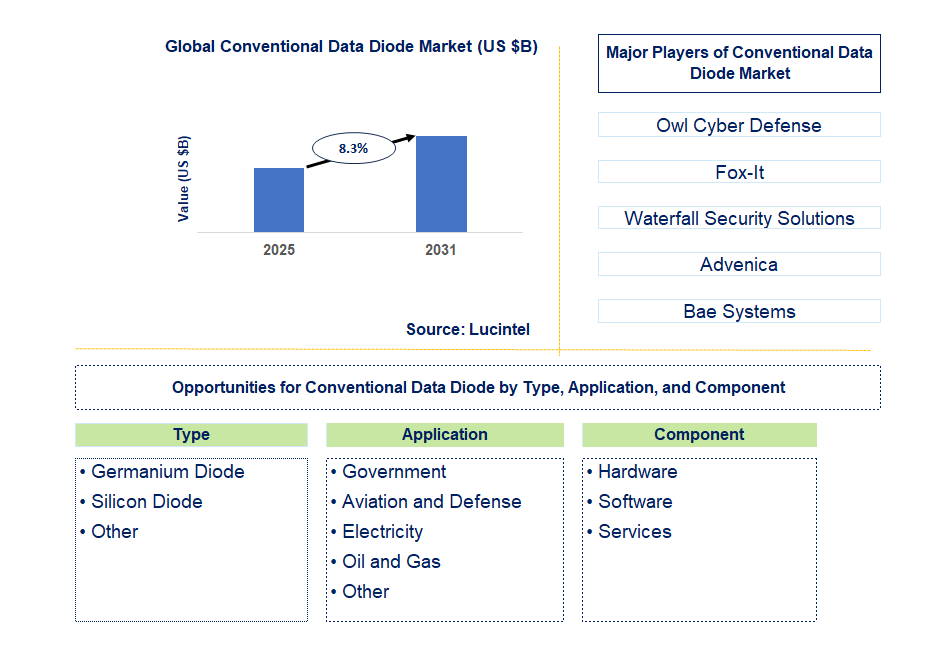
Key data points: The growth forecast = 8.3% annually for the next 7 years. Scroll below to get more insights. This market report covers Trends, opportunity and forecast in conventional data diode market to 2031 by type (germanium diode, silicon diode, and other), application (government, aviation and defense, electricity, oil and gas, and other), component (hardware, software, and services), and region (North America, Europe, Asia Pacific, and the Rest of the World)
We'll send your sample report shortly.
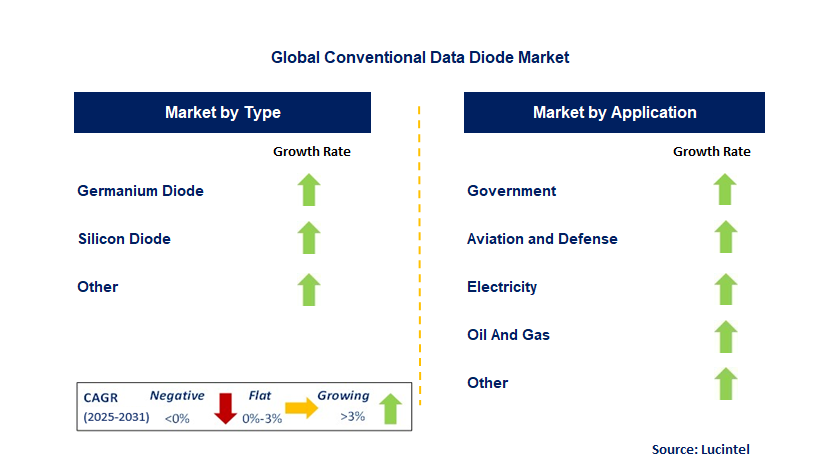
• Lucintel forecasts that, within the type category, germanium diode is expected to witness higher growth over the forecast period due to used in more specialized applications, including high-frequency and high-precision environments.
• Within the application category, government is expected to witness the highest growth due to the need to protect classified information, national security, and critical infrastructure from cyberattacks.
• In terms of region, North America is expected to witness the highest growth over the forecast period due to high demand for data diodes in sectors like defense, government, energy, telecommunications, and critical infrastructure. Gain valuable insights for your business decisions with our comprehensive 150+ page report. Sample figures with some insights are shown below.
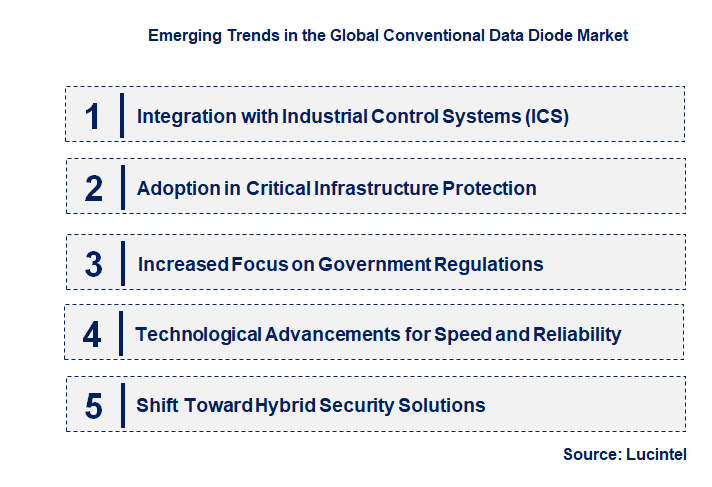
• Integration with Industrial Control Systems (ICS): The increasing use of data diodes in Industrial Control Systems (ICS) is one of the key trends. As industries adopt more advanced automation, securing the data flow between systems becomes crucial. Data diodes are now being integrated into ICS to prevent cyberattacks and data breaches, especially in sectors like manufacturing, energy, and utilities. This integration ensures that critical infrastructure remains safe from both external and internal threats while maintaining the operational efficiency of industrial systems.
• Adoption in Critical Infrastructure Protection: Data diodes are becoming central to critical infrastructure protection, with their role in ensuring the secure transfer of information between isolated networks. As countries focus on protecting power grids, telecommunications, and transportation networks, the demand for data diodes is increasing. Their ability to prevent unauthorized data flow between networks makes them an ideal solution for securing critical infrastructure from cyberattacks, particularly in regions where there are significant concerns over national security and potential foreign threats.
• Increased Focus on Government Regulations: Governments worldwide are increasing their focus on data security and cybersecurity regulations, driving the demand for conventional data diodes. Regulatory requirements, particularly in sectors like finance, defense, and healthcare, require the implementation of strict data security measures. The use of data diodes is being mandated in many regions as a part of compliance with these regulations, as they provide an effective and cost-efficient solution to meet the stringent cybersecurity standards.
• Technological Advancements for Speed and Reliability: As data security becomes more critical, data diode technology is evolving to provide faster and more reliable solutions. Innovations in semiconductor materials and optical technologies are enabling data diodes to deliver higher-speed data transfer while maintaining the one-way data flow essential for security. These advancements are crucial for applications in industries where data transfer speed and reliability are vital, such as financial services and healthcare.
• Shift toward Hybrid Security Solutions: The market is seeing a shift toward hybrid security solutions that combine data diodes with other cybersecurity technologies, such as firewalls, intrusion detection systems (IDS), and secure communication protocols. This approach enhances overall security by providing multiple layers of defense. Hybrid solutions are becoming particularly popular in industries that require comprehensive protection, such as defense, banking, and energy, where a single security technology may not suffice. Emerging trends in the conventional data diode market are significantly reshaping the cybersecurity landscape. The integration with industrial control systems, adoption in critical infrastructure protection, increased regulatory focus, technological advancements, and the shift toward hybrid security solutions are driving the growth and evolution of the market. These trends are enabling businesses and governments to enhance their cybersecurity defenses while adapting to new challenges in data protection.
• Enhanced Data Diode Performance: One of the key developments in the market is the improvement in data diode performance. Manufacturers have focused on enhancing both the speed and reliability of data diodes, making them more suitable for high-demand applications in industries such as finance, defense, and telecommunications. Advances in semiconductor and optical technologies have allowed for faster data transfer rates, improving the effectiveness of data diodes in mission-critical environments while maintaining their one-way data transfer capabilities.
• Introduction of Compact and Scalable Solutions: Manufacturers are increasingly offering compact and scalable data diode solutions to meet the growing needs of smaller businesses and industries that require secure data transmission. These solutions are designed to be cost-effective while maintaining the high level of security required for more extensive systems. The shift toward scalability allows data diodes to be deployed across various sectors, from large government installations to smaller private enterprises, broadening their adoption.
• Expansion into Industrial Automation: Data diodes are increasingly being integrated into industrial automation systems to protect the flow of sensitive data between production networks and corporate networks. This development is driven by the growing need for secure data transmission in industries such as manufacturing, utilities, and energy. By ensuring that data can flow only in one direction, data diodes protect industrial control systems from cyberattacks and prevent unauthorized access to critical infrastructure.
• Global Regulatory Compliance: As governments around the world implement stricter data protection regulations, the use of data diodes is becoming a standard requirement in compliance efforts. Regulations such as the GDPR in Europe and data security laws in the U.S. are encouraging the widespread adoption of data diodes, particularly in industries that handle sensitive personal or corporate data. This regulatory push is helping drive demand for data diode solutions across various sectors, particularly those in critical infrastructure.
• Increased Focus on Cybersecurity in Emerging Markets: Emerging markets, especially in regions like India and Southeast Asia, are seeing a rise in the adoption of data diodes as part of their increasing focus on cybersecurity. With growing concerns over data breaches and cyberattacks, these countries are investing in data diode technology to secure sensitive information in sectors such as banking, government, and healthcare. The growing recognition of the importance of cybersecurity is expanding the market for conventional data diodes in these regions. Recent developments in the conventional data diode market reflect the growing need for enhanced cybersecurity solutions. Improvements in performance, the introduction of scalable and compact solutions, expansion into industrial automation, regulatory compliance efforts, and increased adoption in emerging markets are driving growth in the market. These developments are helping to secure critical systems and infrastructure against evolving cyber threats.
• Critical Infrastructure Protection: One of the most significant growth opportunities lies in protecting critical infrastructure such as power grids, water systems, and transportation networks. With an increasing number of cyberattacks targeting these vital sectors, the demand for data diodes is rising. By enabling secure one-way data transfer, data diodes ensure that sensitive systems cannot be accessed remotely by malicious actors, providing a robust solution to mitigate potential threats.
• Defense and Military Applications: The defense sector presents another strong growth opportunity for data diodes. Military and defense organizations worldwide require highly secure networks to protect sensitive data. Data diodes are being integrated into secure communication systems, preventing unauthorized data flow and safeguarding classified information. As defense budgets increase and cyber warfare becomes more prevalent, the demand for data diodes in military applications is expected to grow significantly.
• Industrial Automation and Manufacturing: Industrial automation is a rapidly growing field, and data diodes are becoming integral to securing manufacturing processes and production systems. By providing a secure one-way data flow between industrial control systems and corporate networks, data diodes help protect against cyberattacks that could disrupt production or compromise safety. The continued growth of Industry 4.0 and the increased automation of manufacturing processes create a significant opportunity for data diode adoption in this sector.
• Healthcare Sector: As the healthcare industry digitizes and adopts more connected medical devices, securing patient data has become a critical concern. Data diodes are being used to protect sensitive health information from breaches, especially in hospitals and research institutions. With stringent healthcare data regulations such as HIPAA in the U.S., the need for secure data transmission solutions like data diodes is expected to rise, creating an opportunity for growth in this sector.
• Banking and Financial Services: The banking and financial services industry is another sector where data diodes are playing an essential role in ensuring secure data transfer. Financial institutions handle vast amounts of sensitive customer and transaction data, making them prime targets for cyberattacks. By preventing data from flowing in the wrong direction, data diodes help safeguard against unauthorized access and ensure compliance with strict financial security regulations. Strategic growth opportunities in the conventional data diode market are abundant, particularly in critical infrastructure protection, defense, industrial automation, healthcare, and financial services. As cybersecurity threats continue to evolve, the demand for secure one-way data transfer solutions is expected to rise across these sectors. Manufacturers and service providers that can tap into these growing applications will be well-positioned for long-term success in the market.
• Owl Cyber Defense
• Fox-It
• Waterfall Security Solutions
• Advenica
• Bae Systems
• Genua
• Belden (Hirschmann)
• Fibersystem
• Deep Secure
• Vado Security Technologies Ltd.
• Germanium Diode
• Silicon Diode
• Other
• Government
• Aviation and Defense
• Electricity
• Oil And Gas
• Other
• North America
• Europe
• Asia Pacific
• The Rest of the World
• United States: The U.S. continues to lead in the development and deployment of conventional data diodes, particularly in critical infrastructure and defense sectors. Recent advancements focus on integrating data diodes into larger cybersecurity systems, providing stronger protection for government and corporate networks. The U.S. government’s emphasis on securing critical infrastructures, including power grids and financial systems, has led to increased adoption of data diodes. There is also significant investment in R&D for enhancing the speed, reliability, and scalability of data diode solutions, ensuring they meet the growing demand for high-security data transfer across sensitive sectors.
• China: China has been accelerating its adoption of conventional data diodes, particularly in sectors such as defense, telecommunications, and energy. With increasing concerns about data security and international cyber threats, the country is prioritizing the development of indigenous data security solutions. Chinese companies are investing in the production of data diodes that offer better performance, while the government is promoting their use in critical national infrastructure. China is also working on tightening its cybersecurity regulations, which has created an environment where the demand for data diodes is set to grow in both government and private sectors.
• Germany: Germany is seeing increased demand for conventional data diodes as part of its strategy to safeguard industrial control systems, critical infrastructure, and sensitive data in various sectors such as manufacturing, energy, and finance. Germany’s focus on cybersecurity, driven by both EU regulations and national security concerns, has spurred investments in high-security data transfer solutions. Furthermore, Germany is leveraging its strong industrial base to integrate data diodes into Industry 4.0 applications, ensuring secure data flow between industrial automation systems. German companies are also focused on advancing the technology to meet the evolving needs of European cybersecurity standards.
• India: India’s conventional data diode market is growing, driven by the increasing demand for enhanced cybersecurity solutions, particularly in government agencies, banking, and energy sectors. While still a developing market, India is seeing a rise in local manufacturing of cybersecurity solutions, including data diodes, due to concerns over cyber-attacks and data breaches. The Indian government has also been pushing for digital transformation initiatives that require stringent cybersecurity measures, creating an expanding market for secure one-way data transmission. The growing focus on protecting critical infrastructure against both internal and external threats has spurred the adoption of these devices.
• Japan: Japan is a key adopter of conventional data diodes, particularly in sectors like manufacturing, defense, and critical infrastructure. The country is emphasizing cybersecurity to protect its extensive industrial networks and ensure the security of sensitive data against cyberattacks. Japan has been focusing on integrating data diodes into national cybersecurity strategies, with particular emphasis on securing its advanced technological infrastructure. Japanese companies are also researching and developing more efficient data diodes to cater to the rising demand for robust security solutions in both the public and private sectors, in line with the country’s strong commitment to technological innovation and cybersecurity.


• Owl Cyber Defense
• Fox-It
• Waterfall Security Solutions
• Advenica
• Bae Systems
• Genua
• Belden (Hirschmann)
• Fibersystem
• Deep Secure
• Vado Security Technologies Ltd. Q5. Which conventional data diode market segment will be the largest in future? Answer: Lucintel forecasts that germanium diode is expected to witness higher growth over the forecast period due to used in more specialized applications, including high-frequency and high-precision environments. Q6. In conventional data diode market, which region is expected to be the largest in next 5 years? Answer: North America is expected to witness the highest growth over the forecast period due to high demand for data diodes in sectors like defense, government, energy, telecommunications, and critical infrastructure. Q7. Do we receive customization in this report? Answer: Yes, Lucintel provides 10% customization without any additional cost.


Choose a license that fits your team. Instant PDF delivery.
Prices exclude taxes. Instant delivery. Custom licensing available on request.
Market Report · July 24, 2026
Market Report · July 20, 2026
Market Report · July 20, 2026
Trusted partner for strategic intelligence and business growth


Receive a complimentary market analysis tailored to your industry. Our analysts will identify key growth opportunities and competitive dynamics specific to your business.

Market size, growth rate, and key trend analysis for your specific sector.

Top competitor positioning and market share analysis.

Strategic recommendations backed by data-driven insights.
Get curated market intelligence and competitive moves straight to your inbox.
By subscribing, you agree to receive our monthly insights. Unsubscribe anytime.
Receive a complimentary market analysis tailored to your industry. Our analysts will identify key growth opportunities and competitive dynamics specific to your business.
Market size, growth rate, and key trend analysis for your specific sector.
Top competitor positioning and market share analysis.
Strategic recommendations backed by data-driven insights.
Get curated market intelligence, emerging trends, and competitive moves straight to your inbox each month.
By subscribing, you agree to receive our monthly insights. Unsubscribe anytime.
We'll send your sample report shortly.