
Market Report · July 15, 2026

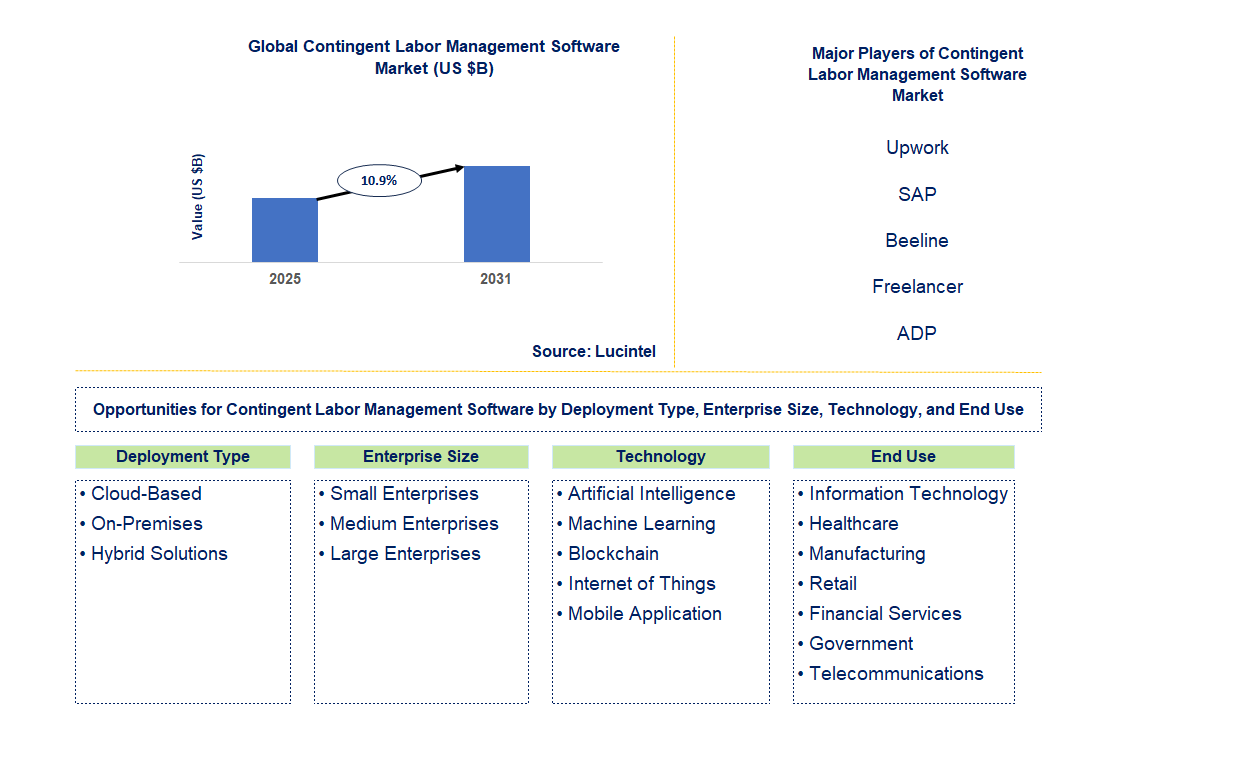
Key data points: The growth forecast = 10.9% annually for the next 7 years. Scroll below to get more insights. This market report covers trends, opportunities and forecasts in contingent labor management software market to 2031 by deployment type (cloud-based, on-premises, and hybrid solutions), enterprise size (small enterprises, medium enterprises, and large enterprises), technology (artificial intelligence, machine learning, blockchain, internet of things, and mobile application), end use (information technology, healthcare, manufacturing, retail, financial services, government, and telecommunications), and region (North America, Europe, Asia Pacific, and the Rest of the World)
We'll send your sample report shortly.
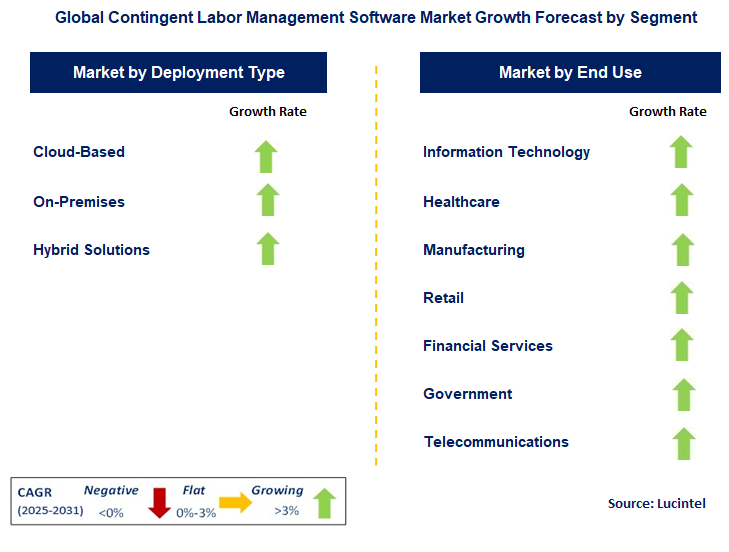
• Lucintel forecasts that, within the deployment type category, cloud-based is expected to witness the highest growth over the forecast period.
• Within the end use category, information technology is expected to witness the highest growth.
• In terms of region, APAC is expected to witness the highest growth over the forecast period. Gain valuable insights for your business decisions with our comprehensive 150+ page report. Sample figures with some insights are shown below.
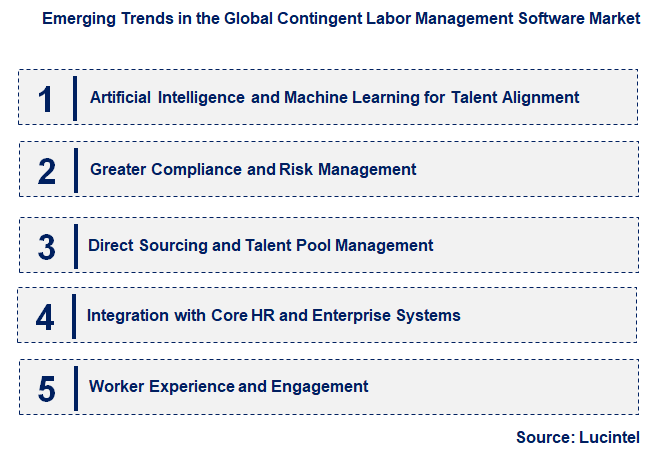
• Artificial Intelligence and Machine Learning for Talent Alignment: This trend is about applying artificial intelligence and machine learning algorithms to smartly align contingent talent with particular project needs and to examine workforce data for insights. AI can detect best-fit candidates, forecast project success, and give insights into skill deficits. The effect is a substantial decrease in time spent on hiring, enhanced quality of talent pickup, and data-driven workforce planning, resulting in improved project outcomes and reduced cost.
• Greater Compliance and Risk Management: As global regulations on contingent labor become more sophisticated (e.g., worker classification, co-employment risks), technology is picking up more robust compliance capabilities. This encompasses automated regulatory checks for compliance, risk analysis, and audit trails. The effect is lowered legal and financial risk to organizations, improved compliance with labor regulations, tax rules, and company policies, thus avoiding misclassification penalties and related liabilities.
• Direct Sourcing and Talent Pool Management: The trend here is to empower organizations to source contingent talent directly from their own private talent pools or freelance marketplaces, skipping the conventional agencies. Software assists in creating and managing these private talent pools. The effect is lower recruitment expenditure, quicker access to pre-screened talent, and better control over the contingent workforce, leading to stronger connections with a desired pool of flexible talent.
• Integration with Core HR and Enterprise Systems: Contingent labor management software is now developed to easily integrate with current Human Capital Management (HCM), Enterprise Resource Planning (ERP), and Vendor Management Systems (VMS). This provides an integrated view of the entire workforce. The effect is simplified workflows, more accurate data among departments, and increased visibility into overall workforce spend and capabilities, facilitating end-to-end talent management strategies.
• Worker Experience and Engagement: This new trend acknowledges the value of creating a positive experience for contingent workers, such as efficient onboarding, open communication channels, simple time tracking, and timely payments. Software platforms are creating features that optimize the worker experience. The outcome is better retention of high-quality contingent talent, enhanced productivity, and improved employer reputation, which is important to attract and retain a flexible workforce in a competitive business market. These new trends are inherently redefining the contingent labor management software market by turning it into a wiser, more integrated, and strategically more valuable category of human capital technology. The focus on AI, compliance, direct sourcing, and worker experience is facilitating organizations to manage their flexible workforces in unprecedented ways of efficiency and effectiveness, making contingent labor an integral part of contemporary workforce strategies.
• AI-Powered Analytics for Workforce Optimization: One major advance is combining artificial intelligence and machine learning for workforce optimization and predictive analytics. These comprise features such as projecting contingent labor requirements, determining ideal talent pools, and performance metrics analysis. The effect is more effective strategic workforce planning, enhanced resource usage, and informed decision-making concerning contingent talent deployment, with improved operational efficiency and cost savings.
• Advanced Compliance and Regulatory Management Capabilities: Newest additions are the integration of more advanced compliance modules in the software to enable companies to handle complex and dynamic labor laws across the world. The capabilities support worker classification, tax laws, and co-employment liabilities. The effect is minimized legal exposure and monetary fines for companies, ensuring compliance with legal requirements and risk reduction of mismanaging contingent workers.
• Direct Sourcing Capabilities Expansion: An increasing trend is towards software solutions that allow organizations to source directly, engage with, and manage freelancers and contractors from their proprietary talent pools or directly through embedded marketplaces. This avoids going through traditional staffing agencies. The effect is lower recruitment costs, quicker talent procurement, and more control over the contingent workforce, building stronger, direct relationships with preferred independent professionals.
• Enhanced User Experience and Mobile Accessibility: New developments target the design of more natural, user-centered interfaces and improved mobile accessibility for both managers and temporary labor. This entails streamlined onboarding processes, simplified time and expense reporting, and mobile-accessible communication tools. The effect is faster adoption rates, enhanced productivity for employees, and greater efficiency for managers, resulting in a smoother overall experience for all concerned.
• Smooth Integration with Larger HR and ERP Ecosystems: A major innovation is strong integration features with current Human Capital Management (HCM), Enterprise Resource Planning (ERP), and financial systems. This provides consistency in data and integrated reporting for an organization’s whole labor force. The result is an integrated understanding of both full-time and temporary labor, supporting end-to-end workforce analytics and strategic planning across every talent pool. These advances are having a fundamental effect on the contingent labor management software market, turning it into a higher-performance and more integrated part of contemporary human resources and business processes. The emphasis on intelligence, compliance, direct interaction, and integration is allowing organizations to regulate their flexible workforces with greater efficiency, strategic awareness, and lowered risk, making contingent labor a more manageable and valuable asset.
• Talent Sourcing and Acquisition Platforms: There lies a strong opportunity to create and build platforms that automate the sourcing and acquisition of contingent talent. This involves integration with varied freelance marketplaces, providing AI-based talent matching, and enabling direct sourcing from private talent pools. The effect is quicker time-to-hire, access to niche skills, and lower recruitment costs, allowing organizations to effectively create dynamic workforces as needed for projects.
• Compliance and Risk Mitigation Solutions: As global labor laws and regulations continue to evolve (e.g., classification of workers, risks of co-employment), there is significant demand for software solutions that will drive compliance and avoid legal and financial risks. Market opportunities exist in delivering automated checks for compliance, regulatory alerts, and secure audit trails. The benefit is coverage from penalties, lowered legal exposure, and assurance for companies operating in complicated employment environments.
• Payments and Financial Management Automation: Automation of the financial operations of contingent labor, such as invoicing, expense management, and global payments processing, is a huge growth opportunity. Highly coveted are solutions that automate these, provide multi-currency capability, and integrate with financial systems. The effect is efficient financial operations, enhanced accuracy, lower administrative costs, and greater satisfaction for contingent workers due to timely and accurate payments.
• Performance Management and Analytics for Contingent Workers: Expanding performance management models and analytics software to the contingent workforce is a new growth opportunity. It means monitoring project status, assessing results, and giving feedback to flexible workers. The payoff is greater productivity, enhanced resource allocation, and data-driven insights into the value being delivered by contingent talent, allowing organizations to maximize their investment in external expertise.
• Onboarding and Offboarding Automation: Automating the administrative steps involved in onboarding and offboarding contingent workers is an imperative opportunity for growth. These involve automated signatures on documents, background checks, granting system access, and also exit processes. The effect is less administrative work, greater compliance, and a good user experience for both the contingent worker and the hiring manager, with quick integration and transition of external talent. Such strategic growth prospects are deeply influencing the contingent labor management software market through specialization and all-encompassing solution development. The growing needs for different operational and strategic uses are compelling software providers to deliver more integrated, intelligent, and user-friendly platforms. Such multi-dimensional growth is solidifying contingent labor management software as a must-have utility for organizations dealing with the intricacies of the flexible workforce of today, making it more efficient and less risky.
• Upwork
• SAP
• Beeline
• Freelancer
• ADP
• Peoplefluent
• OneSpace.com
• HRBoss
• Visma
• Wonolo
• Cloud-Based
• On-Premises
• Hybrid Solutions
• Small Enterprises
• Medium Enterprises
• Large Enterprises
• Artificial Intelligence
• Machine Learning
• Blockchain
• Internet of Things
• Mobile Application
• Information Technology
• Healthcare
• Manufacturing
• Retail
• Financial Services
• Government
• Telecommunications
• North America
• Europe
• Asia Pacific
• The Rest of the World
• United States: The contingent labor management software market in the US is extremely mature due to the large population of gig workers as well as stringent labor laws. New advancements are on adopting AI-driven analytics for talent matching and forecasting workforce planning. Solutions are also putting a strong focus on compliance capabilities to manage complicated regulations such as AB5 in California, providing accurate worker classification and minimizing legal exposure for businesses.
• China: The Chinese on-demand labor market is growing incredibly fast, driven by the explosive gig economy and robust e-commerce environment. Trends involve the growth of localized platforms designed for the vast pool of talent and distinctive regulations. A strong focus on mobile-first solutions that enable frictionless onboarding, payment, and performance monitoring for the big and more flexible workforce, usually integrated with high-end social and payment apps.
• Germany: The German market is compliance and data privacy-led, fueled by stringent labor regulations and GDPR. Trends are centered on strong vendor management systems ensuring complete transparency in contractor interactions and following co-determination principles. Solutions also center around easy integration with current enterprise resource planning and human capital management systems to ensure accurate records and simplified processes.
• India: The Indian contingent labor market is booming, driven by the country’s huge talent pool, growing digitalization, and the increasing popularity of remote work. Recent trends include the appearance of affordable, scalable platforms that are intended to keep track of varied contingent workforces across sectors. There is a big emphasis on making onboarding, payment, and compliance easy for companies and solo contractors alike, frequently with multicurrency support.
• Japan. The Japanese contingent labor market is marked by an increasing embrace of flexible work arrangements, fueled in part by labor shortages and a need for work-life balance. Newsworthy highlights include the rollout of highly intuitive platforms simplifying the procurement and management of expert contingent talent, especially in IT and consulting fields. Priority is given to strong security features and ease of integration with legacy enterprise systems to maintain data integrity and operating efficiency.


• Upwork
• SAP
• Beeline
• Freelancer
• ADP
• Peoplefluent
• OneSpace.com
• HRBoss
• Visma
• Wonolo Q5. Which contingent labor management software market segment will be the largest in future? Answer: Lucintel forecasts that, within the deployment type category, cloud-based is expected to witness the highest growth over the forecast period. Q6. In contingent labor management software market, which region is expected to be the largest in next 5 years? Answer: In terms of region, APAC is expected to witness the highest growth over the forecast period. Q7. Do we receive customization in this report? Answer: Yes, Lucintel provides 10% customization without any additional cost.


Choose a license that fits your team. Instant PDF delivery.
Prices exclude taxes. Instant delivery. Custom licensing available on request.
Market Report · July 15, 2026
Market Report · June 26, 2026
Market Report · June 24, 2026
Trusted partner for strategic intelligence and business growth


Receive a complimentary market analysis tailored to your industry. Our analysts will identify key growth opportunities and competitive dynamics specific to your business.

Market size, growth rate, and key trend analysis for your specific sector.

Top competitor positioning and market share analysis.

Strategic recommendations backed by data-driven insights.
Get curated market intelligence and competitive moves straight to your inbox.
By subscribing, you agree to receive our monthly insights. Unsubscribe anytime.
Receive a complimentary market analysis tailored to your industry. Our analysts will identify key growth opportunities and competitive dynamics specific to your business.
Market size, growth rate, and key trend analysis for your specific sector.
Top competitor positioning and market share analysis.
Strategic recommendations backed by data-driven insights.
Get curated market intelligence, emerging trends, and competitive moves straight to your inbox each month.
By subscribing, you agree to receive our monthly insights. Unsubscribe anytime.
We'll send your sample report shortly.