
Market Report · July 15, 2026

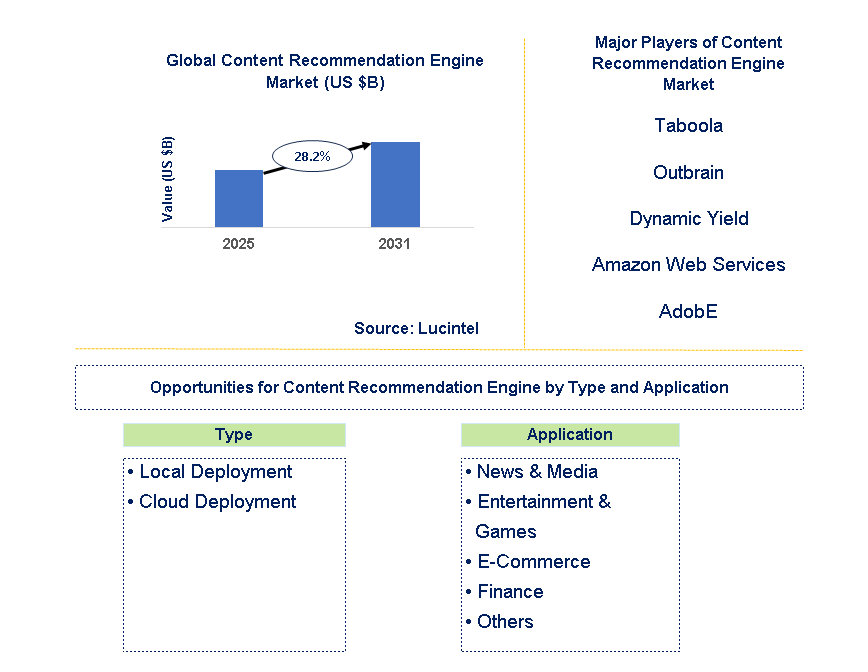
Key data points: The growth forecast = 28.2% annually for the next 7 years. Scroll below to get more insights. This market report covers Trends, opportunity and forecast in content recommendation engine market to 2031 by type (local deployment and cloud deployment), application (news & media, entertainment & games, e-commerce, finance, and others), and region (North America, Europe, Asia Pacific, and the Rest of the World)
We'll send your sample report shortly.
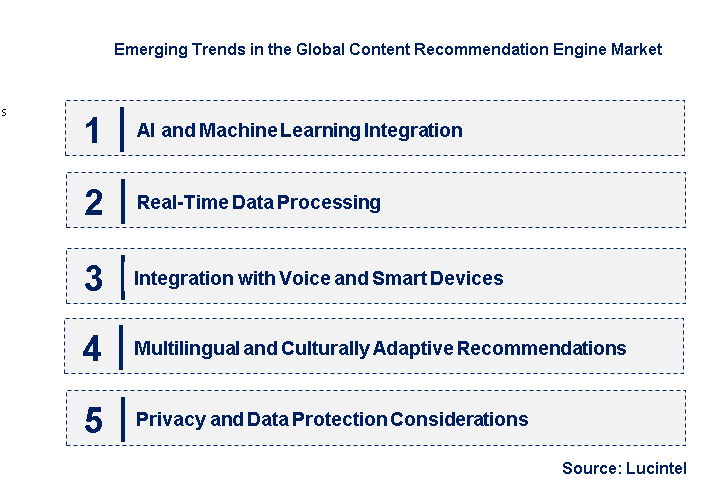
• AI and Machine Learning Integration: Artificial intelligence and machine learning continue to play a pivotal role in improving content recommendation engines. These technologies analyze vast amounts of data, learning from user behavior, preferences, and interactions to deliver more accurate, relevant recommendations. By understanding users on a deeper level, AI and machine learning are enabling platforms to provide personalized content that adapts in real-time, increasing user engagement and satisfaction. As algorithms evolve, AI-driven recommendations are becoming more intuitive, ensuring that users are presented with content they are more likely to enjoy or purchase.
• Real-Time Data Processing: Real-time data processing is becoming increasingly important in the content recommendation engine market. Businesses are using real-time analytics to track user actions and instantly adjust content recommendations based on the most up-to-date information. This trend is helping companies deliver more timely and relevant content, such as personalized video suggestions, product recommendations, or advertisements. Real-time processing allows businesses to cater to immediate user needs and preferences, improving user experience and increasing conversion rates for e-commerce and streaming platforms.
• Integration with Voice and Smart Devices: The rise of voice-activated devices, such as smart speakers and assistants, has led to a growing trend of integrating content recommendation engines with these technologies. Voice assistants like Amazon’s Alexa, Google Assistant, and Apple’s Siri are incorporating personalized content recommendations based on voice queries and previous interactions. This trend is enabling users to receive suggestions through voice commands, making content discovery more convenient. Integration with smart devices is enhancing user experience by allowing content to be recommended based on ambient factors, such as time of day or location.
• Multilingual and Culturally Adaptive Recommendations: As digital content consumption becomes more global, content recommendation engines are incorporating multilingual and culturally adaptive features. This trend allows platforms to cater to a wider audience by providing content suggestions that are not only linguistically accurate but also culturally relevant. Businesses are developing recommendation algorithms that understand regional preferences, helping users discover content that aligns with their cultural background, interests, and language. This trend is especially important for global streaming services and e-commerce platforms that aim to reach diverse international audiences.
• Privacy and Data Protection Considerations: With increasing concerns about data privacy and regulations like GDPR, content recommendation engines are evolving to prioritize user data protection. Companies are implementing privacy-centric models that allow users to control their data while still benefiting from personalized recommendations. This trend is pushing the development of privacy-first recommendation algorithms that anonymize user data and ensure compliance with privacy laws. As consumer trust becomes a critical factor in content consumption, businesses are investing in secure recommendation systems that strike a balance between personalization and privacy. Emerging trends like AI integration, real-time data processing, smart device compatibility, multilingual recommendations, and privacy considerations are significantly shaping the content recommendation engine market. These trends are enhancing the user experience, improving personalization, and enabling businesses to deliver more relevant content to a global audience.
• AI and Deep Learning Algorithms: One of the most significant developments in the content recommendation engine market is the integration of AI and deep learning algorithms. These technologies enable more accurate and personalized content recommendations by analyzing vast amounts of user data. Deep learning algorithms, in particular, can identify patterns and relationships in data that traditional models might miss, resulting in more sophisticated recommendation systems. This development is helping businesses offer highly tailored content that resonates with individual users, increasing engagement and satisfaction.
• Cloud-Based Recommendation Engines: The adoption of cloud-based content recommendation engines is another key development. Cloud-based solutions provide scalability, flexibility, and easy access to real-time data processing, allowing businesses to handle large volumes of data and deliver personalized content across multiple platforms. These cloud-based engines enable companies to reduce infrastructure costs, improve collaboration, and ensure seamless integration with other cloud-based services like analytics and CRM systems. The shift towards cloud technology is also helping businesses innovate faster and deploy updates to recommendation algorithms more efficiently.
• Focus on Privacy and Data Security: With increasing concerns about data privacy, content recommendation engines are undergoing significant changes to prioritize user privacy and comply with regulations like the GDPR. Companies are implementing encryption techniques and anonymizing user data to ensure that sensitive information is protected. This development is driving the adoption of privacy-centric recommendation systems that still deliver personalized content while adhering to privacy laws. As consumers demand more control over their data, businesses are investing in technologies that allow users to manage their preferences and data usage.
• Integration of Multi-Platform Recommendation Systems: Another key development is the integration of recommendation engines across multiple platforms and devices. Users now expect seamless content recommendations across different channels, such as websites, mobile apps, smart TVs, and social media. This trend is driving businesses to create multi-platform recommendation systems that synchronize user preferences and behaviors across various devices. By providing consistent and personalized content across platforms, businesses can increase user engagement and loyalty while delivering a more cohesive and integrated experience.
• Use of Predictive Analytics: Predictive analytics is playing an increasingly important role in content recommendation engines. By analyzing historical user data, predictive algorithms can anticipate future behaviors and preferences, allowing businesses to recommend content that users are likely to engage with before they even realize it. This development is improving the accuracy and relevance of recommendations, leading to higher conversion rates in e-commerce and better content engagement in streaming services. The content recommendation engine market is being shaped by advancements in AI, deep learning, cloud technology, data privacy, and predictive analytics. These developments are making content recommendations more personalized, accurate, and secure, enhancing user experiences and offering businesses new opportunities for engagement and growth.
• E-commerce Personalization: E-commerce platforms are leveraging content recommendation engines to offer personalized product suggestions based on user behavior, preferences, and past purchases. By enhancing product discovery and improving the shopping experience, recommendation engines can drive higher conversion rates and increase customer loyalty. As consumers expect personalized experiences, e-commerce businesses are investing in recommendation technologies to stay competitive and boost sales.
• Streaming Services and Entertainment: Streaming platforms, including Netflix, YouTube, and Spotify, are heavily investing in content recommendation engines to suggest movies, shows, music, and videos based on individual user preferences. Personalized recommendations help enhance user satisfaction and retention by offering content that aligns with users’ tastes. This trend is driving the growth of recommendation engines in the entertainment industry, with companies continually refining their algorithms to deliver more relevant suggestions.
• Social Media and Content Platforms: Social media platforms like Facebook, Instagram, and TikTok are incorporating content recommendation engines to enhance user engagement by providing personalized feeds. These engines use algorithms that analyze user activity, preferences, and interactions to tailor content suggestions, increasing user time on the platform. With the growing demand for personalized social experiences, recommendation systems are becoming essential tools for social media companies to maintain user interest and expand their audiences.
• News and Information Aggregation: Content recommendation engines are becoming increasingly popular in news and information aggregation services. Platforms like Google News and Flipboard use recommendation systems to tailor news articles and stories to users’ interests and reading history. This personalized content delivery helps users stay updated on topics they care about while increasing engagement with the platform. As more users turn to digital news sources, personalized recommendations are becoming a key factor in user retention and content consumption.
• Learning Management Systems (LMS): Educational platforms and learning management systems (LMS) are adopting recommendation engines to suggest relevant courses, resources, and materials based on individual learner progress, interests, and behavior. By providing personalized learning pathways, recommendation systems enhance engagement and retention in educational platforms. As online education grows, this trend is expected to continue driving the adoption of content recommendation engines in the education sector. Strategic growth opportunities in the content recommendation engine market span across e-commerce, streaming services, social media, news platforms, and education. As businesses continue to invest in personalized content delivery, recommendation engines will play a critical role in enhancing user engagement and driving growth across these industries.
• Taboola
• Outbrain
• Dynamic Yield
• Amazon Web Services
• AdobE
• Kibo Commerce
• Optimizely
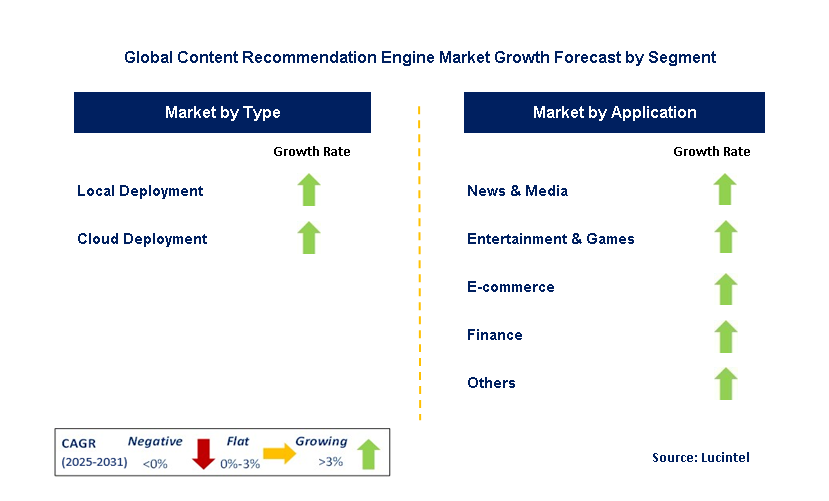
• Local Deployment
• Cloud Deployment
• News & Media
• Entertainment & Games
• E-Commerce
• Finance
• Others
• North America
• Europe
• Asia Pacific
• The Rest of the World
• United States: In the United States, the content recommendation engine market is being driven by advancements in artificial intelligence (AI) and machine learning. Companies like Netflix, Amazon, and Spotify continue to refine their recommendation algorithms, improving their ability to predict user preferences and enhance user engagement. There is a growing emphasis on real-time data processing and personalized content delivery, with businesses increasingly using AI-driven models to recommend content based on a user’s previous behavior, browsing habits, and even mood. Furthermore, the rise of voice-activated devices and smart assistants is pushing the demand for more advanced recommendation technologies.
• China: The content recommendation engine market in China is growing rapidly, fueled by the country’s massive digital user base and the increasing use of AI in the entertainment, e-commerce, and social media sectors. Chinese tech giants like Alibaba, Baidu, and Tencent are heavily investing in recommendation algorithms to personalize user experiences on their platforms. In particular, the e-commerce sector is seeing a rise in AI-powered recommendation systems that suggest products based on user behavior and preferences. Additionally, the use of big data analytics to understand consumer behavior and predict future trends is shaping the future of content recommendations in China.
• Germany: Germany’s content recommendation engine market is developing steadily, with significant advancements in AI and machine learning. The automotive, media, and e-commerce industries are leveraging content recommendation engines to enhance customer experiences and improve service delivery. German businesses are focusing on integrating AI-powered recommendation systems into their websites and mobile apps, allowing for personalized content delivery that aligns with user preferences. Furthermore, Germany is increasingly adopting privacy-centric models for recommendation engines, ensuring that data protection laws are met, which is crucial for user trust and compliance with European Union regulations.
• India: In India, the content recommendation engine market is witnessing significant growth, driven by the expansion of internet penetration and mobile device usage. With the rise of online streaming platforms like Hotstar, Netflix, and Amazon Prime, there is an increasing demand for personalized recommendations to cater to diverse user preferences. Additionally, e-commerce platforms such as Flipkart and Myntra are using recommendation engines to suggest products based on user browsing patterns and purchase history. AI and machine learning algorithms are being deployed to fine-tune recommendations, ensuring that users receive relevant content and product suggestions.
• Japan: Japan’s content recommendation engine market is also seeing growth, with a focus on delivering personalized content to users across digital platforms. Companies in Japan are using AI and deep learning technologies to refine content recommendations in the entertainment and e-commerce sectors. Streaming services, such as Hulu Japan and Netflix Japan, are improving their content suggestion algorithms, while e-commerce giants like Rakuten are implementing recommendation engines to provide personalized shopping experiences. Additionally, the Japanese market is increasingly incorporating multilingual capabilities into recommendation engines to cater to both domestic and international users.


• Taboola
• Outbrain
• Dynamic Yield
• Amazon Web Services
• AdobE
• Kibo Commerce
• Optimizely Q5. Which content recommendation engine market segment will be the largest in future? Answer: Lucintel forecasts that cloud deployment is expected to witness higher growth over the forecast period. Q6. In content recommendation engine market, which region is expected to be the largest in next 5 years? Answer: APAC is expected to witness the highest growth over the forecast period. Q7. Do we receive customization in this report? Answer: Yes, Lucintel provides 10% customization without any additional cost.


Choose a license that fits your team. Instant PDF delivery.
Prices exclude taxes. Instant delivery. Custom licensing available on request.
Market Report · July 15, 2026
Market Report · June 26, 2026
Market Report · June 24, 2026
Trusted partner for strategic intelligence and business growth


Receive a complimentary market analysis tailored to your industry. Our analysts will identify key growth opportunities and competitive dynamics specific to your business.

Market size, growth rate, and key trend analysis for your specific sector.

Top competitor positioning and market share analysis.

Strategic recommendations backed by data-driven insights.
Get curated market intelligence and competitive moves straight to your inbox.
By subscribing, you agree to receive our monthly insights. Unsubscribe anytime.
Receive a complimentary market analysis tailored to your industry. Our analysts will identify key growth opportunities and competitive dynamics specific to your business.
Market size, growth rate, and key trend analysis for your specific sector.
Top competitor positioning and market share analysis.
Strategic recommendations backed by data-driven insights.
Get curated market intelligence, emerging trends, and competitive moves straight to your inbox each month.
By subscribing, you agree to receive our monthly insights. Unsubscribe anytime.
We'll send your sample report shortly.