
Market Report · July 15, 2026

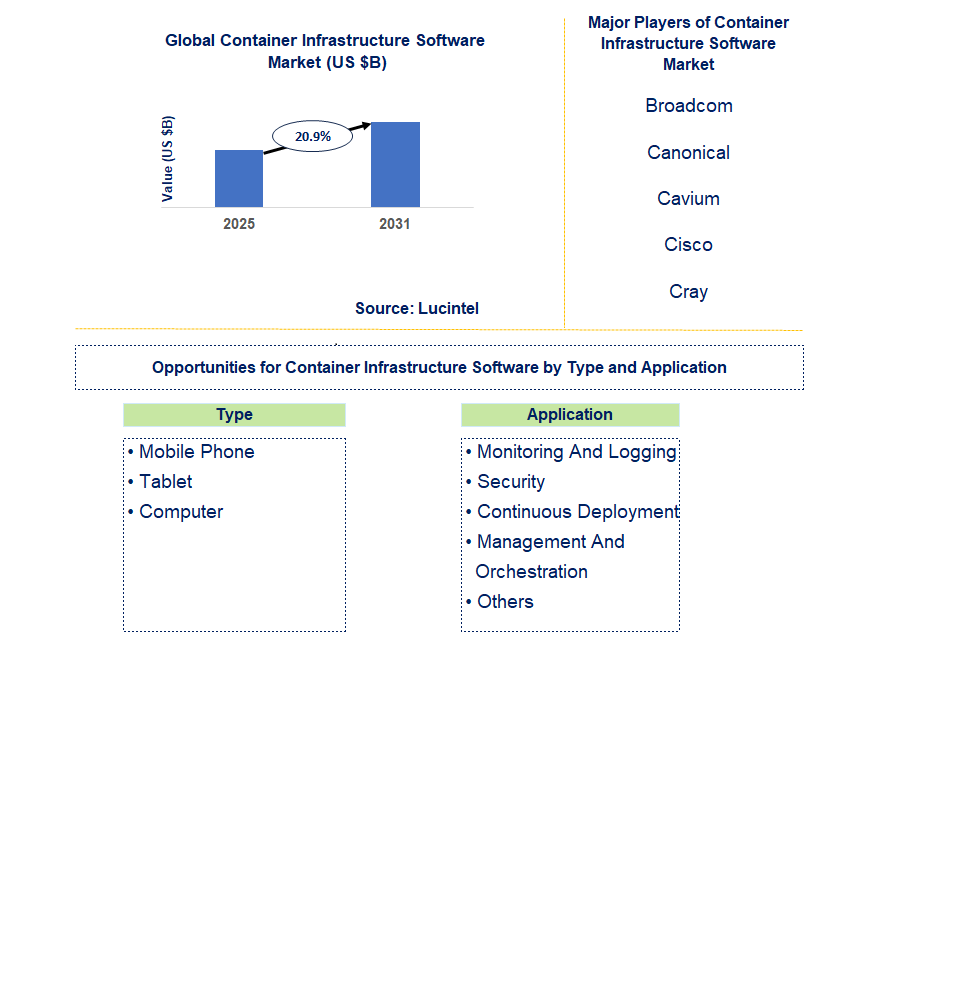
Key data points: The growth forecast = 0.209 annually for the next 7 years. Scroll below to get more insights. This market report covers Trends, opportunities and forecasts in container infrastructure software market to 2031 by type (mobile phone, tablet, and computer), application (monitoring and logging, security, continuous deployment, management and orchestration, and others), and region (North America, Europe, Asia Pacific, and the Rest of the World)
We'll send your sample report shortly.
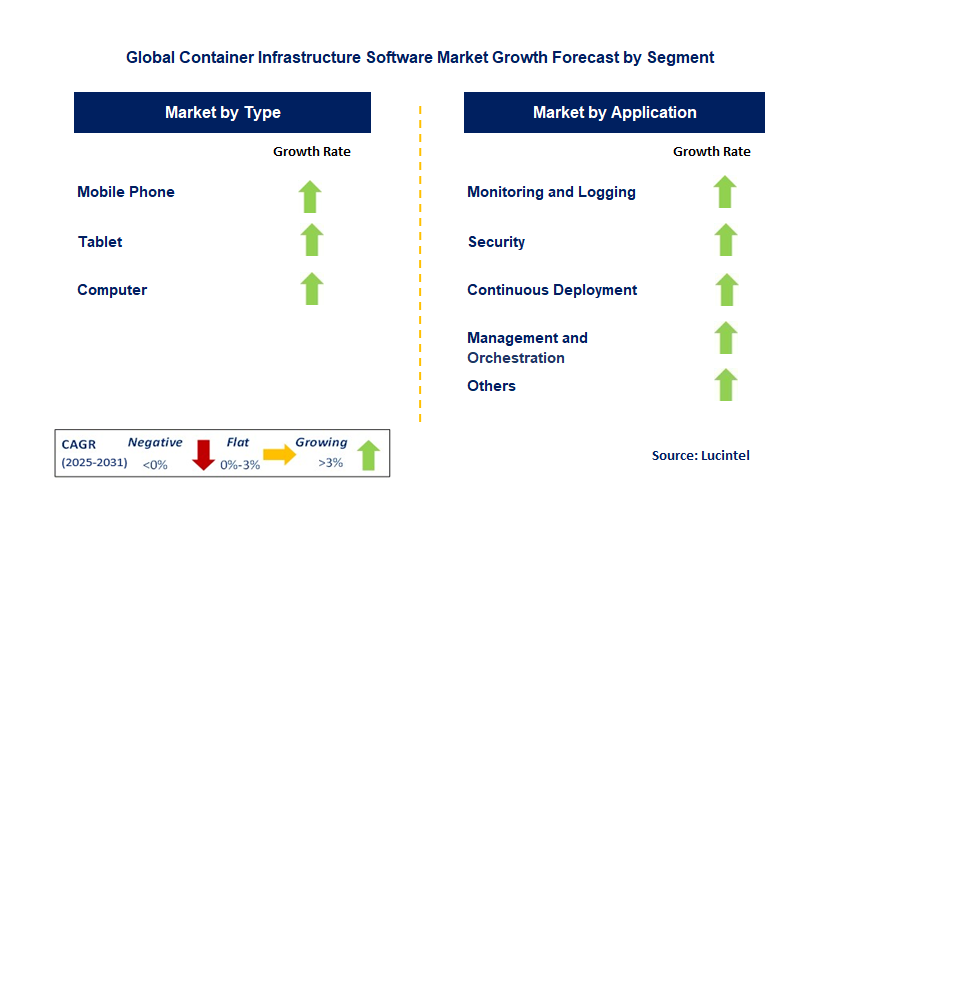
• Lucintel forecasts that, within the type category, mobile phone is expected to witness higher growth over the forecast period due to increasing mobile app containerization and cloud services.
• Within the application category, security is expected to witness the highest growth due to rising concerns over containerized application vulnerabilities and threats.
• In terms of region, APAC is expected to witness the highest growth over the forecast period due to rapid cloud adoption and digital transformation.
• Increased Adoption of Kubernetes: Kubernetes is becoming the standard for container orchestration, enabling enterprises to manage complex applications across hybrid and multi-cloud environments. Businesses are investing in managed Kubernetes services to enhance scalability and reliability while reducing operational complexity.
• Security-First Approach: Security is a primary concern in container adoption. Companies are implementing zero-trust security models, runtime protection, and vulnerability management solutions to safeguard containerized applications. Advanced security tools are integrated into DevOps pipelines for enhanced threat detection and compliance.
• AI and Automation in Container Management: AI-powered automation tools are streamlining container deployment, monitoring, and scaling. Organizations are leveraging machine learning for predictive analytics and resource optimization, improving operational efficiency. Automation reduces manual intervention, enhancing the reliability of containerized applications.
• Hybrid and Multi-Cloud Strategies: Enterprises are adopting hybrid and multi-cloud approaches to ensure flexibility, cost optimization, and resilience. Container infrastructure software is enabling seamless application portability across different cloud providers, reducing vendor lock-in and improving disaster recovery capabilities.
• Edge Computing and Containerization: The rise of edge computing is driving the use of lightweight containerized applications to process data closer to the source. Edge-native container solutions are helping businesses improve real-time decision-making, reduce latency, and enhance overall system performance.
These emerging trends are shaping the container infrastructure software market by improving security, automation, and scalability. Organizations are adopting Kubernetes, AI-driven management, and hybrid-cloud strategies to stay competitive. As the market continues to evolve, innovation in container security and edge computing will drive further growth.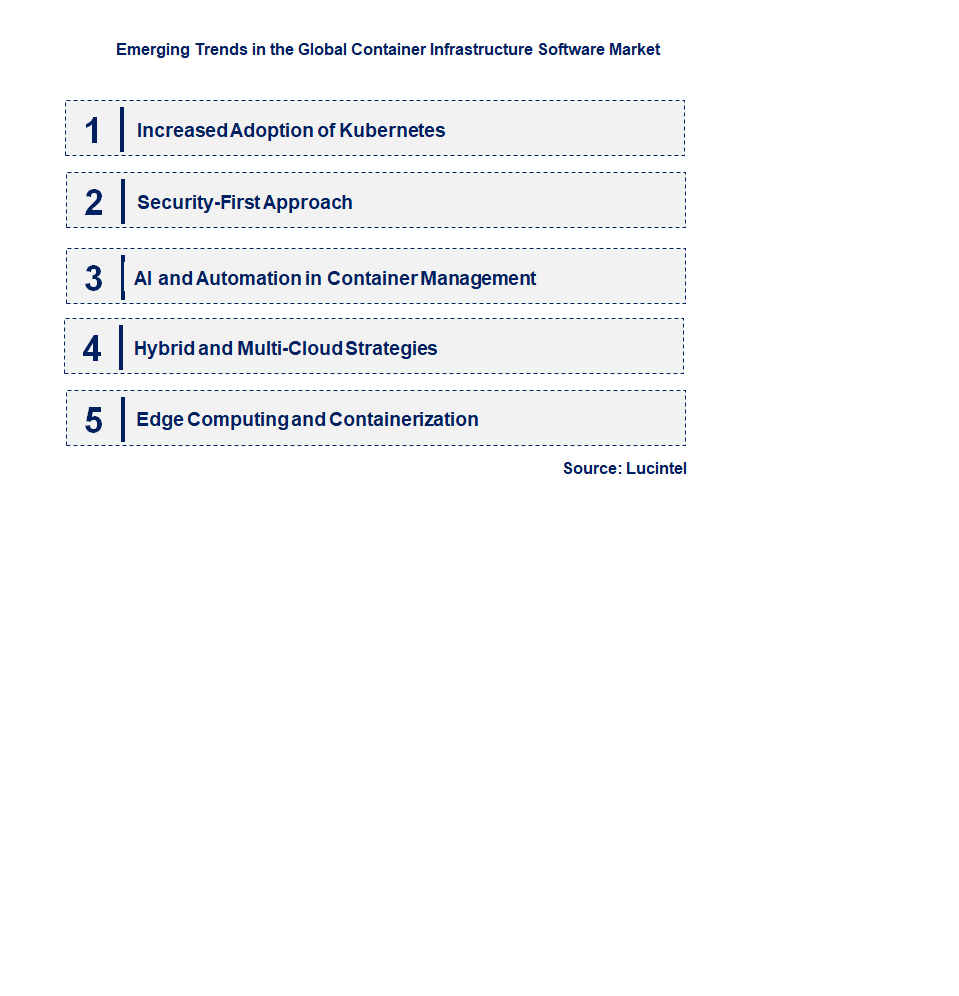
• Rise of Open-Source Container Solutions: Open-source container technologies such as Kubernetes and Docker are gaining widespread adoption. Enterprises are leveraging open-source platforms for greater flexibility, cost savings, and community-driven innovation.
• Enhanced Container Security Solutions: Security is a major focus, with organizations deploying runtime security, vulnerability scanning, and compliance frameworks. Enterprises are investing in container-specific security tools to prevent breaches and improve resilience.
• Integration of DevOps and CI/CD Pipelines: The convergence of DevOps and continuous integration/continuous deployment (CI/CD) pipelines with container infrastructure is enhancing automation and software delivery speed. Businesses are adopting DevSecOps approaches to embed security into development workflows.
• Growth in Serverless Container Offerings: Serverless computing and container infrastructure are merging to create efficient, event-driven applications. Cloud providers are introducing managed serverless container services, enabling developers to focus on application logic rather than infrastructure management.
• Increased Investment in Edge Computing: Edge-native container solutions are gaining traction, supporting real-time processing in remote environments. Industries such as telecommunications and manufacturing are leveraging containerized applications to enhance efficiency and reduce latency.
These developments are driving innovation in the container infrastructure software market. Open-source adoption, enhanced security, DevOps integration, serverless computing, and edge solutions are enabling organizations to optimize performance and scalability. As technology evolves, these advancements will continue shaping the market’s future.• Cloud-Native Application Development: Enterprises are investing in cloud-native applications, leveraging container infrastructure for improved scalability and agility. This shift is driving the need for robust container management solutions and Kubernetes-based platforms.
• Container Security and Compliance: With increasing cybersecurity threats, businesses are prioritizing container security. Investments in vulnerability scanning, compliance frameworks, and zero-trust architectures are creating growth opportunities for security-focused container solutions.
• AI-Driven Container Orchestration: AI and machine learning are optimizing container orchestration by predicting resource requirements and automating scaling. Businesses are adopting AI-powered container management tools to improve operational efficiency and reduce costs.
• Hybrid and Multi-Cloud Deployments: Enterprises are expanding hybrid and multi-cloud strategies to enhance application portability and resilience. The demand for container orchestration solutions that enable seamless cloud integration is increasing rapidly.
• Edge Computing Expansion: The rise of edge computing is creating new opportunities for lightweight container solutions. Organizations are deploying edge-native containerized applications to support IoT, real-time analytics, and low-latency processing.
These growth opportunities are driving advancements in the container infrastructure software market. Businesses are investing in cloud-native applications, security, AI-driven orchestration, hybrid-cloud deployments, and edge computing to stay competitive. These developments are shaping the future of containerization.• Broadcom
• Canonical
• Cavium
• Cisco
• Cray
• Docker
• HPE
• Mobile Phone
• Tablet
• Computer
• Monitoring And Logging
• Security
• Continuous Deployment
• Management And Orchestration
• Others
• North America
• Europe
• Asia Pacific
• The Rest of the World
• United States: The United States is experiencing rapid adoption of Kubernetes-driven container platforms, with a strong focus on multi-cloud and hybrid-cloud strategies. Companies are investing in automation tools and security frameworks to enhance container orchestration. Open-source container projects and enterprise adoption of container security solutions are also driving market growth.
• China: China is focusing on building a self-reliant container infrastructure ecosystem with homegrown cloud providers investing in Kubernetes-based platforms. Government initiatives are supporting cloud-native development, while AI-driven container management solutions are gaining traction. The expansion of domestic cloud services is strengthening the container market in China.
• Germany: Germany's container infrastructure software market is expanding due to increasing enterprise adoption of DevOps practices and cloud-native applications. Businesses are prioritizing compliance, security, and automation, aligning with stringent data protection laws. Hybrid cloud strategies and container security solutions are playing a critical role in shaping the industry.
• India: India is witnessing a surge in container adoption driven by digital transformation initiatives across industries. Enterprises are leveraging containerized applications for scalability and cost-efficiency, while startups are embracing cloud-native technologies. The growing developer community and investment in open-source projects are fostering innovation in the container ecosystem.
• Japan: Japan’s market is seeing increased adoption of container infrastructure in manufacturing and financial sectors. Businesses are focusing on enhancing container security, automation, and multi-cloud integration. Japanese enterprises are also investing in AI-powered container management tools to improve operational efficiency and scalability.


• Broadcom
• Canonical
• Cavium
• Cisco
• Cray
• Docker
• HPE
Q5. Which container infrastructure software market segment will be the largest in future?

Choose a license that fits your team. Instant PDF delivery.
Prices exclude taxes. Instant delivery. Custom licensing available on request.
Market Report · July 15, 2026
Market Report · June 26, 2026
Market Report · June 24, 2026
Trusted partner for strategic intelligence and business growth


Receive a complimentary market analysis tailored to your industry. Our analysts will identify key growth opportunities and competitive dynamics specific to your business.

Market size, growth rate, and key trend analysis for your specific sector.

Top competitor positioning and market share analysis.

Strategic recommendations backed by data-driven insights.
Get curated market intelligence and competitive moves straight to your inbox.
By subscribing, you agree to receive our monthly insights. Unsubscribe anytime.
Receive a complimentary market analysis tailored to your industry. Our analysts will identify key growth opportunities and competitive dynamics specific to your business.
Market size, growth rate, and key trend analysis for your specific sector.
Top competitor positioning and market share analysis.
Strategic recommendations backed by data-driven insights.
Get curated market intelligence, emerging trends, and competitive moves straight to your inbox each month.
By subscribing, you agree to receive our monthly insights. Unsubscribe anytime.
We'll send your sample report shortly.