
Market Report · May 18, 2026

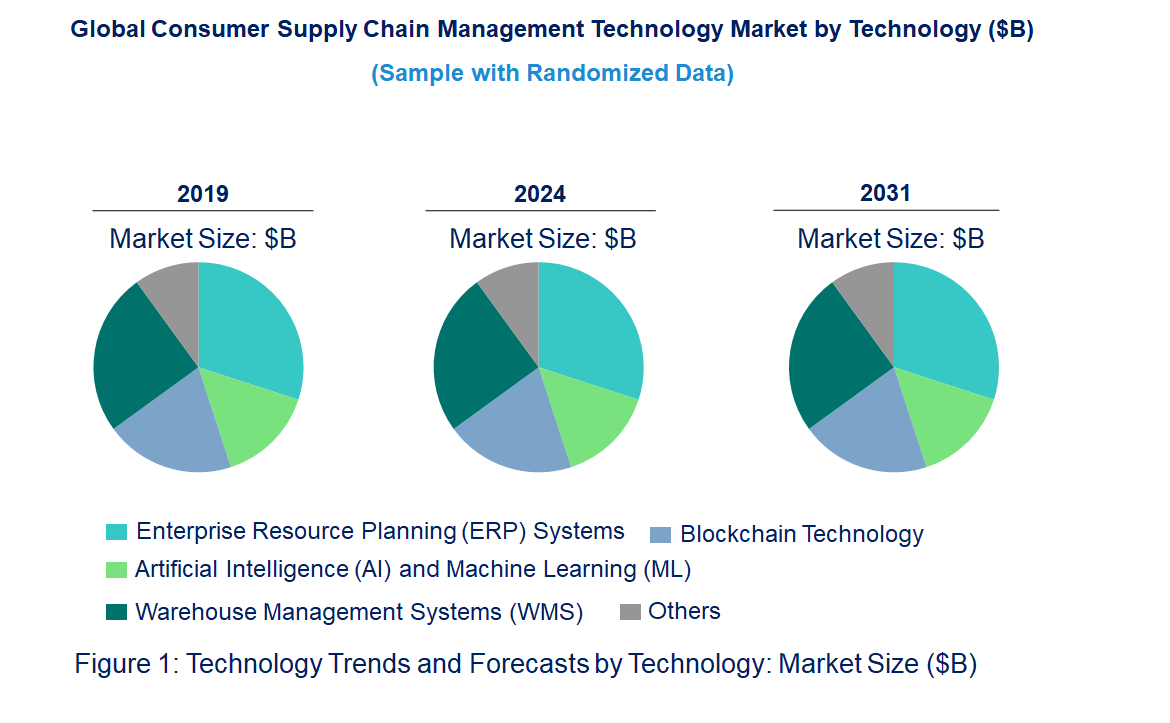
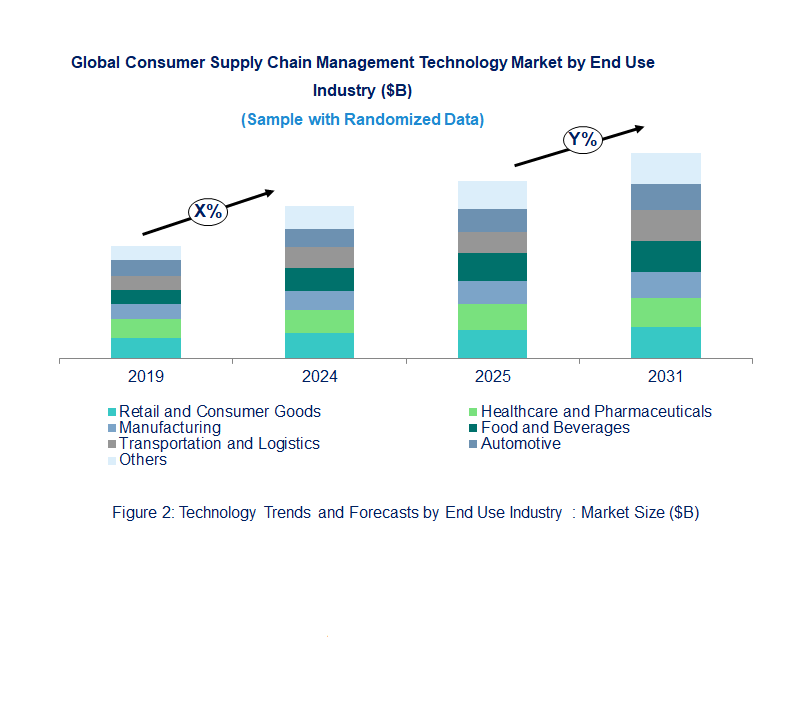
This market report covers trends, opportunities, and forecasts in the global consumer supply chain management market to 2031 by technology (enterprise resource planning (erp) systems, artificial intelligence (ai) and machine learning (ml), blockchain technology, warehouse management systems (wms), and others), end use (retail and consumer goods, healthcare and pharmaceuticals, manufacturing, food and beverages, transportation and logistics, automotive, and others), and region (North America, Europe, Asia Pacific, and the Rest of the World)
We'll send your sample report shortly.
• AI and Machine Learning for Predictive Analytics: AI and ML are being increasingly integrated into supply chain processes to forecast demand, optimize inventory, and predict disruptions. By analyzing large datasets, these technologies enable businesses to make proactive decisions, reducing stockouts, overstocking, and production delays.
• Blockchain for Transparency and Traceability: Blockchain technology ensures the integrity of the supply chain by providing secure, immutable records of every transaction. This trend is particularly valuable in industries like food and pharmaceuticals, where consumers demand greater transparency regarding the origin and handling of products.
• IoT and Real-Time Tracking: The integration of IoT devices in supply chains allows for real-time tracking of products and assets. From smart sensors to RFID tags, IoT is providing businesses with a comprehensive view of inventory and shipments, helping to improve delivery accuracy and reduce operational inefficiencies.
• Automation and Robotics in Warehousing and Fulfillment: Warehouse automation, powered by robotics, is transforming the efficiency of storage, retrieval, and order picking. Automated Guided Vehicles (AGVs), robotic arms, and drones are accelerating fulfillment processes, improving accuracy, and reducing labor costs.
• Sustainability and Green Supply Chains: Companies are increasingly adopting technologies focused on sustainability, such as carbon tracking and eco-friendly logistics solutions. This trend is driven by consumer demand for environmentally responsible practices and regulatory pressures, pushing businesses to incorporate sustainable practices throughout their supply chains. These emerging trends in consumer supply chain management technology are reshaping how businesses operate, making them more agile, transparent, and environmentally conscious. The integration of AI, blockchain, IoT, automation, and sustainability initiatives is not only enhancing operational efficiency but also meeting the growing demands for better customer experiences and responsible business practices.
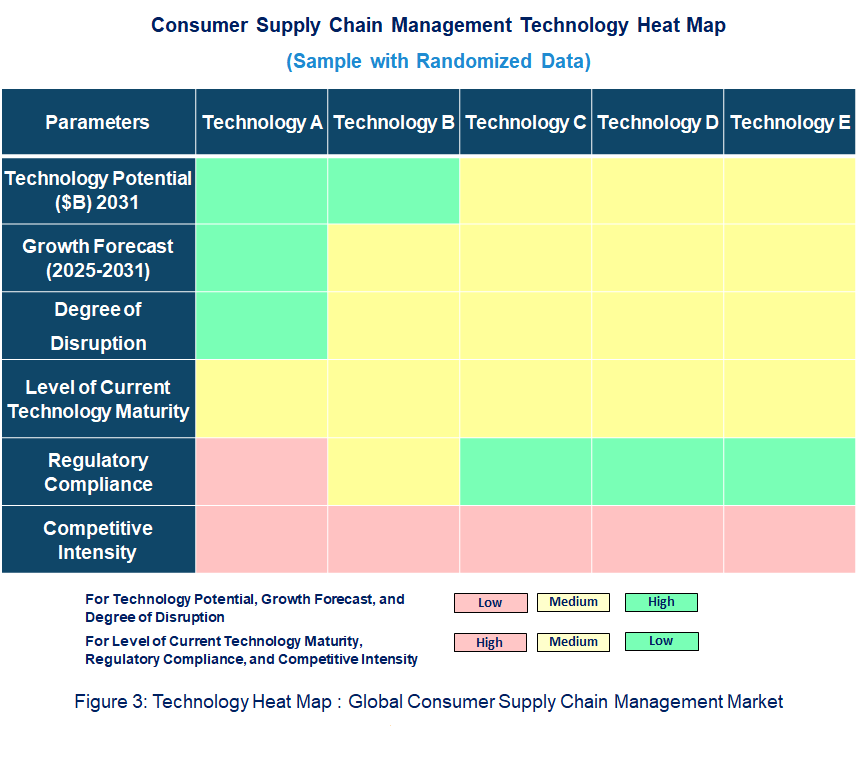
• Potential in Technology: The technology potential within the consumer supply chain management (SCM) market is vast, with innovations enhancing operational efficiency, transparency, and agility. Technologies such as AI, Machine Learning (ML), and Blockchain hold significant potential to disrupt traditional supply chain models. AI and ML can transform demand forecasting, inventory management, and predictive maintenance, leading to more responsive and adaptive supply chains. Blockchain provides transparency, traceability, and enhanced security, addressing consumer demand for verifiable product origins and mitigating fraud risks.
• Degree of Disruption: The degree of disruption varies across technologies. AI/ML is highly disruptive, changing how businesses approach decision-making, risk management, and automation. Blockchain is also disruptive but more incremental, gradually shifting industries toward decentralized, trustless systems. IoT and robotics are transforming warehousing and fulfillment operations, driving higher speed and accuracy in logistics, though the disruption is more operational than strategic.
• Current Technology Maturity Level: Regarding technology maturity, AI, ML, and Blockchain are mature in certain industries but still evolving in others. IoT and robotics are increasingly integrated into mainstream supply chains, though full adoption is limited by high costs and integration complexity.
• Regulatory Compliance: Compliance with regulations such as GDPR, ISO standards, and sustainability mandates is a critical aspect, especially as governments introduce stricter requirements. These technologies must ensure data security, privacy, and ethical sourcing to align with global compliance standards.
• IBM Corporation has expanded its AI-driven supply chain solutions, incorporating Watson AI to enhance demand forecasting, automate supply chain processes, and improve decision-making. IBM’s blockchain solutions, especially in partnership with major retailers, are helping companies ensure transparency and traceability in their supply chains, making them more resilient to disruptions.
• Oracle Corporation has integrated AI and machine learning into its Oracle SCM Cloud, enabling predictive analytics, real-time inventory management, and demand forecasting. The company’s blockchain technology also strengthens its supply chain solutions by providing secure, transparent transactions, aiding in compliance and reducing fraud.
• SAP SE continues to enhance its SAP Integrated Business Planning (IBP) software, combining real-time data with AI and IoT to improve forecasting, inventory optimization, and order fulfillment. SAP’s recent developments focus on digital supply chain transformation, particularly with SAP Ariba for supplier collaboration and procurement efficiency.
• Manhattan Associates has advanced its Warehouse Management System (WMS) by integrating robotics and AI for greater automation and efficiency in order fulfillment. Their cloud-based SCM solutions enable businesses to scale quickly and respond to supply chain fluctuations in real-time.
• Descartes Systems Group Inc. has made significant strides in logistics management through the integration of IoT, GPS, and real-time tracking technologies. Descartes’ cloud-based solutions allow for the optimization of global trade and route planning, enhancing delivery times and reducing transportation costs. These technological advancements are driving supply chain optimization, enhancing real-time visibility, and enabling businesses to adapt more quickly to consumer demands and market changes. The integration of AI, blockchain, robotics, and IoT is transforming how companies approach supply chain management, enabling smarter, more efficient operations.
• The Use of AI and ML: Supply chains are continuously being improved through innovations in AI and ML. These technologies enable demand forecasting, predictive analytics, and automation of many functions within the supply chains. Businesses employing AI can improve inventory forecasting accuracy by upto 50%, reduce accuracy of forecasts, optimize inventory levels, and improve overall business efficacy.
• The Integration of IoT and Real-Time Analytics: The monitoring of goods, equipment, and their environmental conditions in the supply chain is made easier with the aid IoT. With this level of monitoring, businesses can improve shipment, anticipate maintenance, and respond to interruptions in real time which greatly improves operational efficacy and customer relations.
• The Shift To Cloud Based SCM Systems: Supply chain management in the cloud enhances business collaboration since they can access real-time data anywhere. These systems are flexible, scalable, and do not require excessive financial investment in IT infrastructure, aiding most businesses in easily adapting to market dynamics.
• The Focus on Sustainability and Ethical Practices: There is a rising expectation from pretty much every consumer and stakeholder that the supply chains should be sustainable and environmentally friendly. SCM digital technologies enable businesses to monitor the negative impacts on the environment, ensure that the raw materials were not obtained in an unethical way, and obey the laws which help to improve corporate image.
• The Emergence of Blockchain Technology: Blockchain creates a non-tamperable ledger that aids in tracking infrastructure work making supply chains more transparent and easier to trace operations. Challenges:
• High Implementation and Operational Costs: Integration of new SCM technologies comes with great expense in servicing software, hardware, and training. Specialized resources can be expensive, making it difficult for small and medium-sized enterprises.
• Cybersecurity and Data Privacy Concerns: There is an increasing risk of cyberattacks and data breaches as supply chains are more digitized. Protecting the sensitive information contained within a supply chain is essential, demanding strict cybersecurity practices and adequate data protection legislation.
• Integration with Legacy Systems: The integration of new SCM technologies with legacy systems has equally challenging problems. Such integration requires detailed strategy, coupling extensive scope planning, resource allocation, and change management to avert unfriendly operation conditions. Consumer-focused technologies that involve AI, IoT, and cloud computing are enhancing efficiency, transparency, and sustainability for the entire ecosystem, while blockchain reinforces and secures it. Supply chains still face hurdles concerning responsiveness and cost, cybersecurity and system integration, however, presents an attractive opportunity for innovation.
• IBM Corporation
• Oracle Corporation
• SAP SE
• Manhattan Associates
• Descartes Systems Group Inc.
• Technology Readiness: The readiness of technologies for consumer supply chain management varies. ERP systems are mature, widely implemented across industries, and ready for expansion with cloud solutions. AI and ML are rapidly evolving, with growing applications in demand forecasting, inventory management, and logistics optimization, but full integration is still progressing. Blockchain is in the early stages of broader adoption, with pilot projects underway to enhance transparency. WMS technology is highly developed, and solutions are readily available for implementation, supporting automation, real-time inventory tracking, and warehouse optimization. Each technology contributes differently, depending on the application and supply chain goals.
• Competitive Intensity and Regulatory Compliance: The competitive intensity in consumer supply chain management technology is growing, as more companies adopt ERP systems, AI, ML, Blockchain, and WMS to stay competitive. Each technology is becoming essential to achieving operational efficiency, reducing costs, and gaining a competitive edge. However, this also heightens the need for regulatory compliance, especially with Blockchain’s emphasis on transparency and AI/ML’s reliance on data privacy. Companies must adhere to industry standards and data security regulations, like GDPR and ISO standards, to avoid legal repercussions and maintain consumer trust while integrating these technologies.
• Disruption Potential: Technologies such as Enterprise Resource Planning (ERP) systems, Artificial Intelligence (AI), Machine Learning (ML), Blockchain, and Warehouse Management Systems (WMS) are highly disruptive to the consumer supply chain management (SCM) market. ERP systems streamline business operations by integrating key processes, improving efficiency across supply chains. AI and ML revolutionize forecasting, automation, and decision-making, enabling real-time adjustments and predictive capabilities. Blockchain ensures transparency and traceability in supply chains, particularly for verifying product origins. WMS optimizes warehousing operations, reducing errors and enhancing speed. These technologies challenge traditional models, forcing businesses to adopt smarter, more efficient systems, ultimately reshaping the supply chain landscape.
• Enterprise Resource Planning (ERP) Systems
• Artificial Intelligence (AI) and Machine Learning (ML)
• Blockchain Technology
• Warehouse Management Systems (WMS)
• Others
• Retail and Consumer Goods
• Healthcare and Pharmaceuticals
• Manufacturing
• Food and Beverages
• Transportation and Logistics
• Automotive
• Others
• North America
• Europe
• Asia Pacific
• The Rest of the World
• Latest Developments and Innovations in the Consumer Supply Chain Management Technologies
• Companies / Ecosystems
• Strategic Opportunities by Technology Type


Choose a license that fits your team. Instant PDF delivery.
Prices exclude taxes. Instant delivery. Custom licensing available on request.
Market Report · May 18, 2026
Market Report · May 18, 2026
Market Report · May 18, 2026
Trusted partner for strategic intelligence and business growth


Receive a complimentary market analysis tailored to your industry. Our analysts will identify key growth opportunities and competitive dynamics specific to your business.

Market size, growth rate, and key trend analysis for your specific sector.

Top competitor positioning and market share analysis.

Strategic recommendations backed by data-driven insights.
Get curated market intelligence and competitive moves straight to your inbox.
By subscribing, you agree to receive our monthly insights. Unsubscribe anytime.
Receive a complimentary market analysis tailored to your industry. Our analysts will identify key growth opportunities and competitive dynamics specific to your business.
Market size, growth rate, and key trend analysis for your specific sector.
Top competitor positioning and market share analysis.
Strategic recommendations backed by data-driven insights.
Get curated market intelligence, emerging trends, and competitive moves straight to your inbox each month.
By subscribing, you agree to receive our monthly insights. Unsubscribe anytime.
We'll send your sample report shortly.