
Market Report · July 15, 2026

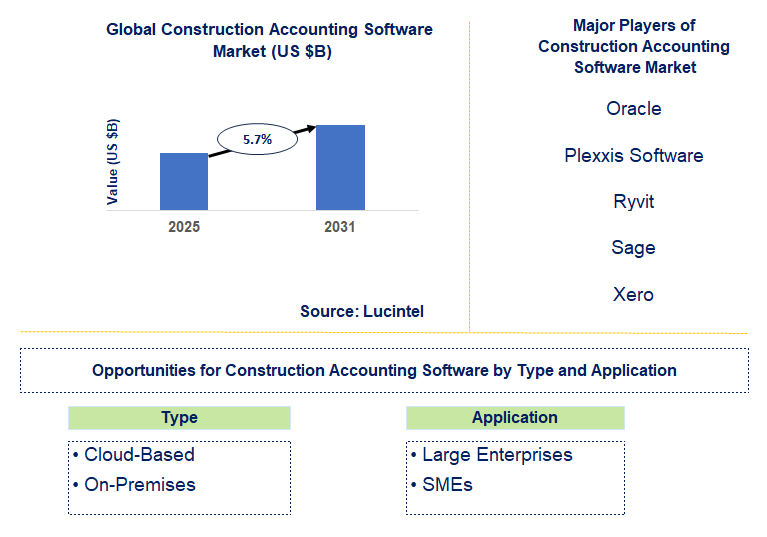
Key data points: The growth forecast = 5.7% annually for the next 7 years. Scroll below to get more insights. This market report covers Trends, opportunity and forecast in construction accounting software market to 2031 by type (cloud-based and on-premises), application (large enterprises and SMEs), and region (North America, Europe, Asia Pacific, and the Rest of the World)
We'll send your sample report shortly.
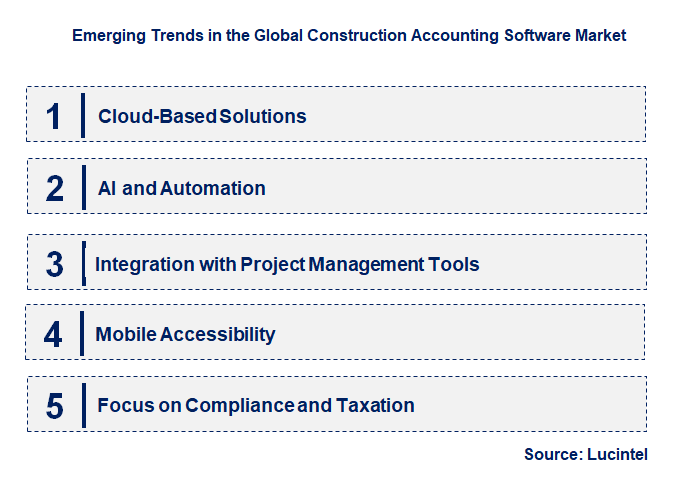
• Cloud-Based Solutions: Cloud-based construction accounting software is becoming more popular due to its flexibility and scalability. These solutions allow businesses to access financial data from anywhere, facilitating collaboration across teams and improving project visibility. Cloud-based systems also reduce the need for on-premise infrastructure, making them more cost-effective for businesses of all sizes.
• AI and Automation: Artificial intelligence (AI) and automation are transforming the construction accounting landscape. These technologies streamline tasks like invoicing, payroll, and cost estimation, reducing manual effort and errors. AI-powered analytics also provide insights into financial performance, helping businesses make data-driven decisions and improve project outcomes.
• Integration with Project Management Tools: Construction accounting software is increasingly being integrated with project management tools to provide a comprehensive view of both financial and project data. This integration improves collaboration, enhances decision-making, and helps companies keep track of costs, timelines, and project progress in real time.
• Mobile Accessibility: The rise of mobile-friendly construction accounting software is enabling project managers and contractors to access financial data on the go. Mobile accessibility ensures that project updates, invoices, and budget changes can be made in real time, providing greater flexibility and improving communication across teams.
• Focus on Compliance and Taxation: Construction accounting software is increasingly being designed to ensure compliance with local tax laws and industry regulations. In countries with complex tax structures and stringent regulations, such as Germany, software solutions are being tailored to provide up-to-date tax information and ensure that businesses meet all financial reporting requirements. Cloud-based solutions, AI and automation, integration with project management tools, mobile accessibility, and compliance focus are key trends reshaping the construction accounting software market. These developments enhance financial management, improve collaboration, and streamline processes, making construction accounting software an essential tool for companies looking to optimize their financial operations and stay competitive in the market.
• Cloud-Based Accounting Platforms: The rise of cloud-based accounting platforms is one of the most significant recent developments. These platforms provide construction companies with real-time access to financial data, reducing the need for on-premise infrastructure. Cloud solutions also enable better data security, collaboration, and scalability, making them highly attractive to businesses of all sizes.
• AI and Machine Learning Integration: AI and machine learning are being integrated into construction accounting software to automate repetitive tasks, such as invoice processing and payroll management. These technologies help improve accuracy, reduce manual errors, and speed up processes, making the software more efficient and valuable to businesses.
• Mobile-Optimized Solutions: Many construction accounting software providers are developing mobile-optimized versions of their platforms. These solutions allow contractors and project managers to access financial information and make updates from anywhere, improving flexibility and communication. Mobile apps also facilitate real-time updates on project costs and progress, helping businesses stay on track
• Advanced Financial Reporting: Recent software advancements include more sophisticated financial reporting features that allow construction businesses to generate customized reports with detailed insights into project costs, cash flow, and profitability. These features are helping businesses make more informed decisions and manage their finances with greater precision.
• Integration with Enterprise Systems: Construction accounting software is increasingly being integrated with other enterprise systems, such as project management tools and CRM platforms. This integration allows for more seamless data sharing across departments, improving overall efficiency and providing businesses with a unified view of their operations. The adoption of cloud-based platforms, AI and machine learning, mobile optimization, advanced financial reporting, and integration with enterprise systems are transforming the construction accounting software market. These developments improve efficiency, accuracy, and collaboration, helping construction companies streamline their financial management and stay competitive in a rapidly evolving industry.
• Small and Medium-Sized Business (SMB) Adoption: Small and medium-sized businesses in the construction industry represent a key growth opportunity for accounting software providers. As SMBs seek cost-effective solutions to streamline their accounting processes, cloud-based and mobile-friendly software solutions are becoming more attractive due to their scalability and low upfront costs.
• Integration with BIM and Project Management Tools: Integrating construction accounting software with Building Information Modeling (BIM) and project management tools presents significant growth opportunities. This integration provides businesses with a comprehensive view of both financial and project data, improving efficiency, reducing errors, and supporting better decision-making across teams.
• Focus on Compliance Solutions: As regulations become increasingly complex, construction accounting software solutions that emphasize compliance with tax laws and industry regulations present strong growth potential. Providers that offer tailored solutions for specific regions or sectors can tap into a growing demand for compliance-focused tools, particularly in markets like Europe and North America.
• Expansion into Emerging Markets: Emerging markets, particularly in Asia and Africa, present significant growth opportunities for construction accounting software providers. As infrastructure development accelerates in these regions, the demand for digital solutions to manage construction finances is expected to grow. Localized solutions that cater to regional requirements will be key to success in these markets
• Real-Time Financial Insights and Analytics: Real-time financial insights and analytics are becoming increasingly important for construction companies. Software solutions that offer predictive analytics and financial forecasting can help businesses make data-driven decisions and improve project profitability. This focus on real-time data and analytics presents a strong growth opportunity in the market. Strategic growth opportunities in the construction accounting software market lie in SMB adoption, integration with BIM and project management tools, compliance-focused solutions, expansion into emerging markets, and real-time analytics. These opportunities reflect the industry‘s growing need for more efficient, collaborative, and compliant financial management solutions, positioning software providers for success in a competitive market.
• Oracle
• Plexxis Software
• Ryvit
• Sage
• Xero
• Cloud-Based
• On-Premises
• Large Enterprises
• SMEs
• North America
• Europe
• Asia Pacific
• The Rest of the World
• United States: In the United States, the construction accounting software market has seen significant growth due to the increasing demand for real-time data and project visibility. Cloud-based solutions have gained popularity, enabling contractors and project managers to access financial data from anywhere. Additionally, there is a greater focus on automation, which simplifies tasks like invoicing and payroll, improving efficiency and reducing manual errors.
• China: China’s construction accounting software market has been evolving rapidly as the country continues to expand its infrastructure and real estate sectors. Local software providers are incorporating AI and automation to handle complex accounting tasks like budgeting and cost estimation more accurately. This integration helps businesses keep track of their financials amidst growing project volumes and regulatory changes, driving growth in the sector.
• Germany: In Germany, construction accounting software is increasingly focused on compliance with local tax laws and industry regulations. German construction companies are adopting cloud-based solutions for better data management and real-time access to project financials. The software also provides enhanced integration with other enterprise systems, helping businesses optimize their financial processes, manage project cash flow, and improve overall efficiency.
• India: In India, the adoption of construction accounting software is gaining traction, particularly in the rapidly growing infrastructure and real estate sectors. Indian businesses are shifting towards digital solutions to streamline accounting processes, manage costs, and ensure better financial visibility. Cloud-based software is becoming increasingly popular due to its cost-effectiveness and scalability, especially among small and medium-sized businesses (SMBs).
• Japan: Japan’s construction accounting software market is witnessing growth, driven by the need for more effective financial management in the country’s competitive construction sector. Businesses are adopting cloud-based software to improve project cost management and enhance team collaboration. There is also growing interest in integrating accounting systems with other project management tools to create more comprehensive, all-in-one solutions.


• Oracle
• Plexxis Software
• Ryvit
• Sage
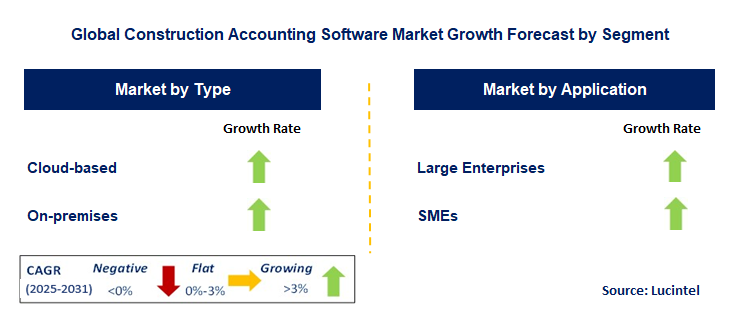
• Xero Q5. Which construction accounting software market segment will be the largest in future? Answer: Lucintel forecasts that cloud-based is expected to witness higher growth over the forecast period. Q6. In construction accounting software market, which region is expected to be the largest in next 5 years? Answer: APAC is expected to witness the highest growth over the forecast period. Q7. Do we receive customization in this report? Answer: Yes, Lucintel provides 10% customization without any additional cost.


Choose a license that fits your team. Instant PDF delivery.
Prices exclude taxes. Instant delivery. Custom licensing available on request.
Market Report · July 15, 2026
Market Report · June 26, 2026
Market Report · June 24, 2026
Trusted partner for strategic intelligence and business growth


Receive a complimentary market analysis tailored to your industry. Our analysts will identify key growth opportunities and competitive dynamics specific to your business.

Market size, growth rate, and key trend analysis for your specific sector.

Top competitor positioning and market share analysis.

Strategic recommendations backed by data-driven insights.
Get curated market intelligence and competitive moves straight to your inbox.
By subscribing, you agree to receive our monthly insights. Unsubscribe anytime.
Receive a complimentary market analysis tailored to your industry. Our analysts will identify key growth opportunities and competitive dynamics specific to your business.
Market size, growth rate, and key trend analysis for your specific sector.
Top competitor positioning and market share analysis.
Strategic recommendations backed by data-driven insights.
Get curated market intelligence, emerging trends, and competitive moves straight to your inbox each month.
By subscribing, you agree to receive our monthly insights. Unsubscribe anytime.
We'll send your sample report shortly.