
Market Report · May 18, 2026

This market report covers trends, opportunities, and forecasts in the global constant current in the led driver market to 2031 by technology (driver ic, discrete component, and others), end use industry (consumer electronics, lighting, automotive, and outdoor displays), and region (North America, Europe, Asia Pacific, and the Rest of the World)
We'll send your sample report shortly.
![Constant Current in the LED Driver Market Trend and Forecast by End Use Industry [Value from 2019 to 2031]:](https://lucintel.com/images/Constant-Current-in-the-LED-Technology-Market-Segment.png "Constant Current in the LED Driver Market Trend and Forecast by End Use Industry [Value from 2019 to 2031]:")
• Digital Control Integration: Digital controls have gained significant traction in LED drivers with an emphasis on more precise, customized lighting solutions. The result of this trend is enhanced dimming performance, load adaptation, and energy efficiency, which can improve system optimization and integrate more easily into smart lighting platforms.
• Wireless Connectivity: More LED drivers are being equipped with wireless communication protocols, such as Bluetooth and Zigbee. This enables users to control lighting systems remotely, integrate with smart home configurations, and leverage IoT capabilities for greater functionality and energy efficiency.
• Adaptive and Dynamic Dimming: Adaptive and dynamic dimming technologies are increasingly common in LED drivers. This feature adjusts light output based on ambient conditions, user preferences, or energy demands, enhancing energy efficiency and user satisfaction in various environments.
• Miniaturization and Compact Designs: Miniaturization is a current trend driven by the demand for smaller, more efficient devices. This leads to more compact, space-saving designs that can integrate high-performance LED drivers in smaller form factors while maintaining reliability.
• Higher Efficiency and Power Factor Correction: The focus on high efficiency and improved power factor correction (PFC) in LED drivers has increased. This contributes to energy efficiency, reduces waste, and enhances system performance, especially in high-power and industrial applications. These emerging trends in the constant current in the LED driver technology fundamentally reshape the landscape of lighting systems, from digital control and wireless connectivity to dynamic dimming and efficiency enhancement. These innovations drive more efficient, versatile, and user-friendly solutions that cater to the growing demand for smart, energy-efficient lighting both indoors and outdoors.
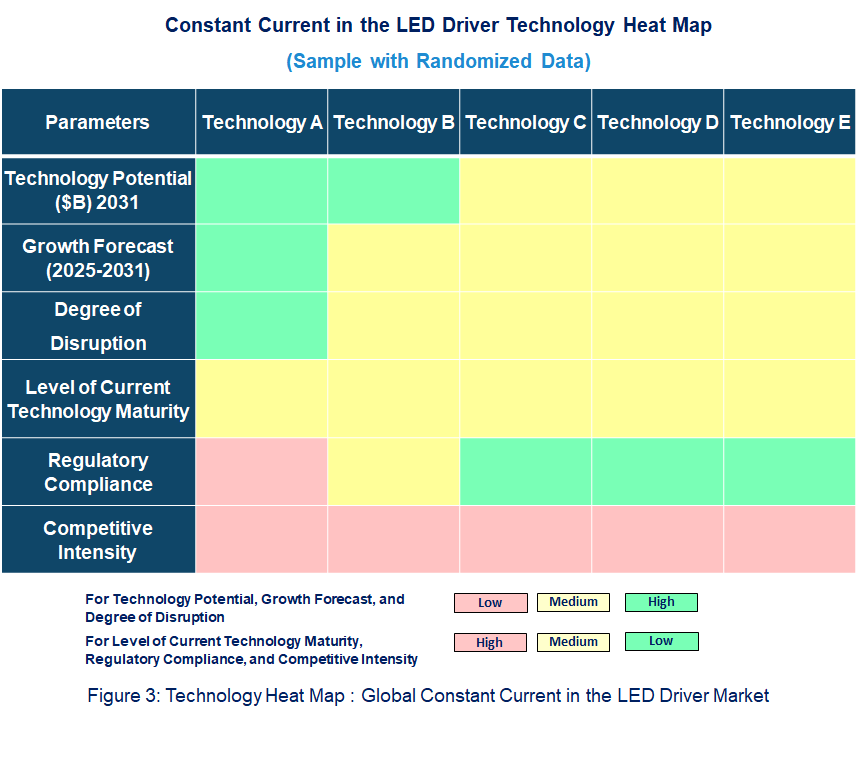
• Technology Potential: The potential in constant current in the LED driver technology is enormous, given its ability to power LED-based lighting systems efficiently and reliably. This technology has the potential to support the shift toward more sustainable, energy-efficient solutions, becoming an essential part of advancements in smart and connected lighting ecosystems.
• Degree of Disruption: The degree of disruption is significant, as it drives innovations such as digital control integration, adaptive dimming, and wireless connectivity, improving the flexibility and performance of lighting systems.
• Level of Current Technology Maturity: The maturity of constant current in the LED driver technology is high, with applications already implemented in more commercial and industrial environments than can be counted. Digital control, wireless communication, and adaptive dimming have evolved enough to move beyond the experimental stage and are now widely deployed. This maturity enables the integration of high-quality and reliable LED drivers into domestic, commercial, or large industrial settings.
• Regulatory Compliance: Constant Current LED Driver technology must meet strict regulatory compliance regarding safety, electromagnetic compatibility, and energy efficiency standards. Compliance ensures that products meet international regulations, such as IEC and UL standards, to operate safely and minimize environmental impact. Meeting these regulations ensures safety and performance and encourages innovations in devices that adhere to environmental and health standards.
• Wolfspeed: Wolfspeed has been a leader in wide-bandgap semiconductors and has advanced silicon carbide (SiC) technology in LED driver solutions. It increases power density and efficiency, enabling LED drivers to operate with more current while minimizing energy loss and heat generation. This enhances the reliability and performance of LED drivers in industrial and high-performance applications.
• General Electric (GE): General Electric has led the integration of smart control features into its LED driver technology. With the application of digital control and adaptive dimming, GE is enabling precise lighting solutions that optimize energy usage and adapt to changing conditions. This allows the LED drivers to be implemented in residential, commercial, and industrial settings, thereby furthering energy savings and enhancing user experiences.
• Macroblock: Macroblock has developed advanced LED driver ICs that support dynamic dimming and color control. Their technology is pivotal for applications requiring precise lighting and color adjustments, such as LED displays and architectural lighting. The advancements made by Macroblock in adaptive control help improve the visual quality and flexibility of lighting systems, making them ideal for specialized applications.
• Koninklijke Philips: Koninklijke Philips has been integrating wireless connectivity features, such as Zigbee and Bluetooth, into its LED driver products. This development supports the growth of smart and IoT-enabled lighting solutions that can be easily controlled and monitored through mobile applications and smart home systems. Philips’ efforts are pushing the market toward more connected and user-friendly lighting experiences.
• Lutron Electronics: Lutron Electronics has focused on advancing dimming technologies and energy efficiency in LED drivers. Their innovations include adaptive dimming, which alters light output based on both user preferences and ambient conditions. Enhancing the performance of LED drivers contributes to more sustainable lighting systems and stimulates energy savings, which are important for both residential and business settings. The latest developments from major players have transformed constant current LED driver technology, steering the market toward improved efficiency, smart integrations, and enhanced application performance.
• Advancements in Energy Efficiency: Continuous improvement in energy efficiency is one of the significant drivers of the Constant Current LED Driver market. High-efficiency drivers are known to reduce energy consumption, decrease operational costs, and contribute to global sustainability objectives. They appeal to consumers and industries focused on carbon footprint reduction and adherence to energy conservation regulations.
• Integration with Smart Lighting Systems: Integration of smart lighting systems with LED drivers offers control, flexibility, and functionality. Remotely manageable technologies and adaptability are transforming the concept of home and commercial lighting, creating space for market growth and improving user experience.
• Increasing Demand for Sustainable Solutions: The global focus on sustainability is driving demand for energy-efficient products. LED drivers that align with eco-friendly initiatives help reduce environmental impact and meet regulatory standards, contributing to the market’s expansion as consumers and industries move toward greener practices. Challenges Impacting the Market
• High Initial Cost of Advanced Technology: The high initial cost of advanced LED driver technology is a challenge to wide-scale adoption. Although long-term savings are significant, the upfront investment could be a barrier for small and medium-sized enterprises, impacting overall market growth.
• Complex Regulatory Compliance: Enforcing stringent safety, electromagnetic compatibility, and energy efficiency regulations on manufacturers can be challenging. Meeting international standards set by governing bodies for research and development to maintain compliance is expensive, inhibiting innovation and market expansion. Major drivers, such as improvements in energy efficiency, smart integration, and sustainability, are shaping the constant current LED driver technology market through growth and innovation. However, issues like high initial costs and complex regulatory requirements must be dealt with. These factors must be managed for sustainable market growth and uptake.
• Wolfspeed
• General Electric
• Macroblock
• Koninklijke Philips
• Lutron Electronics
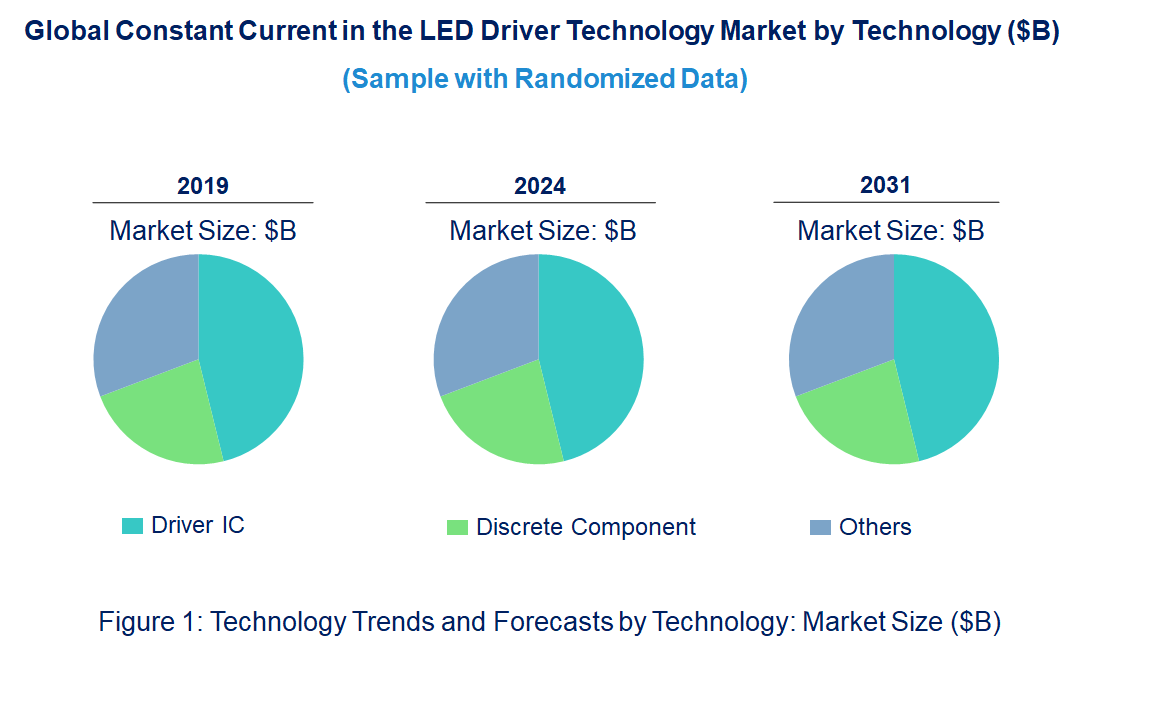
• Technology Readiness: Driver ICs are highly mature, with wide deployments in smart lighting and LED driver systems, allowing for advanced functionalities such as adaptive dimming and wireless communication. Discrete components are also well-established and used in various applications such as simple lighting circuits and power regulation. They offer reliability but lack advanced functionalities. Other technologies, including power management ICs and hybrid solutions, are becoming increasingly ready for commercial use, supporting innovations such as integrated sensors and higher energy efficiency. Driver ICs are essential for high-performance applications, from residential smart bulbs to industrial LED installations, given their ability to support complex, energy-saving functions. For simpler applications where basic performance is sufficient, discrete components are used in home and commercial settings.
• Competitive Intensity and Regulatory Compliance: Constant current in the LED Driver ICs has very high competitive intensity due to fast technological progress and the requirement for differentiation in smart and efficient lighting systems. Discrete components face moderate competition since their application remains critical but less innovative than ICs. Other technologies, such as integrated power management ICs, have competitive markets but are still developing. Regulations for all types are stringent, with driver ICs facing stricter standards for safety, electromagnetic compatibility, and energy efficiency. Discrete components face these regulations, but the complexity of compliance is often lower compared to integrated technologies. Newer technologies need to meet high environmental and performance standards to align with global sustainability goals. Regulatory compliance can be an entry barrier for the manufacturing industry, especially for smaller manufacturers, impacting the speed of innovation.
• Disruption Potential: Driver ICs are highly disruptive due to their enabling role in complex features such as adaptive dimming, digital control, and wireless connectivity, which facilitate smart lighting integration. Discrete components, being mature and reliable, cannot offer advanced functionalities and are thus not as disruptive. Other technologies also exist that improve energy efficiency and miniaturization, enabling market shifts in various aspects. The innovation in driver ICs allows for compact, high-performance solutions that meet changing consumer expectations for smart, energy-efficient lighting. As competition increases, these driver ICs are setting new industry standards for performance and integration.
• Driver IC
• Discrete Component
• Others
• Consumer Electronics
• Lighting
• Automotive
• Outdoor Displays
• North America
• Europe
• Asia Pacific
• The Rest of the World
• Latest Developments and Innovations in the Constant Current in the LED Driver Technologies
• Companies / Ecosystems
• Strategic Opportunities by Technology Type


Choose a license that fits your team. Instant PDF delivery.
Prices exclude taxes. Instant delivery. Custom licensing available on request.
Market Report · May 18, 2026
Market Report · May 18, 2026
Market Report · May 18, 2026
Trusted partner for strategic intelligence and business growth


Receive a complimentary market analysis tailored to your industry. Our analysts will identify key growth opportunities and competitive dynamics specific to your business.

Market size, growth rate, and key trend analysis for your specific sector.

Top competitor positioning and market share analysis.

Strategic recommendations backed by data-driven insights.
Get curated market intelligence and competitive moves straight to your inbox.
By subscribing, you agree to receive our monthly insights. Unsubscribe anytime.
Receive a complimentary market analysis tailored to your industry. Our analysts will identify key growth opportunities and competitive dynamics specific to your business.
Market size, growth rate, and key trend analysis for your specific sector.
Top competitor positioning and market share analysis.
Strategic recommendations backed by data-driven insights.
Get curated market intelligence, emerging trends, and competitive moves straight to your inbox each month.
By subscribing, you agree to receive our monthly insights. Unsubscribe anytime.
We'll send your sample report shortly.