
Market Report · July 15, 2026

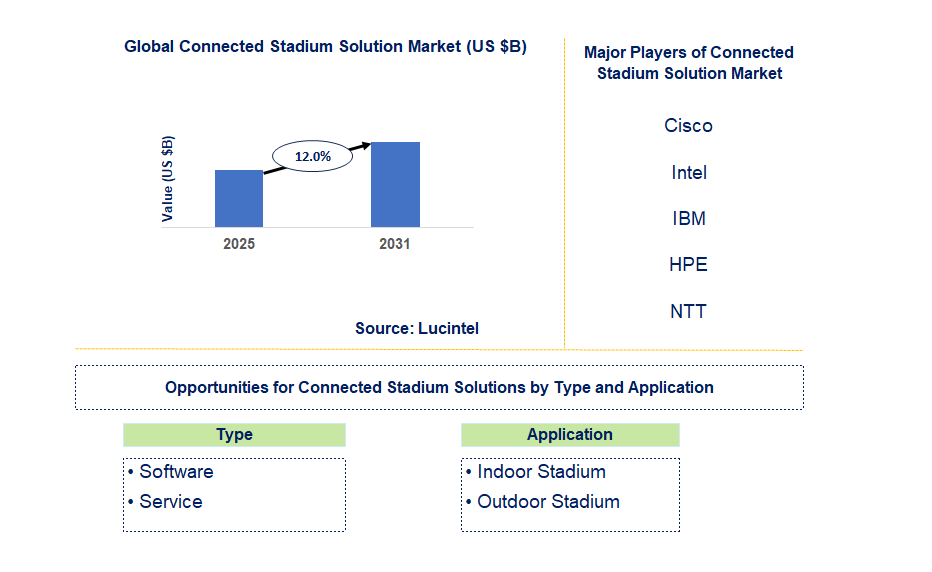
Key data points: The growth forecast = 12.0% annually for the next 7 years. Scroll below to get more insights. This market report covers trends, opportunities and forecasts in connected stadium solution market to 2031 by type (software and service), application (indoor stadium and outdoor stadium), and region (North America, Europe, Asia Pacific, and the Rest of the World)
We'll send your sample report shortly.
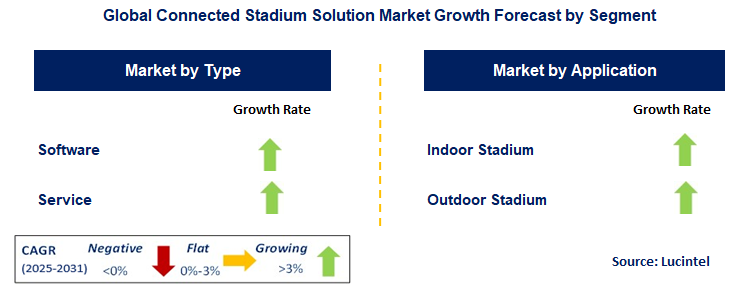
• Lucintel forecasts that, within the type category, software is expected to witness higher growth over the forecast period.
• Within the application category, indoor stadium is expected to witness higher growth.
• In terms of region, APAC is expected to witness the highest growth over the forecast period. Gain valuable insights for your business decisions with our comprehensive 150+ page report. Sample figures with some insights are shown below.
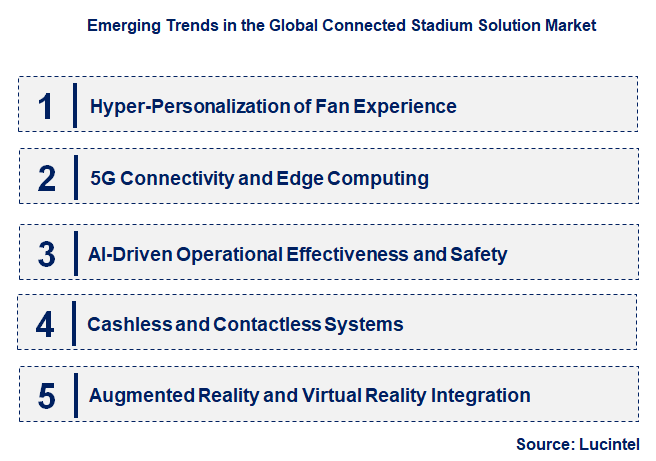
• Hyper-Personalization of Fan Experience: The trend entails utilizing data analytics and artificial intelligence to provide personalized content, offers, and services to individual fans. This entails personalized push notifications, in-app content customized as per preferences, and targeted advertising. The effect is greatly enhanced fan engagement and satisfaction, increased loyalty towards teams and venues, along with new streams of revenue through highly effective, one-to-one marketing and promotional campaigns.
• 5G Connectivity and Edge Computing: 5G network deployment in stadiums is a key trend, providing ultra-fast speeds, low latency, and high levels of device connectivity. Edge computing augments this by processing data nearer to where it’s created, cutting out lag. The result is unbroken streaming of high-quality content, real-time augmented reality experiences, efficient crowd management, and instant in-seat ordering, revolutionizing the live experience and enabling data-intensive operational systems.
• AI-Driven Operational Effectiveness and Safety: Artificial intelligence is finding applications in predictive maintenance of stadium facilities, energy optimization, and security. AI-based video analytics aid crowd monitoring, anomaly detection, and emergency response. The effect is lower operational expenses, enhanced safety for spectators and personnel, and optimized resource allocation, enabling seamless event delivery and minimizing potential risks.
• Cashless and Contactless Systems: The use of cashless payments, digital tickets, and contactless concession stands is increasing, led by convenience and cleanliness reasons. It encompasses mobile ordering apps and tap-to-pay systems. The impact is shorter queues, quicker transactions, and an improved fan experience, reducing physical contact and speeding up operations, resulting in higher customer satisfaction and revenue growth through quicker service.
• Augmented Reality and Virtual Reality Integration: AR and VR technologies are being combined to provide immersive fan experiences, including virtual tours of the stadium, real-time on-field player statistics overlays, and interactive replays seen through personal devices. The effect is a more interactive and vibrant fan experience, competing with home entertainment, drawing more fans, and presenting opportunities for unique sponsorships, with added educational and interactive content. These new trends are, in essence, revolutionizing the connected stadium solution marketplace by compelling venues to evolve as advanced digital ecosystems. The focus on hyper-personalization, dense 5G connectivity, AI-powered efficiency, contactless ease, and immersive AR/VR experiences is revolutionizing the live event experience. This transformation makes stadiums vibrant entertainment hubs that are more engaging for fans and more operationally optimized than ever before.
• Pervasive 5G Network Rollouts: One of the key advancements is the mass deployment of 5G networks across stadiums all over the world. This low-latency, high-bandwidth connectivity is a precursor to numerous other smart stadium capabilities. The effect is a radical transformation in real-time data exchange, supporting smooth streaming, instant information access for spectators, and facilitating leading-edge applications such as AR/VR and real-time crowd analytics, radically boosting the overall connected experience.
• Developments in Digital Access and Ticketing: Recent innovations involve the near-universal acceptance of mobile-first digital access and ticketing products and sophisticated access control systems, commonly linked with facial recognition or QR code scanning. The effect is decreased lines, increased security through verifiable digital identities, and enhanced operational effectiveness. It also enables more precise collection of data on attendance and fan travel patterns within the venue.
• Expansion of In-Seat Ordering and Delivery Solutions: Several stadiums have introduced or developed in-seat food, drink, and merchandise ordering systems through mobile applications, usually in conjunction with delivery options. The effects include greatly enhanced convenience to spectators, decreased concession lines, and additional opportunities for revenue at the venue through expanded ease of purchasing during an event without disturbing the live experience.
• Deployment of AI-Powered Security and Crowd Management: One of the major developments is the growing application of AI-powered video analytics and IoT sensors for real-time crowd surveillance, predictive analytics for potential bottlenecks, and automated alerts for security. The effect is improved public safety through early detection of possible threats, optimized crowd flow management, and quick response capabilities for emergency situations, providing a safer environment for everyone present.
• Immersive Content Consumption through AR/VR and Large LED Screens: Stadiums are making significant investments in enormous LED video boards, ribbon boards, and integrated augmented reality experiences delivered through fan apps. These include live statistics overlays, instant replays with multiple-camera angles, and interactive games. The result is a more dynamic and interactive visual experience for fans, supplementing the live action and generating a more memorable and shareable event, leading to repeat attendance. These advancements are significantly influencing the connected stadium solution space by turning stadiums into advanced technological centers that focus on fan experience, operational effectiveness, and security. The intersection of high-speed connectivity, smart automation, and immersive digital content is revolutionizing the value proposition of live event attendance, making stadiums competitive and desirable venues in the changing entertainment industry.
• Improved Fan Engagement Platforms: The biggest opportunity for growth lies in creating integrated platforms offering customized fan experiences. These include mobile apps with in-seat ordering, interactive venue maps, customized content, gamification, and social media tie-ins. The effect is greater fan loyalty, longer dwell times, and new monetization opportunities through targeted advertising and premium digital content, turning passive viewers into active contributors.
• Advanced Crowd Management and Security Systems: The increasing need for public safety at high-density events is a significant growth prospect. Options consist of video monitoring using AI, predictive analysis of crowd movement, aerial security using drones, and central emergency response systems. The result is greatly enhanced safety and security measures, faster response time, and streamlined operational efficiency for security officers, promoting safety for everyone attending the event.
• Intelligent Concessions and Retail Solutions: Maximizing food, beverage, and merchandise sales presents a high-growth opportunity. This includes launching autonomous checkout stores, mobile delivery and order services, real-time demand-based dynamic pricing models, and tailored promotions. The effect is minimized wait times, higher sales volume via convenience, and enhanced fan satisfaction, directly increasing revenue for venues and adding to the overall fan experience.
• Business Intelligence and Data Analytics: Taking advantage of the huge volumes of data created within a connected stadium (for example, fan travel, buying behavior, app usage) is a large growth opportunity. Solutions are all about delivering actionable insights to venue management, marketing, and sponsorship. The effect is maximized operating tactics, smarter marketing campaigns, enhanced fan preference insight, and the capacity to attract and retain high-value sponsors based on value propositions informed by data.
• Venue Monetization via Digital Signage and Experiential Spaces: Converting static promotion to dynamic, interactive digital signage and developing immersive experiential spaces (i.e., AR/VR experiences, interactive fan walls) provides tremendous growth. These platforms may be rented to sponsors for targeted efforts or employed to create direct revenue. The effect is diverse revenue streams for stadiums outside ticket sales, greater brand exposure for partners, and a more interactive atmosphere for supporters that facilitates extended visits and higher expenditure. These strategic growth prospects are deeply influencing the connected stadium solution market by spearheading the development of holistic, data-centric ecosystems. The emphasis on improving fan experience, strengthening security, optimizing operations, and unlocking new revenue sources is compelling venues to embrace an integrated technology strategy. This multi-faceted growth is making stadiums competitive and desirable entertainment hubs, delivering unmatched value to attendees and stakeholders alike.
• Cisco
• Intel
• IBM
• HPE
• NTT
• Johnson Controls
• Infosys
• Corning
• Evertz
• Ucopia
• Software
• Service
• Indoor Stadium
• Outdoor Stadium
• North America
• Europe
• Asia Pacific
• The Rest of the World
• United States: The United States market is a frontrunner in connected stadium solutions, with significant investments in 5G and high-density Wi-Fi infrastructure. Current advancements are centered on fan engagement through mobile applications for in-seat ordering, personalized content, and augmented reality experiences. There is strong support as well for embedding advanced surveillance and crowd management systems, which are usually driven by AI, to provide security and ease of operations for mass events.
• China: The Chinese networked stadium industry is growing at an exponential pace, driven by government-supported sports efforts and massive technological leaps. Major developments include widespread rollout of 5G networks, large-scale adoption of facial recognition for access control and payments, and IoT applications for smart facility management. There is considerable emphasis on digital content management and immersive fan experiences, frequently drawing on domestic tech majors for end-to-end solutions.
• Germany: Germany focuses on sustainability and operational performance in its networked stadium solutions. New developments involve the installation of fully contactless entry systems, efficient energy management by smart lighting and HVAC, and highly advanced building automation systems. German stadiums are directing their attention to secure and resilient network infrastructures, with an emerging trend towards personalized digital services for improved fan experience at the expense of data security.
• India: The Indian connected stadium industry is in a nascent but fast-growing stage, stimulated by growing investments in sports infrastructure and an emerging sports culture. Developments are centered on enhancing fundamental connectivity through high-density Wi-Fi and the deployment of digital ticketing and payment systems. There is a high focus on using technology to efficiently handle large crowds and improve the overall fan experience at a more affordable cost.
• Japan: The connected stadium economy in Japan is one of state-of-the-art technology and attention to minimizing friction in the user experience, partially driven by major global sporting events. Some recent developments include advanced facial recognition for admission, very interactive mobile apps providing real-time data and AR overlays, and sophisticated digital signage. Precision, dependability, and providing an extremely immersive and convenient experience for audience members are the priorities.


• Cisco
• Intel
• IBM
• HPE
• NTT
• Johnson Controls
• Infosys
• Corning
• Evertz
• Ucopia Q5. Which connected stadium solution market segment will be the largest in future? Answer: Lucintel forecasts that, within the type category, software is expected to witness higher growth over the forecast period. Q6. In connected stadium solution market, which region is expected to be the largest in next 5 years? Answer: In terms of region, APAC is expected to witness the highest growth over the forecast period. Q7. Do we receive customization in this report? Answer: Yes, Lucintel provides 10% customization without any additional cost.


Choose a license that fits your team. Instant PDF delivery.
Prices exclude taxes. Instant delivery. Custom licensing available on request.
Market Report · July 15, 2026
Market Report · June 26, 2026
Market Report · June 24, 2026
Trusted partner for strategic intelligence and business growth


Receive a complimentary market analysis tailored to your industry. Our analysts will identify key growth opportunities and competitive dynamics specific to your business.

Market size, growth rate, and key trend analysis for your specific sector.

Top competitor positioning and market share analysis.

Strategic recommendations backed by data-driven insights.
Get curated market intelligence and competitive moves straight to your inbox.
By subscribing, you agree to receive our monthly insights. Unsubscribe anytime.
Receive a complimentary market analysis tailored to your industry. Our analysts will identify key growth opportunities and competitive dynamics specific to your business.
Market size, growth rate, and key trend analysis for your specific sector.
Top competitor positioning and market share analysis.
Strategic recommendations backed by data-driven insights.
Get curated market intelligence, emerging trends, and competitive moves straight to your inbox each month.
By subscribing, you agree to receive our monthly insights. Unsubscribe anytime.
We'll send your sample report shortly.