
Market Report · July 15, 2026

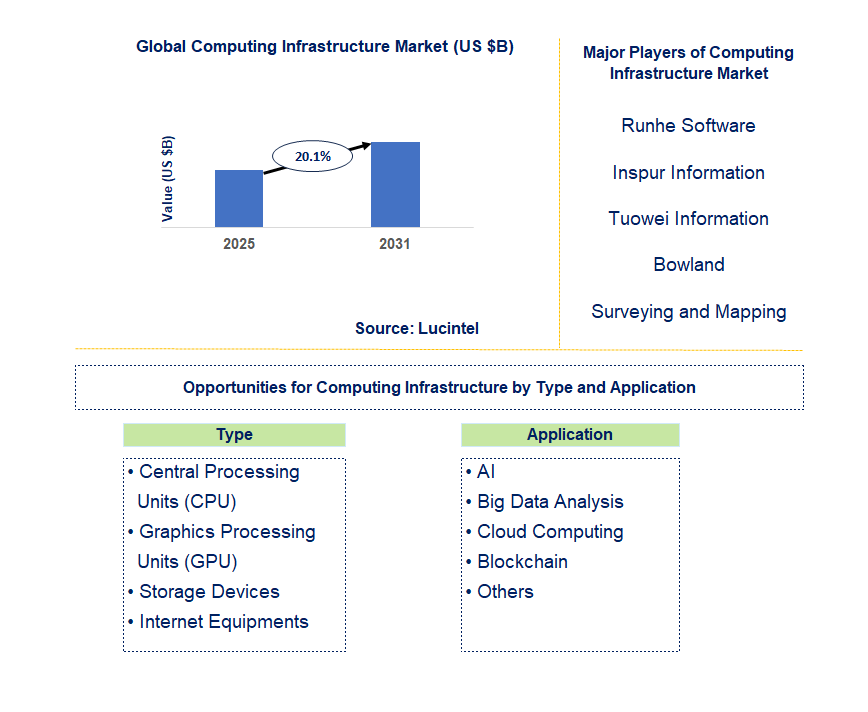
Key data points: The growth forecast = 20.1% annually for the next 7 years. Scroll below to get more insights. This market report covers Trends, opportunity and forecast in computing infrastructure market to 2031 by type (central processing unit (CPU), graphics processing unit (GPU), storage device, and internet equipment), application (AI, big data analysis, cloud computing, blockchain, and others), and region (North America, Europe, Asia Pacific, and the Rest of the World)
We'll send your sample report shortly.
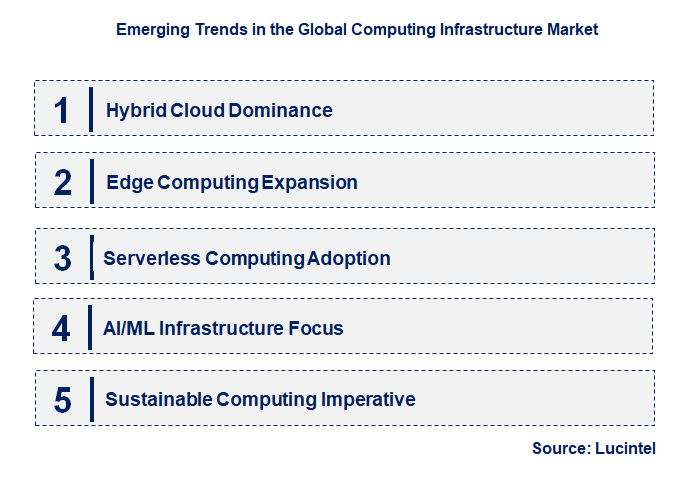
• Hybrid Cloud Dominance: Hybrid cloud, combining on-premises infrastructure with public cloud services, is becoming the dominant IT strategy. Organizations are seeking the flexibility to run workloads in the most appropriate environment, balancing cost, security, and performance. This trend is driving demand for solutions that enable seamless integration and management across hybrid environments. The impact is improved agility, cost optimization, and enhanced control over sensitive data.
• Edge Computing Expansion: Edge computing, processing data closer to the source, is rapidly expanding. Driven by IoT, AI, and real-time applications, edge computing reduces latency, improves bandwidth utilization, and enables new use cases. This trend is driving demand for distributed computing infrastructure and edge-optimized hardware and software. The impact is faster data processing, improved responsiveness, and support for new edge-based applications.
• Serverless Computing Adoption: Serverless computing, where the cloud provider manages the underlying infrastructure, is gaining traction. This model allows developers to focus solely on code, improving agility and reducing operational overhead. This trend drives the adoption of Function-as-a-Service (FaaS) and other serverless technologies. The impact is faster application development, improved scalability, and reduced IT management burden.
• AI/ML Infrastructure Focus: Artificial intelligence and machine learning workloads require specialized computing infrastructure, including GPUs and high-performance networking. Organizations are investing heavily in building AI/ML infrastructure to support training and inference. This trend is driving demand for specialized hardware and software platforms. The impact is accelerated AI innovation, faster model training, and enhanced AI-powered applications.
• Sustainable Computing Imperative: With increasing concerns about environmental impact, sustainable computing is becoming a priority. Organizations are seeking energy-efficient hardware, optimizing resource utilization, and adopting green cloud practices. This trend is driving demand for energy-efficient data centers and sustainable IT solutions. The impact is reduced carbon footprint, lower energy costs, and enhanced corporate social responsibility. These trends are collectively reshaping the computing infrastructure market, creating a more dynamic and competitive landscape. Organizations are embracing new technologies to improve agility, reduce costs, and support their digital transformation initiatives. The future of computing lies in the ability to adapt to these changes and leverage the power of new technologies in a sustainable and responsible manner.
• AI Supercomputers and Power Needs: The advent of AI supercomputers has resulted in record power usage levels. This growth is driven by the rising complexity and size of AI models, which require enormous computational power. Firms such as OpenAI and Nvidia are investing billions in AI infrastructure, highlighting the economic importance of such machines. However, the growth in computational power is not accompanied by similar improvements in energy efficiency. As a result, technology companies are exploring alternative sources of energy, such as nuclear power, to meet these demands.
• Expansion of Edge Computing: Edge computing is emerging as a solution to process data near its source, reducing latency and bandwidth usage. By 2025, more than 75 percent of data generated by enterprises will be generated and processed at the edge, rather than in centralized data centers. This is especially valuable for industries that require real-time data processing, including healthcare, manufacturing, and transportation. Edge computing provides increased performance, lower data transfer costs, and enhanced security by limiting data exposure during transmission.
• Green Data Centers and Green Practices: The environmental footprint of data centers is encouraging a shift toward greener practices. Green data centers use energy-efficient technologies, renewable energy sources, and advanced cooling mechanisms to reduce their carbon footprint. Power Usage Effectiveness (PUE) and Carbon Usage Effectiveness (CUE) are being used to measure and enhance energy efficiency. Companies are also exploring the use of low-power servers and modular data centers to further promote sustainability. Investments in green data center technologies are expected to increase, indicating the sector’s commitment to environmental responsibility.
• Adoption of AIOps for IT Operations: Artificial Intelligence for IT Operations (AIOps) is transforming how organizations manage complex IT systems. By using machine learning and big data analytics, AIOps platforms can automatically identify, diagnose, and resolve issues in real time. This automation improves operational efficiency, reduces downtime, and enables IT staff to focus on strategic initiatives. As IT infrastructures become more complex, the adoption of AIOps is becoming essential for ensuring system reliability and performance.
• Shift to Multi-Cloud Environments: Firms are increasingly adopting multi-cloud models to take advantage of the best features offered by different cloud service providers. This approach offers more flexibility, cost-effectiveness, and improved disaster recovery capabilities. By distributing workloads across multiple clouds, companies can avoid vendor lock-in and tailor cloud solutions to specific needs. The multi-cloud model also enhances resilience, ensuring continuity of services even if one provider experiences issues. The market for computing infrastructure is changing at a fast pace, driven by the growing demands of AI, real-time data processing, and environmental considerations. The convergence of edge computing, green practices, AIOps, and multi-cloud strategies is transforming the way organizations deploy and manage their IT infrastructure. These trends are not only boosting performance and efficiency but also addressing key challenges related to energy consumption and system complexity, paving the way for a more sustainable and adaptable future.
• AI/ML Workloads: The rapid growth of AI and machine learning is creating a surge in demand for specialized computing infrastructure. Growth opportunities exist in providing optimized hardware and software platforms for training and deploying AI models, including GPUs, FPGAs, and AI-specific cloud services. The impact is accelerated AI innovation, faster model training, and enhanced AI-powered applications across various industries.
• Edge Computing Deployments: The rise of edge computing, driven by IoT and real-time applications, presents significant growth opportunities. Demand is increasing for distributed computing infrastructure, edge servers, and edge-optimized software solutions. The impact is reduced latency, improved bandwidth utilization, and enabling new edge-based applications and services, such as smart cities and industrial automation.
• High-Performance Computing (HPC): Scientific research, financial modeling, and other computationally intensive workloads require high-performance computing infrastructure. Growth opportunities exist in providing powerful servers, high-speed networking, and specialized software for HPC applications. The impact is faster scientific discoveries, improved research and development, and enhanced computational capabilities for various industries.
• Data Analytics and Business Intelligence: Organizations are increasingly relying on data analytics and business intelligence to gain insights from their data. This creates growth opportunities for providing scalable and efficient infrastructure for data storage, processing, and analysis, including data lakes, data warehouses, and analytics platforms. The impact is improved decision-making, enhanced business insights, and new revenue opportunities.
• Cloud-Native Application Development: The shift towards cloud-native application development, using microservices and containers, is driving demand for cloud-native infrastructure and platforms. Growth opportunities exist in providing container orchestration platforms, serverless computing services, and other cloud-native tools. The impact is faster application development cycles, improved scalability, and enhanced agility for organizations. These growth opportunities are significantly impacting the computing infrastructure market, driving innovation and investment. Vendors are developing specialized hardware and software solutions to meet the evolving needs of these key application domains. The future of computing infrastructure lies in its ability to support these diverse and demanding workloads, enabling organizations to innovate and compete in the digital age.
• Runhe Software
• Inspur information
• Tuowei Information
• Bowland
• Surveying and mapping shares
• Loongson Zhongke
• Intel Corporation
• NVIDIA Corporation
• Advanced Micro Devices
• Samsung Electronics
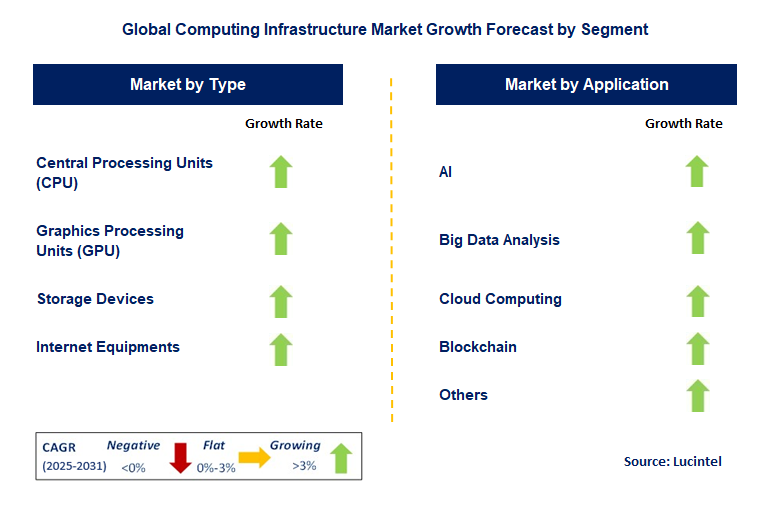
• Central Processing Units (CPU)
• Graphics Processing Units (GPU)
• Storage Devices
• Internet Equipments
• AI
• Big Data Analysis
• Cloud Computing
• Blockchain
• Others
• North America
• Europe
• Asia Pacific
• The Rest of the World
• United States: The US is a mature and highly competitive market for computing infrastructure. Recent developments include the dominance of hyperscale cloud providers like AWS, Azure, and Google Cloud, who are continuously expanding their data center footprints. There is also a strong focus on hybrid cloud solutions, with many organizations adopting a combination of public cloud and on-premises infrastructure. Furthermore, the US market is witnessing significant investment in edge computing infrastructure to support IoT and other latency-sensitive applications.
• China: The Chinese computing infrastructure market is characterized by rapid growth and innovation. Domestic cloud providers like Alibaba Cloud and Tencent Cloud are expanding their market share, competing with global players. The Chinese government is also heavily investing in developing a national cloud infrastructure. Furthermore, a strong focus on AI and high-performance computing drives demand for specialized hardware and advanced data center technologies.
• Germany: The German computing infrastructure market is driven by its strong industrial sector and focus on data privacy and security. German businesses are increasingly adopting hybrid cloud strategies, seeking to balance the benefits of public cloud with the security and control of on-premises infrastructure. There is also a growing emphasis on edge computing to support Industry 4.0 initiatives and other industrial applications.
• India: The Indian computing infrastructure market is experiencing rapid growth, driven by the country's expanding digital economy and increasing adoption of cloud computing. Both global and domestic cloud providers are investing heavily in building data centers in India. There is also a significant focus on providing affordable computing solutions to small and medium-sized businesses.
• Japan: The Japanese computing infrastructure market is characterized by a strong focus on reliability and quality. Japanese businesses are known for their meticulous approach to IT infrastructure, placing a high value on stability and security. Recent developments include the increasing adoption of hybrid cloud and multi-cloud strategies and a growing interest in serverless computing and other cloud-native technologies.


• Runhe Software
• Inspur information
• Tuowei Information
• Bowland
• Surveying and mapping shares
• Loongson Zhongke
• Intel Corporation
• NVIDIA Corporation
• Advanced Micro Devices
• Samsung Electronics Q5. Which computing infrastructure market segment will be the largest in future? Answer: Lucintel forecasts that the central processing unit is expected to witness the highest growth over the forecast period. Q6. In computing infrastructure market, which region is expected to be the largest in next 5 years? Answer: APAC is expected to witness the highest growth over the forecast period. Q7. Do we receive customization in this report? Answer: Yes, Lucintel provides 10% customization without any additional cost.


Choose a license that fits your team. Instant PDF delivery.
Prices exclude taxes. Instant delivery. Custom licensing available on request.
Market Report · July 15, 2026
Market Report · June 26, 2026
Market Report · June 24, 2026
Trusted partner for strategic intelligence and business growth


Receive a complimentary market analysis tailored to your industry. Our analysts will identify key growth opportunities and competitive dynamics specific to your business.

Market size, growth rate, and key trend analysis for your specific sector.

Top competitor positioning and market share analysis.

Strategic recommendations backed by data-driven insights.
Get curated market intelligence and competitive moves straight to your inbox.
By subscribing, you agree to receive our monthly insights. Unsubscribe anytime.
Receive a complimentary market analysis tailored to your industry. Our analysts will identify key growth opportunities and competitive dynamics specific to your business.
Market size, growth rate, and key trend analysis for your specific sector.
Top competitor positioning and market share analysis.
Strategic recommendations backed by data-driven insights.
Get curated market intelligence, emerging trends, and competitive moves straight to your inbox each month.
By subscribing, you agree to receive our monthly insights. Unsubscribe anytime.
We'll send your sample report shortly.