
Market Report · July 16, 2026

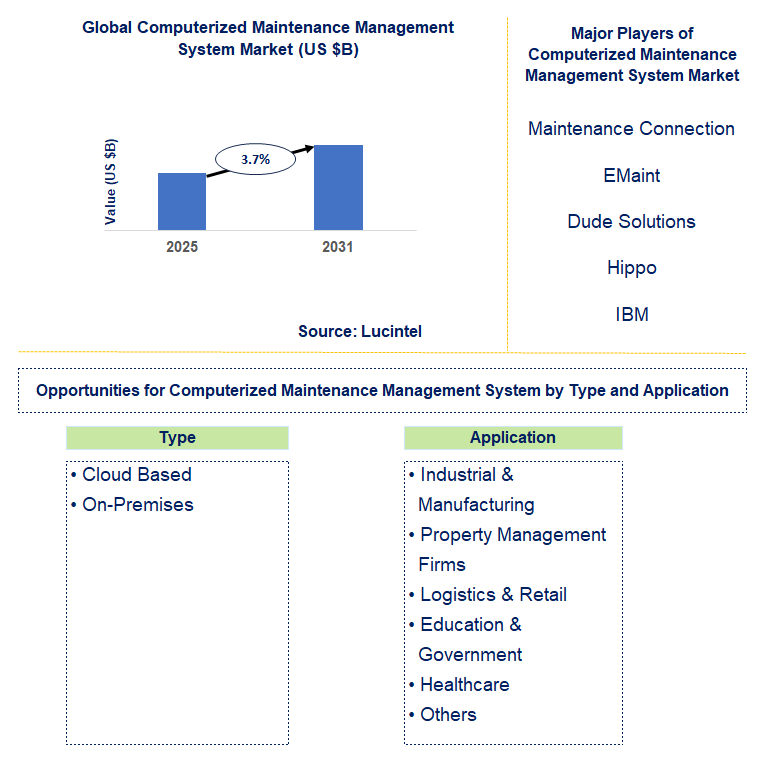
Key data points: The growth forecast = 3.7% annually for the next 7 years. Scroll below to get more insights. This market report covers trends, opportunities and forecasts in computerized maintenance management system market to 2031 by type (cloud based and on-premises), application (industrial & manufacturing, property management firms, logistics & retail, education & government, healthcare, and others), and region (North America, Europe, Asia Pacific, and the Rest of the World)
We'll send your sample report shortly.
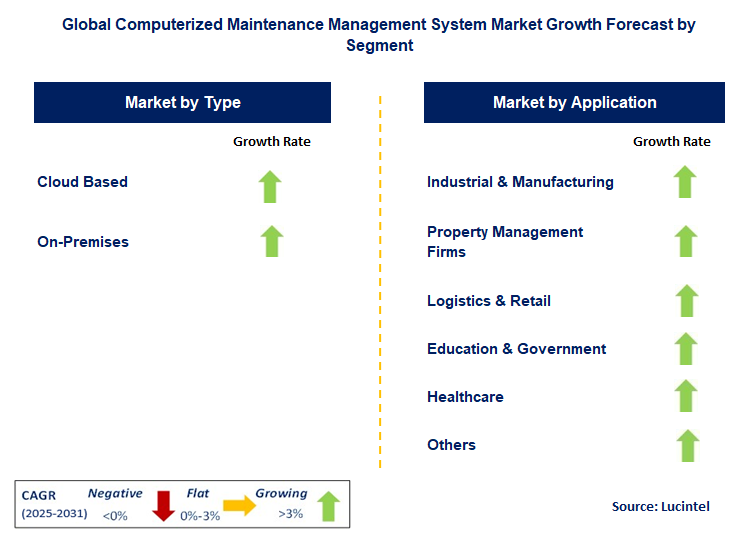
• Lucintel forecasts that, within the type category, cloud based is expected to witness higher growth over the forecast period.
• Within the application category, industrial & manufacturing is expected to witness the highest growth.
• In terms of region, APAC is expected to witness the highest growth over the forecast period. Gain valuable insights for your business decisions with our comprehensive 150+ page report. Sample figures with some insights are shown below.
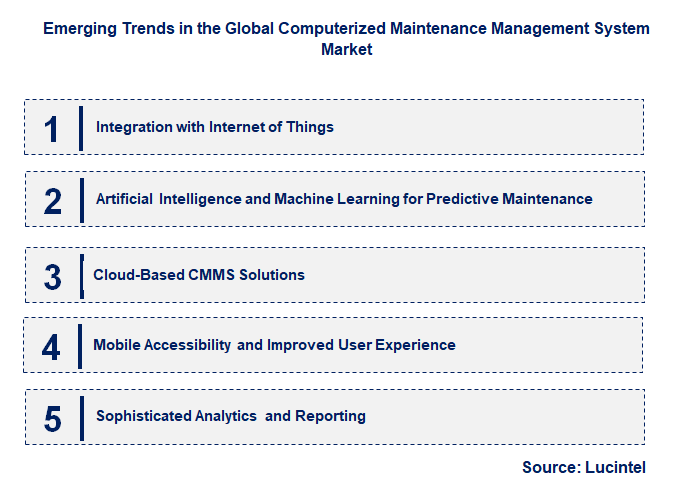
• Integration with Internet of Things: Integration of IoT sensors and devices with CMMS platforms enables the monitoring of equipment performance and environmental conditions in real-time. This integration provides for gathering enormous volumes of data, enabling insights into the health of assets and operating efficiency. For instance, sensors on equipment can report temperature, vibration, and utilization data, which the CMMS analyzes to detect impending problems before they become failure points. In this way, downtime is kept to a minimum, and maintenance schedules are optimized.
• Artificial Intelligence and Machine Learning for Predictive Maintenance: AI and ML algorithms are progressively being added to CMMS to analyze historical data and real-time data, forecasting when the equipment is likely to fail. This helps organizations shift from preventive or reactive maintenance to predictive maintenance, only carrying out maintenance when necessary. For example, AI can spot patterns in sensor readings that foretell a failure and issue a work order automatically and enable maintenance to be done ahead of a breakdown, which saves time and resources.
• Cloud-Based CMMS Solutions: The move towards cloud-based CMMS has several benefits, such as scalability, accessibility, and cost-effectiveness. Cloud platforms do away with huge on-premises IT infrastructure and offer remote access to the system from anywhere, at any time, using different devices. This is especially useful for organizations with multiple locations or field-based maintenance teams. For instance, a technician in a remote site can access work orders, asset history, and manuals using a mobile device connected to the cloud-based CMMS.
• Mobile Accessibility and Improved User Experience: Contemporary CMMS solutions are moving more toward the provision of easy-to-use mobile applications that enable maintenance technicians to view key information, modify work orders, and communicate in real-time remotely. This improves responsiveness and efficiency since technicians can receive tasks, view asset information, and report problems directly via their mobile phones. For example, a technician can fill out an inspection checklist on a tablet and update the CMMS immediately, adding photos or comments regarding any issues discovered.
• Sophisticated Analytics and Reporting: CMMS systems are increasingly providing more advanced analytics and reporting features. These features allow organizations to better understand their maintenance operations, asset performance, and cost trends. Customizable dashboards and reports can assist in finding areas of improvement, improving resource utilization, and making informed decisions based on data. For instance, a CMMS may be able to create a report of the aggregate downtime of each asset over a period of time, enabling managers to locate inefficient machinery and assign maintenance efforts accordingly. Collectively, these trends are transforming the CMMS market such that it becomes more proactive, efficient, and data-driven. The convergence of cutting-edge technologies such as IoT and AI is making predictive maintenance practices possible that reduce downtime and prolong asset life. Cloud-based and mobile-enabled capabilities are enhancing flexibility and communication. Advanced analytics are offering actionable insights for enhanced decision-making. As these trends gain further strength, the computerized maintenance management system market will likely witness even more innovative products that optimize the maintenance process even further.
• Increased Integration Features: Another important development is the growing emphasis on integration of CMMS with other enterprise systems like Enterprise Resource Planning (ERP), Enterprise Asset Management (EAM), and Supervisory Control and Data Acquisition (SCADA) systems. This integration delivers an end-to-end understanding of operations, enabling improved data flow and informed decision-making between departments. For instance, combined with ERP, CMMS can automate spare part procurement upon initiation of maintenance work orders, simplifying the supply chain and eliminating delays.
• Industry-Specific Solution Development: CMMS vendors are now developing solutions specifically crafted to address the specific needs and regulatory requirements of individual industries like healthcare, manufacturing, oil and gas, and facilities management. These sector-specific platforms may have features and functionality that meet specific challenges and compliance requirements within the sectors. For example, a CMMS for healthcare may have medical equipment maintenance and calibration tracking features that meet healthcare regulations.
• Focus on User Experience and User Interface Design: With an awareness of the need for user adoption and productivity, CMMS providers are spending more time refining the user experience and interface of their software. Contemporary CMMS software contains intuitive dashboards, streamlined workflows, and mobile-friendly capabilities to facilitate easier use for maintenance staff. For instance, a well-developed mobile app can enable technicians to easily access work orders, update status, and capture findings with minimal training.
• Greater Emphasis on Cybersecurity: With the increased dependence on digital systems and the rise in connectivity of IoT devices, cybersecurity is now a significant issue in the CMMS space. Vendors are developing their platforms with additional security features to safeguard sensitive maintenance information and block unauthorized access. This involves deploying strong encryption, access controls, and routine security patches. For instance, CMMS vendors are making their cloud-based software meet strict data privacy and security standards to protect user data.
• Use of Augmented Reality and Virtual Reality for Support in Maintenance: New technologies such as AR and VR are starting to gain entry points in the CMMS industry, especially for training and remote support. AR can offer technicians real-time, hands-on instructions superimposed over their sight of equipment, while VR can be used to replicate maintenance situations for training. For instance, an AR glasses-wearing technician might receive visual guidance and step-by-step instructions for a complex repair process to increase accuracy and minimize errors. These advancements are making a significant difference in the CMMS market by introducing solutions that are more integrated, user-friendly, secure, and able to harness advanced technology. Industry-specific solutions ensure that organizations are able to discover CMMS platforms that exactly align with their operational and regulatory requirements. UX/UI focus contributes to increased user adoption and productivity. Stringent security mechanisms instill confidence and safeguard valuable information. Last but not least, AR/VR integration provides innovative modes of assisting maintenance tasks and training.
• Manufacturing: The manufacturing industry represents a strong opportunity for CMMS growth, fueled by the imperative to maximize production uptime, deal with sophisticated machinery, and meet regulatory requirements. CMMS solutions can assist manufacturers to schedule preventive maintenance, monitor equipment performance, handle work orders effectively, and keep a thorough history of maintenance performed on assets. For instance, a CMMS can be utilized to track the condition of critical production machinery, predict potential failures, and schedule maintenance during planned downtimes, thus minimizing disruptions in the production schedule.
• Healthcare: The healthcare sector is increasingly adopting CMMS to manage the maintenance of critical medical equipment, ensure patient safety, and adhere to harsh regulatory requirements. Growth prospects are in offering CMMS solutions that are capable of monitoring maintenance and calibration of medical equipment, facility maintenance management, and ensuring adherence to standards like HIPAA. For example, a hospital would be able to use a CMMS to automate routine maintenance of life-support equipment, monitor its history, and ensure that it meets all regulatory requirements, thus improving patient safety and operational efficiency.
• Facility Management: Facility managers and property management companies are a large market for CMMS since they have to manage large sets of assets across numerous properties ranging from HVAC equipment to elevators and security systems. Growth prospects encompass providing CMMS solutions that can automate work order management, schedule maintenance on a regular basis, monitor service contracts, and offer insights into the cost of operations of various facilities. For instance, a property management firm can utilize a CMMS to oversee tenant maintenance requests, schedule repairs, monitor service vendor performance, and budget for future maintenance requirements across its portfolio of buildings.
• Transportation and Logistics: The transportation and logistics industry, including fleets of vehicles, railways, and airlines, needs solid CMMS solutions to guarantee the safety and operational effectiveness of their assets. There are opportunities for growth in offering CMMS that have the ability to schedule vehicle maintenance, monitor repair history, monitor the health of transport infrastructure, and check compliance with regulations. For example, an airline can utilize a CMMS to monitor the maintenance of its aircraft fleet, plan for inspections, control parts stock, and ensure all maintenance operations meet the regulations of aviation safety standards.
• Utilities and Energy: The utilities and energy industry, such as power generation, transmission, and distribution, depends on CMMS to keep critical equipment in good condition, avoid power outages, and meet regulatory requirements. Opportunities for growth involve providing CMMS solutions that can track the status of power plants, transmission lines, and power distribution lines, set preventive maintenance, plan outages, and monitor environmental and safety compliance. For instance, a power generating facility can utilize a CMMS to track the operation of turbines and generators, program maintenance in accordance with usage and condition, and monitor environmental permit compliance. These strategic expansion prospects underscore the various applications of CMMS and the chance for vendors to make their solutions available to best suit the individualistic demands of each industry. Through an understanding of the distinct challenges and demands of the respective sectors, CMMS providers can create specialized solutions that create substantial value as well as uptake.
• Maintenance Connection
• EMaint
• Dude Solutions
• Hippo
• IBM
• ServiceChannel
• Fiix
• UpKeep
• Siveco
• IFS
• Cloud Based
• On-Premises
• Industrial & Manufacturing
• Property Management Firms
• Logistics & Retail
• Education & Government
• Healthcare
• Others
• North America
• Europe
• Asia Pacific
• The Rest of the World
• United States: The US CMMS market is witnessing rapid growth due to the growing use of cutting-edge technologies such as AI and IoT for predictive maintenance in major industries such as manufacturing, healthcare, and facilities management. Cloud-based CMMS solutions are picking up great momentum, providing flexibility and affordability, especially for SMEs. Major players are prioritizing the integration of CMMS with other enterprise systems and increasing mobile access for maintenance staff. Regulatory requirements and the necessity to manage assets efficiently are ongoing factors driving market growth.
• China: The CMMS market in China is growing quickly with rising industrialization and the increasing focus on intelligent manufacturing. IoT and AI integration in CMMS is expected to facilitate enhanced monitoring of assets and predictive maintenance across industries. Government policies supporting digitalization and operational effectiveness are also fueling market growth. Increased demand for localized CMMS solutions that address the specific needs and regulatory scenario of Chinese businesses is a trend that is being witnessed.
• Germany: The market for CMMS in Germany is dominated by a high interest in Industry 4.0 and CMMS integration with advanced automation and control systems. Predictive maintenance and real-time monitoring of assets are the major areas of growth. There is a preference for secure and heavily customizable CMMS solutions, often with a heavy emphasis on data security and on-premises deployment for large corporations, though cloud usage is rising as well.
• India: India's CMMS market is observing noteworthy growth as a result of swift industrialization and infrastructure growth. Growing recognition of the advantages of digital maintenance and the presence of affordable cloud-based CMMS solutions are persuading adoption, particularly in SMEs. The healthcare segment is equally a key growth sector with emphasis on efficient management of critical medical infrastructure. The market is drawing both international and domestic CMMS vendors.
• Japan: Japan's CMMS market is transforming with an emphasis on utilizing IoT and AI for better asset management and predictive maintenance, especially in manufacturing and infrastructure industries. There is increased focus on solutions that enhance operational efficiency and prolong the life of aging infrastructure. While traditionally on-premises solutions have been dominant, cloud-based CMMS is picking up pace, providing scalability and flexibility. Integration with current enterprise systems is also a primary trend.


• Maintenance Connection
• EMaint
• Dude Solutions
• Hippo
• IBM
• ServiceChannel
• Fiix
• UpKeep
• Siveco
• IFS Q5. Which computerized maintenance management system market segment will be the largest in future? Answer: Lucintel forecasts that, within the type category, cloud based is expected to witness higher growth over the forecast period. Q6. In computerized maintenance management system market, which region is expected to be the largest in next 5 years? Answer: In terms of region, APAC is expected to witness the highest growth over the forecast period. Q7. Do we receive customization in this report? Answer: Yes, Lucintel provides 10% customization without any additional cost.


Choose a license that fits your team. Instant PDF delivery.
Prices exclude taxes. Instant delivery. Custom licensing available on request.
Market Report · July 16, 2026
Market Report · May 18, 2026
Market Report · May 18, 2026
Trusted partner for strategic intelligence and business growth


Receive a complimentary market analysis tailored to your industry. Our analysts will identify key growth opportunities and competitive dynamics specific to your business.

Market size, growth rate, and key trend analysis for your specific sector.

Top competitor positioning and market share analysis.

Strategic recommendations backed by data-driven insights.
Get curated market intelligence and competitive moves straight to your inbox.
By subscribing, you agree to receive our monthly insights. Unsubscribe anytime.
Receive a complimentary market analysis tailored to your industry. Our analysts will identify key growth opportunities and competitive dynamics specific to your business.
Market size, growth rate, and key trend analysis for your specific sector.
Top competitor positioning and market share analysis.
Strategic recommendations backed by data-driven insights.
Get curated market intelligence, emerging trends, and competitive moves straight to your inbox each month.
By subscribing, you agree to receive our monthly insights. Unsubscribe anytime.
We'll send your sample report shortly.