
Market Report · May 18, 2026

This market report covers trends, opportunities, and forecasts in the global computer & networking osat market to 2031 by packaging technology (wire bond, flip chip, wafer level, and others), application (communication, consumer electronics, automotive, computing and networking, industrial, and others), and region (North America, Europe, Asia Pacific, and the Rest of the World)
We'll send your sample report shortly.
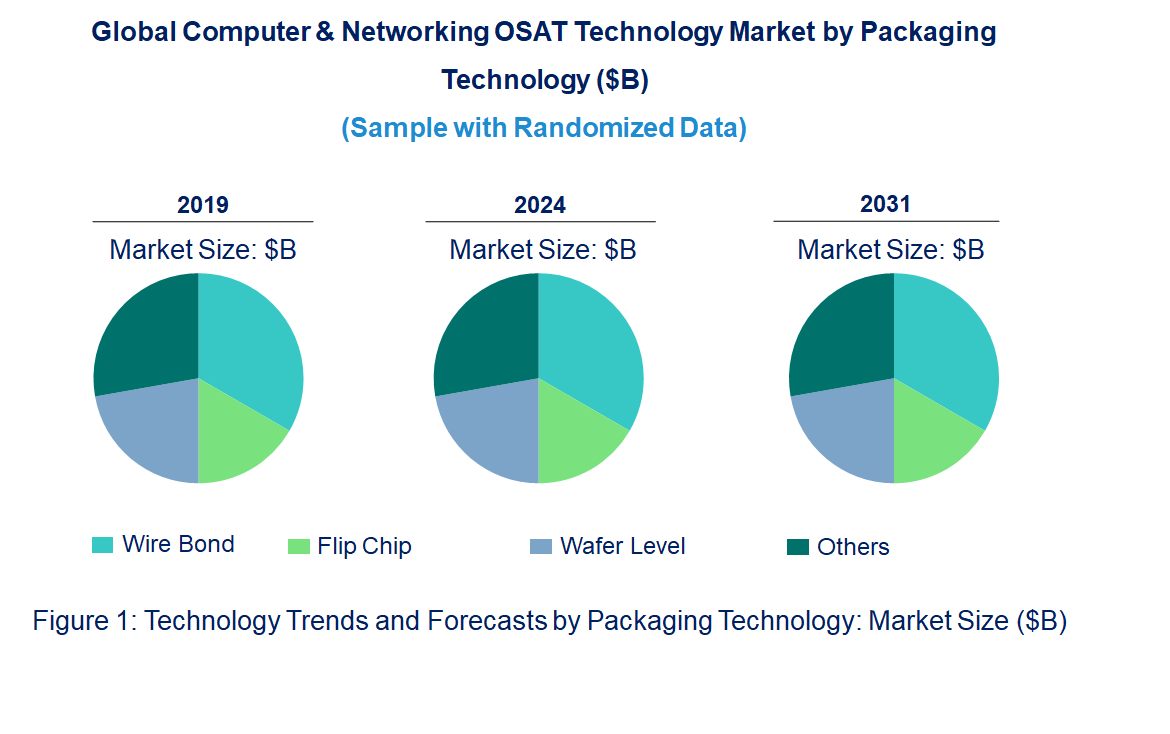
![Computer & Networking OSAT Market Trend and Forecast by Application [Value from 2019 to 2031]:](https://lucintel.com/images/Computer-&-Networking-OSAT-Technology-Market-Segment.png "Computer & Networking OSAT Market Trend and Forecast by Application [Value from 2019 to 2031]:")
• Adoption of Advanced Packaging Technologies: Advanced packaging methods like 3D ICs and system-in-package (SiP) are becoming popular. This technology allows more semiconductor devices to be integrated within a single package, enhancing the performance and reducing power consumption. This trend supports the development of smaller and more powerful devices used in data centers and high-performance computing.
• Integration of Advanced Materials: New materials such as copper and low-k dielectrics are improving the efficiency and performance of OSAT processes. These materials reduce electrical resistance and improve signal integrity, contributing to faster data transfer rates and better energy management in networking and computing devices.
• More emphasis on automation and AI: The integration of automation and AI into assembly and testing has further improved yield, quality, and cost-effectiveness. Automated processes assist in reducing human error while ensuring that the semiconductor component offers high-speed production and superior quality control, thus ensuring reliable performance.
• Growth of 5G and IoT Applications: The expansion of 5G networks and IoT devices has increased demand for OSAT services, mainly those for high-frequency and high-performance semiconductors. OSAT providers are coming up with specialized packaging solutions that serve the specific requirements of 5G and IoT, which include reduced size and enhanced connectivity.
• Sustainability and Eco-Friendly Practices: Sustainability is a growing concern within the OSAT sector, wherein the focus is increasing on greenness and carbon footprints. Producing energy-efficient methods, recycling materials, and developing an environmentally friendly packaging solution are some measures that can help meet international environmental standards as well as meet consumer demands for sustainable products. These trends are shaping the computer & networking OSAT technology by driving innovation in packaging techniques, material innovation, and process automation. More attention is being paid to sustainability practices, and high-demand applications like 5G and IoT are further driving the industry forward. These advancements enable the fulfillment of evolving modern computing and networking infrastructure requirements, ensuring continued growth and technological advancement.
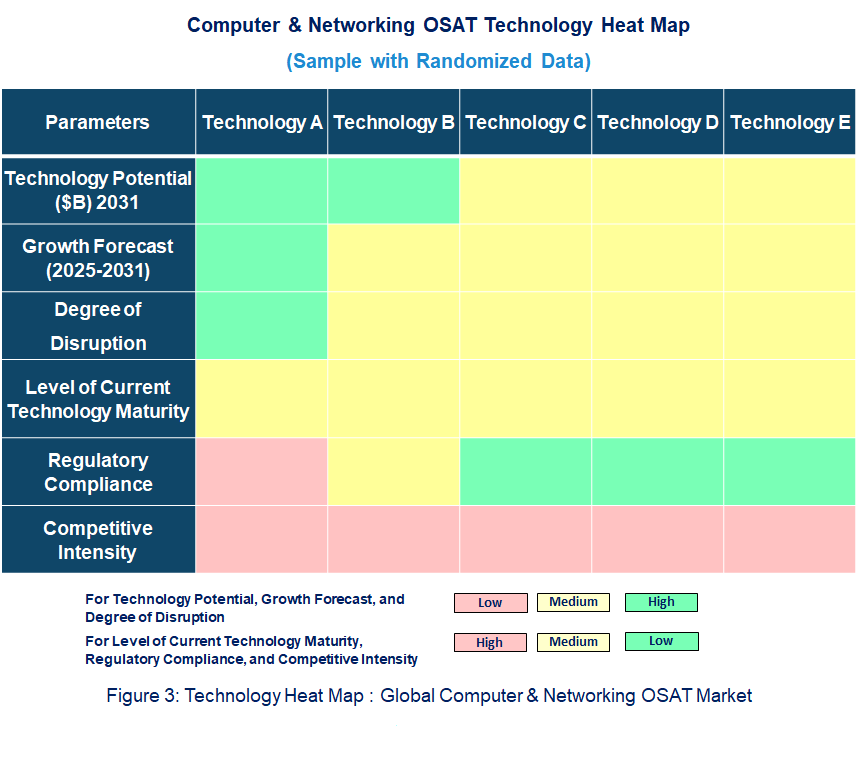
• Technology Potential: OSAT technology holds much promise, mainly in the direction of compact semiconductor solutions of high performance. The techniques of advanced packaging that are disrupting the industry include 3D ICs and system-in-package. These will bring improvements to device performance and integration.
• Degree of Disruption: Advanced devices are needed in data centers, 5G networks, and IoT applications, where the requirements of high speed and power efficiency come into play. This is giving rise to smarter, faster, and more efficient computing devices.
• Maturity of Current Technology Levels: OSAT technologies differ in their level of maturity, depending on the application. While established basic packaging methods exist, more recent technologies such as 3D ICs and advanced SiP are still emerging, but have reached a point of commercialization. In the market, there is investment in research and development that can be seen to continue to mature the advanced technologies.
• Regulatory Compliance: The standards imposed by regulation are rigorous and set on the environment, safety, and performance. A provider of OSAT must align with the regulations issued internationally, known as RoHS and WEEE, to produce on an environmentally-friendly level. Being compliant with these is vital to accessing the market to meet both consumer and environmental expectations.
• Advanced Semiconductor: Advanced Semiconductor has been leading the charge in the advancement of packaging technologies, especially with 3D ICs and system-in-package (SiP) solutions. By creating high-density and multi-layered packaging methods, the company has helped improve data transfer rates and energy efficiency in data centers and other high-performance applications. This has allowed for greater miniaturization and enhanced functionality in electronic devices.
• Amkor Technology: Amkor has furthered its advance packaging capabilities by investing in R&D for high-performance packages that support 5G and IoT applications. Such innovations include flip-chip and wafer-level packaging technologies that improve data processing speed while eliminating signal interference. Further focus on automation and quality control has enhanced the reliability of its production efficiency and output.
• Jiangsu Changjiang Electronics Technology (JCET): JCET has been advancing its capabilities to provide integrated solutions for both consumer and industrial markets. Its innovations in packaging and testing processes have helped to increase production yields and supported the shift to higher-frequency and compact designs required for contemporary communication devices. This has further strengthened their competitive position in the OSAT market.
• Siliconware Precision Industries (SPIL): Siliconware Precision Industries has been expanding its portfolio by launching high-end packaging technologies, such as 2.5D and 3D IC solutions. These new technologies have helped the company to manufacture more efficient semiconductor devices that can support complex processing requirements in next-generation networking equipment. SPIL’s continued research and development of eco-friendly production processes also follows the trend of sustainability around the world.
• PTI (Powertech Technology Inc.): PTI has significantly developed high-performance packaging solutions designed to support the requirements of 5G, AI, and cloud computing. Using innovative technologies such as fan-out wafer-level packaging (FO-WLP), PTI has emerged as a leader in flexible, scalable solutions to meet the growing demand for high-speed, high-bandwidth applications. Their focus on enhancing the reliability and efficiency of their processes has further strengthened their market position. These recent developments emphasize the collective push of the industry towards better, more efficient, and sustainable packaging solutions. Leading players are innovating to capitalize on the surge in demand for next-gen computing and networking technologies, transforming the Computer & Networking OSAT landscape.
• Increasing Need for Advanced Packaging Solutions: Need is increasing in high-performance computing and networking equipment. The new high-technology packages like 3D ICs and system-in package enable these characteristics to enhance speed, improve efficiency, and miniaturization. The trend has already caused OSAT companies to capitalize on more market share using an advanced and customized packaging approach.
• Technological Developments in Automation: The integration of automation and AI into assembly and testing processes has improved the production efficiency and reliability. Automation will reduce human error, yield improvement, and streamlines quality control, which is allowing OSAT providers to achieve higher volume and quality that market demands. This trend also supports scalability and cost efficiency.
• Growth of 5G and IoT Applications: The demand for OSAT services is being driven by the expansion of 5G networks and IoT devices. These applications require specialized packaging technologies that can handle higher frequencies and performance needs. This has encouraged OSAT companies to innovate and adapt their services to cater to these next-gen technologies, making them crucial players in the connectivity market. Challenges
• Challenges of Technological Complexity: The rapid adoption of advanced packaging solutions has increased the complexity in design and manufacturing processes. OSAT companies face challenges in upgrading their facilities and training employees to manage intricate technologies. The need for specialized expertise could create operational inefficiencies that would drive up production costs and reduce profitability.
• Compliance with Regulations and Environmental Requirements: Stricter environmental and safety laws like RoHS and WEEE standards impose stringent requirements on OSAT manufacturers to comply with them to ensure that the products do not fail the environmental safety criteria of performance. Though it’s essential, this increases cost and requires constant investment into sustainability. The computer & networking OSAT market has significant growth opportunities, largely driven by advanced packaging requirements, technological progress in automation, and the growth of 5G and IoT applications. Companies are then challenged with the high complexity of the technology and the need for regulatory compliance, where constant adaptation and innovation are needed. In this light, these opportunities and challenges reshape the OSAT landscape, which urges companies to enhance their capabilities, adopt sustainability practices, and give due prominence to R&D to remain competitive and respond to emerging market requirements.
• Advanced Semiconductor
• Amkor
• Jiangsu Changjiang Electronics Technology (JCET)
• Siliconware Precision Industries
• PTI
• Technology Readiness: Wire bond technology is a mature technology with a lot of applications in traditional electronics, such as consumer products and automotive applications. Flip chip technology has matured to high readiness and supports applications requiring higher performance, such as mobile devices and servers. Wafer-level packaging, though a newer technology, is gaining traction in areas like IoT, wearables, and high-speed computing due to its miniaturization and performance benefits. Other emerging technologies, such as 3D ICs and SiP, are moving from research to commercial use, supporting applications in advanced computing, high-speed data transmission, and AI. Each of these technologies serves a specific purpose in the wide range of requirements for electronics.
• Competitive Intensity and Regulatory Compliance: The intensity of competition in computer and networking OSAT thesemiconductor assembly technologies is high, with companies competing to provide the most efficient, cost-effective, and scalable solutions. Flip chip and wafer-level solutions are now challenging wire bond technology because they offer greater performance benefits. In all sectors, regulatory compliance is crucial to meet environmental and safety standards. Wire bonding is typically less controlled because of its easier production, whereas flip chips and WLP often need higher compliance in terms of materials and energy efficiency. The complexity of the 3D ICs makes the regulation of such technologies highly complex.
• Disruption Potential: The disruption potential of semiconductor assembly technologies varies significantly. Wire bond technology, though traditional, remains widely used for its cost-effectiveness in lower-performance devices. Flip chip technology has significant disruption potential due to its ability to offer high-density interconnections and enhanced performance, driving advances in mobile and high-speed computing. Wafer-level packaging is especially revolutionary, allowing smaller, more efficient, and faster devices that are needed for next-generation consumer electronics and IoT applications. Other advanced techniques include 3D ICs and system-in-package, providing unprecedented integration, processing power, and energy efficiency. These disruptive technologies are moving the industry toward more sophisticated and compact solutions that push the limits of electronic performance.
• Wire Bond
• Flip Chip
• Wafer Level
• Others
• Communication
• Consumer Electronics
• Automotive
• Computing and Networking
• Industrial
• Others
• North America
• Europe
• Asia Pacific
• The Rest of the World
• Latest Developments and Innovations in the Computer & Networking OSAT Technologies
• Companies / Ecosystems
• Strategic Opportunities by Technology Type


Choose a license that fits your team. Instant PDF delivery.
Prices exclude taxes. Instant delivery. Custom licensing available on request.
Market Report · May 18, 2026
Market Report · May 18, 2026
Market Report · May 18, 2026
Trusted partner for strategic intelligence and business growth


Receive a complimentary market analysis tailored to your industry. Our analysts will identify key growth opportunities and competitive dynamics specific to your business.

Market size, growth rate, and key trend analysis for your specific sector.

Top competitor positioning and market share analysis.

Strategic recommendations backed by data-driven insights.
Get curated market intelligence and competitive moves straight to your inbox.
By subscribing, you agree to receive our monthly insights. Unsubscribe anytime.
Receive a complimentary market analysis tailored to your industry. Our analysts will identify key growth opportunities and competitive dynamics specific to your business.
Market size, growth rate, and key trend analysis for your specific sector.
Top competitor positioning and market share analysis.
Strategic recommendations backed by data-driven insights.
Get curated market intelligence, emerging trends, and competitive moves straight to your inbox each month.
By subscribing, you agree to receive our monthly insights. Unsubscribe anytime.
We'll send your sample report shortly.