
Market Report · May 18, 2026

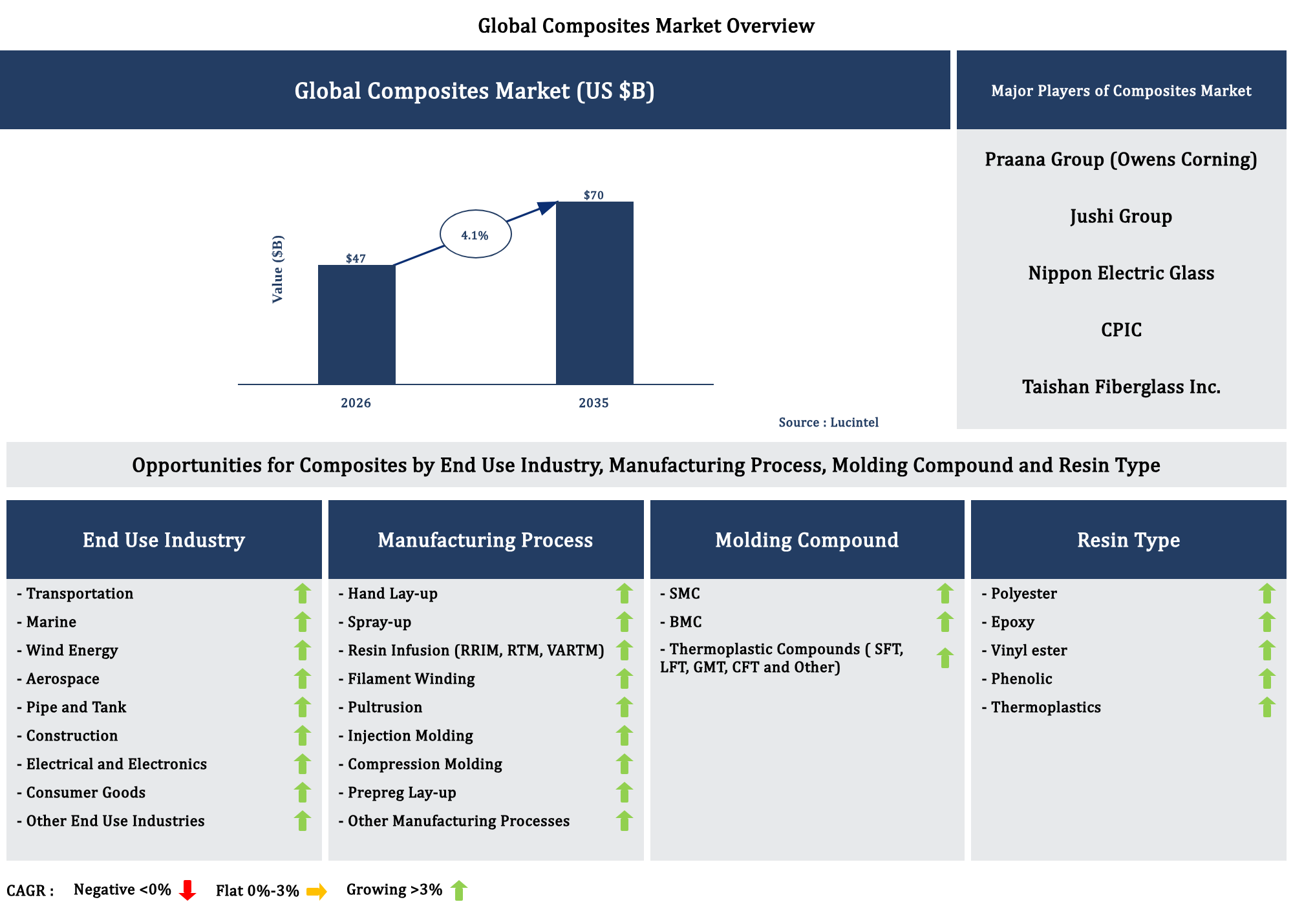
Key data points: Market size in 2026 = $47 billion and 2035 = $70 billion, growth forecast = 4.1% annually for the next 9 years. Scroll below to get more insights. This market report covers trends, opportunities, and forecasts in the global composites market to 2035 by end use industry (transportation, marine, wind energy, aerospace, pipe and tank, construction), manufacturing process (hand lay-up, spray-up, resin infusion (rrim, rtm, vartm), filament winding, pultrusion, injection molding, compression molding, prepreg lay-up), molding compound (smc, bmc and thermoplastic compounds (sft, lft, gmt, cft and other)), resin type (polyester, epoxy, vinyl ester, phenolic and thermoplastics), fiber type (glass fiber, carbon fiber and aramid fiber), fiber glass product form, carbon fiber type, and regions.
We'll send your sample report shortly.
The future of the global composites market looks promising with opportunities in the pan based carbon fiber and pitch based carbon fiber markets. The global composites market is expected to reach an estimated $70 billion by 2035 from $47 billion in 2026 with a CAGR of 4.1% from 2026 to 2035. The major drivers for this market are growing demand in automotive and aerospace sectors for lightweight, high-strength materials drives composites adoption to improve fuel efficiency and reduce emissions, expansion in construction, wind energy, and marine sectors boosts composites use due to corrosion resistance, durability, and long service life and innovations in resin systems, fiber reinforcement, and processes like injection molding and automated layup enhance performance, reduce costs, and expand composites applications.
Gain valuable insights for your business decisions with our comprehensive 150+ page report.
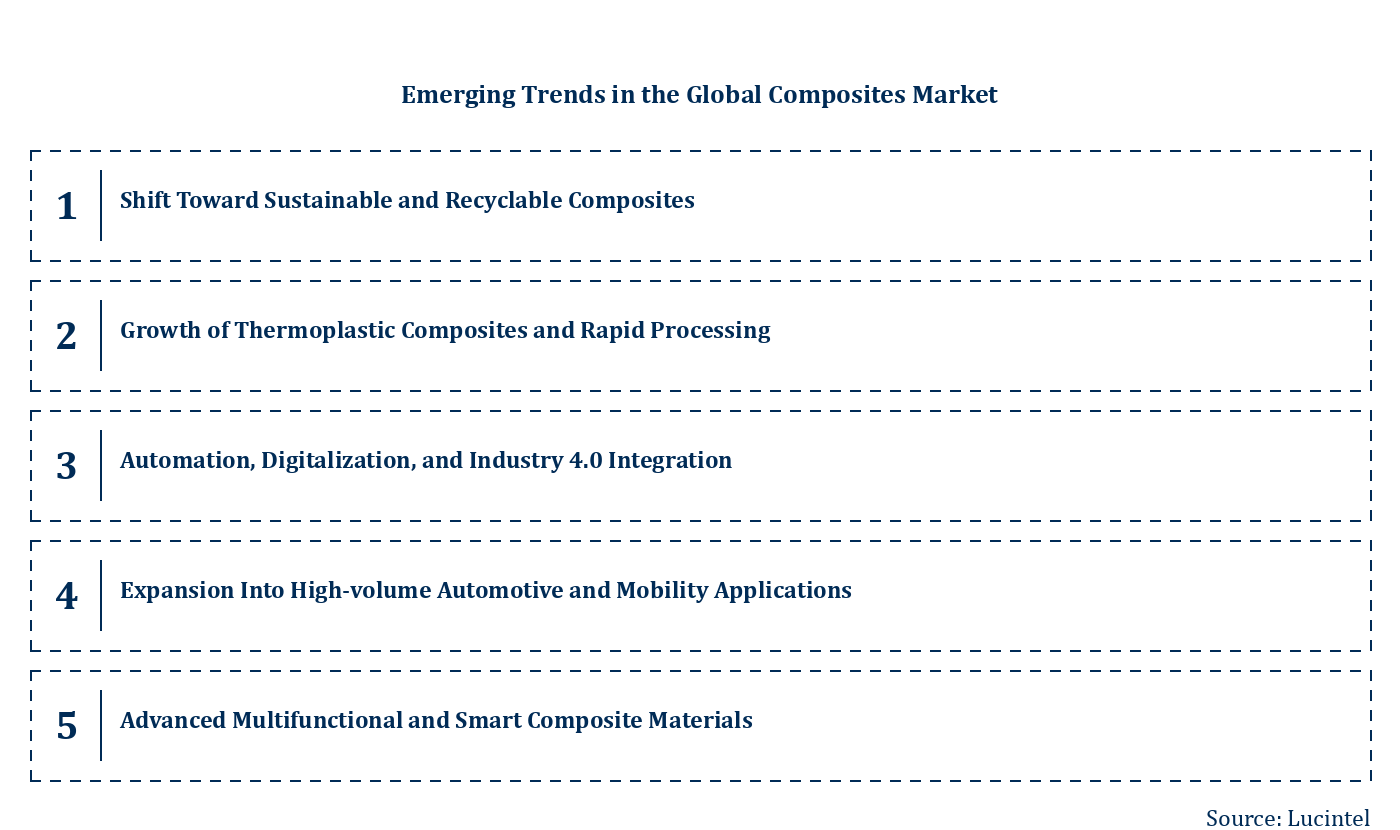
The composites market is evolving rapidly as manufacturers, end users, and regulators seek lighter, stronger, and more sustainable materials across industries. Aerospace, automotive, construction, wind energy, and consumer goods are increasingly specifying advanced composites to meet performance and emissions targets that metals and traditional plastics struggle to achieve. At the same time, digital manufacturing, automation, and new chemistries are reshaping how composites are designed, produced, and recycled. These dynamics are giving rise to new business models, supply chains, and standards. The following emerging trends capture how the composites market is transforming to meet future technical and environmental demands.
The composites market is undergoing a period of accelerated change as manufacturers, end‑use industries, and technology providers pursue lighter, stronger, and more sustainable materials. Advances in resin chemistries, fiber architectures, and automated manufacturing are expanding the performance envelope of composites while lowering production costs and cycle times. At the same time, regulatory pressure and customer expectations are pushing the value chain toward recyclability and reduced carbon footprints. Strategic partnerships, mergers, and capacity expansions are reshaping competitive dynamics across aerospace, automotive, wind energy, construction, and consumer goods. These recent developments are redefining how and where composites are designed, produced, and applied.
The composites market is undergoing robust strategic growth as material innovations, sustainability pressures, and performance demands converge across multiple end-use applications. Advanced composites are increasingly favored for their superior strength-to-weight ratios, corrosion resistance, design flexibility, and lifecycle cost advantages. As manufacturers seek to decarbonize operations and enhance product performance, demand for high-value composite solutions is accelerating in transportation, energy, construction, electronics, and consumer goods. These trends are reshaping value chains, catalyzing investments in automation, recycling, and digital design tools. Companies that align portfolios and partnerships with the most dynamic application segments can unlock outsized growth and long-term competitive differentiation.
The global composites market is shaped by a multifaceted combination of technological progress, shifting end‑use demand, cost dynamics, and evolving regulatory and sustainability expectations. Advancements in fiber reinforcement, resin chemistries, and manufacturing processes are expanding performance capabilities and lowering lifecycle costs, which encourages broader adoption across aerospace, automotive, energy, and construction. At the same time, market growth is influenced by macroeconomic cycles, raw material price volatility, and the need to meet stricter environmental standards. Understanding these drivers and challenges is essential for producers, fabricators, and end users seeking to optimize design choices, supply chains, and investment strategies in the composites ecosystem.
The factors responsible for driving the composites market include:
The challenges in the composites market are:
The global composites market is being propelled by the need for lightweight, high‑performance materials, expanding renewable energy and infrastructure investments, rapid process innovation, and unique design flexibility that enables functional integration. At the same time, widespread adoption is tempered by elevated costs, recycling and sustainability constraints, and the complexity of design, standardization, and talent requirements. These opposing forces create a dynamic landscape where value is unlocked by companies that can demonstrate compelling lifecycle economics, develop sustainable material systems, and streamline engineering and certification. Stakeholders that successfully navigate these drivers and challenges are positioned to capture outsized growth as composites move further into mainstream applications.
Companies in the market compete on the basis of product quality offered. Major players in this market focus on expanding their manufacturing facilities, R&D investments, infrastructural development, and leverage integration opportunities across the value chain. Through these strategies composites market companies cater increasing demand, ensure competitive effectiveness, develop innovative products & technologies, reduce production costs, and expand their customer base. Some of the composites market companies profiled in this report include-
The study includes a forecast for the global composites market by end use industry, manufacturing process, molding compound, resin type, fiber type, fiber glass product form, carbon fiber type, and region.
The global composites market is undergoing rapid transformation as industries seek lightweight, high‑strength, and corrosion‑resistant materials to improve performance and reduce emissions. Advances in carbon fiber, glass fiber, and natural fiber composites are reshaping applications across aerospace, automotive, construction, renewable energy, and electronics. Automation in manufacturing, recycling technologies, and tougher regulatory standards on sustainability are driving innovation. Each major economy is pursuing its own strategy, balancing domestic supply chains, technological leadership, and climate goals. Recent developments in the United States, China, Germany, India, and Japan illustrate how composite materials are becoming central to industrial competitiveness and energy transition.
Lucintel has been in the business of market research and management consulting since 2000 and has published over 1000 market intelligence reports in various markets / applications and served over 1,000 clients worldwide. This study is a culmination of four months of full-time effort performed by Lucintel's analyst team. The analysts used the following sources for the creation and completion of this valuable report:
Extensive research and interviews are conducted across the supply chain of this market to estimate market share, market size, trends, drivers, challenges, and forecasts. Below is a brief summary of the primary interviews that were conducted by job function for this report.

Thus, Lucintel compiles vast amounts of data from numerous sources, validates the integrity of that data, and performs a comprehensive analysis. Lucintel then organizes the data, its findings, and insights into a concise report designed to support the strategic decision-making process. The figure below is a graphical representation of Lucintel's research process.

Choose a license that fits your team. Instant PDF delivery.
Prices exclude taxes. Instant delivery. Custom licensing available on request.
Some of the key composites market companies are as follows:
Market Report · May 18, 2026
Market Report · May 16, 2026
Market Report · May 16, 2026
Trusted partner for strategic intelligence and business growth


Receive a complimentary market analysis tailored to your industry. Our analysts will identify key growth opportunities and competitive dynamics specific to your business.

Market size, growth rate, and key trend analysis for your specific sector.

Top competitor positioning and market share analysis.

Strategic recommendations backed by data-driven insights.
Get curated market intelligence and competitive moves straight to your inbox.
By subscribing, you agree to receive our monthly insights. Unsubscribe anytime.
Receive a complimentary market analysis tailored to your industry. Our analysts will identify key growth opportunities and competitive dynamics specific to your business.
Market size, growth rate, and key trend analysis for your specific sector.
Top competitor positioning and market share analysis.
Strategic recommendations backed by data-driven insights.
Get curated market intelligence, emerging trends, and competitive moves straight to your inbox each month.
By subscribing, you agree to receive our monthly insights. Unsubscribe anytime.
We'll send your sample report shortly.