Composites Market in South Africa

This market report covers trends, opportunities, and forecasts in the composites market in South Africa to 2035 by end use industry (transportation, marine, wind energy, aerospace, pipe and tank, construction, electrical and electronics, consumer goods and other end use industries), manufacturing process (hand lay-up, spray-up, resin infusion (RRIM, RTM, VARTM), filament winding, pultrusion, injection molding, compression molding, prepreg lay-up and other manufacturing processes), molding compound (SMC, BMC and thermoplastic compounds ( SFT, LFT, GMT, CFT and Other)), resin type (polyester, epoxy, vinyl ester, phenolic and thermoplastics), fiber type (glass fiber, carbon fiber and aramid fiber), fiber glass product form (single end roving, multi end roving, ducs, continuous filament mat and yarn) and carbon fiber type (PAN based carbon fiber and PITCH based carbon fiber)

Publisher: Lucintel Published: June 2026
See Pricing

Download Sample Report

| ✨ New Download Sample report — Get instant insights! | ✨ New Download Sample report — Get instant insights!

Composites Market in South Africa

Composites Market in South Africa Trends and Forecast


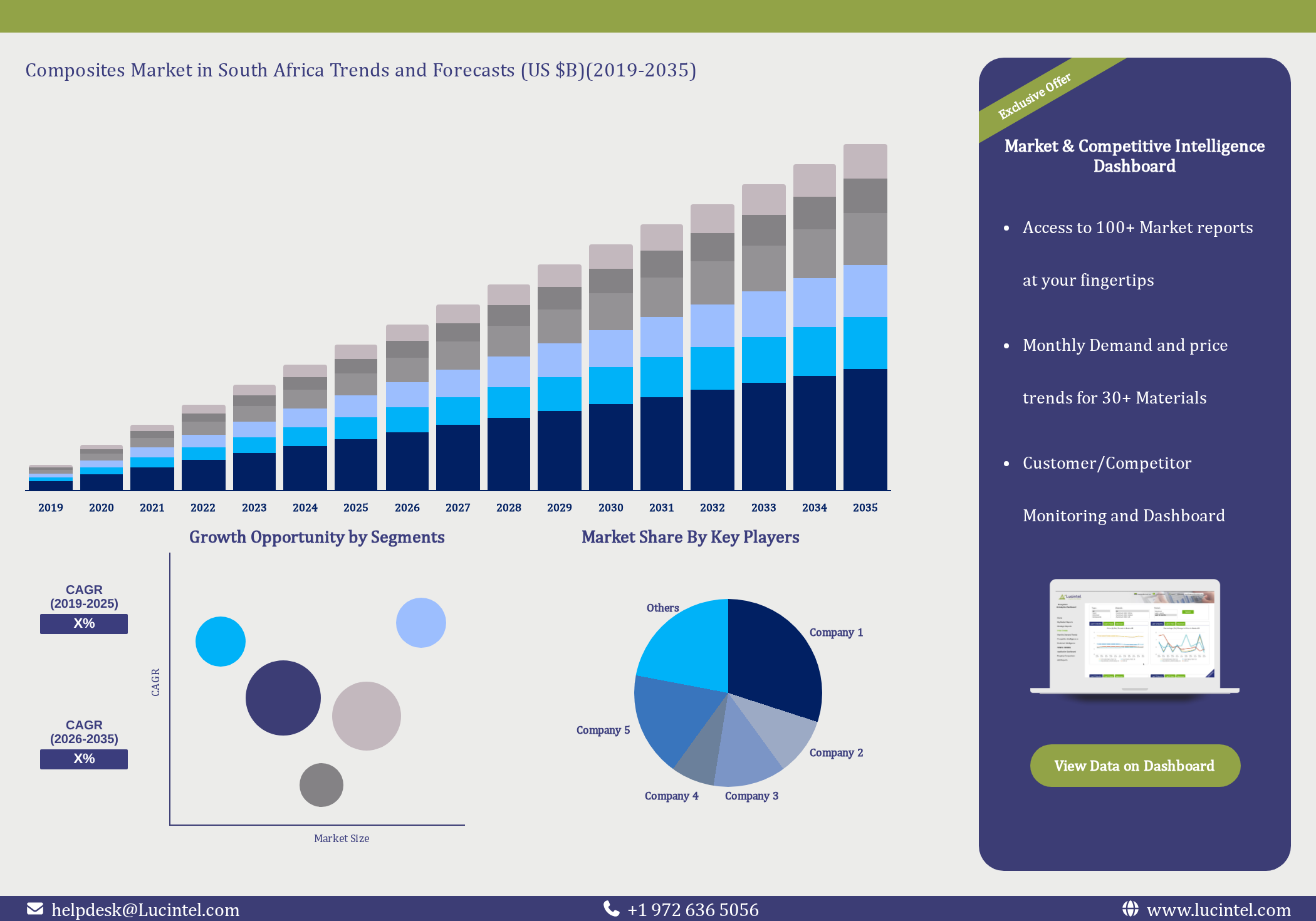
The future of the composites market in South Africa looks promising with opportunities in the PAN based carbon fiber and PITCH based carbon fiber markets. The global composites market is expected to reach an estimated $70 billion by 2035 with a CAGR of 4.1% from 2026 to 2035. The composites market in South Africa is also forecasted to witness strong growth over the forecast period. The major drivers for this market are growing demand in automotive and aerospace sectors for lightweight, high-strength materials drives composites adoption to improve fuel efficiency and reduce emissions, expansion in construction, wind energy, and marine sectors boosts composites use due to corrosion resistance, durability, and long service life and innovations in resin systems, fiber reinforcement, and processes like injection molding and automated layup enhance performance, reduce costs, and expand composites applications.

• Lucintel forecasts that, within the end use industry category, transportation will remain the largest segment over the forecast period as growing demand for lightweight, fuel-efficient, and low emission vehicles is driving composite adoption in transportation. Composites reduce vehicle weight, improve performance to meet stringent emission regulations.

• Within the carbon fiber type category, pAN based carbon fiber will remain the largest segment due to the demand for ultra-lightweight, high-strength materials is driving PAN based carbon fiber growth due to its superior stiffness, fatigue resistance, and high performance-to-weight ratio.
Composites Market in South Africa Trends and Forecast

Emerging Trends in the Composites Market in South Africa

The composites market in South Africa is undergoing rapid transformation as manufacturers, end users, and policymakers seek lighter, stronger, and more sustainable materials. Rising infrastructure investment, automotive localization, and renewable energy deployment are accelerating demand for advanced composite solutions. At the same time, local supply chain constraints, skills gaps, and cost pressures are shaping how innovations are adopted. New applications in transport, construction, and energy are expanding the addressable market, while digital design and automation reshape production processes. Together, these forces are redefining competitiveness and creating new growth pathways in the composites market in South Africa.

  • Growth in Renewable Energy and Wind Blade Applications: The composites market in South Africa is benefitting from renewed momentum in wind and solar projects, where lightweight, fatigue-resistant materials are essential. Wind turbine blades use glass and carbon fibre composites to increase rotor diameter and energy capture while minimizing structural weight. Local fabrication of blades and nacelle components is being explored to improve energy security and cut import costs. This trend deepens the link between composites and South Africa’s decarbonisation agenda, creating opportunities for specialized resins, reinforcements, tooling, and maintenance services.
  • Lightweighting in Automotive and Commercial Transport: Vehicle makers are turning to the composites market in South Africa to meet fuel-efficiency, emissions, and payload targets without sacrificing safety or durability. Glass fibre reinforced plastics are increasingly used for body panels, leaf springs, interior structures, and truck fairings, while higher-end segments pilot carbon fibre parts. Local content rules and regional export aspirations encourage tooling and mould production within South Africa. This shift supports more efficient logistics fleets, extends vehicle life, and opens demand for repair and recycling services tailored to composite-intensive platforms.
  • Adoption of Composites in Infrastructure and Construction: Civil engineers and developers are adopting solutions from the composites market in South Africa to address corrosion, maintenance costs, and lifecycle performance in harsh environments. Fibre-reinforced polymer (FRP) rebar, bridge decks, utility poles, and gratings are gaining favour in coastal, mining, and chemical plant projects where traditional steel degrades quickly. Prefabricated composite elements enable faster installation and reduced downtime on congested sites. As design codes and familiarity improve, composite-intensive structures are expected to expand, supporting local pultrusion, panel fabrication, and engineering design capabilities.
  • Shift Toward Sustainable, Recyclable, and Bio-based Materials: Environmental regulation, corporate ESG commitments, and landfill constraints are pushing the composites market in South Africa toward greener chemistries and circular solutions. Producers are experimenting with bio-based resins, natural fibre reinforcements such as hemp and flax, and recyclable thermoplastic composites for automotive and consumer products. At the same time, businesses are piloting mechanical grinding, co-processing, and chemical recycling routes for end-of-life wind blades and industrial components. These developments align composite use with South Africa’s broader sustainability goals while differentiating local suppliers in export markets.
  • Digitalization and Automation of Composite Manufacturing: To tackle labour intensity, quality variability, and cost, manufacturers in the composites market in South Africa are investing in digital engineering and advanced processing technologies. Tools such as computer-aided design, finite element analysis, and simulation-driven layup optimization shorten development cycles and reduce material wastage. On the factory floor, automated fibre placement, resin infusion, and robotics-assisted trimming improve consistency while enabling higher volumes. Integration of sensors and real-time monitoring supports predictive maintenance and traceability, helping South African producers meet demanding performance and certification requirements in global supply chains.

Recent Developments in the Composites Market in South Africa

The composites market in South Africa is undergoing notable transformation as manufacturers, end users, and policymakers converge around lightweight, durable, and sustainable materials. Growth is being propelled by infrastructure renewal, transport modernization, and the emergence of local value chains linked to global OEMs. Recent developments span bio-based innovations, capacity expansions, new regulatory drivers, and digital manufacturing practices. Together, these shifts are redefining performance benchmarks, cost structures, and competitive dynamics, while creating new opportunities for South African firms to integrate into high-value regional and international supply networks.

  • Expansion of Local Production Capacity: The composites market in South Africa is seeing significant capacity expansion as manufacturers invest in new molding lines, resin infusion systems, and automated layup cells to meet rising demand from construction, automotive, and energy sectors. These investments reduce import dependence, shorten lead times, and improve price competitiveness for local customers. By scaling up production, South African composite fabricators can offer larger, more complex components, attract long-term contracts from OEMs, and support export-oriented projects across the Southern African region, strengthening industrial resilience and employment.
  • Growth of Composites in Renewable Energy Projects: The composites market in South Africa is benefiting from the country’s accelerated deployment of wind and solar power, which requires lightweight, corrosion-resistant materials. Glass- and carbon-fibre composites are increasingly specified for wind turbine blades, nacelle covers, and support structures, as well as for mounting systems and enclosures in solar installations. This trend drives higher volumes, encourages technology transfer from global turbine manufacturers, and stimulates specialized skills development. It also nudges local suppliers to meet strict performance and fatigue standards, positioning them to compete for projects across Africa’s expanding renewable energy corridor.
  • Increased Adoption in Automotive and Rail Lightweighting: The composites market in South Africa is seeing faster adoption in automotive and rail segments, supported by emissions-reduction policies and fuel-efficiency targets. Local vehicle assemblers and railcar manufacturers are specifying composite body panels, interior modules, and structural reinforcements to reduce mass without compromising safety. This shift promotes design innovation, such as integrated multi-function parts and modular assemblies. It also drives collaboration between material suppliers, tooling specialists, and Tier-1 system integrators, enabling South African plants to align with global lightweighting trends and qualify as production hubs for regional export programs.
  • Rising Focus on Bio-Based and Recycled Composites: The composites market in South Africa is increasingly orienting toward bio-based resins and natural fibre reinforcements such as hemp, flax, and sisal, as well as recycled fibre streams from end-of-life components. Universities and research councils are partnering with industry to validate local agricultural fibres for semi-structural applications in construction, furniture, and automotive interiors. This development enhances sustainability credentials, creates new demand for rural biomass, and opens prospects for green public procurement. It also encourages investment in recycling technologies, helping address waste management challenges and aligning South African producers with global ESG benchmarks.
  • Digitalisation and Advanced Manufacturing Integration: The composites market in South Africa is being reshaped by the integration of digital tools such as simulation, digital twins, and automated process monitoring into design and production workflows. Fabricators are adopting CNC cutting, robotic spraying, and automated fibre placement on a selective basis, improving repeatability and reducing scrap. This digitalisation enables faster prototyping for aerospace, defense, and high-performance sport applications, improves traceability for regulated sectors, and supports predictive maintenance of tooling. Collectively, these capabilities raise productivity, attract foreign technology partnerships, and elevate South Africa’s reputation as a capable composites engineering and manufacturing hub.

Strategic Growth Opportunities for Composites Market in South Africa

The composites market in South Africa is entering a pivotal growth phase, supported by industrial diversification, sustainability priorities, and infrastructure modernization. Local manufacturers are increasingly shifting from traditional materials such as steel, aluminum, and concrete toward lighter, stronger composite solutions. Government investments in transport, energy, and housing, combined with global supply chain reconfiguration, are opening new opportunities across end-use applications. Five strategic growth avenues stand out for investors and producers, each offering potential to scale volumes, deepen localization, and enhance South Africa’s competitiveness in regional and global composite value chains.

  • Transportation and Lightweight Mobility: The composites market in South Africa can accelerate growth in road, rail, and bus applications as OEMs seek lighter structures to improve fuel efficiency and meet emissions regulations, driving demand for glass- and carbon-fiber components in body panels, interior parts, and structural elements in passenger vehicles, trucks, and public transport fleets, while localizing production can reduce import dependence, support Tier-2 and Tier-3 suppliers, and position South Africa as a regional export base for composite-intensive mobility platforms.
  • Renewable Energy and Power Infrastructure: Rapid expansion of wind and solar capacity in South Africa is creating sustained demand for composite blades, nacelle covers, spars, cable trays, and structural supports that offer excellent fatigue resistance and corrosion performance, and composite solutions in transmission and distribution infrastructure, including poles, cross-arms, and insulator components, can reduce maintenance costs and improve reliability in harsh coastal and high-UV environments, enabling utilities and independent power producers to extend asset life while contributing to South Africa’s long-term energy transition objectives.
  • Construction, Infrastructure, and Corrosion-Resistant Structures: The composites market in South Africa has strong upside in bridges, pedestrian walkways, marine structures, and chemical plant assets where corrosion and maintenance costs are high, and fiber-reinforced polymer rebars, gratings, cladding panels, and modular structural profiles can offer extended service life and lower lifecycle costs versus steel and concrete, supporting infrastructure upgrades in ports, water treatment plants, mines, and industrial parks, while prefabricated composite building components can accelerate housing projects and improve thermal performance in climate-resilient developments.
  • Mining, Industrial, and Chemical Processing Applications: South Africa’s mining and heavy industrial base represents a high-value niche for advanced composite piping, tanks, chutes, and wear-resistant liners that can handle abrasive slurries, corrosive chemicals, and high-moisture conditions, and composite ventilation ducts, fan blades, platforms, and safety equipment can improve uptime and reduce structural degradation in underground and open-pit mines, enabling operators to lower total cost of ownership, enhance worker safety, and align with stricter environmental and health regulations while stimulating specialized local fabrication capabilities.
  • Aerospace, Defense, and High-Performance Niche Manufacturing: The composites market in South Africa can capture premium growth by supplying advanced composite parts for regional aerospace programs, unmanned aerial vehicles, defense platforms, and sports and recreation products that require high strength-to-weight ratios and precise engineering, and leveraging existing aerospace clusters, research institutions, and qualification facilities can help local firms move up the value chain from basic laminates to certified structural components, promoting technology transfer, skills development, and export-led growth in specialized composite applications across Africa and global niche markets.

Composites Market in South Africa Driver and Challenges

The composites market in South Africa is influenced by a mix of technological, economic, and regulatory dynamics that shape demand across construction, automotive, renewable energy, and aerospace sectors. Advancements in materials science, lightweighting trends, and decarbonization policies are expanding application possibilities, while local industrialization goals encourage domestic production and value addition. At the same time, cost pressures, skills gaps, and standards compliance requirements add layers of complexity. Understanding the main growth drivers and structural challenges is essential for assessing long‑term opportunities and strategic positioning within South Africa’s evolving advanced materials ecosystem.

The factors responsible for driving the composites market in South Africa include:

  • Expansion of Infrastructure and Construction Projects: Rapid urbanization and the need to upgrade aging infrastructure in South Africa support sustained demand for composite materials in bridges, water treatment facilities, transport systems, and commercial real estate. Composites offer corrosion resistance, design flexibility, and long service life, which reduce lifecycle maintenance costs compared to steel or traditional concrete reinforcements. Their superior performance in harsh coastal or industrial environments is particularly valuable for South African ports and mining-related infrastructure. As public and private capital expenditure programs emphasize durability and lower total ownership cost, architects and civil engineers are more inclined to specify composite rebar, panels, and pipes, expanding adoption across the built environment.
  • Growth of Renewable Energy and Decarbonization Initiatives: South Africa’s energy transition, driven by policy incentives and load‑shedding challenges, is accelerating investments in wind and solar power, where composites are critical components. Large wind turbine blades rely heavily on glass and carbon fiber composites to combine light weight with high stiffness and fatigue resistance, enabling larger rotor diameters and better energy capture. In solar, composites are increasingly used in mounting structures, enclosures, and cable trays with strong resistance to UV, corrosion, and temperature cycling. As the country pursues its Just Energy Transition Investment Plan and independent power producers expand capacity, the composites market in South Africa benefits from higher local content requirements, service demands, and opportunities for regional export of composite components.
  • Lightweighting Trends in Automotive and Transportation: The push to improve fuel efficiency, meet emissions standards, and prepare for electric mobility is stimulating composite use in South Africa’s automotive and commercial vehicle industries. Local assemblers and component manufacturers are incorporating glass and carbon fiber reinforced plastics in body panels, structural parts, and interior components to reduce vehicle weight without compromising safety. Lightweight buses, trucks, and rail components also help fleets lower operational costs and comply with tightening environmental regulations. As South Africa seeks to remain a competitive manufacturing hub within global automotive value chains, adoption of advanced materials becomes a differentiator, driving investment in composite design capabilities, tooling, and localized supply of resins and fibers.
  • Growing Demand from Mining, Marine, and Industrial Sectors: South Africa’s mining, chemicals, and marine industries operate in highly corrosive and mechanically demanding environments, making composites attractive for equipment and infrastructure. Applications include acid‑resistant tanks, piping systems, gratings, ventilation ducts, and protective linings that outperform metals in long‑term corrosion resistance. In the marine segment, composite boats, hulls, and offshore structures benefit from reduced maintenance and lower fuel consumption due to lighter weight. Industrial users value the ability to design complex shapes and integrate multiple functions into single composite components. As operators seek to reduce downtime, extend asset life, and comply with stricter health, safety, and environmental standards, demand for engineered composite solutions increases across core South African industrial value chains.
  • Government Industrialization Policies and Localization Incentives: South Africa’s industrial policy, including the focus on advanced manufacturing, localization, and export promotion, supports the development of a domestic composites ecosystem. Initiatives under the Department of Trade, Industry and Competition, special economic zones, and technology support programs encourage investment in composite fabrication, tooling, and research partnerships with universities and science councils. Local content targets in sectors such as rail, renewable energy, and defense create predictable demand for composite components manufactured within the country. These measures attract foreign direct investment, foster technology transfer, and help small and medium‑sized enterprises move up the value chain from basic fabrication to high‑precision, engineered composite systems, reinforcing growth prospects for the composites market in South Africa.

The challenges in the composites market in South Africa are:

  • High Material Costs and Limited Local Raw Material Production: One of the primary barriers to wider adoption of composites in South Africa is the relatively high cost of raw materials such as specialty resins, glass fibers, and carbon fibers, many of which are imported. Exchange rate volatility and logistics costs can significantly raise input prices, making composite solutions less competitive against traditional materials in cost‑sensitive sectors. Local production of precursor materials remains limited, and economies of scale are not yet fully realized. As a result, smaller fabricators face tight margins and may struggle to invest in advanced equipment or quality systems, slowing market penetration in applications where upfront price is the dominant purchasing criterion.
  • Skills Gaps, Technical Know‑how, and Capacity Constraints: The composites market in South Africa is constrained by shortages of specialized skills in design, engineering, and processing of advanced composite systems. Many small and medium‑sized enterprises rely on traditional hand lay‑up techniques and lack expertise in automated processes such as resin transfer molding, pultrusion, and filament winding. Limited access to formal training, certification programs, and industry‑academic collaboration reduces the pace of innovation and adoption of best practices. This skills deficit can lead to inconsistent quality, slower project turnaround, and hesitancy among end‑users to specify composites for mission‑critical infrastructure or structural applications, thereby restraining the market’s full potential.
  • Regulatory Uncertainty, Standards Compliance, and Market Acceptance: Although global standards for composite materials are well established in sectors such as aerospace and automotive, South Africa’s regulatory environment and local standards implementation can be fragmented or slow to evolve. Engineers, insurers, and public authorities may remain cautious about approving composites for structural or safety‑critical uses without clear, locally validated guidelines. Certification processes can be time‑consuming and costly for smaller manufacturers, discouraging them from entering high‑value segments. In addition, end‑user familiarity with traditional materials can create resistance to change, requiring extensive education and demonstration of long‑term performance. These regulatory and perception challenges limit the speed at which the composites market in South Africa can scale into new, higher‑margin applications.

Combined, the growth drivers and structural challenges create a complex but promising outlook for the composites market in South Africa. Infrastructure expansion, renewable energy growth, industrial applications, and supportive industrial policy are steadily increasing demand for advanced composite solutions. However, high input costs, skills shortages, and regulatory hurdles continue to moderate adoption and concentrate opportunities among better‑resourced players. Stakeholders that invest in local raw material supply, workforce development, standards alignment, and end‑user education will be best positioned to unlock sustainable, long‑term value within South Africa’s composites value chain.

List of Composites Market in South Africa Companies

Companies in the market compete on the basis of product quality offered. Major players in this market focus on expanding their manufacturing facilities, R&D investments, infrastructural development, and leverage integration opportunities across the value chain. Through these strategies, composites market companies cater to increasing demand, ensure competitive effectiveness, develop innovative products & technologies, reduce production costs, and expand their customer base. Some of the composites market companies profiled in this report include:

  • Company 1
  • Company 2
  • Company 3
  • Company 4
  • Company 5
  • Company 6
  • Company 7
  • Company 8
  • Company 9
  • Company 10
  • Company 11
  • Company 12
  • Company 13
  • Company 14
  • Company 15
  • Company 16
  • Company 17
  • Company 18
  • Company 19
  • Company 20

Composites Market in South Africa by Segment

The study includes a forecast for the composites market in South Africa by end use industry, manufacturing process, molding compound, resin type, fiber type, fiber glass product form and carbon fiber type.

  • Composites Market in South Africa by End Use Industry [Value ($B) and Volume (Million Pounds) from 2019 to 2035]:
    • Transportation
    • Marine
    • Wind Energy
    • Aerospace
    • Pipe and Tank
    • Construction
    • Electrical and Electronics
    • Consumer Goods
    • Other End Use Industries
  • Composites Market in South Africa by Manufacturing Process [Value ($B) and Volume (Million Pounds) from 2019 to 2035]:
    • Hand Lay-up
    • Spray-up
    • Resin Infusion (RRIM, RTM, VARTM)
    • Filament Winding
    • Pultrusion
    • Injection Molding
    • Compression Molding
    • Prepreg Lay-up
    • Other Manufacturing Processes
  • Composites Market in South Africa by Molding Compound [Value ($B) and Volume (Million Pounds) from 2019 to 2035]:
    • SMC
    • BMC
    • Thermoplastic Compounds ( SFT, LFT, GMT, CFT and Other)
  • Composites Market in South Africa by Resin Type [Value ($B) and Volume (Million Pounds) from 2019 to 2035]:
    • Polyester
    • Epoxy
    • Vinyl ester
    • Phenolic
    • Thermoplastics
  • Composites Market in South Africa by Fiber Type [Value ($B) and Volume (Million Pounds) from 2019 to 2035]:
    • Glass Fiber
    • Carbon Fiber
    • Aramid Fiber
  • Composites Market in South Africa by Fiber Glass Product Form [Value ($B) and Volume (Million Pounds) from 2019 to 2035]:
    • Single End Roving
    • Multi End Roving
    • DUCs
    • Continuous Filament Mat
    • Yarn
  • Composites Market in South Africa by Carbon Fiber Type [Value ($B) and Volume (Million Pounds) from 2019 to 2035]:
    • PAN Based Carbon Fiber
    • PITCH Based Carbon Fiber

Features of the Composites Market

  • Market Size Estimates: Composites market in South Africa size estimation in terms of value ($B).
  • Trend and Forecast Analysis: Market trends and forecasts by various segments.
  • Segmentation Analysis: Composites market in South Africa size by end use industry, manufacturing process, molding compound, resin type, fiber type, fiber glass product form and carbon fiber type in terms of value ($B).
  • Growth Opportunities: Analysis of growth opportunities in different end use industry, manufacturing process, molding compound, resin type, fiber type, fiber glass product form and carbon fiber type for the composites market in South Africa.
  • Strategic Analysis: This includes M&A, new product development, and competitive landscape of the composites market in South Africa.
  • Analysis of competitive intensity of the industry based on Porter’s Five Forces model.

Article

Composites Market in South Africa: How Are Advanced Materials Rewriting Industrial Strategy?

Dallas, June 4, 2026 – The composites market in South Africa is moving from niche engineering material to strategic enabler for the country’s energy, mobility, construction, and technology ambitions. As domestic manufacturers seek lighter, stronger, and more durable solutions, composite materials are reshaping competitive dynamics across sectors ranging from wind energy and rail to telecoms infrastructure and consumer electronics. This article examines the major trends, the sectors most impacted, the challenges and opportunities ahead, and the emerging use cases in the technology industry, alongside recent developments that signal where the market is heading.

What Major Trends Are Redefining the composites market in South Africa?

Several converging shifts are changing how South African companies specify, design, and source composite materials. These shifts reflect both global innovation and local industrial policy priorities, including localization, energy transition, and infrastructure resilience.

  • A key trend is the growing adoption of fiber-reinforced composites in renewable energy and utility infrastructure, particularly in wind turbine blades, solar mounting structures, and corrosion-resistant components for power and water systems.
  • Another trend reshaping the composites market in South Africa is the pivot toward lightweighting in transport and mobility, spanning automotive, commercial vehicles, rail, and aerospace supply chains that are seeking fuel savings and emissions reductions.
  • Design-for-durability in civil and industrial infrastructure is becoming a central theme, with composite rebar, profiles, and panels increasingly used to combat corrosion and extend asset life in harsh coastal and mining environments.
  • Digitalization of materials engineering is emerging, as South African design offices and OEMs adopt simulation tools, digital twins, and advanced testing methodologies to accelerate composite part design and validate performance.
  • Local value chain development, including resin formulation, fiber processing, and component fabrication, is gaining momentum, as policymakers and investors look to reduce import dependence and build export-ready composite capabilities.

Which Sectors Will Feel the Strongest Impact from These Composite Innovations?

The composites market in South Africa is not evolving in isolation; it is tightly intertwined with strategic sectors that underpin growth and job creation. The most pronounced disruption is expected in energy, transportation, construction, and technology-linked manufacturing.

  • Energy and utilities in South Africa will see significant impact as composite materials enable longer-life wind blades, lighter and more resilient transmission structures, and corrosion-resistant components in water treatment and desalination plants.
  • Automotive and commercial vehicle manufacturers in South Africa are beginning to integrate glass fiber and carbon fiber components for body panels, structural elements, and interior modules to reduce weight and improve fuel efficiency.
  • Rail and mass transit infrastructure is increasingly adopting composites for doors, interior panels, roof elements, and track-side structures, supporting noise reduction, safety, and lower maintenance in South Africa’s passenger and freight networks.
  • The construction sector is experiencing disruption as composite rebar, façade systems, bridge decks, and modular panels offer superior performance in corrosive coastal regions and mining hubs across South Africa.
  • Telecommunications and electronics in South Africa are leveraging composites for antenna radomes, telecom tower components, 5G small cell housings, and ruggedized casings that must balance RF performance, weight, and environmental resistance.

How Will These Trends Disrupt Competitive Dynamics Across Industries?

The rise of advanced composites is altering cost structures, supplier relationships, and product strategies in the composites market in South Africa. Companies that adapt quickly can reposition themselves as solution providers rather than commodity suppliers.

  • Traditional materials such as steel and aluminum will face substitution in applications where life-cycle cost, weight, and corrosion resistance matter more than upfront price, pressuring incumbents to innovate or partner with composite specialists.
  • OEMs in South Africa that master composite design and manufacturing will gain differentiation through lighter products, improved durability, and lower maintenance, which can unlock export opportunities into regional African markets.
  • Tiered supply chains will be disrupted as integrated composite manufacturers offer design-to-manufacture services, potentially displacing fragmented networks of small fabricators reliant on legacy processes.
  • Asset owners in energy, transport, and construction will increasingly evaluate projects on total cost of ownership, creating an economic rationale for composite-intensive designs and changing procurement criteria in South Africa.
  • Technology-driven entrants with expertise in simulation, automation, and additive processes will find openings to challenge established materials suppliers, especially where complex geometries and high-performance requirements converge.

What Key Challenges Could Slow the Momentum of the composites market in South Africa?

Despite strong structural drivers, the composites market in South Africa faces practical and strategic barriers that could constrain its trajectory if not addressed through coordinated industry and policy action.

  • High capital expenditure requirements for advanced composite manufacturing, including autoclaves, precision molds, and quality control systems, can deter smaller South African firms from scaling capabilities.
  • Skills shortages in composite engineering, automated lay-up, non-destructive testing, and design-for-composites create execution risk, particularly as demand for complex structural parts grows.
  • Fragmented standards, limited local testing infrastructure, and slow certification processes can delay adoption of composite solutions in regulated sectors such as rail, aerospace, and critical infrastructure.
  • Supply chain vulnerability, especially in imported carbon fibers, specialty resins, and high-performance fabrics, exposes South African manufacturers to currency risk and logistical disruptions.
  • End-of-life management and recycling of composite materials remain underdeveloped in South Africa, raising sustainability concerns and regulatory questions for high-volume applications.

Where Do the Biggest Opportunities Lie for Stakeholders in South Africa?

For investors, industrial groups, and policymakers, the composites market in South Africa presents a portfolio of opportunities that align with national development priorities and emerging export niches.

  • Localization of composite manufacturing for wind turbine blades, tower components, and grid infrastructure offers a pathway to support South Africa’s renewable energy build-out while creating skilled jobs.
  • Development of composite-intensive platforms for buses, truck bodies, and light commercial vehicles can strengthen the local automotive industry as it adapts to emissions regulations and electrification trends.
  • Targeted investment in composite solutions for mining, such as wear-resistant liners, corrosion-proof piping, and lightweight structural components, can unlock productivity and safety benefits.
  • Cross-border export of composite components and systems into Southern African markets, including rail, telecoms, and modular construction, provides a growth corridor for South African manufacturers.
  • Innovation in bio-based resins and natural fiber composites derived from local agricultural feedstocks can position South Africa as a leader in sustainable composite materials tailored to regional conditions.

How Is the Technology Industry Using Composites in South Africa?

The technology ecosystem is a rapidly evolving frontier for the composites market in South Africa, as hardware, connectivity, and advanced manufacturing converge.

  • Electronics and telecom OEMs in South Africa are utilizing composite housings and radomes for 4G and 5G equipment that must be lightweight, weather-resistant, and radio-frequency transparent.
  • Data center and networking infrastructure increasingly rely on composite-based cable trays, structural supports, and cooling system components to optimize space use and reduce corrosion risks.
  • Defense and aerospace-related technology programs in South Africa employ carbon fiber composites for UAV airframes, satellite structures, and radar components, combining low mass with high stiffness.
  • Consumer electronics and wearables are seeing gradual integration of composite back plates, frames, and protective cases that provide impact resistance while keeping devices slim and light.
  • Advanced manufacturing and robotics platforms use composite end-effectors, machine covers, and structural arms to enhance performance, reduce inertia, and improve resistance to chemicals and abrasion in South African factories.

What Recent Developments Signal the Future Direction of the composites market in South Africa?

Recent project announcements, partnerships, and technology deployments provide early indicators of how the composites market in South Africa is likely to evolve over the next few years.

  • New investments in wind and solar projects have prompted supply chain discussions about localized composite blade and structural component manufacturing, with feasibility studies under way for coastal industrial zones.
  • South African rail operators and rolling stock suppliers have initiated programs to retrofit passenger coaches with composite interiors and exterior components to reduce weight and enhance fire performance.
  • Universities and research institutions in South Africa have expanded composite-focused programs, including collaborative labs focused on resin innovation, fatigue testing, and digital simulation of composite structures.
  • Telecom operators and infrastructure providers have begun piloting composite poles, cross-arms, and enclosures designed to withstand harsh weather and vandalism, aimed at improving network uptime in remote regions.
  • Emerging technology startups are experimenting with hybrid composite structures using additive manufacturing, particularly for drones, medical devices, and specialized industrial tools tailored to South African operating conditions.

How Should Businesses Position Themselves as the composites market in South Africa Matures?

Strategic positioning in the composites market in South Africa will require a blend of technology choices, ecosystem partnerships, and long-term capability-building. Companies that treat composites as a core competency rather than a peripheral material category are likely to outperform.

  • Industrial players should embed composite expertise early in product development cycles, linking design engineering with manufacturing partners to optimize performance, cost, and manufacturability.
  • Collaboration across the value chain, including fiber producers, resin formulators, converters, OEMs, and end users, will be essential to scale innovation and accelerate certifications in South Africa.
  • Businesses should align composite strategies with South Africa’s sustainability and localization objectives, emphasizing life-cycle benefits, lower emissions, and potential for local sourcing and recycling.
  • Investment in talent, training, and partnerships with universities and technical institutes will be critical to build a workforce capable of handling advanced composite design, processing, and quality control.
  • Proactive monitoring of regulations, standards, and public procurement policies will help companies anticipate shifts that favor composite solutions in infrastructure, mobility, and renewable energy projects across South Africa.

The composites market in South Africa is entering a decisive phase, where material science, industrial policy, and digital engineering intersect. Stakeholders that move quickly to leverage these trends stand to shape not only their own competitive futures, but also the trajectory of South Africa’s broader industrial transformation.

Top 5 Companies

1. Jushi Group

  • Headquarters: Tongxiang, Zhejiang, China.
  • Website: https.www.jushi-group.com.
  • Total Revenue (2024): Publicly available sources do not provide a confirmed 2024 revenue figure for Jushi Group; only historical approximate ranges are disclosed.
  • Establishment Year: 1993.

Jushi Group is one of the world’s largest producers of fiberglass and glass fiber reinforcements, supplying a broad spectrum of materials that underpin the Composites Market in South Africa. Headquartered in Tongxiang, China and founded in 1993, the company employs many thousands of people across manufacturing bases in China, Egypt, and other regions, and serves customers in more than 100 countries, including South Africa through regional distributors and trading partners. Its product portfolio relevant to the Composites Market in South Africa includes E-glass and ECR-glass rovings, chopped strands, mats, woven roving fabrics, and specialty reinforcements used in pipes and tanks, wind blades, marine, automotive, and building and construction applications. Jushi has expanded its geographic reach into Africa mainly via its large glass fiber plant in Egypt, which improves logistics and lead times for South African converters and OEMs. The company focuses on supply chain reliability, technical service, and cost-competitive high-volume reinforcements that are widely adopted by South African composite manufacturers in corrosion-resistant infrastructure, mining equipment, and transportation components. There are no widely reported recent mergers or acquisitions by Jushi Group that are specifically tied to the Composites Market in South Africa; its strategy in the region has primarily centered on export capacity expansion, local warehousing via partners, and strengthening relationships with South African distributors and fabricators to support growth in fiberglass-based composites.

2. CPIC

  • Headquarters: Chongqing, China.
  • Website: https.www.cpictx.com.
  • Total Revenue (2024): Publicly available sources do not provide a confirmed 2024 revenue figure for CPIC; only historical approximate ranges are disclosed.
  • Establishment Year: 1991.

CPIC (Chongqing Polycomp International Corporation) is a leading global glass fiber manufacturer with a strong presence in industrial and infrastructure applications that are important to the Composites Market in South Africa. Established in 1991 and headquartered in Chongqing, China, CPIC operates multiple production bases in China and internationally, employing several thousand staff across manufacturing, R&D, and commercial operations. For the Composites Market in South Africa, CPIC’s core offerings include E-glass direct rovings, assembled rovings, chopped strands, continuous filament mats, combo mats, and fabrics designed for use in filament-wound pipes, GRP tanks, pultruded profiles, rebar, wind power components, and automotive applications. The company’s corrosion-resistant grades are particularly relevant for South Africa’s mining sector, chemical storage, and water infrastructure projects. CPIC has expanded geographically by building overseas plants in Europe and the Middle East and by leveraging trading hubs that support African markets, enabling shorter delivery times and more consistent supply to South African converters. While there are no widely documented mergers or acquisitions by CPIC that are directly linked to the Composites Market in South Africa, the company has focused on technical cooperation with global resin and sizing suppliers and on enhancing regional distribution networks to serve customers in Southern Africa. Its strategic emphasis on advanced sizing technology, application engineering, and cost-effective reinforcement solutions positions CPIC as a key supplier of fiberglass materials to South African composite manufacturers targeting infrastructure, energy, and transportation growth segments.

3. Taishan Fiberglass Inc.

  • Headquarters: Taian, Shandong, China.
  • Website: https.www.ctgf.com.cn.
  • Total Revenue (2024): Publicly available sources do not provide a confirmed 2024 revenue figure for Taishan Fiberglass Inc.; only historical approximate ranges are disclosed.
  • Establishment Year: 1997.

Taishan Fiberglass Inc. (often referenced as CTG) is a major Chinese manufacturer of glass fiber and related composite reinforcement products that feed into a wide array of applications in the Composites Market in South Africa. Founded in 1997 and headquartered in Taian, Shandong Province, the company is part of China National Building Material Group (CNBM) and employs a large workforce across several production bases, with output exported to numerous countries worldwide including South Africa. Taishan’s product portfolio relevant to the Composites Market in South Africa includes E-glass rovings, chopped strands, stitched fabrics, mats, and high-performance specialty fibers used in wind energy, marine, sports and leisure, and automotive components, as well as in pipes, tanks, and construction panels. South African composite manufacturers source Taishan materials mainly through trading houses and regional distributors, benefiting from a broad range of cost-competitive reinforcement formats tailored for processes such as filament winding, pultrusion, vacuum infusion, and hand lay-up. The company has bolstered its geographic expansion by increasing export capacity, optimizing logistics routes via ports that efficiently serve Southern Africa, and enhancing technical support to international customers, which indirectly strengthens its footprint in South Africa. There are no widely publicized recent mergers or acquisitions directly tied to the Composites Market in South Africa involving Taishan Fiberglass Inc.; its growth strategy has largely emphasized capacity additions, process modernization, and product diversification, including reinforcements for renewable energy and infrastructure, sectors that align closely with South Africa’s ongoing investments in corrosion-resistant, lightweight composite solutions.

4. Toray Industries Inc.

  • Headquarters: Tokyo, Japan.
  • Website: https.www.toray.com.
  • Total Revenue (Fiscal Year 2024): Publicly available sources report Toray Industries Inc.’s consolidated revenue for its latest fiscal year in the low tens of billions of U.S. dollars; an exact 2024 figure can vary by source and exchange rate and is not consistently reported for 2024 alone.
  • Establishment Year: 1926.

Toray Industries Inc. is a diversified Japanese materials company and one of the global leaders in advanced composites, playing an important role as a technology and material supplier to high-performance segments of the Composites Market in South Africa. Established in 1926 and headquartered in Tokyo, Toray employs tens of thousands of people worldwide and operates production and R&D facilities in Asia, Europe, the Americas, and other regions. Toray’s composite-related portfolio relevant to the Composites Market in South Africa includes carbon fiber (Torayca), glass fiber, thermoset and thermoplastic prepregs, resin systems, and molded parts for aerospace, automotive, wind energy, sporting goods, industrial, and pressure vessel applications. South African customers typically access Toray materials through global aerospace and automotive supply chains, specialized distributors, and technology partnerships, particularly in high-end applications such as motorsport, defense, and advanced industrial structures. The company has expanded geographically through acquisitions and joint ventures in North America and Europe and through manufacturing sites that serve global OEMs, some of which are active in South Africa, thereby indirectly deepening Toray’s material penetration into the country. While there are no widely documented mergers or acquisitions by Toray that are specifically focused on the Composites Market in South Africa, its global M&A and partnership strategy in carbon fibers, aerospace materials, and automotive composites contributes to the availability of advanced Toray products to South African fabricators. Toray’s emphasis on lightweighting, sustainability, and next-generation composite technologies aligns well with emerging opportunities in South Africa’s transportation, renewable energy, and industrial upgrade projects.

5. Hexcel Corporation

  • Headquarters: Stamford, Connecticut, USA.
  • Website: https.www.hexcel.com.
  • Total Revenue (2024): Publicly available sources indicate that Hexcel Corporation’s recent annual revenue is in the low billions of U.S. dollars; a precise 2024 figure may vary by reporting source and currency and is not yet uniformly disclosed for 2024 alone.
  • Establishment Year: 1948.

Hexcel Corporation is a leading global supplier of advanced composite materials, particularly carbon fiber, honeycomb, and resin systems, and its technologies support multiple high-performance segments within the Composites Market in South Africa. Founded in 1948 and headquartered in Stamford, Connecticut, Hexcel employs several thousand people across manufacturing plants and R&D centers in North America, Europe, and the Asia-Pacific region. For the Composites Market in South Africa, Hexcel’s relevant portfolio includes aerospace-grade carbon fibers, prepregs, honeycomb cores, engineered fabrics, and structural adhesives that are utilized in aircraft structures, helicopters, defense platforms, high-end industrial components, and performance sports equipment. South African aerospace and defense programs, MRO operations, and niche industrial fabricators often access Hexcel products through global OEMs, licensed processors, and specialized distributors. The company’s geographic expansion has concentrated on co-locating production near major aerospace and wind energy hubs, along with technical centers that support downstream customers, which indirectly enhances supply reliability and technical support for South African users. There are no widely reported recent mergers or acquisitions by Hexcel that are explicitly targeted at the Composites Market in South Africa; however, its historic strategic actions, including technology collaborations and past M&A in aerospace composites, have broadened its product breadth available to South African markets. Hexcel’s focus on lightweighting, fuel efficiency, and advanced structural performance positions it as a key premium materials provider where South African industries require high-specification composite solutions in aviation, defense, and specialized industrial applications.

Table of Contents

1. Executive Summary
13.1 Competitive Analysis

List of Figures

List of Tables

Table 4.1: Attractiveness Analysis for the Composites Market in South Africa by End Use Industry Table 4.2: Size and CAGR of Various End Use Industry in the Composites Market in South Africa by Value (2019-2025) Table 4.3: Size and CAGR of Various End Use Industry in the Composites Market in South Africa by Value (2026-2035) Table 4.4: Size and CAGR of Various End Use Industry in the Composites Market in South Africa by Volume (2019-2025) Table 4.5: Size and CAGR of Various End Use Industry in the Composites Market in South Africa by Volume (2026-2035) Table 4.6: Trends of Transportation in the Composites Market in South Africa (2019-2025) Table 4.7: Forecast for Transportation in the Composites Market in South Africa (2026-2035) Table 4.8: Trends of Marine in the Composites Market in South Africa (2019-2025) Table 4.9: Forecast for Marine in the Composites Market in South Africa (2026-2035) Table 4.10: Trends of Wind Energy in the Composites Market in South Africa (2019-2025) Table 4.11: Forecast for Wind Energy in the Composites Market in South Africa (2026-2035) Table 4.12: Trends of Aerospace in the Composites Market in South Africa (2019-2025) Table 4.13: Forecast for Aerospace in the Composites Market in South Africa (2026-2035) Table 4.14: Trends of Pipe and Tank in the Composites Market in South Africa (2019-2025) Table 4.15: Forecast for Pipe and Tank in the Composites Market in South Africa (2026-2035) Table 4.16: Trends of Construction in the Composites Market in South Africa (2019-2025) Table 4.17: Forecast for Construction in the Composites Market in South Africa (2026-2035) Table 4.18: Trends of Electrical and Electronics in the Composites Market in South Africa (2019-2025) Table 4.19: Forecast for Electrical and Electronics in the Composites Market in South Africa (2026-2035) Table 4.20: Trends of Consumer Goods in the Composites Market in South Africa (2019-2025) Table 4.21: Forecast for Consumer Goods in the Composites Market in South Africa (2026-2035) Table 4.22: Trends of Other End Use Industries in the Composites Market in South Africa (2019-2025) Table 4.23: Forecast for Other End Use Industries in the Composites Market in South Africa (2026-2035)
Table 5.1: Attractiveness Analysis for the Composites Market in South Africa by Manufacturing Process Table 5.2: Size and CAGR of Various Manufacturing Process in the Composites Market in South Africa by Value (2019-2025) Table 5.3: Size and CAGR of Various Manufacturing Process in the Composites Market in South Africa by Value (2026-2035) Table 5.4: Size and CAGR of Various Manufacturing Process in the Composites Market in South Africa by Volume (2019-2025) Table 5.5: Size and CAGR of Various Manufacturing Process in the Composites Market in South Africa by Volume (2026-2035) Table 5.6: Trends of Hand Lay-up in the Composites Market in South Africa (2019-2025) Table 5.7: Forecast for Hand Lay-up in the Composites Market in South Africa (2026-2035) Table 5.8: Trends of Spray-up in the Composites Market in South Africa (2019-2025) Table 5.9: Forecast for Spray-up in the Composites Market in South Africa (2026-2035) Table 5.10: Trends of Resin Infusion (RRIM, RTM, VARTM) in the Composites Market in South Africa (2019-2025) Table 5.11: Forecast for Resin Infusion (RRIM, RTM, VARTM) in the Composites Market in South Africa (2026-2035) Table 5.12: Trends of Filament Winding in the Composites Market in South Africa (2019-2025) Table 5.13: Forecast for Filament Winding in the Composites Market in South Africa (2026-2035) Table 5.14: Trends of Pultrusion in the Composites Market in South Africa (2019-2025) Table 5.15: Forecast for Pultrusion in the Composites Market in South Africa (2026-2035) Table 5.16: Trends of Injection Molding in the Composites Market in South Africa (2019-2025) Table 5.17: Forecast for Injection Molding in the Composites Market in South Africa (2026-2035) Table 5.18: Trends of Compression Molding in the Composites Market in South Africa (2019-2025) Table 5.19: Forecast for Compression Molding in the Composites Market in South Africa (2026-2035) Table 5.20: Trends of Prepreg Lay-up in the Composites Market in South Africa (2019-2025) Table 5.21: Forecast for Prepreg Lay-up in the Composites Market in South Africa (2026-2035) Table 5.22: Trends of Other Manufacturing Processes in the Composites Market in South Africa (2019-2025) Table 5.23: Forecast for Other Manufacturing Processes in the Composites Market in South Africa (2026-2035)

Methodology

Lucintel has been in the business of market research and management consulting since 2000 and has published over 1000 market intelligence reports in various markets / applications and served over 1,000 clients worldwide. This study is a culmination of four months of full-time effort performed by Lucintel's analyst team. The analysts used the following sources for the creation and completion of this valuable report:

  • In-depth interviews of the major players in this market
  • Detailed secondary research from competitors' financial statements and published data
  • Extensive searches of published works, market, and database information pertaining to industry news, company press releases, and customer intentions

A compilation of the experiences, judgments, and insights of Lucintel's professionals, who have analyzed and tracked this market over the years.

Extensive research and interviews are conducted across the supply chain of this market to estimate market share, market size, trends, drivers, challenges, and forecasts. Below is a brief summary of the primary interviews that were conducted by job function for this report.

Primary interviews by job function

Thus, Lucintel compiles vast amounts of data from numerous sources, validates the integrity of that data, and performs a comprehensive analysis. Lucintel then organizes the data, its findings, and insights into a concise report designed to support the strategic decision-making process. The figure below is a graphical representation of Lucintel's research process.

Lucintel's methodology for market research

Buy Now

Choose a license that fits your team. Instant PDF delivery.

1 User PDF

$2,990
Buy Now

2-5 Users PDF

$3,850
Buy Now

Corporate PDF

$5,350
Buy Now

Global PDF

$7,050
Buy Now

Prices exclude taxes. Instant delivery. Custom licensing available on request.

Frequently Asked Questions

What are the major drivers influencing the growth of the Composites Market in South Africa?
The major drivers for this market are growing demand in automotive and aerospace sectors for lightweight, high-strength materials drives composites adoption to improve fuel efficiency and reduce emissions, expansion in construction, wind energy, and marine sectors boosts composites use due to corrosion resistance, durability, and long service life and innovations in resin systems, fiber reinforcement, and processes like injection molding and automated layup enhance performance, reduce costs, and expand composites applications.
What are the major segments for Composites Market in South Africa?
The future of the Composites Market in South Africa looks promising with opportunities in the PAN Based Carbon Fiber and PITCH Based Carbon Fiber markets.
Which Composites Market segment in South Africa will be the largest in future?
Lucintel forecasts that, within the End Use Industry category, Transportation will remain the largest segment over the forecast period as growing demand for lightweight, fuel-efficient, and low emission vehicles is driving composite adoption in transportation. Composites reduce vehicle weight, improve performance to meet stringent emission regulations.
Do we receive customization in this report?
Yes, Lucintel provides 10% customization without any additional cost.

Key Questions

  • What are some of the most promising, high-growth opportunities for the Composites Market in South Africa by End Use Industry (Transportation, Marine, Wind Energy, Aerospace, Pipe and Tank, Construction, Electrical and Electronics, Consumer Goods, and Other End Use Industries), Manufacturing Process (Hand Lay-up, Spray-up, Resin Infusion (RRIM, RTM, VARTM), Filament Winding, Pultrusion, Injection Molding, Compression Molding, Prepreg Lay-up, and Other Manufacturing Processes), Molding Compound (SMC, BMC, and Thermoplastic Compounds ( SFT, LFT, GMT, CFT and Other)), Resin Type (Polyester, Epoxy, Vinyl ester, Phenolic, and Thermoplastics), Fiber Type (Glass Fiber, Carbon Fiber, and Aramid Fiber), Fiber Glass Product Form (Single End Roving, Multi End Roving, DUCs, Continuous Filament Mat, and Yarn), and Carbon Fiber Type (PAN Based Carbon Fiber and PITCH Based Carbon Fiber)?
  • Which segments will grow at a faster pace and why?
  • What are the key factors affecting market dynamics? What are the key challenges and business risks in this market?
  • What are the business risks and competitive threats in this market?
  • What are the emerging trends in this market and the reasons behind them?
  • What are some of the changing demands of customers in the market?
  • What are the new developments in the market? Which companies are leading these developments?
  • Who are the major players in this market? What strategic initiatives are key players pursuing for business growth?
  • What are some of the competing products in this market and how big of a threat do they pose for loss of market share by material or product substitution?
  • What M&A activity has occurred in the last 9 years and what has its impact been on the industry?
  • For any questions related to Composites Market in South Africa, Composites Market in South Africa Size, Composites Market in South Africa Growth, Composites Market in South Africa Analysis, Composites Market in South Africa Report, Composites Market in South Africa Share, Composites Market in South Africa Trends, Composites Market in South Africa Forecast, Composites Market Companies, write Lucintel analyst at email: helpdesk@lucintel.com. We will be glad to get back to you soon.
Why Choose Us

The Lucintel Advantage

Trusted partner for strategic intelligence and business growth

25+ Years Excellence

25+ Years Excellence

Quarter century of proven expertise in management consulting and market research across global markets.
Game-Changer Ideas

Game-Changer Ideas

Innovative strategies and actionable insights that help clients become the smartest in their industry.
Global Reach

Global Reach

Extensive coverage across 50+ industries and markets worldwide with localized expertise.
Start Your Growth Journey

Get Your Free
Market Intelligence
Briefing

Receive a complimentary market analysis tailored to your industry. Our analysts will identify key growth opportunities and competitive dynamics specific to your business.

Custom Market Snapshot

Market size, growth rate, and key trend analysis for your specific sector.

Competitive Landscape Overview

Top competitor positioning and market share analysis.

Growth Opportunity Identification

Strategic recommendations backed by data-driven insights.

Subscribe

Subscribe to our Newsletter

Get curated market intelligence and competitive moves straight to your inbox.

By subscribing, you agree to receive our monthly insights. Unsubscribe anytime.

Industry Trends Market Signals Opportunities Competitor Moves