
Market Report · July 15, 2026

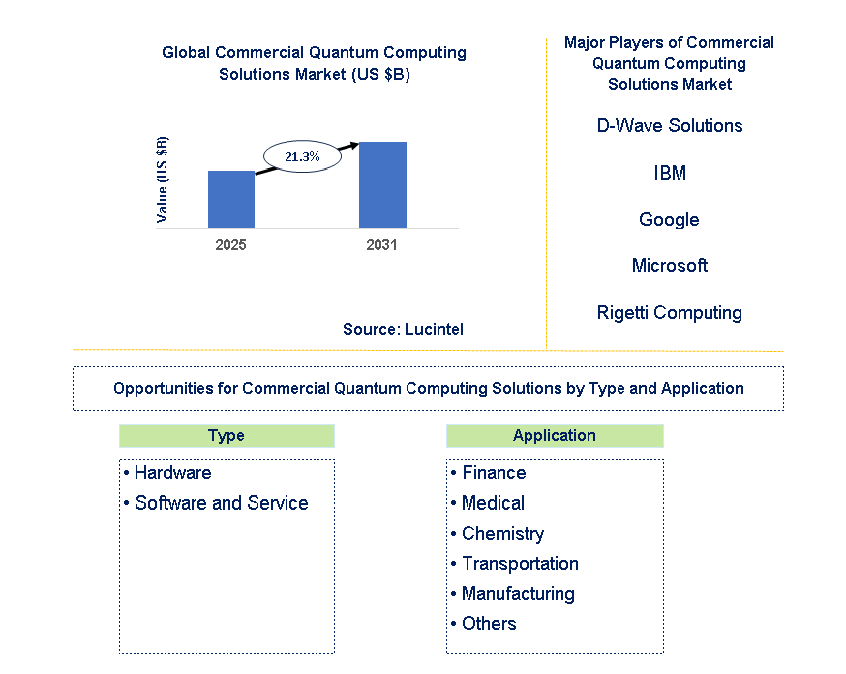
Key data points: The growth forecast = 21.3% annually for the next 7 years. Scroll below to get more insights. This market report covers Trends, opportunities and forecasts in commercial quantum computing solutions market to 2031 by type (hardware and software and service), application (finance, medical, chemistry, transportation, manufacturing, and others), and region (North America, Europe, Asia Pacific, and the Rest of the World)
We'll send your sample report shortly.
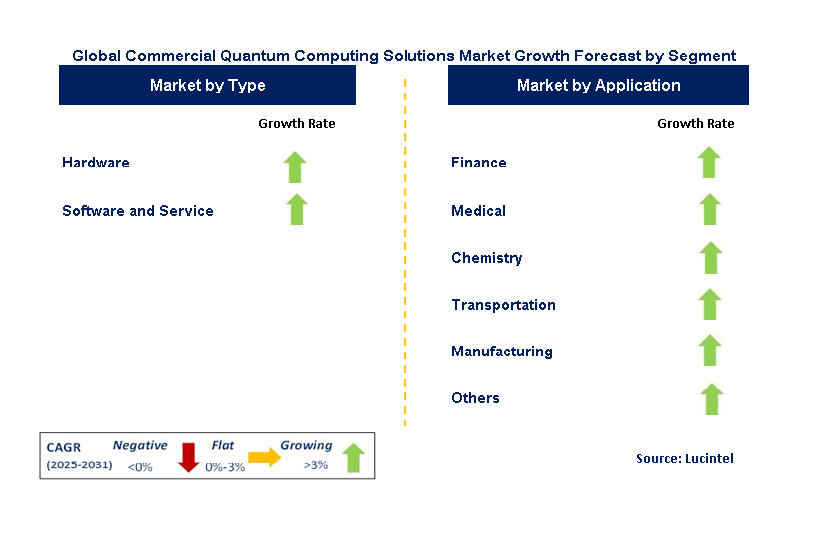
• Lucintel forecasts that, within the type category, hardware is expected to witness higher growth over the forecast period.
• Within the application category, finance is expected to witness the highest growth.
• In terms of region, APAC is expected to witness the highest growth over the forecast period.
• Quantum Cloud Platforms: Cloud-based quantum computing is becoming increasingly accessible. Major players, such as IBM and Microsoft, are offering cloud-based quantum computing platforms to allow businesses and developers to experiment with quantum algorithms without the need for expensive hardware. These platforms democratize access to quantum computing and open up opportunities for a wide range of industries to explore potential applications in optimization, machine learning, and cryptography. Cloud platforms lower the entry barrier and make possible fast prototyping of quantum applications.
• Quantum Error Correction Progress: The largest impediment in the area of quantum computing is that of quantum errors generated due to noise and decoherence. Researchers have lately made much headway into the domain of quantum error correction, which makes the advent of practical quantum computers even more achievable. Companies and research institutions are inventing new methods to enhance the reliability and stability of quantum systems. The further development of quantum error correction will enable the computation of increasingly complex calculations on a quantum computer and make them increasingly reliable for commercial applications in industries such as pharmaceuticals, logistics, and finance.
• Emergence of Quantum Algorithms For Specific Industries: The development of industry-specific quantum algorithms is accelerating. As the capability of quantum computers increases, quantum algorithms are being developed for applications such as supply chain optimization, drug discovery, financial modeling, and machine learning. These algorithms are designed to solve complex problems faster and more accurately than classical algorithms. By targeting industry-specific needs, quantum computing is poised to revolutionize key sectors by providing solutions that were previously impossible or too costly to achieve.
• Increased Interlocking between Public and Private Sectors: Governments and private firms are joining hands to speed up the progress of quantum computing technology. Knowledge sharing, funding, and resource distribution through public-private partnerships spur faster innovation and development. In addition, the funding for quantum research and development provided by the government in a country like the United States, China, or Germany is also highly significant. It helps establish the ecosystem where the growth of quantum technologies occurs with faster commercialization and adoption in industries.
• Quantum Cryptography for Improved Security: With digitization, cybersecurity is at its peak, and a breakthrough in quantum computing is seen as the next solution to these old cryptographic vulnerabilities, providing a platform for quantum cryptography, especially quantum key distribution (QKD). Quantum principles guarantee highly secure encrypted data and are, therefore, of paramount importance for industry applications such as finance, defense, and telecommunications. Such networks require secure communication networks, hence generating high interest in the areas of quantum cryptography technologies as this technology advances with quantum computing.
Emerging trends such as quantum cloud platforms, progresses in error correction, development of industry-specific algorithms, rise in public-private collaborations, and focus on quantum cryptography are reshaping the commercial quantum computing solutions market. As more and more of these trends develop, quantum computing is becoming nearer to the stage where it will be an applied technology with fully commercial viability, opening up new opportunities for multiple industries.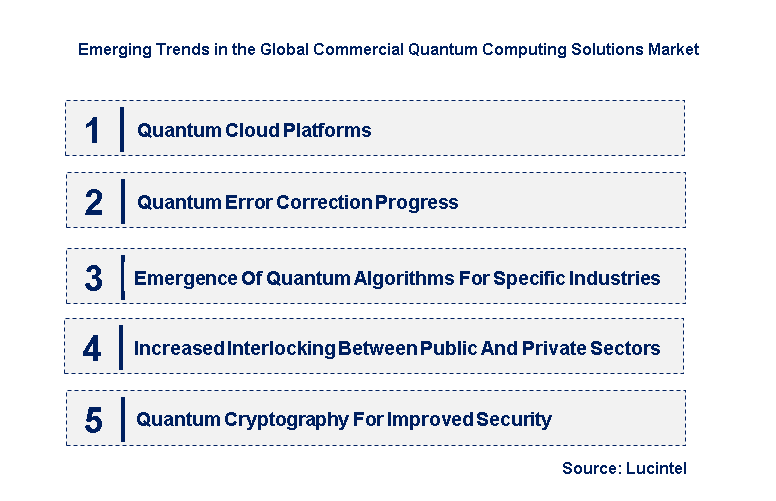
• Quantum Hardware Advances: It is mainly commercial quantum computing solution advancement driven through the advances seen in quantum hardware. For example, companies, such as IBM and Google, have made extensive progress with enhanced qubit count and improved coherence times of their quantum processors, thus pushing more complex computations possible and enabling even larger problems solved with the support of quantum. Increased hardware improvement will allow quantum computers to solve many real-life problems for businesses, such as logistics, pharmaceuticals, and energy companies.
• Increased Investment in Quantum Computing Startups: Quantum computing market growth has attracted a lot of investment, especially towards quantum computing startups. Venture capital firms and even governments are making investments in early-stage quantum companies that are involved in innovative quantum hardware, software, and applications. This influx of capital is helping to accelerate the pace of research and development, bringing quantum solutions closer to practical implementation. The rise of quantum computing startups is fostering competition, driving innovation, and contributing to the rapid evolution of the field.
• Introduction of Quantum Software for Industry Applications: Companies are designing industry-specific quantum software. In this regard, quantum software is being designed to support financial modeling, supply chain optimization, and drug discovery. This solution aims to utilize the potential capabilities of quantum computers to solve problems faster and with greater precision than classical computers. As the industry-specific software continues to evolve, so too will the use of quantum computing to solve the challenges facing industries where speed and efficiency are critical.
• Government and Industry Collaborations: Governments are collaborating with industry leaders to accelerate quantum computing innovation. The U.S. National Quantum Initiative and the EU's Quantum Flagship program are some of the initiatives that encourage collaboration between research institutions, companies, and governments. These programs are increasing funding, infrastructure, and resources for quantum research. The collaborative efforts are accelerating the development of quantum technologies, ensuring that both the public and private sectors are involved in bringing quantum computing to market.
• Quantum Computing as a Service (QCaaS): Quantum Computing as a Service (QCaaS) is revolutionizing the way businesses gain access to quantum technologies. IBM and Amazon Web Services are some of the companies offering cloud-based quantum computing services. This enables organizations to run quantum algorithms without having to purchase the hardware. This service model helps businesses try out quantum solutions with lower costs and entry barriers. QCaaS is driving market growth by making quantum computing more accessible, thus enabling industries to explore quantum algorithms for applications in optimization, finance, and machine learning.
All these latest developments, from hardware advancements, increased investment in startups, the development of industry-specific software, government-industry collaborations, and the emergence of QCaaS, are all supporting the acceleration of the commercialization of quantum computing solutions. In the process of these developments, quantum computing is becoming more accessible and practical for a variety of industries, leading to growth in the market.• Optimization in Supply Chain Management: Supply chain management can be revolutionized with the help of powerful quantum optimization capabilities. With the help of quantum algorithms, companies can optimize inventory management, distribution networks, and demand forecasting to save significantly on costs, enhance efficiency, and make decisions much faster. Using quantum computing, complex logistics problems that classical computers will fail to solve in practice or will take them an unfeasible amount of time will become soluble.
• Drug Discovery and Healthcare Applications: Quantum computing will be able to change the healthcare industry, especially in drug discovery and molecular simulations. Quantum algorithms can model complex molecules and simulate their interactions with drugs, thereby accelerating the discovery of new treatments. This will bring life-saving drugs to market more quickly, saving time-to-market and improving the efficiency of pharmaceutical research. Quantum computing will therefore play a crucial role in the acceleration of innovation in healthcare as it develops.
• Financial modeling and risk analysis: In finance, quantum computing will transform how the financial systems are modeled and how portfolios can be optimized along with conducting risks analysis. Quantum algorithms process and solve huge quantities of data on optimization problems significantly faster than a classical approach. Using quantum computers can enable banks and financial houses to refine trading strategies, complex modeling of various systems, and assessment of the associated risks more efficiently. It can also positively influence the whole financial sector because access to it will improve continuously.
• Quantum cryptography for secure communications: As the threat of cyber attacks increases, the need for secure communication systems is at its peak. Quantum cryptography, especially quantum key distribution (QKD), provides virtually unbreakable encryption through the principles of quantum mechanics. As digital communications become more and more important, quantum cryptography is becoming a vital solution for industries such as finance, defense, and telecommunications. This new application is one of the major growth opportunities, as businesses seek ways to protect sensitive information from cyber threats.
• Artificial intelligence and machine learning: The advancement of quantum computing will give way to even better artificial intelligence (AI) and machine learning (ML). The algorithms applied here have a chance of highly speeding up training time and raising the performance bar for AI models. Industries that have been significantly dependent on high-volume data sets include healthcare, automotive, and robotics. Fast processing and more accuracy will ensure this industry witnesses advancement in the systems developed based on AI.
Growth opportunities in optimization, healthcare, finance, cryptography, and AI are changing the commercial solutions market for quantum computing. As these areas mature, industries are embracing the power of quantum computing to solve complex challenges and unlock new capabilities.• D-Wave Solutions
• IBM
• Microsoft
• Rigetti Computing
• Intel
• Origin Quantum Computing Technology
• Anyon Systems
• Cambridge Quantum Computing Limited
• Quantum Computing
• Hardware
• Software And Service
• Finance
• Medical
• Chemistry
• Transportation
• Manufacturing
• Others
• North America
• Europe
• Asia Pacific
• The Rest of the World
• United States: The United States has led the development of quantum computers. IBM, Google, and Microsoft lead the way in commercial applications of these systems with growing commercial applications. IBM has released a roadmap for scaling up quantum computing capabilities, aiming for practical quantum advantage by 2023. Additionally, U.S. tech companies are focusing on making quantum computing accessible via cloud platforms, like IBM Quantum Experience, enabling developers to experiment with quantum algorithms. The U.S. government has also invested in quantum research, establishing initiatives like the National Quantum Initiative Act to secure quantum leadership.
• China: China has rapidly grown in the area of quantum computing, exploring foundational and applied research. Companies such as Alibaba and Baidu are developing quantum cloud services using their own built quantum processors. China's government has invested significantly in quantum research to become a global leader. In 2020, China marked a major milestone in quantum computing by claiming to achieve quantum supremacy in a task that would be impossible for classical computers. China's focus on quantum technologies includes applications in secure communications and AI, making the nation a key player in the global quantum race.
• Germany: Germany is emerging as a leader in quantum computing solutions within Europe. SAP and Bosch are making massive investments in quantum technologies to create quantum software and hardware solutions. The government of Germany, besides the Quantum Future Program, is also investing in quantum research initiatives, including programs for both startups and established companies. The development of quantum algorithms and applications in logistics, manufacturing, and pharmaceuticals is a key area of focus. Further, Germany's research establishments are collaborating with industrial leaders to further its advancement in quantum technologies, which is making the country a critical innovation hub for quantum computers.
• India: India is heavily investing in quantum computing technologies, and it continues to have a focus between government and private sectors on this next-generation technology. Companies like Tata Consultancy Services in India are currently working on quantum algorithms and building capabilities for application with regard to quantum computing. The Indian government has started establishing a strong national quantum ecosystem with initiatives like National Mission on Quantum Technologies and Applications. Additionally, Indian research institutes are teaming up with world leaders to leapfrog in developing quantum hardware.
• Japan: Fujitsu has driven the interest of Japan in quantum computing as the company works towards building solutions of quantum computing that can be used in business. Japan's government has unveiled its Quantum Technology Innovation Strategy to advance research and also commercialize the quantum computing technology. Japan has been progressing well in quantum hardware development, targeting quantum annealers, and considering applications in finance, logistics, and AI. Japan is also evaluating quantum cryptography as an important domain, where it focuses on enhancing security in digital communications and financial transactions.


• D-Wave Solutions
• IBM
• Microsoft
• Rigetti Computing
• Intel
• Origin Quantum Computing Technology
• Anyon Systems
• Cambridge Quantum Computing Limited
• Quantum Computing
Q5. Which commercial quantum computing solutions market segment will be the largest in future?

Choose a license that fits your team. Instant PDF delivery.
Prices exclude taxes. Instant delivery. Custom licensing available on request.
Market Report · July 15, 2026
Market Report · June 26, 2026
Market Report · June 24, 2026
Trusted partner for strategic intelligence and business growth


Receive a complimentary market analysis tailored to your industry. Our analysts will identify key growth opportunities and competitive dynamics specific to your business.

Market size, growth rate, and key trend analysis for your specific sector.

Top competitor positioning and market share analysis.

Strategic recommendations backed by data-driven insights.
Get curated market intelligence and competitive moves straight to your inbox.
By subscribing, you agree to receive our monthly insights. Unsubscribe anytime.
Receive a complimentary market analysis tailored to your industry. Our analysts will identify key growth opportunities and competitive dynamics specific to your business.
Market size, growth rate, and key trend analysis for your specific sector.
Top competitor positioning and market share analysis.
Strategic recommendations backed by data-driven insights.
Get curated market intelligence, emerging trends, and competitive moves straight to your inbox each month.
By subscribing, you agree to receive our monthly insights. Unsubscribe anytime.
We'll send your sample report shortly.