
Market Report · July 22, 2026

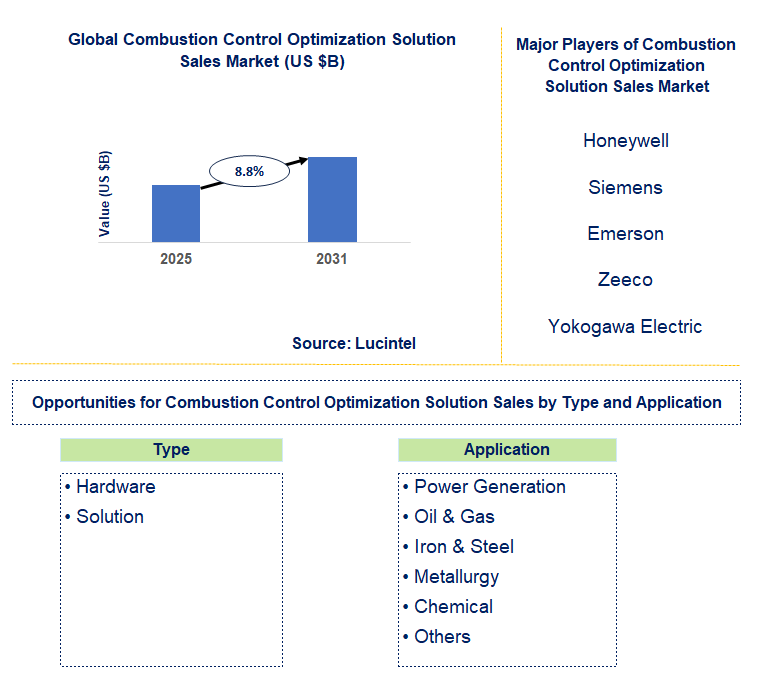
Key data points: The growth forecast = 8.8% annually for the next 7 years. Scroll below to get more insights. This market report covers Trends, opportunities and forecasts in combustion control optimization solution sales market to 2031 by type (hardware and solution), application (power generation, oil & gas, iron & steel, metallurgy, chemical, and others), and region (North America, Europe, Asia Pacific, and the Rest of the World)
We'll send your sample report shortly.
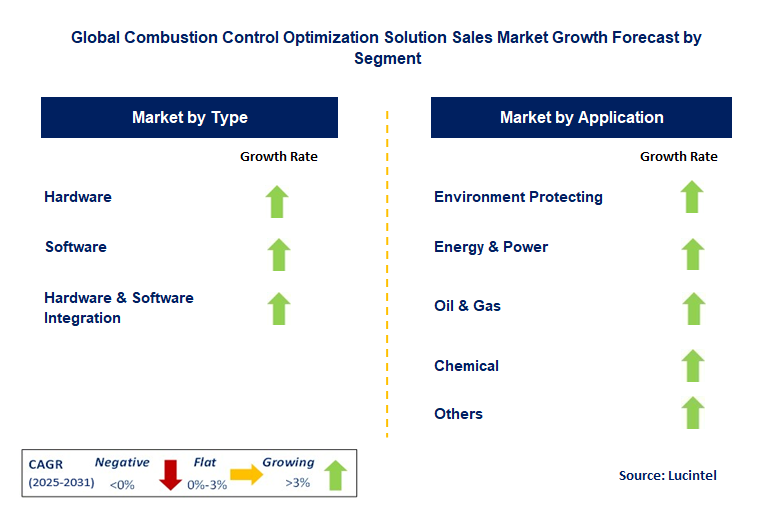
• Lucintel forecasts that, within the type category, hardware is expected to witness higher growth over the forecast period due to the increasing demand for physical components.
• Within the application category, power generation is expected to witness the highest growth.
• In terms of region, APAC is expected to witness the highest growth over the forecast period.
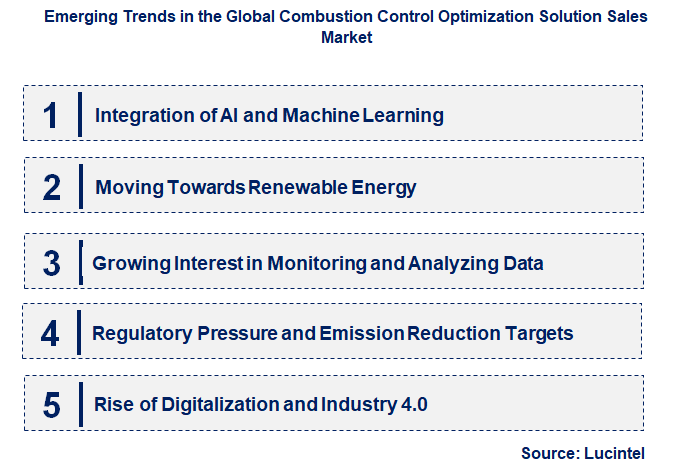
• Integration of AI and Machine Learning: The field of AI is disrupting all domains and optimization of combustion control solutions is not an exception. With these technologies, it is now possible to do real-time data analysis, predictive maintenance, and adaptive control on combustion systems. With the prognosis of issues, costs related to maintenance and infrastructure are reduced. Organizations seem to be adopting these technologies with the aim of creating smarter automated systems that provide energy saving features coupled with emission reductions and operational performance enhancements.
• Moving Towards Renewable Energy: As countries and industries keep working towards sustainability, there is a noticeable shift towards the adoption of solutions in combustion control optimization technology systems with alternative, renewable, and low emission fuel capabilities. These solutions help industries change from fossil fuels to cleaner sources of energy like biofuels, hydrogen, and natural gas. This shift is increasing the need for combustion systems that can use fuels efficiently and reduce emissions which will aid in fighting climate change and complying with environmental regulations.
• Growing Interest in Monitoring and Analyzing Data: There has been a noticeable increase in requirement for real time monitoring and data analytics in the combustion control optimization market. Many industries are now integrating systems that provide accurate and real time feedback to their estimation on efficiency of combustion processes, fuel consumption, emissions, and other systematic activities. This makes it possible for personnel in charge to take immediate actionable steps which will simplify the processes in the optimized combustion and improve overall system efficiency. The speed of processing, analyzing and acting on information in real time is making it easier for companies to improve utility efficiency, waste reduction, and compliance with environmental regulations.
• Regulatory Pressure and Emission Reduction Targets: Stringent CTRL (Control) measures per region with Environmental Compliance The emission control optimization markets have been growing due to the changing emission control policies and regulatory measures. Such regulations are adopted on an international basis and require the implementation of modern technologies which are more productive and environmentally sustainable. This has changed the way businesses invest in advanced combustion control solutions. In addition to emission reductions, regulatory pressure is making cleaner and more efficient combustion breakdown innovations more necessary.
• Rise of Digitalization and Industry 4.0: The rise of the ‘fourth industrial revolution’ also called Digital Revolution is having far-reaching implications globally on technology optimization and control. Combustion systems have become automated and integrated with IoT devices and technologies, thus enabling efficient operations and optimal resource utilization. Autonomous systems at maximum ability can communicate, store, and control data to adjust themselves to make maximum productivity of the combustion processes. The result of this shift in paradigm allows companies increasing operational efficiency, reduced operational costs as well as better sustainability. The improvement in the combustion control optimization solution sales market is heavily influenced by AI, real time monitoring, and the integration of other sustainable energy sources. There is also an increase in regulatory digitalization and enforcement. Companies are attempting to achieve better performance while remaining compliant to modern standards and decreasing their carbon footprint. All of these resulted in a much more dynamically changing market. These new emerging technologies are shifting the focus of combustion control optimization solution sales toward being more tech-savvy and eco-friendly.
• Development of Smart Combustion Control Systems: Out of all the recent developments, the introduction of smart combustion control systems is the most advanced. These systems utilize AI, machine learning, and the IoT to increase combustion efficiency, perform maintenance, and control emissions. In addition to that, these systems also modify the combustion process in real-time to guarantee proper fuel consumption and to avoid unnecessary waste. With these innovations, industries are able to increase their efficiency and sustainability while also minimize costs.
• Easing Growing Environmental Concerns Through Emission Monitoring Technologies: Industries are continuously enhancing emission monitoring and reduction technologies due to growing emissions regulations. These systems are programmed to analyze and control emissions in real time, as well as modify combustion parameters to reduce pollutant output. Specialized systems are being developed to make strict environmental regulations achievable without hampering economic activity. Modern combustion control technologies require this type of emission control, especially in developing industries like manufacturing and power generation.
• Predictive Maintenance Capabilities: Through IoT Integration Predictive maintenance is made possible through IoT technology in combustion control systems. IoT devices that are enabled can collect data from combustion systems, which can be analyzed to predict system failures and solve issues before any serious damage occurs. This kind of maintenance strategy minimizes system downtimes and operational interruptions, leading to more efficient combustion processes and increased reliability of the system. Predictive maintenance through IoT is becoming widely adopted across many industries that want to improve productivity and cut costs on maintenance.
• Support and Incentives from the Government: Support for new technologies that use energy efficiently has been one of the government incentives that most optimizes the combustion control solution market. Several countries are offering tax credits, subsidies, and other financial incentives to industries that install sophisticated combustion control instruments. These incentives help in recovering part of the investment, which encourages more industries to adopt these solutions. With heightened focus on sustainability, global warming and other environmental issues and much support is expected for these technologies.
• Support Enhancements in Research and Development: Support towards increased budgetary allocations spending on research and development is one of the significant market drivers for the support in the combustion control optimization. Businesses make heavy expenditure in R&D for newer mechanically sophisticated units that provide better combustion control, reduce the pollutants as well as adapt to newer regulations. This spending leads to the industry acquiring more advanced emission control technologies that are efficient and easy to use for better process optimization. These changes are driven by the instigation of technological innovations in government policy support and greater investments for R&D and have an impact in driving the market towards more automated and intelligent sustainable systems, that aid in enforcing lower emissions while meeting regulatory requirements on the use of combustion control optimization solution services.
• Energy and Power Generation: The power and energy sector is a major contributor to the development of advanced combustion control optimization solutions. To meet the rising demand for cleaner and more efficient energy, power plants are looking for innovative solutions to optimize combustion processes and reduce emissions. Such advanced solutions enable power plants to improve fuel efficiency, reduce operational costs, and meet stringent environmental regulations. Growing adoption of renewable energy sources also provides opportunities for development of combustion control solutions for hybrid energy systems.
• Manufacturing and Industrial Applications: Combustion control optimization solutions are essential, particularly in cement, steel, and chemical manufacturing. These industries rely on combustion for heating and power generation, and optimizing fuel expenditures while minimizing emissions is vital. Advanced combustion systems not only have the ability to enhance efficiency and reduce fuel consumption, but also helps industries meet environmental laws, translate into meaningful profit, and sustain the environment.
• Automotive Industry: As part of efforts to lower emissions and improve fuel efficiency, the automotive industry has also been adopting combustion control optimization solutions. In an effort to make cars more energy efficient, vehicle manufacturers are developing newer engines that greatly benefit from optimized combustion systems. With the emerging demand for cleaner modes of transport, and tightening emission laws across global markets, this trend is bound to increase.
• Aerospace and Aviation: The adoption of combustion control optimization technologies is becoming more prevalent in the aerospace and aviation industry sectors for fuel consumption and environmental impact mitigation. As fuel prices increase and regulations to cut emissions become more stringent, the need for enhanced combustion systems in aircraft engines is on the rise. These systems allow airlines to optimize fuel consumption, minimize emissions, and decrease operating expenses. This makes them an imperative aspect of the aviation industry profitability and sustainability goals.
• Residential and Commercial Buildings: In the Residential and Commercial Building sectors, there is significant and growing use of combustion control solutions for heating system optimization and efficiency improvement. This is particularly critical in economically colder regions where winter poses a harsh challenge. It is well known that heating consumes a huge portion of energy. Especially, these solutions help lower energy costs, reduce carbon footprints, and help buildings meet energy efficiency standards. The optimization of combustion control system presents myriad strategic applications which demonstrate growth opportunities in other sectors such as energy and power generation, manufacturing, automotive, etc. The industries need enhanced effectiveness, sustainability, and regulations compliance, which contributes towards growth possibilities. By adopting these solutions, businesses will be able to lower the cost and provide advanced technologies that require less energy for combustion.
• Honeywell
• Siemens
• Emerson
• Zeeco
• Yokogawa Electric
• DURAG
• Valmet
• Koch
• Fuji Electric
• Focused Photonics
• Hardware
• Solution
• Power Generation
• Oil & Gas
• Iron & Steel
• Metallurgy
• Chemical
• Others
• North America
• Europe
• Asia Pacific
• The Rest of the World
• US: Both the renewable and conventional resource sectors have bought advanced applications for the combustion solution. The demand for state-of-the-art combustion heating equipment is increasing in the industrial and agriculture sectors, as the energy control optimization system sales market is evolving technologically. With the growing need for environmental heating systems, there is also a growing need for highly efficient control systems for industrial heating equipment. The North American market is witnessing a surge in demand for power plants, municipal heating systems, as well as large oil and gas fields. These construction projects incur large investments and employ advanced systems for control and automation, ranging tools from sensors and controllers to complex computer systems integrated with intelligent monitoring and control systems.
• China: Optimization strategies for combustion control in China are driven by its emission reduction as well as industrial efficiency improvement commitments. Environmental objectives are driving the adoption of sophisticated combustion technologies in diverse Chinese sectors. The market is also driven by the government’s increased emphasis on controlling air pollution and enhancing energy efficiency in the manufacturing sector. Local firms are developing innovations that meet the distinct requirements for Chinese industries, especially in the power and industrial segments. These technologies are increasingly being funded by the government, which creates opportunities for both domestic and foreign investors.
• Germany: Germany is among the frontrunners in the application of modernized combustion control features because of the country’s strong dedication to sustainable development and energy transformation. The adoption of new commercialized combustion control features in the country has also been spurred by the government’s harsh emissions cap-and-trade system and greenhouse gases restriction. German companies are concentrating on new automation and digitization oriented Industry 4.0 applications for combustion control. This has resulted in the development of smart combustion systems that monitor and predict the powerful system's efficiency, leading to enhanced competitiveness of German firms in the international market.
• India: The markets for combustion control optimization solutions are increasing in India with India facing problems from high consumption of energy and industrial development. Due to the higher need for energy, along with growing environmental policies, industries, including power generation, cement production, and steel manufacturing, need emission solutions. Indian businesses are moving towards cheaper combustion control solutions that are provided within India and that satisfy standards. Even though the market is new, has considerable room for improvement due to the increased awareness about sustainability and support from the government will certainly help.
• Japan: Due to its focus on energy preservation and concern for the environment, Japan’s market for combustion control optimization has been steadily increasing. Various programs and subsidies by the government are aiding Japan toward adoption of different advanced combustion technologies, which is especially true for the industrial combustion optimization sector. The application of sophisticated technologies such as AI, IoT, and clever analytics into the combustion systems enable Japanese firms to utilize them for better fuel economy and pollution emission reduction. Major benefits from these solutions can be obtained in the automotive, manufacturing and power generation industries where optimization will reduce costs and increase sustainability.


• Honeywell
• Siemens
• Emerson
• Zeeco
• Yokogawa Electric
• DURAG
• Valmet
• Koch
• Fuji Electric
• Focused Photonics Q5. Which combustion control optimization solution sales market segment will be the largest in future? Answer: Lucintel forecasts that, within the type category, hardware is expected to witness higher growth over the forecast period due to the increasing demand for physical components. Q6. In combustion control optimization solution sales market, which region is expected to be the largest in next 5 years? Answer: In terms of region, APAC is expected to witness the highest growth over the forecast period. Q7. Do we receive customization in this report? Answer: Yes, Lucintel provides 10% customization without any additional cost.


Choose a license that fits your team. Instant PDF delivery.
Prices exclude taxes. Instant delivery. Custom licensing available on request.
Market Report · July 22, 2026
Market Report · July 22, 2026
Market Report · July 17, 2026
Trusted partner for strategic intelligence and business growth


Receive a complimentary market analysis tailored to your industry. Our analysts will identify key growth opportunities and competitive dynamics specific to your business.

Market size, growth rate, and key trend analysis for your specific sector.

Top competitor positioning and market share analysis.

Strategic recommendations backed by data-driven insights.
Get curated market intelligence and competitive moves straight to your inbox.
By subscribing, you agree to receive our monthly insights. Unsubscribe anytime.
Receive a complimentary market analysis tailored to your industry. Our analysts will identify key growth opportunities and competitive dynamics specific to your business.
Market size, growth rate, and key trend analysis for your specific sector.
Top competitor positioning and market share analysis.
Strategic recommendations backed by data-driven insights.
Get curated market intelligence, emerging trends, and competitive moves straight to your inbox each month.
By subscribing, you agree to receive our monthly insights. Unsubscribe anytime.
We'll send your sample report shortly.