
Market Report · July 15, 2026

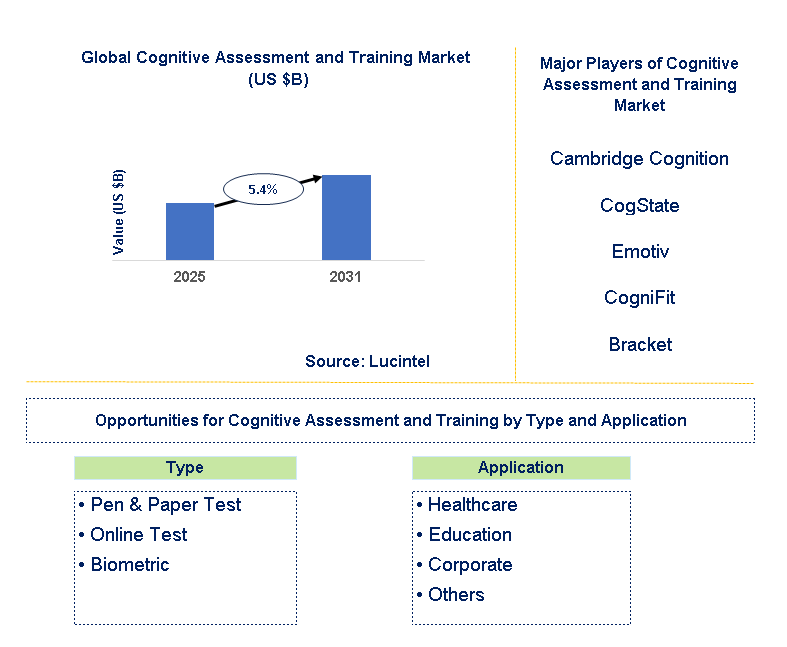
Key data points: The growth forecast = 5.4% annually for the next 7 years. Scroll below to get more insights. This market report covers trends, opportunities and forecasts in cognitive assessment and training market to 2031 by type (pen & paper test, online test, and biometric), application (healthcare, education, corporate, and others), and region (North America, Europe, Asia Pacific, and the Rest of the World)
We'll send your sample report shortly.
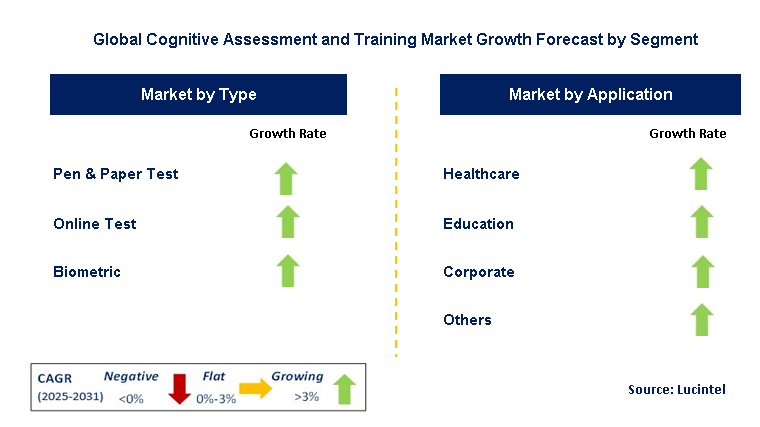
• Lucintel forecasts that, within the type category, online test is expected to witness the highest growth over the forecast period.
• Within the application category, education is expected to witness the highest growth.
• In terms of region, North America is expected to witness the highest growth over the forecast period. Gain valuable insights for your business decisions with our comprehensive 150+ page report. Sample figures with some insights are shown below.
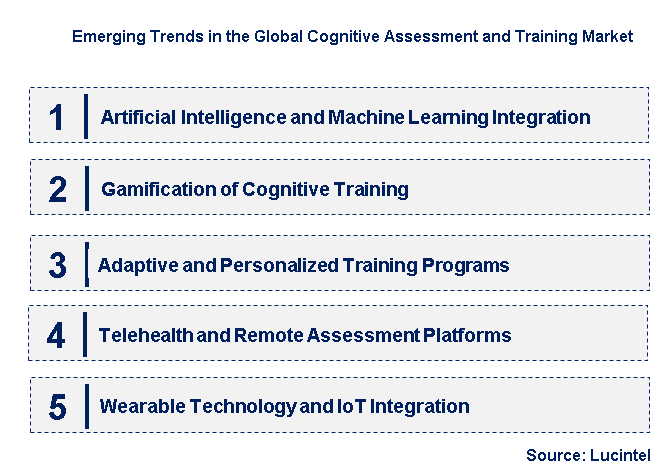
• Artificial Intelligence and Machine Learning Integration: This trend entails the growing deployment of AI and ML algorithms to customize cognitive assessments and training programs. AI is capable of scanning large volumes of user data in order to determine individual cognitive strengths and weaknesses and provide individualized interventions. Machine learning supports adaptive difficulty levels, real time feedback, and predictive analytics for cognitive decline. The effect is very personalized and more efficient training, with greater outcomes for users. It also allows for earlier and more precise detection of cognitive impairments, enhancing clinical decision making and intervention approaches.
• Gamification of Cognitive Training: Gamification has been seen to incorporate game design elements and principles into non-game situations, thereby making cognitive training more appealing and motivational. This movement utilizes the attributes of points, badges, leaderboards, and interactive challenges to promote user compliance and enjoyment. The result is improved user engagement and compliance with training programs, which is essential to the attainment of long-term cognitive gains. Gamified treatments render mental exercises less repetitive and more engaging, especially for young adults and those interested in brain fitness in an entertaining format.
• Adaptive and Personalized Training Programs: Beyond generic exercises, this trend aims at developing highly adaptive and personalized cognitive training experience. These programs adapt dynamically to the performance of an individual, their learning style, and particular cognitive objectives. Taking advantage of data from evaluations, such systems optimally refine training material and difficulty continually. The effect is more effective and efficient cognitive enhancement because training is specifically targeted to correct individual cognitive impairments or build on specific strengths. This method maximizes the potential for neuroplasticity and brain health optimization.
• Telehealth and Remote Assessment Platforms: With the growing use of telehealth, cognitive assessment and training have had a major influence, with remote delivery made possible. This includes platforms that make it possible to conduct cognitive evaluations and training virtually, in many cases from a patient’s home. The effect is greatly enhanced accessibility, especially for persons in rural settings, those with mobility issues, or during public health emergencies. It minimizes logistical hurdles, making cognitive care more accessible and ubiquitous, and enables ongoing tracking of cognitive health patterns across time.
• Wearable Technology and IoT Integration: This tendency entails using wearable devices and Internet of Things (IoT) sensors to non-obtrusively track cognitive markers and supply data for evaluation and training. Wearables can monitor physiological signals such as sleep patterns, heart rate variability, and activity levels that are associated with cognitive function. The effect is the possibility of gathering real world, continuous data on cognitive health without the need for active user input, providing a more complete picture of brain function outside of laboratory testing conditions. This enables early identification of subtle cognitive changes and provides objective data for personalized interventions. These trends are deeply transforming the cognitive assessment and training market by making solutions smarter, intuitive, and more accessible. The focus is moving towards preventive cognitive health management, tailored interventions, and ongoing monitoring. This transformation empowers individuals to be more proactive about their brain health, while allowing healthcare providers and other organizations to deliver more effective and scalable cognitive care.
• Growth of Digital and Mobile Based Solutions: One major trend is the mass movement towards digital and mobile solutions for cognitive assessment and training. These comprise apps on smartphones, web platforms, and apps on tablets that provide sets of exercises and tests. This significantly adds convenience and accessibility, enabling users to access cognitive programs anywhere, at any time. This has leveled the playing field for brain training, taking it out of the specialized clinic setting and into everyday life and bringing the market’s reach significantly to a broad user base of consumers, students, and employees.
• Artificial Intelligence and Machine Learning Integration: The inclusion of AI and ML algorithms is a revolutionary change. Both these technologies allow for adaptive training programs that adjust in real time to a user’s performance, balancing the difficulty level and material. AI also allows more advanced data analysis for precise cognitive assessment, spotting fine patterns of decline or improvement. The effect is more efficient and highly personalized interventions, with improved cognitive results. This also increases the accuracy of diagnostic tools and renders the delivery of individualized feedback automated.
• In Growing Demand in Commercial and Educational Environments: In addition to healthcare, an important development is the growing demand for cognitive assessment and training solutions in corporate wellness programs and schools. These tools are being applied by companies to assess employees, train employees for key skills such as decision making and problem solving, and reduce stress. In schools, they are being applied to detect learning disabilities and promote cognitive ability in learners. The effect is enhanced workforce productivity, better learning outcomes, and expanded recognition of cognitive well being as an essential aspect of well being and performance across many areas.
• Emphasis on Early Detection and Prevention of Cognitive Decline: One of the key developments is increased focus on leveraging cognitive assessment instruments to detect and prevent age related cognitive decline, including dementia and Alzheimer’s disease. Electronic assessments enable regular, non-surgical monitoring of cognitive change over time, facilitating early intervention. The effect is enhanced quality of life for an older global population because early detection means lifestyle changes or medical interventions that can delay progress. It enhances innovation in diagnostic precision and preventive brain health programs.
• Validation and Evidence Based Practices: The market continues to mature with greater demand for scientifically supported cognitive assessment measures and training programs. Researchers and consumers are increasingly seeking evidence based solutions that can prove measurable improvements in cognitive function. This trend results in more stringent clinical trials and peer reviewed publications attesting to the efficacy of products. The effect is enhanced credibility and trust in the market, displacing unsubstantiated claims and promoting investment in genuinely effective interventions, resulting in a more reliable and reputable industry. These advancements are essentially transforming the cognitive assessment and training market into a more technologically sophisticated, user focused, and integrated into day to day life market. The transition towards digital, AI driven, and evidence based solutions is driving the market’s efficiency, accessibility, and credibility, towards a proactive stance in cognitive health and general well being for all age groups and industries.
• Clinical Trials and Neurological Disorder Management: This is a growth-rich segment as cognitive tests are critical to screen, track disease progression, and measure treatment effectiveness in clinical trials of neurological diseases such as Alzheimer’s, Parkinson’s, and multiple sclerosis. There are opportunities for creating highly sensitive, reliable, and standardized digital assessment measures to capture subtle changes in cognition. The benefit is faster drug development and discovery, more accurate patient stratification, and better management of neurological diseases through objective cognitive data. This component is important for improving medical research and therapeutic interventions.
• Employee Wellness and Corporate Learning Programs: As recognition of cognitive fitness’s effects on employee well-being and productivity increases, the corporate world holds an enormous growth potential. Firms are making investments in cognitive evaluation tools for talent management, development of skills (e.g., decision making, problem solving), as well as stress management. Training programs can increase employees’ focus, memory, and decision-making. The effect is enhanced employee performance, decreased burnout, and improved employee retention, as organizations increasingly value mental flexibility and resilience among their employees, which results in greater organizational effectiveness.
• Education Sector and Learning Improvement: The education sector provides a huge potential for cognitive testing and training, ranging from childhood development to higher education. These technologies can detect learning disabilities, tailor educational curricula, and strengthen foundational cognitive abilities such as attention, memory, and executive functions in students. There are opportunities in creating interactive, adaptable systems for various age groups and different learning styles. The effect is enhanced academic achievement, more inclusive classrooms, and improved student readiness for demanding cognitive requirements, leading to lifelong learning abilities.
• Consumer Brain Fitness and Wellness: The emerging consumer market for brain fitness and overall cognitive improvement is a big growth area. This encompasses apps and websites aimed at healthy consumers looking to enhance or preserve memory, concentration, and general mental acuity. The growing population of older adults, coupled with an increasingly health-aware behavior, drives this demand. The effect is a widespread acceptance of cognitive training as part of a full wellness regimen, maintaining active aging and mental robustness among the general population, leading to a healthier society.
• Sports and Enhancement of Performance: The use of cognitive testing and training in sports and performance enhancement is a new growth opportunity. These are tools athletes can employ to enhance reaction time, decision-making, focus, and strategic thinking. Chances are found in constructing specialized programs across different sports, bridging cognitive skills with on field performance. The effect is improved athletic performance, lessened risk of injury through enhanced awareness, and maximized training protocols. This usage uses cognitive science to provide competitive advantage and enhance general physical and mental preparedness. These strategic growth prospects are refashioning the cognitive assessment and training market by broadening its applications and extending its scope to different industries. Attention is given to customizing solutions to suit individual requirements in each application, resulting in more focused product development and market penetration. This application driven approach is fueling innovation and ensuring the expansion of the market and its relevance in an increasingly cognitively complex world.
• Cambridge Cognition
• CogState
• Emotiv
• CogniFit
• Bracket
• Pearson
• Lumosity
• Brain Resource
• ImPACT Applications
• ProPhase
• Pen & Paper Test
• Online Test
• Biometric
• Healthcare
• Education
• Corporate
• Others
• North America
• Europe
• Asia Pacific
• The Rest of the World
• United States: The United States is a prominent market for Cognitive Training and Assessment, distinguished by extensive research and development, heavy investment in digital health technologies, and an increasing population of older citizens. Strong emphasis exists on the use of artificial intelligence and machine learning to personalize training programs and identify cognitive decline early. Telehealth has also gained traction for remote cognitive tests, especially post-pandemic. Large players are continuously involved in product development and strategic alliances to increase their products’ range in clinical, education, and consumer markets.
• China: China’s cognitive assessment and training market is growing strongly, driven by a large and aging population, growing healthcare expenditure, and rising focus on mental well being. The market is witnessing an increase in local players creating mobile applications and gamified solutions, frequently combined with AI, to serve a wide consumer audience. Initiatives by the government for healthy aging and digital health are also driving the market, with emphasis on affordable and scalable solutions for managing cognitive health.
• Germany: Germany’s cognitive assessment and training industry is dominated by a heavy focus on evidence-based solutions and within the healthcare system. The elderly population and increasing awareness of neurological conditions create demand for trusted assessment tools and proven training modules. Clinical applications are in focus, with the emphasis on digital therapeutics and solutions that adhere to stringent data privacy standards like GDPR. Research organizations and healthcare professionals are strong change drivers.
• India: India’s cognitive assessment and training market is becoming one of the most rapidly growing, fueled by explosive digitalization, rising internet penetration, and heightened consciousness about mental health and cognitive well-being among young and old alike. Affordable and accessible solutions, frequently provided on a mobile platform, are increasingly in demand. Schools and corporate wellness initiatives are also beginning to use these tools. The market is also experiencing growth in local startups dedicated to innovative and culturally adapted cognitive solutions.
• Japan: Japan has one of the world’s largest percentages of elderly residents and strongly believes in cognitive health. Its cognitive assessment and training market is prompted by the necessity to respond to age-related cognitive weakening and provide for healthy aging programs. There is a significant emphasis on research and development, especially in sectors such as brain training games and digital solutions for the elderly. The market emphasizes solutions that are scientifically proven and easily integrated into healthcare and wellness programs.


• Cambridge Cognition
• CogState
• Emotiv
• CogniFit
• Bracket
• Pearson
• Lumosity
• Brain Resource
• ImPACT Applications
• ProPhase Q5. Which cognitive assessment and training market segment will be the largest in future? Answer: Lucintel forecasts that, within the type category, online test is expected to witness the highest growth over the forecast period. Q6. In cognitive assessment and training market, which region is expected to be the largest in next 5 years? Answer: In terms of region, North America is expected to witness the highest growth over the forecast period. Q7. Do we receive customization in this report? Answer: Yes, Lucintel provides 10% customization without any additional cost.


Choose a license that fits your team. Instant PDF delivery.
Prices exclude taxes. Instant delivery. Custom licensing available on request.
Market Report · July 15, 2026
Market Report · June 26, 2026
Market Report · June 24, 2026
Trusted partner for strategic intelligence and business growth


Receive a complimentary market analysis tailored to your industry. Our analysts will identify key growth opportunities and competitive dynamics specific to your business.

Market size, growth rate, and key trend analysis for your specific sector.

Top competitor positioning and market share analysis.

Strategic recommendations backed by data-driven insights.
Get curated market intelligence and competitive moves straight to your inbox.
By subscribing, you agree to receive our monthly insights. Unsubscribe anytime.
Receive a complimentary market analysis tailored to your industry. Our analysts will identify key growth opportunities and competitive dynamics specific to your business.
Market size, growth rate, and key trend analysis for your specific sector.
Top competitor positioning and market share analysis.
Strategic recommendations backed by data-driven insights.
Get curated market intelligence, emerging trends, and competitive moves straight to your inbox each month.
By subscribing, you agree to receive our monthly insights. Unsubscribe anytime.
We'll send your sample report shortly.