
Market Report · July 16, 2026

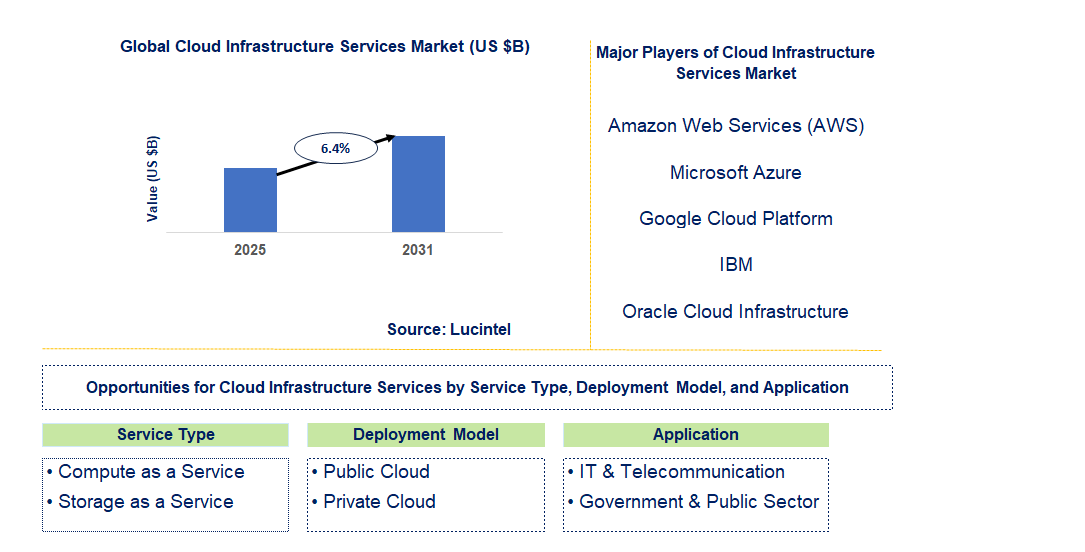
Key data points: The growth forecast = 6.4% annually for the next 7 years. Scroll below to get more insights. This market report covers Trends, opportunity and forecast in cloud infrastructure services market to 2031 by service type (compute as a service and storage as a service), deployment model (public cloud and private cloud), application (IT & telecommunication and government & public sector), and region (North America, Europe, Asia Pacific, and the Rest of the World)
We'll send your sample report shortly.
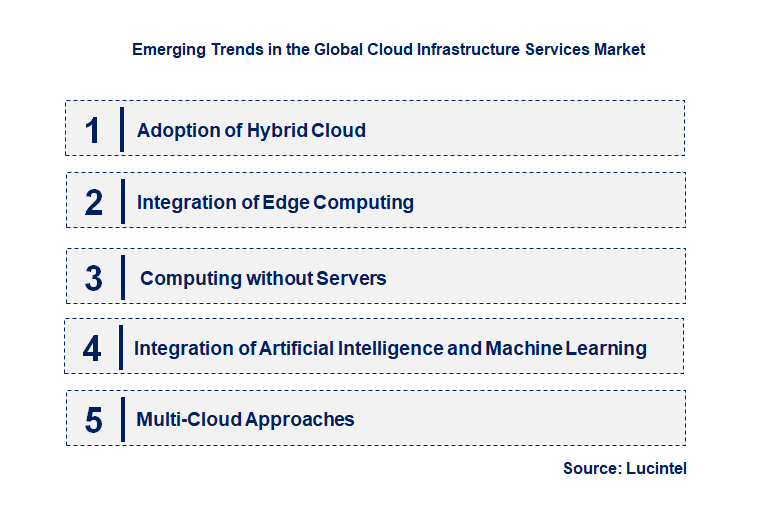
• Adoption of Hybrid Cloud: A growing number of enterprises are adopting hybrid cloud approaches, especially in regard to the consumption of multi-cloud environments. This strategy allows businesses to control more sensitive information internally while still being able to access the cost-effective and scalable services offered externally. The ability to efficiently manage IT resources and increase operational flexibility is now possible with hybrid systems.
• Integration of Edge Computing: This is described as a major shift from relying on centralized data centers for data processing and storage. Certain industries, such as manufacturing, healthcare, and autonomous vehicles, require data to be processed in real-time and with minimal delay, which makes edge computing integration crucial to these fields.
• Computing Without Servers: The popularity of serverless computing rests in its ability to let developers run applications without managing the hardware. When compared to traditional systems, this business model enables greater scaling capability, lower costs, and simplified management, allowing businesses to become more agile in application development and deployment.
• Integration of Artificial Intelligence and Machine Learning: AI and machine learning technologies are incorporated into cloud technologies to automate tasks and enhance data analysis. Everything from analyzing large datasets to improving workflow processes and making better-informed decisions can be done more efficiently. With the increasing popularity of AI cloud services, organizations can further expand and create new business prospects.
• Multi-cloud Approaches: A number of businesses are now using multi-cloud approaches in order to minimize dependency on one vendor and improve operational agility. With the support of several cloud service providers, businesses can achieve greater uptime, enhanced backup and restoration capabilities, and fine-tune their cloud services to better align with their particular business objectives. These patterns are changing the interaction of businesses and consumers with the cloud and its underlying infrastructure. The increased use of hybrid cloud, edge computing, serverless architecture, and AI mark a shift towards greater efficiency, flexibility, and scalability in the services offered. The trend toward multi-cloud strategies also indicates the necessity for diversification among cloud vendors in order to enhance performance and mitigate risks.
• Hybrid Cloud Solutions: Businesses stand to benefit from public cloud resources more than ever because of the growing popularity of hybrid cloud infrastructure. This is due to the need for more flexible and cost-efficient solutions that can be scaled dynamically. Hybrid cloud solutions enable companies to enhance efficiency and security by managing sensitive data internally while offloading less critical workloads to public clouds. Furthermore, these companies can save money by not having to invest in additional infrastructure.
• Edge Computing Deployment: With rapid advancement in technology comes the requirement for faster data processing capabilities. As such, there has been a massive rise in the deployment of edge computing with cloud infrastructure services. Companies can now enhance performance, lower latency, and improve real-time decisions by processing data at the edge where it is generated. This is especially true for the manufacturing, healthcare, and smart city industries.
• AI and Automation Integration: Cloud infrastructure services are being adopted at an increasing rate because businesses are realizing how much automation tools and AI can improve their day-to-day operations. From making management and data analytics simpler to enhancing business operations, the possibilities are endless with automation and AI. Companies can now automate tasks and receive actionable insights from massive troves of data, resulting in lower operational costs and improved efficiency.
• Integration of 5G Networks: The deployment of 5G networks is increasing the rate of development of cloud infrastructure services because it facilitates reliable and speedy connectivity. Cloud service providers are actively investing in supporting 5G services on their platforms to improve user experiences in streaming, gaming, and the Internet of Things (IoT) device interaction.
• Strengthening Privacy and Security: As dependence on cloud infrastructure grows, protecting and securing data has become a primary concern. Cloud providers are continuously improving their security measures to mitigate increasing risks of data breaches, threats from cyberspace, and compliance with regulatory frameworks. Businesses are implementing stronger encryption and multi-factor authentication alongside advanced threat detection systems. These advancements illustrate that the market for cloud infrastructure services is growing at a tremendous rate in response to the demand for secure, flexible, and scalable solutions. The incorporation of AI, edge computing, 5G technology, and additional security features is transforming the sector and empowering companies to increase their capacity to innovate and meet changing market needs.
• Cloud Storage and Backup: Increased volumes of data necessitate the development of scalable, dependable backup solutions. Businesses want affordable solutions for protecting their data with efficient retrieval options. There is an increase in demand for these services, giving cloud providers the chance to expand with new pricing models and backup options.
• Cloud Security Services: Security breaches have prompted organizations globally to pay more attention to cloud security services. The growing threat of cyberattacks has made cloud providers enhance their offerings by providing encryption, multi-level authentication, and elaborate threat detection to meet the demand for security and compliance.
• Disaster Recovery Service Solutions: The use of cloud infrastructure to support disaster recovery (DR) solutions has increased, enabling businesses to safeguard their data and applications from system failures and outages. Providers that can offer economical, high-availability DR solutions are poised to take advantage of this opportunity as more businesses look to reduce downtime.
• AI and Data Analytics: The increasing need for actionable information drives AI and data analytics services built on cloud infrastructure. The growing need for deeper insights and understanding has necessitated machine learning, deep learning, and predictive analysis. Businesses are looking at decision-making enhancement and operational efficiency improvement, and they need to use specialized AI and analytics platforms.
• Smart Devices and IoT Integration: There are a multitude of connected devices and applications for IoT, making the use of cloud infrastructure vital for its adoption. For specific IoT cloud services, IoT data processing, storage, and connectivity, these providers allow other sectors, including healthcare, manufacturing, and logistics, to benefit from the growing IoT market. Incorporating AI and IoT, as well as the growing demand for flexible, scalable, and secure cloud services to capture new market segments, are the main drivers of the growth of the cloud infrastructure services economy. These changes in businesses enable a shift toward these evolving business requirements for storage, security, disaster recovery, and infrastructure automation and also they also serve as a stimulus for cloud providers to increase their offerings.
• Amazon Web Services (AWS)
• Microsoft Azure
• Google Cloud Platform
• IBM
• Oracle Cloud Infrastructure
• Salesforce
• Rackspace
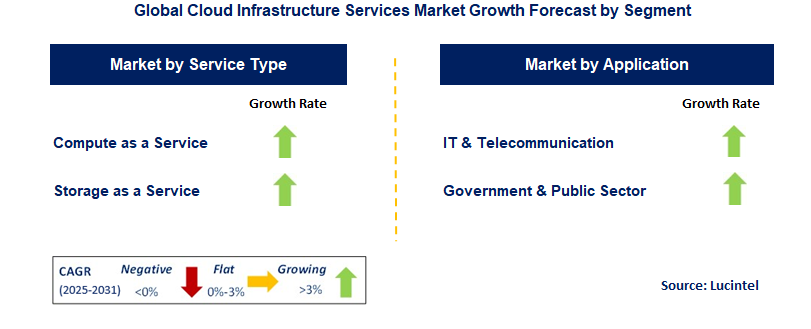
• Compute as a Service
• Storage as a Service
• Public Cloud
• Private Cloud
• North America
• Europe
• Asia Pacific
• The Rest of the World
• United States: The advancements and adoption of the cloud have dramatically transformed the infrastructure of the U.S. through the integration of new technologies by top corporations like Amazon Web Services, Microsoft Azure, and Google Cloud. The hybrid cloud computing model has also witnessed a sharp rise as companies are increasingly adopting a combination of public and private clouds due to their cost-effectiveness, scalability, and flexibility. Industries such as healthcare and manufacturing have also been experiencing a shift in how cloud services are delivered due to the growing adoption of 5G technology and edge computing.
• China: Because the government in China is focused on encouraging a digital economy, domestic cloud computing, AI, and data management service providers such as Tencent Cloud and Alibaba Cloud have emerged. These companies are investing heavily in AI technology and the construction of cloud data centers to improve service capabilities. Coupled with the rapid expansion of internet users, data security, data sovereignty, and virtualization have intensified China’s drive for the localization of cloud computing to fulfill regulatory obstacles and aid in international competition.
• Germany: Germany is gradually changing direction and getting on board with adopting cloud computing, starting with specific sectors, notably automotive and manufacturing, which are taking advantage of the new cloud infrastructure to increase productivity and creativity. There is a growing cloud computing market in Germany, and providers like SAP and Deutsche Telekom are the first to create tailored cloud services addressing privacy and local regulations. As digitization becomes a requirement for business success, there is an increasing shift toward transforming legacy systems into the cloud, and this is expected to drive the growth of cloud services in Germany.
• India: The adoption of cloud solutions is growing across the public sector and industries such as healthcare, education, and agriculture. The government initiatives to promote cloud technology, combined with the digitization of services, are creating a shift in mobile-first consumers. The country's cloud infrastructure market is set to boom further through large-scale investments from global players, including AWS and Microsoft, coupled with local investments pioneered by Tata Communications.
• Japan: Automation and technological innovation are at the forefront of cloud infrastructure solutions in Japan. Companies adopting hybrid and multi-cloud strategies is becoming commonplace to streamline their operations. Fujitsu and NTT are leaders in providing integrated cloud services that include IoT devices, big data, AI, and analytics capabilities. The existing infrastructure is set to benefit from the growing adoption of cloud gaming as cloud services widen their scope.


• Amazon Web Services (AWS)
• Microsoft Azure
• Google Cloud Platform
• IBM
• Oracle Cloud Infrastructure
• Salesforce
• Rackspace Q5. Which cloud infrastructure services market segment will be the largest in future? Answer: Lucintel forecasts that storage as a service will remain larger segment over the forecast period. Q6. In cloud infrastructure services market, which region is expected to be the largest in next 5 years? Answer: APAC is expected to witness the highest growth over the forecast period. Q7. Do we receive customization in this report? Answer: Yes, Lucintel provides 10% customization without any additional cost.


Choose a license that fits your team. Instant PDF delivery.
Prices exclude taxes. Instant delivery. Custom licensing available on request.
Market Report · July 16, 2026
Market Report · May 18, 2026
Market Report · May 18, 2026
Trusted partner for strategic intelligence and business growth


Receive a complimentary market analysis tailored to your industry. Our analysts will identify key growth opportunities and competitive dynamics specific to your business.

Market size, growth rate, and key trend analysis for your specific sector.

Top competitor positioning and market share analysis.

Strategic recommendations backed by data-driven insights.
Get curated market intelligence and competitive moves straight to your inbox.
By subscribing, you agree to receive our monthly insights. Unsubscribe anytime.
Receive a complimentary market analysis tailored to your industry. Our analysts will identify key growth opportunities and competitive dynamics specific to your business.
Market size, growth rate, and key trend analysis for your specific sector.
Top competitor positioning and market share analysis.
Strategic recommendations backed by data-driven insights.
Get curated market intelligence, emerging trends, and competitive moves straight to your inbox each month.
By subscribing, you agree to receive our monthly insights. Unsubscribe anytime.
We'll send your sample report shortly.