
Market Report · July 15, 2026

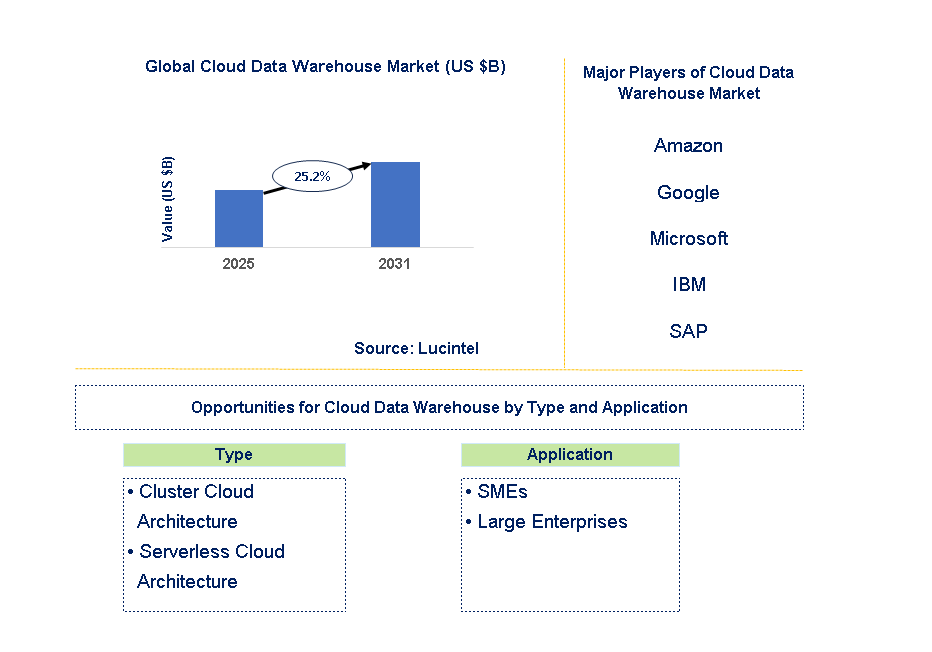
Key data points: The growth forecast = 25.2% annually for the next 7 years. Scroll below to get more insights. This market report covers trends, opportunities and forecasts in cloud data warehouse market to 2031 by type (cluster cloud architecture and serverless cloud architecture), application (smes and large enterprises), and region (North America, Europe, Asia Pacific, and the Rest of the World)
We'll send your sample report shortly.
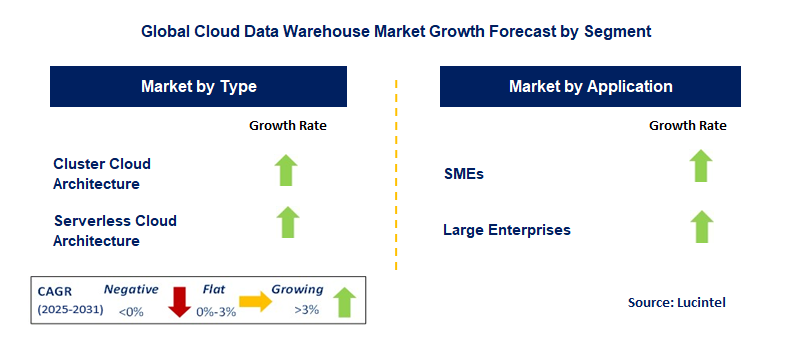
• Lucintel forecasts that, within the type category, serverless cloud architecture is expected to witness higher growth over the forecast period.
• Within the application category, large enterprise is expected to witness higher growth.
• In terms of region, North America is expected to witness the highest growth over the forecast period. Gain valuable insights for your business decisions with our comprehensive 150+ page report. Sample figures with some insights are shown below.
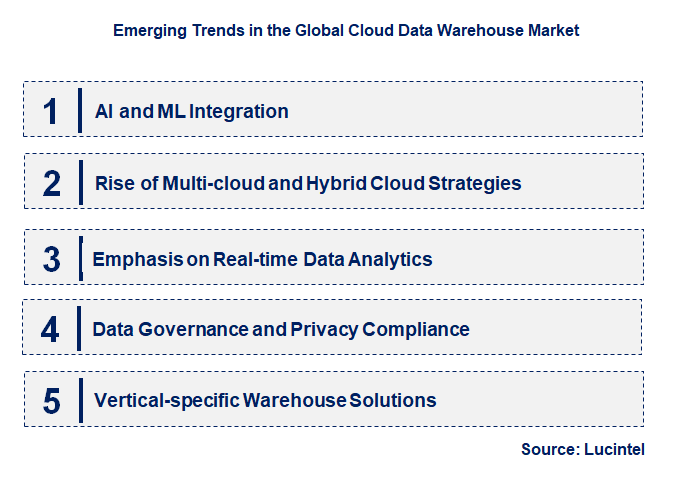
• AI and ML Integration: Cloud data warehouses are increasingly integrating AI and ML tools to automate data management tasks such as query optimization, anomaly detection, and predictive analytics. Vendors are embedding native AI engines to support advanced use cases like natural language querying and data enrichment. This trend helps organizations make faster, data-driven decisions and enhances productivity by reducing manual intervention. For example, Snowflake and Big Query now offer integrated ML capabilities that allow data scientists to build models directly within the warehouse. As this trend accelerates, it will shift cloud data warehouses from passive storage solutions to active data intelligence platforms.
• Rise of Multi-cloud and Hybrid Cloud Strategies: Enterprises are adopting multi-cloud and hybrid cloud strategies to avoid vendor lock-in and ensure greater flexibility, data sovereignty, and performance optimization. Cloud data warehouses are being designed to support data movement across public, private, and on-premises environments. This trend is especially pronounced in regions with strict regulatory requirements such as Germany and Japan. Tools that enable seamless data federation and interoperability between platforms like AWS, Azure, and Google Cloud are gaining popularity. As data environments become more complex, these strategies provide resilience and allow organizations to leverage the best features of each cloud provider.
• Emphasis on Real-time Data Analytics: The need for real-time decision-making is pushing enterprises to adopt cloud data warehouses that support streaming data ingestion and instant analytics. Solutions like Amazon Redshift Streaming and Google Cloud’s Dataflow are enabling businesses to derive actionable insights from live data feeds. This trend is crucial in industries like e-commerce, finance, and logistics, where latency can directly impact competitiveness. Real-time analytics capabilities also support emerging use cases in fraud detection, customer experience personalization, and supply chain optimization. As businesses aim to become more agile, cloud data warehouses with robust real-time features are becoming essential.
• Data Governance and Privacy Compliance: With increasing regulatory scrutiny around data privacy, organizations are prioritizing robust governance frameworks in their cloud data warehousing strategies. Platforms are evolving to offer advanced data masking, role-based access, and audit trails to comply with global and local regulations such as GDPR, CCPA, and PIPL. This trend is especially significant in regions like the European Union and China. Cloud providers are also offering data residency options to help organizations meet sovereignty requirements. Enhanced governance features improve data quality and trust, facilitating better analytics outcomes while ensuring compliance.
• Vertical-specific Warehouse Solutions: Vendors are developing cloud data warehouse solutions tailored to specific industries such as healthcare, retail, banking, and manufacturing. These vertical-specific platforms come with pre-built data models, compliance templates, and connectors that accelerate time-to-value. For instance, healthcare data warehouses often include HIPAA compliance features, while financial services platforms emphasize fraud detection and regulatory reporting. This trend reduces complexity and increases adoption, particularly among small to mid-sized enterprises. As competition intensifies, tailored solutions are enabling providers to differentiate their offerings and deliver more business-centric value. These emerging trends are redefining the cloud data warehouse market, pushing the boundaries of performance, flexibility, and intelligence. AI integration is transforming data interaction; multi-cloud strategies offer resilience; real-time analytics provide agility; governance ensures compliance; and industry-specific solutions enhance adoption. Together, these trends are moving cloud data warehousing from a traditional storage paradigm to a dynamic decision-making engine. As organizations continue to seek competitive advantage through data, vendors that align their offerings with these trends will be best positioned to lead the evolving market landscape.
• AI-Augmented Query Engines: Vendors are increasingly embedding AI in query engines to automate optimization and improve performance. For example, Google Big Query has introduced AI-enhanced insights and predictive analysis capabilities, reducing query latency and resource usage. This allows users to run complex queries more efficiently and gain insights faster, even on large datasets. Such AI enhancements also simplify user interaction with natural language processing, enabling broader organizational access to data. The development supports business agility and reduces the need for deep technical expertise, making data warehouses more user-friendly and accessible across departments.
• Expansion of Regional Data Centers: Major cloud providers are investing in localized data centers to address regulatory demands and reduce latency. AWS, Microsoft Azure, and Google Cloud have all announced new regions in countries like India, Germany, and Japan. These expansions enable faster data access, better disaster recovery, and compliance with local data residency laws. This development is crucial for organizations that need to store sensitive data within national borders. By offering region-specific data warehouse services, providers are enhancing their appeal to industries like healthcare, finance, and government, which operate under strict data governance norms.
• Industry-tailored Platforms: A significant development is the launch of data warehouse platforms tailored for verticals like healthcare, finance, and retail. Snowflake’s Financial Services Data Cloud and Oracle’s Healthcare Data Warehouse exemplify this trend. These solutions come with built-in compliance, analytics models, and integration capabilities, reducing deployment complexity and improving time-to-insight. Businesses can leverage these purpose-built environments for specific use cases such as fraud detection, patient data analysis, or inventory optimization. This vertical focus increases the relevance of cloud data warehouses and accelerates their adoption across specialized domains.
• Integration with Open-source and Third-party Tools: To enhance flexibility and interoperability, cloud data warehouses are integrating with popular open-source tools such as Apache Spark, Kafka, and debt. This allows organizations to customize their data pipelines, leverage community support, and reduce vendor lock-in. For example, Azure Synapse supports integration with GitHub and Power BI for end-to-end analytics workflows. These integrations make it easier for enterprises to adopt a modular approach to data management and analytics, enhancing ecosystem compatibility and developer productivity.
• Real-time Streaming and ETL Enhancements: Real-time data ingestion and transformation are becoming central to cloud data warehousing strategies. Tools like Amazon Kinesis, Google Dataflow, and Azure Stream Analytics now enable streaming ETL capabilities, allowing businesses to analyze data as it arrives. This is essential for applications that require immediate insights, such as fraud detection or supply chain monitoring. Improved ETL tools reduce latency, improve data accuracy, and support more dynamic decision-making processes. This development is pivotal in making cloud warehouses more adaptive to modern data workflows. These developments are collectively transforming cloud data warehouses into agile, intelligent, and industry-ready platforms. AI-driven query optimization improves accessibility and efficiency, while regional expansions ensure compliance and performance. Vertical-specific solutions and third-party integrations enhance business relevance and flexibility, and real-time streaming boosts responsiveness. Together, they empower organizations to derive actionable insights more quickly and with greater precision. As cloud adoption deepens, these innovations will play a critical role in determining vendor competitiveness and market direction.
• Customer Analytics and Personalization: Customer analytics is a top growth area, with enterprises using cloud data warehouses to integrate omnichannel customer data and deliver personalized experiences. Businesses in retail, e-commerce, and banking are leveraging real-time insights to segment audiences, predict behavior, and optimize marketing strategies. Cloud platforms enable rapid scaling and AI integration, allowing teams to analyze large datasets with speed and accuracy. As customer expectations evolve toward personalization and immediacy, this application area becomes critical for competitiveness. Companies adopting customer-centric data warehousing strategies can drive loyalty, increase conversion rates, and improve customer lifetime value through more informed, agile decision-making.
• Fraud Detection and Risk Management: In sectors such as banking, insurance, and e-commerce, cloud data warehouses support advanced fraud detection and risk management applications. These platforms facilitate real-time monitoring of transactional data, user behavior patterns, and anomalies using integrated AI and ML tools. The scalability of cloud warehouses enables continuous analysis across millions of data points without latency. Organizations benefit from proactive risk mitigation and faster incident response times. As digital transactions grow, so do fraud attempts, making this application vital. Cloud-based risk intelligence frameworks help institutions stay compliant with regulations and improve operational resilience against increasingly sophisticated security threats.
• Operational Intelligence and Process Optimization: Enterprises are using cloud data warehouses to drive operational intelligence by analyzing performance metrics, equipment logs, employee productivity, and system alerts. In manufacturing, logistics, and energy sectors, this enables predictive maintenance, optimized resource allocation, and workflow automation. Real-time dashboards and analytics models provide actionable insights that enhance decision-making across departments. Cloud scalability allows processing of high-frequency data generated from IoT and edge devices. As businesses prioritize agility and efficiency, integrating operational intelligence into strategic processes becomes a key competitive advantage. This application supports continuous improvement and ensures that operations remain aligned with organizational goals and market demands.
• Supply Chain and Inventory Optimization: Cloud data warehouses are playing a crucial role in modernizing supply chain management by enabling end-to-end visibility and predictive analytics. By integrating data from suppliers, logistics partners, sales channels, and inventory systems, businesses can forecast demand, identify bottlenecks, and reduce excess inventory. Retailers, manufacturers, and e-commerce firms are increasingly relying on these insights to optimize stocking levels and improve delivery accuracy. The ability to perform real-time and historical analysis enhances responsiveness to market fluctuations and disruptions. This application area not only improves customer satisfaction but also reduces operational costs and boosts supply chain agility.
• Regulatory Compliance and Reporting: Cloud data warehouses are increasingly used to streamline regulatory compliance and reporting processes, especially in finance, healthcare, and telecommunications. These platforms facilitate secure data storage, audit trails, access controls, and data lineage tracking—all crucial for meeting standards like GDPR, HIPAA, and SOX. Automating report generation reduces manual errors and improves response times during audits or investigations. The flexibility of cloud platforms ensures quick adaptation to changing regulations. As global compliance requirements become more stringent and complex, leveraging cloud solutions for regulatory reporting not only ensures adherence but also enhances trust and transparency with stakeholders. These five application areas—customer analytics, fraud detection, operational intelligence, supply chain optimization, and compliance—are driving transformative growth in the cloud data warehouse market. As enterprises prioritize data-driven strategies, cloud platforms offer the agility, scalability, and intelligence required to meet evolving business needs. These applications enable organizations to enhance customer engagement, protect assets, optimize performance, and ensure regulatory conformity. Consequently, they are shaping vendor innovation, influencing platform design, and accelerating cloud adoption across industries. By aligning product offerings with these strategic growth opportunities, stakeholders can capture value and maintain competitiveness in a rapidly evolving market landscape.
• Amazon
• Microsoft
• IBM
• SAP
• Oracle
• Snowflake
• Teradata
• Yellowbrick Data
• Cloudera
• Cluster Cloud Architecture
• Serverless Cloud Architecture
• SMEs
• Large Enterprises
• North America
• Europe
• Asia Pacific
• The Rest of the World
• United States: The United States remains a frontrunner in Cloud Data Warehouse adoption, led by heavy investments in AI-powered analytics and real-time data processing. Enterprises are increasingly migrating from legacy systems to platforms like Snowflake, Google Big Query, and Amazon Redshift. A major development is the integration of generative AI into warehouse platforms for enhanced query optimization and decision support. Regulatory frameworks such as the CPRA are influencing how data is stored and processed in the cloud. Additionally, vertical-specific warehousing solutions for sectors like healthcare and finance are gaining traction, offering compliant and customizable data environments.
• China: China’s cloud data warehouse market is growing rapidly, spurred by national digital economy initiatives and rising enterprise cloud migration. Key players like Alibaba Cloud and Tencent Cloud are enhancing their data warehouse offerings with AI and edge computing capabilities. Local demand is driven by e-commerce, financial services, and government agencies requiring scalable analytics platforms. Compliance with data sovereignty laws and the Personal Information Protection Law (PIPL) has led to significant localization of cloud infrastructure. Increasing collaboration between Chinese tech giants and startups is also driving innovation in real-time analytics and hybrid cloud deployments.
• Germany: Germany’s cloud data warehouse market is characterized by strong demand from manufacturing, automotive, and healthcare sectors focused on Industry 4.0 initiatives. The country places high emphasis on data security and GDPR compliance, influencing cloud vendor selection and architecture. Major providers like Microsoft Azure and SAP Data Warehouse Cloud are expanding their local data center footprints to meet rising demand. Enterprises are embracing hybrid and multi-cloud models to maintain data sovereignty while leveraging advanced analytics. The push for interoperability and open-source standards is also shaping warehouse integration with existing enterprise resource planning (ERP) systems.
• India: India is witnessing rapid growth in the cloud data warehouse market, driven by the digital transformation of banking, telecom, and government services. Rising internet penetration and mobile usage are generating massive data volumes, necessitating efficient storage and processing solutions. Domestic and international players like AWS, Microsoft Azure, and Google Cloud are expanding partnerships and data center presence to support regional demand. Startups and SMEs are adopting cost-effective, cloud-native warehousing models. Additionally, regulatory frameworks such as the Digital Personal Data Protection Act are pushing providers to offer more secure and compliant solutions tailored for the Indian environment.
• Japan: Japan’s cloud data warehouse market is evolving steadily with growing demand for AI-driven analytics, especially in the retail, finance, and logistics sectors. The government’s “Digital Garden City Nation” initiative is promoting digital transformation and cloud adoption. Providers like NTT Data, Fujitsu, and global players are focusing on offering localized services with high reliability and regulatory compliance. Data integration with IoT and robotics is becoming prominent, especially for real-time supply chain optimization. Cultural preference for trusted partnerships and cautious cloud migration is leading to hybrid cloud deployments and customized warehouse solutions with enhanced support services.


• Amazon
• Microsoft
• IBM
• SAP
• Oracle
• Snowflake
• Teradata
• Yellowbrick Data
• Cloudera Q5. Which cloud data warehouse market segment will be the largest in future? Answer: Lucintel forecasts that, within the type category, serverless cloud architecture is expected to witness higher growth over the forecast period. Q6. In cloud data warehouse market, which region is expected to be the largest in next 5 years? Answer: In terms of region, North America is expected to witness the highest growth over the forecast period. Q7. Do we receive customization in this report? Answer: Yes, Lucintel provides 10% customization without any additional cost.


Choose a license that fits your team. Instant PDF delivery.
Prices exclude taxes. Instant delivery. Custom licensing available on request.
Market Report · July 15, 2026
Market Report · June 26, 2026
Market Report · June 24, 2026
Trusted partner for strategic intelligence and business growth


Receive a complimentary market analysis tailored to your industry. Our analysts will identify key growth opportunities and competitive dynamics specific to your business.

Market size, growth rate, and key trend analysis for your specific sector.

Top competitor positioning and market share analysis.

Strategic recommendations backed by data-driven insights.
Get curated market intelligence and competitive moves straight to your inbox.
By subscribing, you agree to receive our monthly insights. Unsubscribe anytime.
Receive a complimentary market analysis tailored to your industry. Our analysts will identify key growth opportunities and competitive dynamics specific to your business.
Market size, growth rate, and key trend analysis for your specific sector.
Top competitor positioning and market share analysis.
Strategic recommendations backed by data-driven insights.
Get curated market intelligence, emerging trends, and competitive moves straight to your inbox each month.
By subscribing, you agree to receive our monthly insights. Unsubscribe anytime.
We'll send your sample report shortly.