
Market Report · July 31, 2026

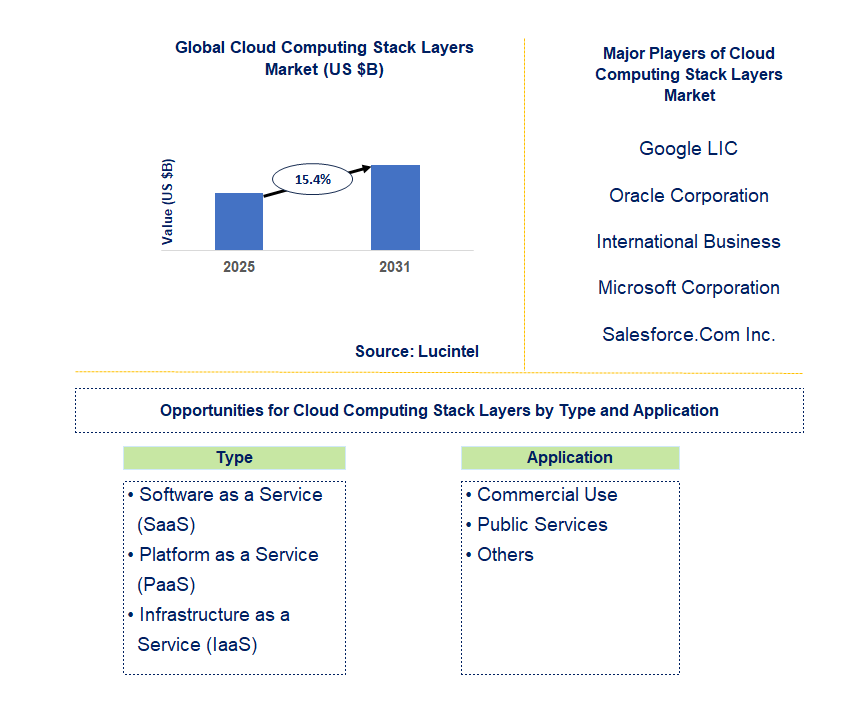
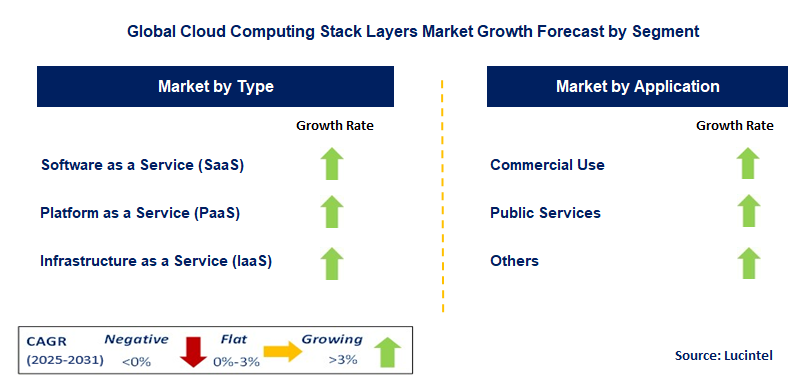
Key data points: The growth forecast = 15.4% annually for the next 7 years. Scroll below to get more insights. This market report covers Trends, opportunity and forecast in cloud computing stack layers market to 2031 by type (software as a service (SaaS), platform as a service (PaaS), and infrastructure as a service (IaaS)), application (commercial use, public services, and others), and region (North America, Europe, Asia Pacific, and the Rest of the World)
We'll send your sample report shortly.
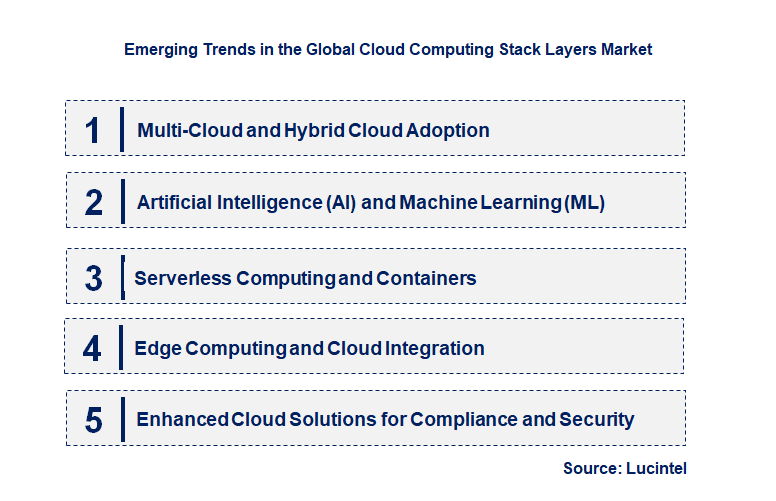
• Multi-Cloud and Hybrid Cloud Adoption: Multi-cloud and hybrid cloud strategies are becoming increasingly popular among businesses aiming to reduce dependency on a single cloud provider and enhance flexibility. Organizations are combining public and private cloud services to meet specific workload requirements, ensuring that they can manage costs and performance efficiently. This trend is driving providers to offer more seamless integration between various cloud platforms, providing businesses with greater control and scalability over their cloud environments.
• Artificial Intelligence (AI) and Machine Learning (ML) Integration: AI and ML integration with cloud services is enabling organizations to extract valuable insights from large datasets, automate tasks, and improve decision-making. Cloud providers are increasingly providing AI and ML tools as part of their stack, which businesses can leverage without requiring special infrastructure. This trend is fueling the growth of cloud-based intelligent applications, particularly in healthcare, finance, and retail industries where data-driven insights are crucial to success.
• Serverless Computing and Containers: Serverless computing and containerization are changing the way applications are built and deployed in the cloud. Serverless computing allows developers to run applications without managing the underlying infrastructure, while containers provide a lightweight, portable solution for deploying applications across different cloud environments. These technologies enable faster development cycles, lower operational costs, and enhanced scalability, making them attractive for businesses looking to modernize their application development processes.
• Edge Computing and Cloud Integration: As IoT devices proliferate, edge computing is emerging as a vital extension of the cloud. Edge computing involves processing data closer to the source of data generation, which reduces latency and improves performance for real-time applications. When integrated with cloud computing, edge computing enables organizations to efficiently handle large amounts of data and deliver faster, more responsive services. This trend is more important for sectors like manufacturing, transportation, and autonomous vehicles.
• Enhanced Cloud Solutions for Compliance and Security: As cloud adoption is on the rise, security and compliance remain the top priority for organizations. Cloud providers are investing heavily in enhancing security features, such as end-to-end encryption, advanced threat detection, and compliance with regional regulations. The demand for secure cloud solutions is driving the development of more robust cybersecurity tools and protocols, helping businesses protect sensitive data and comply with industry standards like GDPR, HIPAA, and others. These emerging trends are reshaping the cloud computing stack layers market by improving scalability, performance, and security. Businesses are increasingly adopting multi-cloud and hybrid cloud strategies, integrating AI and ML technologies, and leveraging serverless computing and edge computing to drive digital transformation. Enhanced cloud security and compliance solutions also play a critical role in ensuring data privacy and regulatory compliance. These trends are positioning cloud computing as a key enabler of business innovation and operational efficiency.
• Cloud Infrastructure as a Service (IaaS) Growth: The cloud infrastructure as a service (IaaS) market is growing rapidly as organizations shift from on-premises infrastructure to the cloud. IaaS allows organizations to scale their infrastructure needs dynamically, reducing capital expenditures and offering more flexibility. This development is being driven by the growing demand for cost-efficient, scalable computing resources and the increasing adoption of cloud-native technologies.
• Adoption of Cloud-Native Technologies: Cloud-native technologies, such as containers, microservices, and Kubernetes, are rapidly gaining traction as organizations move towards agile, scalable application development. These technologies allow businesses to build and deploy applications faster, with better scalability and resilience. This shift is enabling organizations to modernize their software architecture and respond more rapidly to market demands.
• Increased Investment in Cloud Security: Cloud security is a growing concern as cyber threats evolve, prompting businesses to invest in advanced security solutions. Cloud providers are enhancing their security offerings with features like encryption, identity and access management, and advanced threat detection. This focus on security is driving trust in cloud computing services, particularly for businesses that handle sensitive data or operate in highly regulated industries.
• Cloud Data Centers Expansion Globally: Cloud providers are rapidly expanding their data center footprints to meet the growing demand for cloud services. The expansion is particularly notable in emerging markets, where cloud adoption is accelerating. By establishing data centers closer to end-users, cloud providers can reduce latency and improve service performance. This development is also helping organizations comply with data residency requirements and ensure faster access to cloud services.
• Focus on Sustainability and Green Cloud Initiatives: Increasingly, concerns about the environment are bringing in the aspect of sustainability and green cloud initiatives by cloud providers. More providers commit to renewable sources of energy that power data centers, minimizing their carbon footprints. As sustainability is emerging as a prime differentiation for cloud providers, it attracts businesses to such partners that also support the objectives of these business entities related to the environment. These key developments are significantly influencing the cloud computing stack layers market by driving innovation and improving service offerings. The growing adoption of IaaS, cloud-native technologies, and enhanced cloud security solutions is enabling businesses to optimize their cloud infrastructure. The expansion of data centers and focus on sustainability are further accelerating cloud adoption globally. These developments are reshaping the market by providing businesses with more flexible, secure, and environmentally responsible cloud solutions.
• Growth in Cloud for Healthcare Applications: The adoption of cloud is increasing rapidly in the healthcare industry. This rise is due to a scalable, secure solution in the management of huge patient data volumes. Health care units can effectively store, access, and analyze patient data using cloud computing. It enhances patient outcomes and operational efficiency. Since healthcare regulatory compliance continues to become ever more complex, the need for secure, HIPAA-compliant cloud solutions becomes increasingly pressing-a significant growth area for cloud service providers in this industry.
• Cloud Adoption in the Financial Services Industry: The financial services sector is embracing cloud computing for improved agility, better data security, and less operational cost. Cloud solutions allow financial institutions to streamline operations, manage risk, and deliver innovative services such as mobile banking and digital payments. As demand for cloud-based financial services increases, along with challenges related to regulatory action, this highly regulated industry represents an opportunity for cloud providers to offer specialized solutions.
• Cloud-Based E-Commerce Solutions: The e-commerce industry is a fast-growing one. Scalable cloud-based solutions are in constant demand, capable of handling large transaction volumes and high customer traffic. Cloud computing allows e-commerce businesses flexibility in scaling infrastructure, enhancing customer experience, and incorporating new technologies like AI and ML. It is an application area that will remain a growth driver for cloud providers well into the future with the emergence of global e-commerce platforms.
• Cloud Adoption in Education and E-Learning: Cloud computing is transforming the education sector by enabling remote learning, collaboration, and data management. Educational institutions are adopting cloud-based platforms for virtual classrooms, digital content delivery, and administrative processes. The growing demand for e-learning solutions presents significant growth opportunities for cloud providers to offer customized solutions for educational institutions and e-learning platforms.
• Cloud Solutions for Smart Cities: The use of cloud computing supports smart cities to improve better infrastructure, transportation systems, energy, and public services. With the help of cloud solutions, a smart city can collect and analyze information provided by numerous sensors and IoT devices to make informed decisions and optimize resources. Based on the trend to modernize and green their cities, there is much scope for companies in the cloud space to provide customized solutions to smart city initiatives. Cloud computing stack layers market presents many strategic growth opportunities across various sectors such as healthcare, financial services, e-commerce, education, and smart cities. Such applications are driving the demand for flexible, secure, and scalable cloud solutions. The more businesses are embracing cloud computing to make things efficient and innovative, the market will grow and open doors to further growth and differentiation for cloud providers.
• Google LIC
• Oracle Corporation
• International Business Machines Corporation
• Microsoft Corporation
• Salesforce.Com Inc.
• Amazon Web Services Inc.
• OVHcloud
• Rackspace Inc.
• SAP SE
• Avaya Inc.
• Software as a Service (SaaS)
• Platform as a Service (PaaS)
• Infrastructure as a Service (IaaS)
• Commercial Use
• Public Services
• Others
• North America
• Europe
• Asia Pacific
• The Rest of the World
• United States: In the United States, the market for cloud computing stack layers has grown drastically. Main players in the sector are Amazon Web Services (AWS), Microsoft Azure, and Google Cloud. The multi-cloud strategy, hybrid cloud deployments, and the use of artificial intelligence and machine learning are driving the market. Government initiatives like the Federal Cloud Computing Strategy coupled with increased data security concerns have led to higher adoption of clouds across public as well as private sectors. This increased the demand for cloud infrastructure services and solutions in various industries.
• China: China has become one of the largest cloud markets worldwide, thanks to rapid digitization and robust government support for technological advancements. Investments from local companies such as Alibaba Cloud and Tencent Cloud have increased significantly in the country. China‘s cloud computing sector has been supported by policies that favor digital transformation, e-commerce growth, and 5G deployment. Besides that, regulations imposed by the government on data security and privacy encourage local and international companies to invest in cloud computing infrastructure. Further, AI and IoT applications increase the speed of cloud adoption.
• Germany: Cloud computing in Germany is progressing along with the ever-increasing digital transformation requirements across Europe. The country places significant emphasis on data privacy and compliance with the General Data Protection Regulation (GDPR), which has led to an increase in demand for cloud solutions that offer enhanced security features. Key players like Deutsche Telekom’s T-Systems and SAP are strengthening their cloud offerings to meet local regulatory standards and business needs. The growth of Industry 4.0, which integrates cloud with IoT and AI, is contributing to the growing adoption of cloud computing solutions across manufacturing and other sectors.
• India: India has emerged as a rapidly growing cloud computing market due to the surge in digital transformation and the expansion of internet connectivity. The increasing adoption of cloud services by businesses, government agencies, and startups is boosting the market. Heavy investment is being done by major players such as Amazon Web Services, Microsoft Azure, and Google Cloud in the region with data centers built to cater to local demand. Furthermore, the push from the Indian government for initiatives such as Digital India and the encouragement toward cloud-enabled smart cities has also helped boost the adoption of cloud solutions across education, healthcare, and e-commerce sectors.
• Japan: Market for cloud computing stack layers growing steadily in the country as corporations are increasingly taking to cloud adoption for innovation and operational efficiency. Focus on the development of smart cities, AI, and IoT is enhancing cloud service demand by NTT Communications and Rakuten. The Japan government has given significant importance to cloud-based solutions in healthcare services, financial institutions, and administration. Data security concern and regulatory compliance issues still haunt, but digital initiatives are happening at a frantic pace in that country, propelling the technology infrastructure, with a growth impact on the market of cloud computing.


• Google LIC
• Oracle Corporation
• International Business Machines Corporation
• Microsoft Corporation
• Salesforce.Com Inc.
• Amazon Web Services Inc.
• OVHcloud
• Rackspace Inc.
• SAP SE
• Avaya Inc. Q5. Which cloud computing stack layers market segment will be the largest in future? Answer: Lucintel forecasts that software as a service (SaaS) is expected to witness the highest growth over the forecast period due to the broad application across industries, cost-effectiveness, ease of use, and scalability. Q6. In cloud computing stack layers market, which region is expected to be the largest in next 5 years? Answer: North America is expected to witness the highest growth over the forecast period due to its mature and advanced technology ecosystem, widespread adoption of cloud services across industries. Q7. Do we receive customization in this report? Answer: Yes, Lucintel provides 10% customization without any additional cost.


Choose a license that fits your team. Instant PDF delivery.
Prices exclude taxes. Instant delivery. Custom licensing available on request.
Market Report · July 31, 2026
Market Report · July 31, 2026
Market Report · July 31, 2026
Trusted partner for strategic intelligence and business growth


Receive a complimentary market analysis tailored to your industry. Our analysts will identify key growth opportunities and competitive dynamics specific to your business.

Market size, growth rate, and key trend analysis for your specific sector.

Top competitor positioning and market share analysis.

Strategic recommendations backed by data-driven insights.
Get curated market intelligence and competitive moves straight to your inbox.
By subscribing, you agree to receive our monthly insights. Unsubscribe anytime.
Receive a complimentary market analysis tailored to your industry. Our analysts will identify key growth opportunities and competitive dynamics specific to your business.
Market size, growth rate, and key trend analysis for your specific sector.
Top competitor positioning and market share analysis.
Strategic recommendations backed by data-driven insights.
Get curated market intelligence, emerging trends, and competitive moves straight to your inbox each month.
By subscribing, you agree to receive our monthly insights. Unsubscribe anytime.
We'll send your sample report shortly.