
Market Report · July 16, 2026

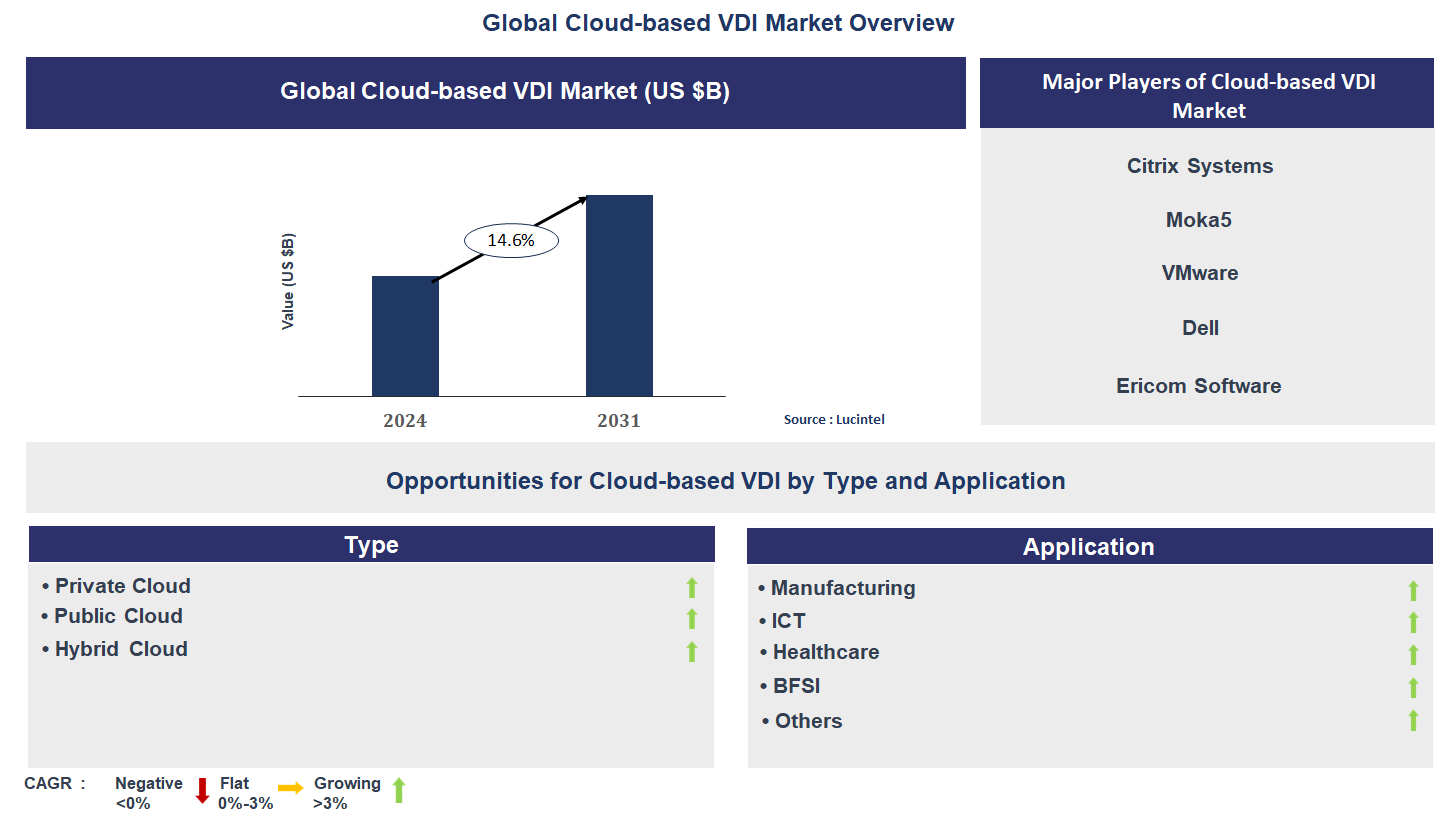
Key data points: The growth forecast = 14.6% annually for the next 7 years. Scroll below to get more insights. This market report covers trends, opportunities and forecasts in cloud-based VDI market to 2031 by type (private cloud, public cloud, and hybrid cloud), application (manufacturing, ICT, healthcare, BFSI, and others), and region (North America, Europe, Asia Pacific, and the Rest of the World)
We'll send your sample report shortly.
• Lucintel forecasts that, within the type category, hybrid cloud is expected to witness the highest growth over the forecast period.
• Within the application category, healthcare is expected to witness the highest growth.
• In terms of region, APAC is expected to witness the highest growth over the forecast period. Gain valuable insights for your business decisions with our comprehensive 150+ page report. Sample figures with some insights are shown below.
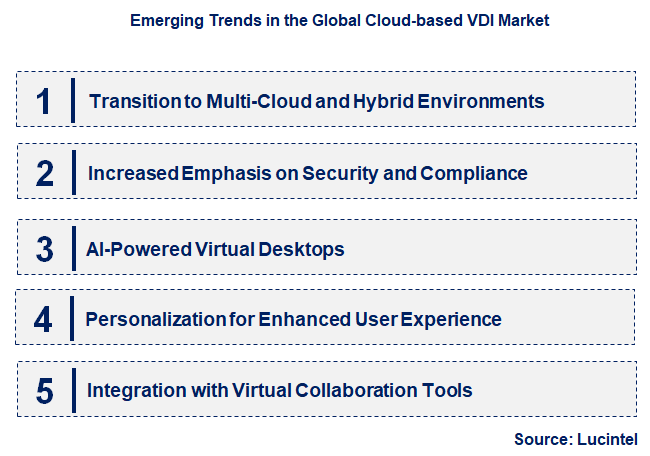
• Transition to Multi-Cloud and Hybrid Environments: Organizations are moving towards hybrid and multi-cloud VDI environments to enhance scalability, flexibility, and performance. These environments give organizations the leverage of utilizing the strengths of more than one cloud platform while keeping control of their infrastructure. Hybrid solutions are more desirable as they provide the ability to blend public cloud solutions with on-premise resources to address particular business needs.
• Increased Emphasis on Security and Compliance: As remote work has increased, securing cloud-based environments is at the forefront. Enterprises are implementing sophisticated security measures such as end-to-end encryption, multi-factor authentication, and zero-trust architecture to safeguard sensitive data. Compliance with local and international regulations, including GDPR and HIPAA, is also a top issue propelling organizations to consider VDI solutions that include built-in compliance capabilities.
• AI-Powered Virtual Desktops: Artificial intelligence (AI) is increasingly being used to enhance the performance and management of cloud-based VDI solutions. AI-powered virtual desktops provide improved automation features, including predictive analytics for workload optimization and real-time allocation of resources. These AI features enable companies to minimize operational costs and enhance overall user experiences through demand anticipation and virtual desktop environment optimization.
• Personalization for Enhanced User Experience: Improving the user experience is a growing importance in cloud-based VDI solutions. Organizations are utilizing sophisticated customization capabilities to provide customized virtual desktops that match individual user needs. This ranges from modifying desktop interfaces, application parameters, and even performance settings to enable users to work on applications and files with ease, enhancing productivity and satisfaction.
• Integration with Virtual Collaboration Tools: Cloud-based VDI solutions are being increasingly integrated with virtual collaboration tools like video conferencing, messaging platforms, and file-sharing systems. These integrations permit smooth communication and collaboration within the VDI environment, a requirement for organizations with remote or distributed teams. The trend is helping companies simplify workflows and improve team collaboration irrespective of geographical location. These trends indicate how the cloud-based VDI market is transforming towards increased security, flexibility, and integration with current collaboration tools. As companies continue to implement remote work and digital transformation, demand for cloud-based desktop virtualization solutions that focus on user experience, compliance, and performance is anticipated to grow.
• Advanced Security Features: VDI cloud-based solutions now incorporate advanced security features, including better encryption, multi-factor authentication (MFA), and real-time threat detection. These advances have come about due to the higher risk of cyberattacks, especially in the case of remote work. With the integration of these security features, VDI solutions help ensure that companies can offer secure access to business-critical applications and data without the trade-off of performance.
• Integration with Cloud-Based Storage Solutions: Several cloud-based VDI vendors are now integrating their offerings with cloud-based storage solutions to allow users to store and retrieve data effortlessly from their virtual desktops. This integration provides better scalability and flexibility while minimizing the use of on-premise storage infrastructure. It also enables centralized management of data, thereby making it convenient for organizations to handle their resources and make their data available.
• More User-Centric Solutions: There has been an increased focus on creating VDI solutions that make the user experience and customization more of a priority. Providers have been concentrating on providing virtual desktops that can be optimized according to the specific needs of users for a seamless and personalized experience. Customizable desktops, application performance optimization, and mobile support are all becoming the norm in cloud-based VDI solutions.
• Cost Savings and Efficiency: Cloud-based VDI solutions are being increasingly viewed as a means to optimize costs. By moving away from the conventional on-premises infrastructure to cloud-based environments, organizations can minimize capital expenses on hardware and software. Secondly, the pay-as-you-go pricing option made available by cloud services enables organizations to scale resources in proportion to demand, enabling cost savings and flexibility in resource allocation.
• Hybrid and Multi-Device Environment Support: With more businesses embracing a greater number of operating systems and devices, VDI vendors are making their solutions hybrid environment friendly. This involves providing virtual desktops that are compatible with multiple devices such as desktops, laptops, tablets, and smartphones. The feature to access virtual desktops from any device is becoming a deciding factor for cloud-based VDI solutions. All these advances tell us that cloud-based VDI solutions are becoming more secure, easier to use, and cost-effective. As companies implement more flexible working models, such solutions are likely to be a key tool in delivering instant and secure access to business-critical applications.
• Hybrid Cloud Solution Adoption: Companies are increasingly embracing hybrid cloud solutions, blending private and public cloud facilities to develop more scalable and agile VDI solutions. Hybrid cloud provides the advantages of both worlds—scalability on demand from the public cloud and added security from private cloud infrastructure. Providers can take advantage of this trend by providing hybrid VDI solutions that assimilate smoothly with current IT infrastructure.
• Target Small and Medium-Sized Businesses (SMEs): Although large businesses have been the early adopters of cloud-based VDI, SMEs are increasingly realizing its capability to facilitate cost reduction and enhance operational performance. By providing cost-effective and scalable VDI solutions that address the needs of smaller organizations, service providers can address this untapped market segment, offering an expanding customer base with a clear basis for future expansion.
• Cloud VDI for Education and Healthcare: The healthcare and education industries are the best prospects for cloud-based VDI deployments. VDI solutions can be utilized by educational institutions to support remote learning, and healthcare institutions can make use of VDI to offer secure access to patient records and medical applications. VDI providers can target these industries and propose custom solutions that suit particular regulatory and performance demands.
• AI and Automation in VDI Management: The inclusion of artificial intelligence (AI) and automation features in VDI solutions offers great growth opportunities. These features enable the optimization of resource management, performance, and security. The use of AI-based features allows VDI providers to provide efficient and cost-saving solutions for businesses seeking to optimize their IT functions.
• Regional Expansion into Emerging Markets: Growth into emerging markets is a significant opportunity for cloud-based VDI providers. Growing internet penetration and digital transformation projects in nations such as India, Brazil, and Southeast Asia provide suppliers with the ability to benefit from demand for cloud infrastructures supporting remote working, scalability, and agility. These expansion opportunities mirror the changing needs of companies and industries looking for more agile, scalable, and secure VDI solutions. Through access to new markets, industries, and through the application of advanced technologies, cloud-based VDI vendors can dramatically broaden their customer base and market presence.
• Citrix Systems
• Moka5
• VMware
• Dell
• Ericom Software
• HP
• Netelligent
• Red Hat
• Secure Online Desktop
• Virtual Bridge
• Private Cloud
• Public Cloud
• Hybrid Cloud
• Manufacturing
• ICT
• Healthcare
• BFSI
• Others
• North America
• Europe
• Asia Pacific
• The Rest of the World
• United States: In the US, cloud-based VDI adoption has grown at a very fast pace with the onset of the COVID-19 pandemic, which led to a massive shift towards remote working. The bigger organizations and SMBs are looking to deploy VDI solutions in increasing numbers to provide uninterrupted access to business applications remotely. The market is also experiencing growth in the demand for secure, scalable, and customizable VDI solutions on the basis of optimizing the user experience and minimizing infrastructure expenses.
• China: China has become one of the most prominent players in the cloud-based VDI market, with businesses adopting VDI solutions as a part of their overall digital transformation plans. The governments focus on smart cities and digital infrastructure has ignited demand for cloud services, including VDI. Chinese enterprises are seeking more cloud-based VDI solutions with high-performance computing and strong security capabilities. Local regulatory requirements for data privacy and cybersecurity levels hinder international VDI providers, hence a preference for local service providers that meet government regulations.
• Germany: In Germany, the growth of cloud-based VDI has been fueled by the growing demand for flexibility and cost savings. Businesses are looking for cloud solutions to enable hybrid work environments while complying with stringent data protection laws like the GDPR. The market is seeing more emphasis on private cloud VDI solutions that provide more control over data security. In addition, German businesses are leveraging VDI to enhance IT infrastructure management as well as simplify software deployment across varied sectors like finance, healthcare, and manufacturing.
• India: India cloud-based VDI market is growing with small and medium businesses (SMEs) and large businesses embracing cloud solutions to enhance operational effectiveness and deliver remote work capabilities. The impetus of the Indian government for digitalization and initiatives such as "Digital India" are driving demand for scalable cloud solutions. Moreover, since IT outsourcing is still robust in India, VDI solutions are gaining traction to facilitate cooperation and cater to the increasing demand for agile working environments. Internet connectivity and regional data centers issues need to be overcome for wide-scale adoption.
• Japan: Japans cloud-based VDI market is expanding steadily, with organizations looking for dependable and secure answers to facilitate remote work and digitalization. Cloud adoption is robust, particularly in the public and private sectors, where organizations are making VDI increasingly their go-to for secure remote access to critical systems. Japans emphasis on technological innovation, including automation and AI, is also fueling demand for sophisticated cloud infrastructure. The market is shifting to suit the tastes of local users, and it emphasizes user-centric solutions with a strong bias toward security, efficiency, and scalability.


• Citrix Systems
• Moka5
• VMware
• Dell
• Ericom Software
• HP
• Netelligent
• Red Hat
• Secure Online Desktop
• Virtual Bridge Q5. Which cloud-based VDI market segment will be the largest in future? Answer: Lucintel forecasts that, within the type category, hybrid cloud is expected to witness the highest growth over the forecast period. Q6. In cloud-based VDI market, which region is expected to be the largest in next 5 years? Answer: In terms of region, APAC is expected to witness the highest growth over the forecast period. Q7. Do we receive customization in this report? Answer: Yes, Lucintel provides 10% customization without any additional cost.


Choose a license that fits your team. Instant PDF delivery.
Prices exclude taxes. Instant delivery. Custom licensing available on request.
Market Report · July 16, 2026
Market Report · May 18, 2026
Market Report · May 18, 2026
Trusted partner for strategic intelligence and business growth


Receive a complimentary market analysis tailored to your industry. Our analysts will identify key growth opportunities and competitive dynamics specific to your business.

Market size, growth rate, and key trend analysis for your specific sector.

Top competitor positioning and market share analysis.

Strategic recommendations backed by data-driven insights.
Get curated market intelligence and competitive moves straight to your inbox.
By subscribing, you agree to receive our monthly insights. Unsubscribe anytime.
Receive a complimentary market analysis tailored to your industry. Our analysts will identify key growth opportunities and competitive dynamics specific to your business.
Market size, growth rate, and key trend analysis for your specific sector.
Top competitor positioning and market share analysis.
Strategic recommendations backed by data-driven insights.
Get curated market intelligence, emerging trends, and competitive moves straight to your inbox each month.
By subscribing, you agree to receive our monthly insights. Unsubscribe anytime.
We'll send your sample report shortly.