
Market Report · July 15, 2026

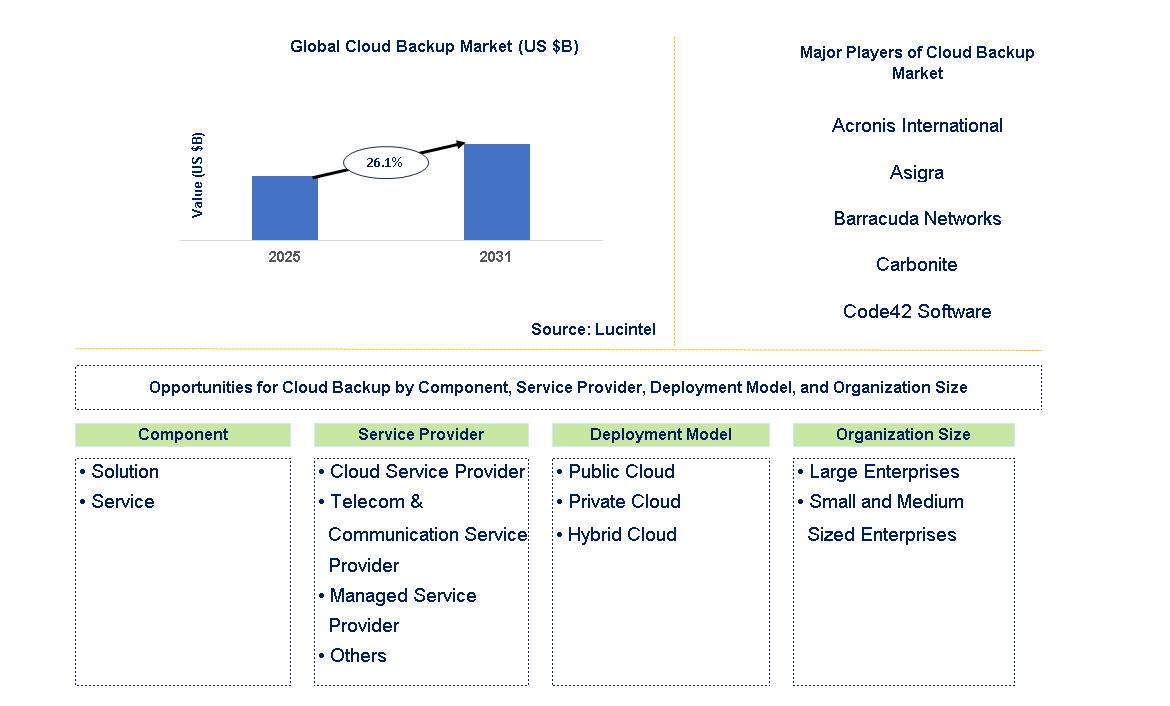
Key data points: The growth forecast = 26.1% annually for the next 7 years. Scroll below to get more insights. This market report covers trends, opportunities and forecasts in cloud backup market to 2031 by component (solution and service), service provider (cloud service provider, telecom & communication service provider, managed service provider, and others), deployment model (public cloud, private cloud, and hybrid cloud), organization size (large enterprises and small and medium-sized enterprises), and region (North America, Europe, Asia Pacific, and the Rest of the World)
We'll send your sample report shortly.
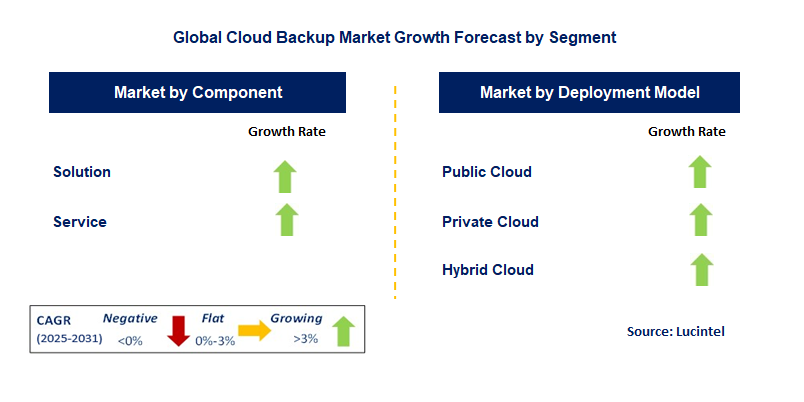
• Lucintel forecasts that, within the component category, service is expected to witness higher growth over the forecast period.
• Within the deployment model category, public cloud is expected to witness the highest growth.
• In terms of region, North America is expected to witness the highest growth over the forecast period. Gain valuable insights for your business decisions with our comprehensive 150+ page report. Sample figures with some insights are shown below.
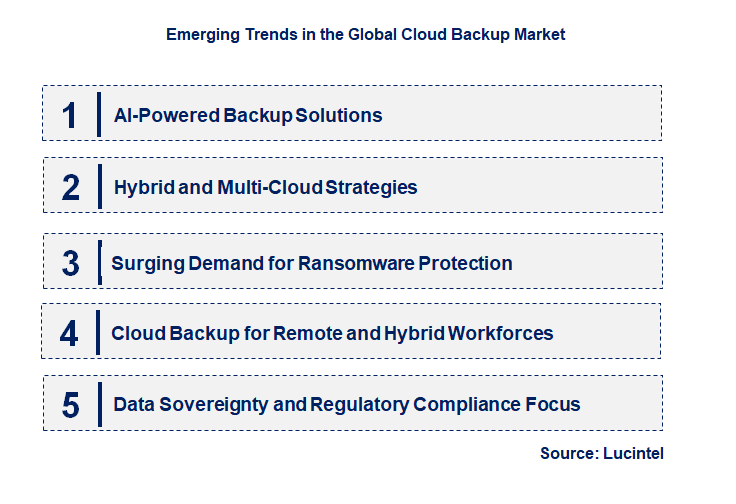
• AI-Powered Backup Solutions: Backup efficiency and security are being greatly enhanced by artificial intelligence. AI allows predictive analytics, anomaly detection, and smart recovery prioritization. These features assist in minimizing backup time, detecting likely risks, and recovering quicker during outages. As data complexity increases, AI-based automation avoids human errors and maintains data integrity. Businesses are implementing AI-enabled backup solutions to improve resiliency, lower operational costs, and simplify compliance management. The trend is likely to become a standard component of next-generation backup solutions.
• Hybrid and Multi-Cloud Strategies: Hybrid and multi-cloud strategies are being increasingly used by organizations to achieve cost, performance, and data sovereignty. Hybrid configurations enable data to be backed up on-premises as well as in the cloud, with flexibility and redundancy. Multi-cloud strategies minimize vendor lock-in and facilitate companies to decide on the most efficient service provider for each workload. Such strategies provide more resilience and the ability to design more specific disaster recovery plans. With companies looking for agility and security, hybrid and multi-cloud backup strategies are increasingly finding strong traction.
• Surging Demand for Ransomware Protection: Ransomware attacks have rendered secure cloud backup an utmost priority for business organizations. Ransomware detection technologies, immutable storage, and emergency recovery procedures are now being incorporated into backup systems. Backup solutions are now equipped with air-gapped replicas and multi-factor authentication to ensure unauthorized access. Organizations are making it a point to keep backup data resistant to ransomware. The trend is forcing innovation in backup infrastructure and investment in cybersecurity-enriched cloud backup systems.
• Cloud Backup for Remote and Hybrid Workforces: The transition to remote and hybrid work patterns has boosted the demand for easy-to-use, secure, and elastic cloud backup technologies. There is a need for data protection of remote devices and dispersed teams working beyond the corporate firewall. Cloud backup vendors are delivering endpoint backup solutions, real-time synchronization, and role-based access controls to meet that demand. As remote work is now permanent for most enterprises, cloud backup has to evolve to serve an extremely mobile and diverse workforce. It has to do so without sacrificing data security.
• Data Sovereignty and Regulatory Compliance Focus: Data protection legislation is fueling the need for region-specific and compliant cloud-based backup solutions. Companies are required to meet compliancy with regulations like GDPR, HIPAA, and industry-specific requirements. Cloud vendors are incorporating compliance features into their backup systems, such as audit trails, data residency, and encryption standards. This is driving the development of cloud services localized to the region and more alliances between local service providers and international vendors. Compliance is no longer an option but a major factor in choosing a backup solution. These new trends are redefining the cloud backup market by bringing it in sync with the evolving requirements of digital businesses. Advancements in AI, hybrid architectures, ransomware security, and compliance are propelling product development and vendor strategies. The inclusion of smart technologies and adaptive architectures guarantees that cloud backup becomes an integral part of contemporary IT infrastructure. As more businesses advance on their digital transformation paths, these trends will define data protection and continuity planning in the future.
• Rollout of AI-Based Recovery Platforms: A number of vendors have released AI-based platforms that facilitate predictive analytics and data recovery based on intelligence. The systems identify anomalies and recommend best recovery paths. They also offer backup optimization through the analysis of usage patterns. This innovation has improved backup reliability and recovery performance, especially in mission-critical environments.
• SaaS Application Integration: Cloud backup companies are now providing integration with well-known SaaS applications like Google Workspace, Salesforce, and Microsoft 365. This innovation enables automated backup of application data without any gaps in cloud-native business processes. It eases backup management and offers centralized visibility into secured data.
• Data Center Footprint Expansion: Major cloud providers have increased their presence of data centers globally to enhance data residency, lower latency, and maintain regional compliance. It aligns with data sovereignty needs and backs up service performance in new and regulated markets. Local infrastructure investments further enhance trust and adoption for enterprises.
• Immutable Backup Architectures Deployment: Immutable backup techniques are being implemented to protect data from ransomware and insider attacks. Such architectures guarantee that once data has been written, it cannot be modified or erased for a given retention duration. This innovation provides increased security and compliance confidence, particularly in healthcare and financial industries.
• Pay-as-You-Go Backup Model Adoption: Flexible pricing schemes are being implemented to accommodate the backup requirements of small and medium enterprises. It enables companies to pay only for what they use in terms of storage and features. It fosters access, scalability, and affordability. This trend is attracting more companies towards shifting to cloud-based backup systems. These critical innovations are transforming the cloud backup industry by improving security, scalability, and price. The deployment of smart features, further development of worldwide infrastructure, and emphasis on user-centric models are making cloud backup highly accessible and dependable. With more businesses depending on digital assets, such innovations are critical to ensure data resilience and business continuity.
• Healthcare Data Management: The healthcare sector is adopting cloud backup solutions to manage growing volumes of electronic medical records and ensure data security. Compliance with healthcare data regulations such as HIPAA is driving the need for encrypted, reliable, and redundant storage. Cloud backup supports the secure exchange of patient data across systems and facilities. Real-time backup and disaster recovery capabilities are critical for uninterrupted patient care. This opportunity allows vendors to offer sector-specific backup services, ensuring data integrity and accessibility in critical care environments.
• Financial Services Compliance: Financial institutions require robust data backup solutions to meet compliance with regulations such as SOX and GDPR. The sector is adopting cloud backup to ensure secure data archiving, transaction logging, and recovery from breaches or outages. Cloud solutions offer encrypted, scalable, and audit-ready storage options that support business continuity and fraud prevention. This growth opportunity focuses on enabling regulatory alignment while enhancing operational resilience. Providers can capture market share by offering tailored solutions with features such as multi-layer authentication and secure access management.
• Education Sector Digital Learning: Cloud backup is increasingly important in the education sector as digital learning becomes a mainstream model. Institutions require secure storage for course content, student data, and administrative systems. Backup solutions support the continuity of academic operations and remote learning environments. Cloud-based disaster recovery ensures minimal disruption during outages or cyberattacks. This opportunity allows vendors to address the unique needs of educational institutions by providing affordable, scalable, and compliant backup systems that protect sensitive academic data.
• IT and Managed Services Integration: IT service providers and managed service providers (MSPs) are integrating cloud backup into their offerings to meet client demands for comprehensive IT infrastructure. Cloud backup enables centralized management, remote monitoring, and automated scheduling. The rise in outsourced IT operations has created opportunities for providers to offer backup-as-a-service solutions. This segment is expected to drive demand for flexible pricing, scalability, and compatibility with diverse client environments. Providers can increase their value proposition by bundling cloud backup with monitoring and cybersecurity services.
• Government and Public Sector Compliance: Government agencies are embracing cloud backup to protect mission-critical data and ensure compliance with national data governance policies. Backup solutions support disaster recovery, inter-agency collaboration, and citizen data protection. The demand for sovereign cloud infrastructure and secure data handling is prompting public sector investment in compliant and resilient solutions. This opportunity emphasizes the role of data protection in maintaining public trust and continuity of services. Vendors with government-certified backup platforms can gain a competitive edge in this regulated market. Strategic growth opportunities across applications are redefining the cloud backup market. Tailored solutions for healthcare, finance, education, IT, and government are driving innovation and customization. These developments are prompting cloud backup vendors to focus on compliance, scalability, and automation. By addressing specific sector needs, providers can expand market reach and contribute to a more resilient digital economy.
• Acronis International
• Asigra
• Barracuda Networks
• Carbonite
• Code42 Software
• Datto
• Druva Software
• Efolder
• International Business Machines Corporation
• Iron Mountain Incorporated
• Solution
• Service
• Cloud Service Provider
• Telecom & Communication Service Provider
• Managed Service Provider
• Others
• North America
• Europe
• Asia Pacific
• The Rest of the World
• United States: The United States has seen rapid adoption of cloud backup technologies by government, healthcare, and financial organizations. Top technology companies have introduced zero-trust backup offerings and artificial intelligence-based threat detection capabilities. Cloud-native backup integration with corporate SaaS applications such as Microsoft 365 and Salesforce has picked up. Federal agencies have been expanding their moves of important data to the cloud, spearheaded by regulatory environments like FedRAMP. Investments in cyber resilience have been on the rise because of increasing ransomware attacks. These trends identify the United States as a leader in scalable and smart cloud backup systems.
• China: The Chinese cloud backup market is growing fast as state-owned companies are increasingly adopting digitalization and stringent data localization requirements. Top players are improving localized storage and backup functions according to the Chinese Cybersecurity Law. Policies such as the New Infrastructure Plan are promoting cloud infrastructure development. Local cloud titans are providing combined AI and blockchain-based backup services in an attempt to enhance security and confidence. Increasing multi-cloud strategy and hybrid cloud adoption demand is also responsible for the growth of cloud backup deployments in different industries in the Chinese economy.
• Germany: Germany has placed emphasis on improving data privacy and cloud backup services in compliance with the General Data Protection Regulation. Organizations are implementing end-to-end encrypted cloud backup infrastructure to provide secure storage within European borders. The growth in Industry 4.0 projects has raised the stakes for dependable data backup in manufacturing and logistics sectors. Local players are partnering with international vendors to provide GDPR-compliant cloud backup solutions. Government incentives to drive digital transformation among small and medium businesses have also stepped up cloud backup adoption nationwide.
• India: The Indian cloud backup industry is witnessing growth because of the growing startup ecosystem and the rising dependence on cloud operations. The take-up of government schemes such as Digital India and data protection acts has created awareness about secure cloud storage practices. Businesses in IT, education, and healthcare sectors are making investments in cost-effective and scalable backup solutions. Cloud-native vendors are providing elastic pricing and multi-level backup to meet the needs of small businesses. Growing cyber attacks have caused organizations to implement automated cloud-based disaster recovery plans to ensure business continuity.
• Japan: Japan is investing in high-end cloud backup technologies to support its digital transformation initiative. Organizations in industries like automotive, manufacturing, and finance are implementing hybrid backup strategies to deal with massive amounts of sensitive data. Government cloud cybersecurity programs and local laws are promoting data localization and cloud use. AI-driven predictive analytics and self-healing backup systems are being integrated by Japanese vendors in partnership with global players. The aging population has made workforce automation a major growth driver, thereby making Japan a top performer in operationally efficient cloud backup solutions.


• Acronis International
• Asigra
• Barracuda Networks
• Carbonite
• Code42 Software
• Datto
• Druva Software
• Efolder
• International Business Machines Corporation
• Iron Mountain Incorporated Q5. Which cloud backup market segment will be the largest in future? Answer: Lucintel forecasts that, within the component category, service is expected to witness higher growth over the forecast period. Q6. In cloud backup market, which region is expected to be the largest in next 5 years? Answer: In terms of region, North America is expected to witness the highest growth over the forecast period. Q7. Do we receive customization in this report? Answer: Yes, Lucintel provides 10% customization without any additional cost.


Choose a license that fits your team. Instant PDF delivery.
Prices exclude taxes. Instant delivery. Custom licensing available on request.
Market Report · July 15, 2026
Market Report · June 26, 2026
Market Report · June 24, 2026
Trusted partner for strategic intelligence and business growth


Receive a complimentary market analysis tailored to your industry. Our analysts will identify key growth opportunities and competitive dynamics specific to your business.

Market size, growth rate, and key trend analysis for your specific sector.

Top competitor positioning and market share analysis.

Strategic recommendations backed by data-driven insights.
Get curated market intelligence and competitive moves straight to your inbox.
By subscribing, you agree to receive our monthly insights. Unsubscribe anytime.
Receive a complimentary market analysis tailored to your industry. Our analysts will identify key growth opportunities and competitive dynamics specific to your business.
Market size, growth rate, and key trend analysis for your specific sector.
Top competitor positioning and market share analysis.
Strategic recommendations backed by data-driven insights.
Get curated market intelligence, emerging trends, and competitive moves straight to your inbox each month.
By subscribing, you agree to receive our monthly insights. Unsubscribe anytime.
We'll send your sample report shortly.