
Market Report · July 29, 2026

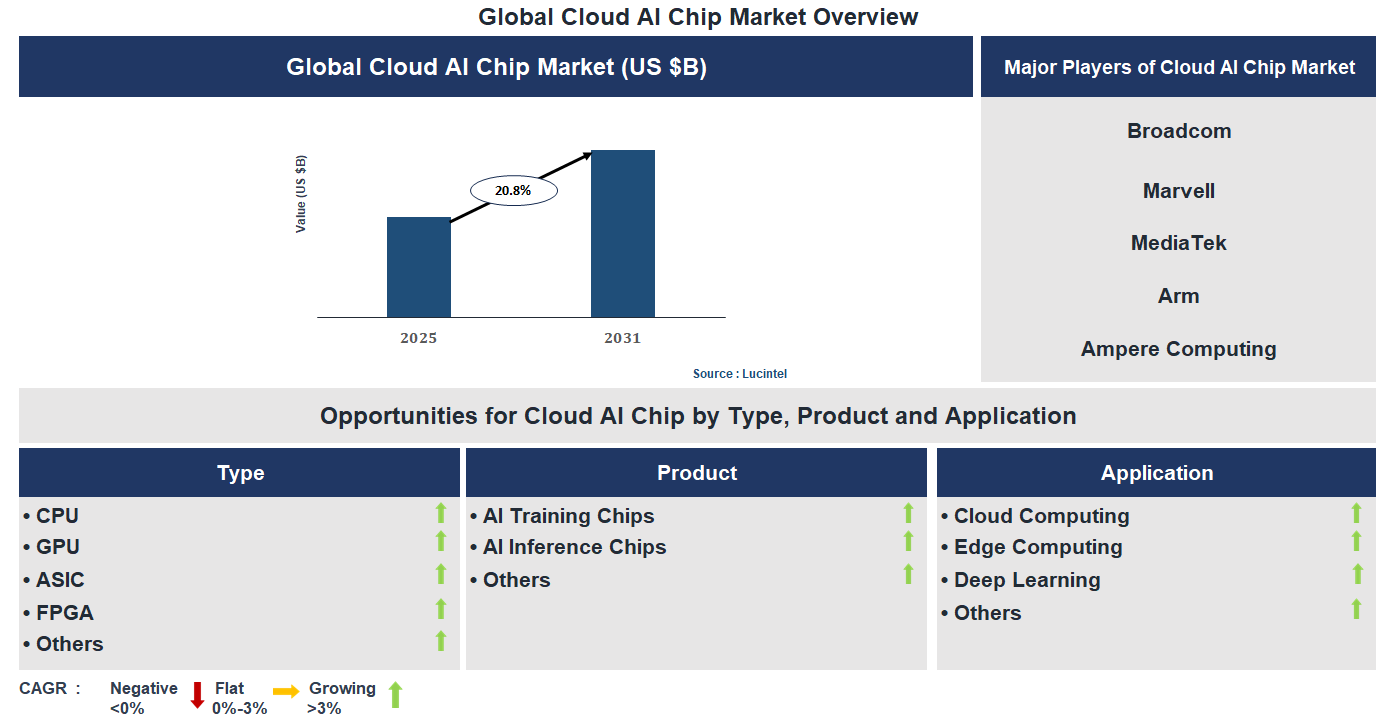
Key data points: The growth forecast = 20.8% annually for the next 6 years. Scroll below to get more insights. This market report covers trends, opportunities and forecasts in cloud AI chip market to 2031 by type (CPU, GPU, ASIC, FPGA, and others), product (AI training chips, AI inference chips, and others), application (cloud computing, edge computing, deep learning, and others), and region (North America, Europe, Asia Pacific, and the Rest of the World)
We'll send your sample report shortly.
• Lucintel forecasts that, within the type category, ASIC is expected to witness the highest growth over the forecast period.
• Within the application category, deep learning is expected to witness the highest growth.
• In terms of region, APAC is expected to witness the highest growth over the forecast period. Gain valuable insights for your business decisions with our comprehensive 150+ page report. Sample figures with some insights are shown below.
• Increased Adoption of Custom AI Chips: Custom-designed AI chips tailored for specific cloud workloads are gaining popularity. These chips offer optimized performance, lower latency, and improved energy efficiency compared to general-purpose processors. Major cloud providers are investing in developing proprietary hardware to gain a competitive edge, leading to a more tailored and efficient AI infrastructure. This trend enhances the ability to handle complex AI models at scale, reducing operational costs and improving user experience. As a result, the market is moving toward more specialized hardware solutions that meet diverse AI application needs.
• Integration of Edge AI with Cloud Infrastructure: The convergence of edge AI and cloud AI is creating a hybrid ecosystem that enhances real-time data processing and decision-making. Edge AI chips enable data processing closer to the source, reducing latency and bandwidth usage, while cloud AI provides scalable computing power. This integration supports applications like autonomous vehicles, smart cities, and IoT devices, where immediate data analysis is critical. The trend is driving innovation in chip design to support seamless connectivity and interoperability between edge and cloud environments, expanding AI deployment possibilities and improving overall system efficiency.
• Focus on Energy Efficiency and Sustainability: As AI workloads grow, so does the energy consumption associated with data centers and cloud infrastructure. Market players are prioritizing the development of energy-efficient AI chips that reduce power usage without compromising performance. This focus aligns with global sustainability goals and helps cloud providers lower operational costs. Innovations include the use of advanced manufacturing processes, low-power architectures, and specialized hardware accelerators. The emphasis on sustainability is reshaping product development strategies and influencing market competition, ultimately leading to greener and more cost-effective AI solutions.
• Advancements in Hardware-Software Co-Design: The trend toward integrated hardware and software development is enabling more optimized AI performance. By designing chips specifically for AI algorithms and frameworks, developers can achieve higher efficiency and better resource utilization. This co-design approach facilitates faster training and inference times, reduces bottlenecks, and enhances overall system robustness. Cloud providers are collaborating with hardware manufacturers to create tailored solutions that maximize AI workload performance. This synergy is transforming the market by fostering innovation and delivering more powerful, adaptable AI capabilities.
• Growing Role of AI Chips in Data Center Infrastructure: AI chips are becoming central to modern data center architectures, replacing traditional CPUs for specific workloads. These chips accelerate AI training and inference, enabling faster data processing and analytics. Cloud providers are investing heavily in AI hardware to support large-scale AI services and applications. The trend is leading to the development of integrated data center solutions that combine CPUs, GPUs, and AI accelerators for optimal performance. This shift is reshaping the infrastructure landscape, making data centers more efficient, scalable, and capable of supporting the next generation of AI-driven services. In summary, these emerging trends are fundamentally reshaping the cloud AI chip market by driving innovation, improving efficiency, and expanding application possibilities. The focus on customization, integration, sustainability, and infrastructure transformation is enabling more powerful, cost-effective, and accessible AI solutions. As these trends continue to evolve, they will significantly influence the competitive landscape and accelerate the adoption of AI across industries, fostering a more intelligent and connected future.

• Growth in Cloud AI Chip Adoption: Increasing integration of AI chips into cloud platforms is enhancing processing speed and efficiency. This trend allows businesses to handle complex AI workloads more effectively, reducing latency and operational costs. As cloud providers expand their AI offerings, the market is witnessing a surge in demand for specialized chips, which boosts innovation and competitiveness. This growth is expected to continue as AI applications become more sophisticated and widespread across industries.
• Advancements in Chip Technology: Innovations in chip architecture, such as neuromorphic and quantum-inspired designs, are significantly improving AI processing capabilities. These technological breakthroughs enable faster data analysis and lower power consumption, making AI solutions more scalable and sustainable. Companies investing in R&D are gaining competitive advantages, leading to a more dynamic market landscape. Enhanced chip performance is also facilitating the deployment of real-time AI applications, expanding market reach.
• Expansion of Cloud Service Providers: Major cloud providers like AWS, Google Cloud, and Microsoft Azure are heavily investing in AI chip integration to differentiate their services. This expansion allows for more tailored AI solutions, attracting a broader customer base. The increased deployment of AI chips in cloud infrastructure enhances service reliability and scalability, fostering innovation. As providers continue to develop proprietary chips, the market is poised for rapid growth, with more industries adopting cloud-based AI solutions.
• Rising Demand from Industry Verticals: Sectors such as healthcare, automotive, finance, and retail are increasingly adopting cloud AI chips to improve operational efficiency and decision-making. These industries require high-performance computing for tasks like diagnostics, autonomous driving, fraud detection, and personalized marketing. The integration of AI chips into cloud platforms enables real-time data processing and analytics, transforming business models. This vertical-specific demand is driving market expansion and encouraging tailored chip development.
• Increasing Focus on Sustainability and Energy Efficiency: Market players are prioritizing eco-friendly chip designs that consume less power without compromising performance. This focus aligns with global sustainability goals and reduces operational costs for data centers. Energy-efficient AI chips are crucial for large-scale cloud deployments, enabling greener data processing solutions. The push for sustainable technology is fostering innovation in chip manufacturing, influencing market dynamics, and attracting environmentally conscious customers. These developments are significantly transforming the cloud AI chip market by enhancing processing capabilities, expanding industry applications, and promoting sustainable practices. The integration of advanced chips into cloud infrastructure is driving innovation, increasing efficiency, and broadening market reach. As key players continue to invest in technology and infrastructure, the market is poised for sustained growth, shaping the future of AI-powered cloud services and redefining data processing standards globally.
• Expansion of AI Capabilities in Cloud Infrastructure: The integration of advanced AI chips into cloud infrastructure enables faster data processing, real-time analytics, and improved machine learning model training. This growth opportunity allows cloud providers to offer more powerful AI services, attract enterprise clients, and differentiate their offerings. As AI workloads become more complex, the demand for specialized chips that optimize performance and energy efficiency will surge, fueling market expansion.
• Increasing Adoption of Edge AI for Real-Time Processing: The rise of edge computing combined with AI chips allows data processing closer to data sources, reducing latency and bandwidth costs. This trend supports applications like autonomous vehicles, smart cities, and IoT devices. Cloud AI chip vendors can capitalize on this by developing scalable, energy-efficient chips tailored for edge environments, expanding their market reach, and enabling new use cases that require immediate data analysis.
• Strategic Collaborations Between Chip Manufacturers and Cloud Providers: Partnerships between AI chip developers and cloud service providers facilitate the development of optimized hardware and software solutions. These collaborations accelerate innovation, improve integration, and enhance performance for end-users. Such alliances can lead to co-branded products, joint marketing efforts, and shared R&D investments, creating a competitive advantage and expanding market penetration for both parties.
• Growing Demand for AI-Accelerated Cloud Services in Healthcare and Finance: Sectors like healthcare and finance are increasingly leveraging AI-powered cloud solutions for diagnostics, risk assessment, and fraud detection. The need for high-speed, energy-efficient AI chips to handle sensitive data securely and efficiently presents a significant growth opportunity. Vendors that tailor their offerings to meet industry-specific compliance and performance requirements can tap into these lucrative markets.
• Development of Custom AI Chips for Specific Cloud Applications: Customization of AI chips for particular cloud workloads, such as natural language processing or image recognition, enhances performance and reduces operational costs. This opportunity allows vendors to differentiate their products and meet the unique needs of diverse clients. As demand for specialized AI solutions grows, the market for tailored chips will expand, driving innovation and increasing revenue streams for chip manufacturers. The overall market outlook indicates that these growth opportunities will significantly influence the evolution of the cloud AI chip market, fostering innovation, expanding application domains, and enabling cloud providers to deliver more efficient, scalable, and specialized AI solutions across industries.
• Technological Innovation: The rapid evolution of AI algorithms and cloud infrastructure necessitates advanced hardware solutions. Cloud AI chips are designed to optimize processing power, reduce latency, and improve energy efficiency, enabling faster AI model training and inference. As organizations seek scalable and high-performance computing resources, demand for these specialized chips increases. Continuous R&D efforts lead to more sophisticated chip architectures, fostering innovation and expanding application possibilities across industries such as healthcare, finance, and autonomous vehicles. This technological progression directly fuels market growth by meeting the rising need for efficient AI processing at scale.
• Growing Data Volumes: The exponential increase in data generated by IoT devices, social media, and enterprise applications demands robust processing capabilities. Cloud AI chips are essential for managing and analyzing large datasets efficiently, enabling real-time insights and decision-making. As data volumes continue to grow, organizations require more powerful and scalable hardware solutions to handle this influx. The ability to process vast amounts of information quickly and accurately enhances operational efficiency and competitive advantage. This surge in data-driven applications significantly contributes to the expanding demand for cloud AI chips, reinforcing their critical role in modern digital ecosystems.
• Cloud Computing Expansion: The widespread adoption of cloud services by businesses of all sizes accelerates the need for high-performance hardware. Cloud providers are investing heavily in AI-specific infrastructure to support machine learning, deep learning, and analytics workloads. Cloud AI chips enable these providers to offer faster, more efficient services, reducing operational costs and improving user experience. The scalability and flexibility of cloud platforms make them ideal for deploying AI applications at scale. As cloud computing continues to grow, so does the demand for specialized AI hardware, positioning cloud AI chips as a vital component of the digital transformation journey.
• Strategic Investments and Partnerships: Major technology companies and startups are investing heavily in developing and deploying cloud AI chips. Collaborations between chip manufacturers, cloud service providers, and AI software firms foster innovation and accelerate product development. These strategic alliances facilitate the integration of cutting-edge hardware with cloud platforms, expanding market reach and application scope. Investment in R&D ensures the continuous improvement of chip performance, energy efficiency, and cost-effectiveness. Such initiatives attract funding, boost confidence among stakeholders, and drive market expansion, making strategic partnerships a key driver in shaping the future landscape of the cloud AI chip market.
• Regulatory and Standardization Frameworks: Increasing focus on data privacy, security, and ethical AI deployment influences hardware development and deployment strategies. Governments and industry bodies are establishing standards and regulations that impact how cloud AI chips are designed, manufactured, and used. Compliance with these standards ensures market acceptance and mitigates legal risks. Additionally, regulatory frameworks encourage innovation in secure and privacy-preserving hardware solutions, fostering trust among users and organizations. As these standards evolve, they shape product features and deployment models, ultimately influencing market growth by ensuring responsible and compliant AI hardware solutions. The challenges in the cloud AI chip market are:
• High Development and Manufacturing Costs: Developing advanced cloud AI chips involves significant investment in R&D, specialized manufacturing processes, and testing. These costs can be prohibitive for smaller players, limiting market competition and innovation. Additionally, the complexity of designing energy-efficient, high-performance chips increases production expenses. The need for continuous updates to keep pace with AI advancements further escalates costs. High manufacturing costs can lead to increased product prices, potentially restricting adoption among cost-sensitive customers and slowing overall market growth. Overcoming these financial barriers requires strategic investments and economies of scale.
• Rapid Technological Obsolescence: The fast-paced nature of AI and cloud technology means that hardware solutions can quickly become outdated. Continuous innovation demands frequent upgrades and new product launches, which can strain resources and lead to shorter product life cycles. Companies face the challenge of balancing investment in current technologies with the risk of obsolescence. This rapid evolution can also create compatibility issues, complicating integration with existing systems. Market players must stay agile and invest in flexible, upgradable hardware to remain competitive, but the pace of change can hinder long-term planning and profitability.
• Regulatory and Security Concerns: Increasing regulatory scrutiny around data privacy, security, and ethical AI deployment presents significant challenges. Compliance with diverse international standards requires ongoing modifications to hardware design and deployment practices, increasing costs and complexity. Security vulnerabilities in cloud AI chips can lead to data breaches and loss of trust, impacting market reputation and customer confidence. Navigating these regulatory landscapes demands substantial resources and expertise, which can be a barrier for smaller firms. Ensuring hardware security and regulatory compliance is critical but challenging, influencing market dynamics and potentially slowing innovation. In summary, the cloud AI chip market is driven by technological advancements, increasing data and cloud adoption, strategic investments, and regulatory developments. However, high costs, rapid obsolescence, and regulatory complexities pose significant challenges. These factors collectively shape the market’s growth trajectory, requiring stakeholders to innovate continuously, manage costs effectively, and navigate evolving standards. The interplay of drivers and challenges will determine the pace and direction of market expansion, emphasizing the need for strategic agility and technological resilience to capitalize on emerging opportunities.
• Broadcom
• Marvell
• MediaTek
• Arm
• Ampere Computing
• Tenstorrent
• SambaNova Systems
• Cerebras Systems
• Graphcore
• Groq
• CPU
• GPU
• ASIC
• FPGA
• Others
• AI Training Chips
• AI Inference Chips
• Others
• Cloud Computing
• Edge Computing
• Deep Learning
• Others
• North America
• Europe
• Asia Pacific
• The Rest of the World
• United States: The US leads in cloud AI chip innovation, with major companies like NVIDIA, Intel, and AMD investing heavily in R&D. Recent advancements include the launch of next-generation AI accelerators optimized for cloud data centers, improving processing speed and energy efficiency. The US government is also funding research initiatives to develop domestic AI chip manufacturing capabilities, reducing reliance on foreign suppliers. Cloud service providers such as Amazon Web Services and Google Cloud are integrating advanced AI chips to enhance their offerings, driving market growth. Startups are emerging with innovative solutions, further strengthening the USs position as a market leader.
• China: China is rapidly advancing in cloud AI chip development, supported by government initiatives like the "Made in China 2025" plan. Companies such as Huawei and Alibaba are developing domestically produced AI chips to reduce dependency on foreign technology. Recent breakthroughs include the launch of AI chips tailored for cloud computing and big data analytics, with a focus on cost-effective solutions. The Chinese market is witnessing increased investments in AI hardware startups, fostering innovation. Additionally, collaborations between tech giants and research institutions are accelerating the commercialization of new AI chip technologies, positioning China as a significant player in the global market.
• Germany: Germany is focusing on integrating AI chips into industrial and automotive applications, leveraging its strong manufacturing base. Recent developments include partnerships between automotive manufacturers and chip developers to create specialized AI chips for autonomous vehicles and smart factories. The country is also investing in research projects aimed at improving the energy efficiency and reliability of AI chips for cloud applications. German startups are exploring innovative designs for AI hardware, supported by government grants and EU funding programs. These efforts aim to enhance Germany’s competitiveness in the European AI ecosystem and promote sustainable technological growth.
• India: India is emerging as a key player in cloud AI chip development, with increased government support and private sector investments. Recent initiatives include the launch of indigenous AI chip projects aimed at reducing import dependence and fostering local innovation. Indian startups are developing affordable AI chips optimized for cloud computing, targeting both domestic and international markets. Collaborations with academic institutions are driving research in AI hardware design. The government’s focus on digital transformation and smart infrastructure is creating a conducive environment for AI chip advancements, positioning India as a growing hub for AI hardware innovation in the region.
• Japan: Japan is emphasizing the development of energy-efficient AI chips for cloud applications, leveraging its expertise in electronics and manufacturing. Recent progress includes the creation of AI chips designed for high-performance computing with low power consumption, suitable for cloud data centers. Japanese companies are collaborating with global tech firms to incorporate advanced AI hardware into their cloud services. The government is supporting R&D through funding programs aimed at sustainable and resilient AI hardware solutions. Japan’s focus on innovation and quality is driving the development of specialized AI chips that cater to the needs of cloud infrastructure, reinforcing its position in the global market.


• Broadcom
• Marvell
• MediaTek
• Arm
• Ampere Computing
• Tenstorrent
• SambaNova Systems
• Cerebras Systems
• Graphcore
• Groq Q5. Which cloud AI chip market segment will be the largest in future? Answer: Lucintel forecasts that, within the type category, ASIC is expected to witness the highest growth over the forecast period. Q6. In cloud AI chip market, which region is expected to be the largest in next 5 years? Answer: In terms of region, APAC is expected to witness the highest growth over the forecast period. Q7. Do we receive customization in this report? Answer: Yes, Lucintel provides 10% customization without any additional cost.


Choose a license that fits your team. Instant PDF delivery.
Prices exclude taxes. Instant delivery. Custom licensing available on request.
Market Report · July 29, 2026
Market Report · July 20, 2026
Market Report · July 20, 2026
Trusted partner for strategic intelligence and business growth


Receive a complimentary market analysis tailored to your industry. Our analysts will identify key growth opportunities and competitive dynamics specific to your business.

Market size, growth rate, and key trend analysis for your specific sector.

Top competitor positioning and market share analysis.

Strategic recommendations backed by data-driven insights.
Get curated market intelligence and competitive moves straight to your inbox.
By subscribing, you agree to receive our monthly insights. Unsubscribe anytime.
Receive a complimentary market analysis tailored to your industry. Our analysts will identify key growth opportunities and competitive dynamics specific to your business.
Market size, growth rate, and key trend analysis for your specific sector.
Top competitor positioning and market share analysis.
Strategic recommendations backed by data-driven insights.
Get curated market intelligence, emerging trends, and competitive moves straight to your inbox each month.
By subscribing, you agree to receive our monthly insights. Unsubscribe anytime.
We'll send your sample report shortly.