
Market Report · July 29, 2026

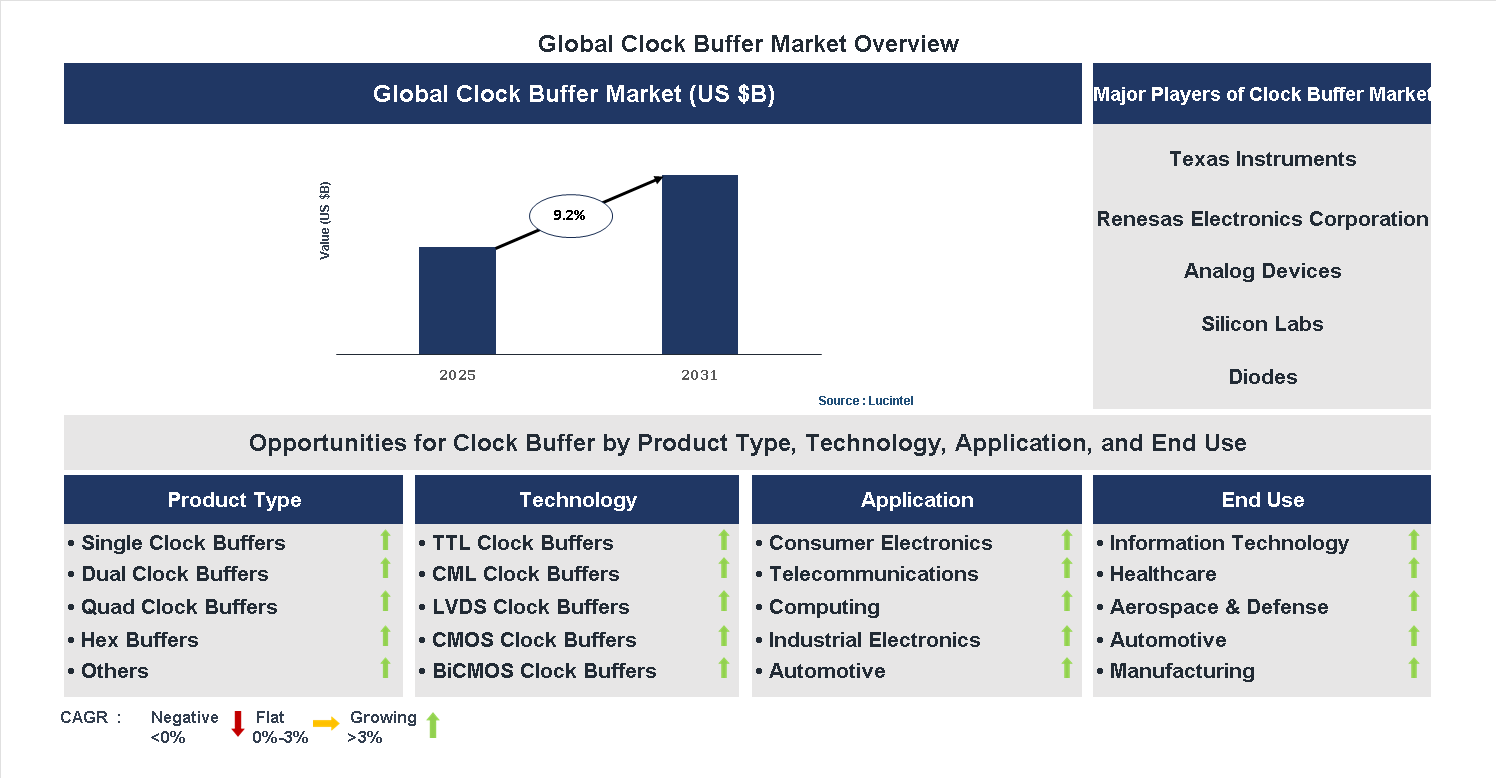
Key data points: The growth forecast = 9.2% annually for the next 7 years. Scroll below to get more insights. This market report covers trends, opportunities and forecasts in clock buffer market to 2031 by product type (single clock buffers, dual clock buffers, quad clock buffers, hex buffers, and others), technology (TTL clock buffers, CML clock buffers, LVDS clock buffers, CMOS clock buffers, and BICMOS clock buffers), application (consumer electronics, telecommunications, computing, industrial electronics, and automotive), end use (information technology, healthcare, aerospace & defense, automotive, and manufacturing), and region (North America, Europe, Asia Pacific, and the Rest of the World)
We'll send your sample report shortly.
• Lucintel forecasts that, within the product type category, quad clock buffer is expected to witness the highest growth over the forecast period.
• Within the end use category, information technology is expected to witness the highest growth.
• In terms of region, APAC is expected to witness the highest growth over the forecast period. Gain valuable insights for your business decisions with our comprehensive 150+ page report. Sample figures with some insights are shown below.
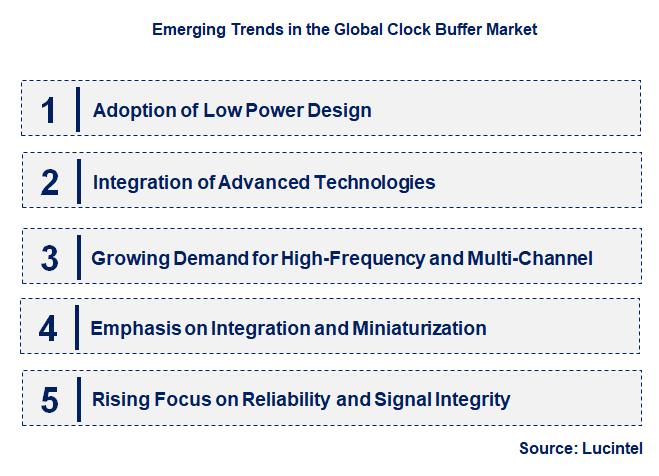
• Adoption of Low Power Design: The industry is shifting towards low-power clock buffers to reduce energy consumption in portable and energy-efficient devices. This trend is driven by the increasing demand for battery-powered electronics and environmentally sustainable solutions. Low-power clock buffers help extend device battery life and reduce overall power consumption in data centers and high-performance computing systems. As energy efficiency becomes a key criterion, manufacturers are innovating with new materials and circuit designs to deliver high performance with minimal power usage, thus expanding market opportunities in green technology sectors.
• Integration of Advanced Technologies: Incorporating technologies such as Silicon Germanium (SiGe) and FinFET transistors into clock buffers enhances performance, speed, and signal integrity. These advanced materials enable higher frequency operation and better noise immunity, which are critical for high-speed applications like 5G networks and data centers. The integration of these technologies allows for more compact, efficient, and reliable clock distribution solutions, meeting the demands of next-generation electronic devices. This trend is fostering innovation and enabling the development of more sophisticated timing solutions that support the growing complexity of digital systems.
• Growing Demand for High-Frequency and Multi-Channel Buffers: As devices become faster and more complex, there is an increasing need for high-frequency clock buffers capable of supporting multi-channel configurations. These buffers ensure synchronized operation across multiple components, reducing timing errors and signal degradation. Industries such as telecommunications, aerospace, and high-performance computing are driving this demand. The development of multi-channel buffers improves system stability and performance, enabling more efficient data transfer and processing. This trend is pushing manufacturers to innovate with scalable, high-speed solutions that can handle the increasing data throughput requirements.
• Emphasis on Integration and Miniaturization: The market is witnessing a push towards integrating clock buffers into System-on-Chip (SoC) designs to save space and reduce complexity. Miniaturization is essential for portable devices, wearables, and compact electronic systems. Integrated clock buffers improve overall system performance by reducing parasitic effects and signal delay. This trend is supported by advancements in semiconductor fabrication technologies, allowing for more compact and efficient designs. As a result, manufacturers are focusing on developing highly integrated solutions that deliver high performance within smaller footprints, opening new avenues in consumer electronics and IoT applications.
• Rising Focus on Reliability and Signal Integrity: Ensuring consistent performance and minimizing jitter and skew are critical in clock buffer design. The market is increasingly emphasizing robust solutions that maintain signal integrity under various operating conditions. This trend is driven by the need for dependable timing in critical applications such as aerospace, medical devices, and high-speed communication systems. Innovations include improved shielding, better power management, and advanced circuit techniques to reduce noise and interference. Enhanced reliability and signal integrity are vital for maintaining system stability, reducing downtime, and ensuring compliance with stringent industry standards, thereby boosting market confidence and adoption. In summary, these emerging trends are fundamentally reshaping the clock buffer market by promoting energy efficiency, technological innovation, higher performance, miniaturization, and reliability. These developments are enabling the industry to meet the increasing demands of modern electronic systems, fostering growth across various sectors, and paving the way for future advancements in digital timing solutions.
• Integration of Low-Power Technologies: The adoption of low-power design techniques in clock buffers has led to reduced energy consumption, which is critical for battery-powered devices and energy-efficient systems. This development enhances device longevity and supports sustainable electronics, thereby expanding market applications and increasing demand for advanced clock buffer solutions.
• Emergence of High-Speed Clock Buffers: Innovations in high-speed clock buffers enable faster data transfer rates and improved signal integrity in high-performance computing and telecommunications. This development has significantly impacted the market by supporting the growth of data centers, 5G infrastructure, and high-frequency trading systems, where timing precision is crucial.
• Adoption of CMOS Technology: The shift towards CMOS-based clock buffers has improved integration density and reduced manufacturing costs. This technological advancement allows for more compact designs and supports the miniaturization trend in electronic devices, broadening the market scope and enabling new product innovations.
• Development of Programmable and Reconfigurable Clock Buffers: The introduction of programmable clock buffers offers flexibility in clock distribution and system customization. This development enhances system performance and simplifies design modifications, making clock buffers more adaptable to diverse applications and increasing their market adoption.
• Focus on Signal Integrity and Noise Reduction: Recent efforts to improve signal integrity and minimize jitter and noise have led to more reliable clock distribution. These improvements are vital for sensitive applications such as aerospace, medical devices, and high-speed computing, thereby expanding the market for high-quality clock buffer solutions. In summary, these recent developments are driving the clock buffer market towards higher performance, greater efficiency, and broader application scope. The integration of low-power and high-speed technologies, along with advancements in CMOS and reconfigurable solutions, is fostering innovation and competitive growth. Enhanced signal integrity and miniaturization are further supporting market expansion, positioning the industry for sustained growth in the evolving electronics landscape.
• Consumer Electronics: Enhanced clock buffers improve device performance and power efficiency, enabling faster processing and longer battery life in smartphones, tablets, and wearables, thus driving market growth.
• Telecommunications: As 5G networks expand, reliable clock distribution becomes critical for network synchronization, making advanced clock buffers essential for maintaining high-speed, low-latency communication.
• Data Centers: The increasing volume of data traffic necessitates robust clock distribution solutions to ensure system stability and performance, positioning clock buffers as vital components in data infrastructure.
• Automotive: The rise of autonomous vehicles and connected car systems demands precise timing for sensors and communication modules, boosting demand for high-performance clock buffers in automotive electronics.
• Industrial Automation: Growing adoption of IoT and smart manufacturing requires synchronized operations, where clock buffers facilitate accurate timing, enhancing efficiency and reliability in industrial systems. In summary, these growth opportunities are significantly impacting the clock buffer market by expanding its application scope and driving technological innovation. The increasing need for precise, reliable, and efficient timing solutions across diverse sectors is fueling market expansion. As industries continue to adopt advanced digital systems, the demand for sophisticated clock buffer technologies will grow, fostering competitive advancements and opening new revenue streams. This evolution is positioning the market for sustained growth and strategic development in the coming years.
• Technological Innovation: The rapid evolution of semiconductor technology necessitates advanced clock buffers to support high-speed data transfer and reduce signal integrity issues. As devices become more complex, the demand for precise timing solutions increases, prompting manufacturers to develop innovative buffer architectures that enhance performance and power efficiency. This technological progression ensures the market remains competitive and aligned with industry needs, fostering continuous growth.
• Growing Adoption of IoT and Wearables: The proliferation of Internet of Things (IoT) devices and wearable technology has significantly increased the demand for compact, energy-efficient clock buffers. These devices require reliable timing components to ensure seamless data synchronization and operation. As IoT applications expand across industries such as healthcare, automotive, and smart homes, the market for clock buffers is expected to grow correspondingly, driven by the need for miniaturization and low power consumption.
• Increasing Demand for High-Speed Data Processing: The surge in data-intensive applications like cloud computing, 5G networks, and artificial intelligence necessitates high-performance clock buffers capable of supporting faster data rates. These buffers are critical in maintaining signal integrity and synchronization across high-speed circuits. The push for faster, more efficient data processing systems directly fuels the demand for advanced clock buffering solutions, thereby expanding the market.
• Rising Investment in Semiconductor Manufacturing: Governments and private entities are increasing investments in semiconductor fabrication facilities to meet global demand. This investment boosts the production of integrated circuits, which rely heavily on clock buffers for timing accuracy. As manufacturing capacity expands, so does the need for sophisticated clock buffering components, driving market growth and technological innovation.
• Regulatory and Industry Standards: Stringent regulations concerning energy efficiency, electromagnetic compatibility, and electronic safety influence the design and deployment of clock buffers. Compliance with these standards encourages the development of low-power, environmentally friendly solutions. Adapting to evolving regulatory requirements ensures market players remain competitive and compliant, fostering sustainable growth. The challenges facing this clock buffer market include:
• Complexity of Integration: Integrating clock buffers into increasingly complex IC designs presents significant challenges. As circuits become more miniaturized and multi-functional, ensuring compatibility and optimal performance of clock buffers requires advanced design techniques. This complexity can lead to increased development time, higher costs, and potential reliability issues, hindering market growth and innovation.
• Power Consumption Concerns: Despite advancements, power consumption remains a critical issue, especially for portable and battery-operated devices. Developing clock buffers that deliver high performance while maintaining low power usage is challenging. Excessive power consumption can lead to thermal management issues and reduced device lifespan, limiting adoption in energy-sensitive applications.
• Rapid Technological Obsolescence: The fast-paced nature of technological advancements in semiconductors means that clock buffer solutions can quickly become outdated. Companies face pressure to continuously innovate and upgrade their offerings, which can increase R&D costs and lead to market saturation with obsolete products. This rapid obsolescence poses a significant challenge to sustained market stability and profitability. In summary, the clock buffer market is driven by technological advancements, increasing adoption of IoT and high-speed data applications, and supportive investments and regulations. However, integration complexity, power consumption issues, and rapid technological changes pose notable challenges. These factors collectively influence the markets trajectory, requiring stakeholders to innovate continuously and adapt to evolving standards. Overall, the markets growth prospects remain promising, provided that companies effectively address these challenges through strategic R&D and technological innovation.
• Texas Instruments
• Renesas Electronics Corporation
• Analog Devices
• Silicon Labs
• Diodes
• ON Semiconductor
• Cypress Semiconductor
• Maxim Integrated
• Microchip
• AKM
• Single Clock Buffers
• Dual Clock Buffers
• Quad Clock Buffers
• Hex Buffers
• Others
• TTL Clock Buffers
• CML Clock Buffers
• LVDS Clock Buffers
• CMOS Clock Buffers
• BiCMOS Clock Buffers
• Consumer Electronics
• Telecommunications
• Computing
• Industrial Electronics
• Automotive
• Information Technology
• Healthcare
• Aerospace & Defense
• Automotive
• Manufacturing
• North America
• Europe
• Asia Pacific
• The Rest of the World
• United States: The US market has seen substantial growth driven by advancements in data centers and cloud infrastructure. Major tech companies are investing heavily in developing high-speed, low-latency clock buffers to support 5G and AI applications. Innovation in integrated circuit design and the adoption of advanced manufacturing processes have improved performance and energy efficiency. The US government’s focus on semiconductor research and development has further boosted local production capabilities, fostering a competitive environment for clock buffer technology.
• China: China is rapidly expanding its clock buffer market through significant investments in semiconductor manufacturing and research. The government’s "Made in China 2025" initiative emphasizes domestic chip production, leading to increased R&D activities. Chinese companies are focusing on developing cost-effective, high-performance clock buffers to meet the demands of 5G infrastructure and consumer electronics. Strategic collaborations with international firms and advancements in materials science are also contributing to the market’s growth.
• Germany: Germany’s market is characterized by its strong automotive and industrial sectors, which require precise timing solutions. The country is investing in innovative clock buffer designs to enhance the reliability and efficiency of automotive electronics and industrial automation systems. German firms are also focusing on integrating clock buffers into smart manufacturing and Industry 4.0 initiatives. The emphasis on quality and durability has driven the development of high-performance, robust clock buffer solutions tailored for industrial applications.
• India: India’s clock buffer market is witnessing rapid expansion due to the growing electronics manufacturing sector and government initiatives like "Make in India." The focus is on developing cost-effective, energy-efficient clock buffers to support the burgeoning telecom and consumer electronics industries. Local startups and established players are investing in R&D to improve product performance and reduce dependence on imports. The increasing adoption of 5G and IoT devices is expected to further propel market growth in the coming years.
• Japan: Japan remains a key player in the clock buffer market, driven by its advanced semiconductor industry and focus on innovation. Japanese companies are developing high-precision, low-power clock buffers for use in consumer electronics, automotive, and industrial applications. The country’s emphasis on miniaturization and energy efficiency has led to breakthroughs in materials and design. Collaborations between industry and academia are fostering new solutions that enhance performance and reliability, maintaining Japan’s competitive edge in this sector.


• Texas Instruments
• Renesas Electronics Corporation
• Analog Devices
• Silicon Labs
• Diodes
• ON Semiconductor
• Cypress Semiconductor
• Maxim Integrated
• Microchip
• AKM Q5. Which clock buffer market segment will be the largest in future? Answer: Lucintel forecasts that, within the product type category, quad clock buffer is expected to witness the highest growth over the forecast period. Q6. In clock buffer market, which region is expected to be the largest in next 5 years? Answer: In terms of region, APAC is expected to witness the highest growth over the forecast period. Q7. Do we receive customization in this report? Answer: Yes, Lucintel provides 10% customization without any additional cost.


Choose a license that fits your team. Instant PDF delivery.
Prices exclude taxes. Instant delivery. Custom licensing available on request.
Market Report · July 29, 2026
Market Report · July 20, 2026
Market Report · July 20, 2026
Trusted partner for strategic intelligence and business growth


Receive a complimentary market analysis tailored to your industry. Our analysts will identify key growth opportunities and competitive dynamics specific to your business.

Market size, growth rate, and key trend analysis for your specific sector.

Top competitor positioning and market share analysis.

Strategic recommendations backed by data-driven insights.
Get curated market intelligence and competitive moves straight to your inbox.
By subscribing, you agree to receive our monthly insights. Unsubscribe anytime.
Receive a complimentary market analysis tailored to your industry. Our analysts will identify key growth opportunities and competitive dynamics specific to your business.
Market size, growth rate, and key trend analysis for your specific sector.
Top competitor positioning and market share analysis.
Strategic recommendations backed by data-driven insights.
Get curated market intelligence, emerging trends, and competitive moves straight to your inbox each month.
By subscribing, you agree to receive our monthly insights. Unsubscribe anytime.
We'll send your sample report shortly.