
Market Report · July 15, 2026

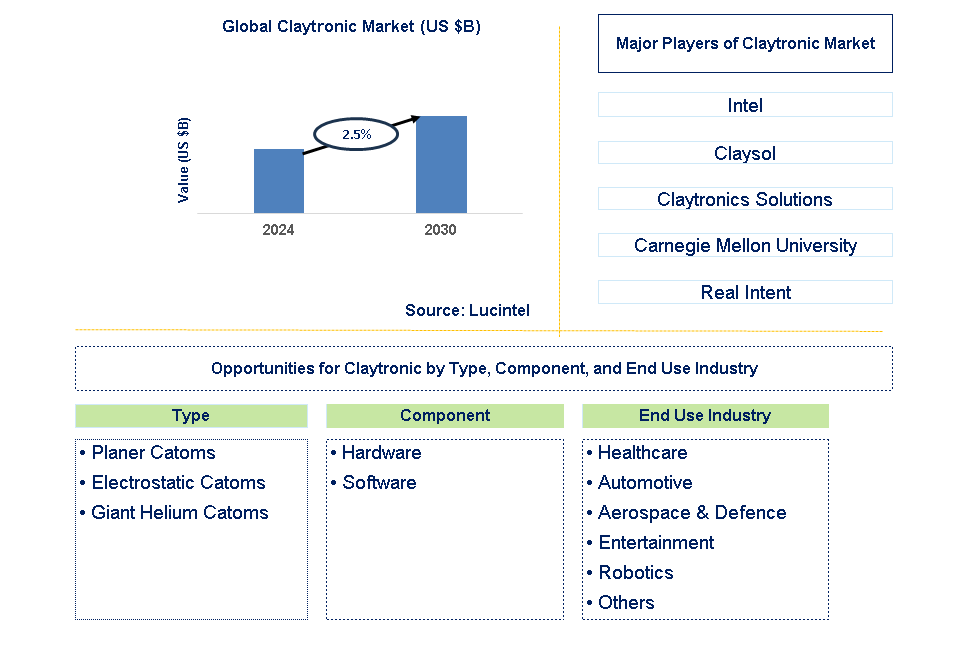
Key data points: The growth forecast = 2.5% annually for the next 6 years. Scroll below to get more insights. This market report covers trends, opportunities, and forecasts in the global claytronic market to 2030 by type (planer catoms, electrostatic catoms, and giant helium catoms), component (hardware and software), end use industry (healthcare, automotive, aerospace & defense, entertainment, robotics, and others), and region (North America, Europe, Asia Pacific, and the Rest of the World)
We'll send your sample report shortly.
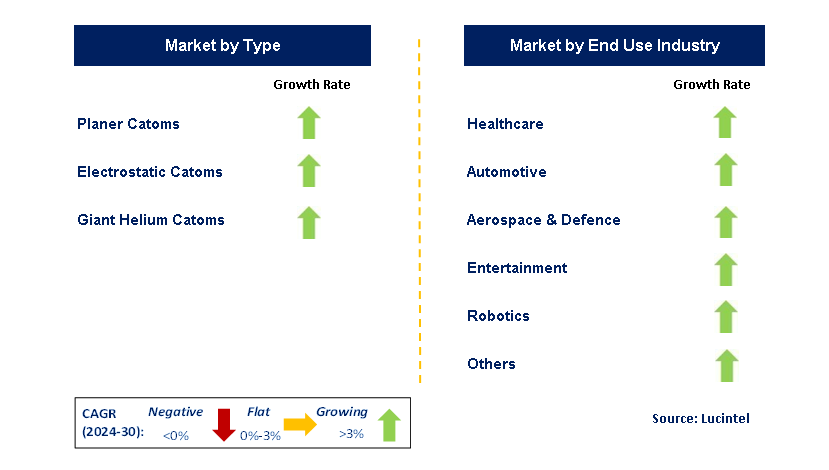
• Lucintel forecasts that, within the component category, hardware is expected to witness a higher growth over the forecast period.
• Within the end use category, healthcare is expected to witness highest growth over the forecast period.
• In terms of regions, North America is expected to witness highest growth over the forecast period. Gain valuable insights for your business decisions with our comprehensive 150+ page report.
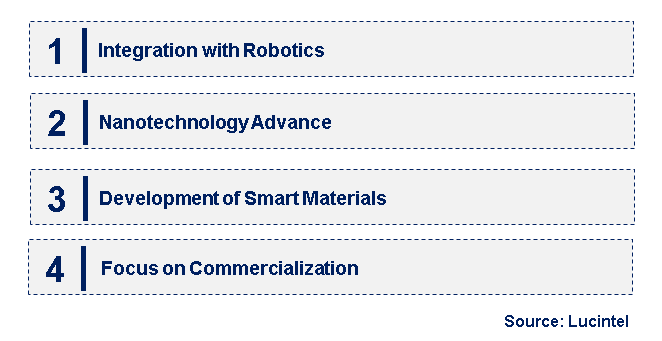
• Integration with Robotics: Claytronics is being integrated more with robotics in adaptive and interactive systems. This integration enables robots to manipulate their physical form and interact with the environment. It is opening new frontiers for applications such as manufacturing, healthcare, and entertainment, enhancing flexibility and functionality.
• Nanotechnology Advances: The advancement of nanotechnology is driving innovation in claytronics through the capability for more controlled programmable matter at the molecular level. These techniques improve the performance and scalability of claytronic systems, thus enabling the development of more advanced and diverse applications. As nanotechnology advances, control over matter becomes more precise, greatly extending the possible applications of programmable matter.
• Development of Smart Materials: There is increasing interest in the development of smart materials whose properties may be dynamically changed by external environmental stimuli. The integration of smart materials and claytronics will fully enable the implementation of adaptive systems that can respond to changes in their environment. Applications for such materials are further extended to adaptive architecture, consumer electronics, and wearable technology, increasing user functionality and interaction.
• Focus on Commercialization: There is an increasing emphasis on translating claytronic research into commercial products and solutions. The commercialization of claytronic technologies informs the current development of products and applications for the market. This has led to collaboration between research institutions and industry players to develop practical, scalable claytronic solutions in different fields. These trends are reshaping the claytronic market, driving technological advancement, expanding applications, and pushing commercialization. Further integration with robotics, nanotechnology, and smart materials will drive significant growth in the market for programmable matter, opening up new opportunities and innovations for a range of industries.
• Nanotechnology Developments: Advances in nanotechnology have enabled the development of more precise and scalable claytronic systems. These advances enhance functionality and performance, extending the range of applications for programmable matter and increasing its competitiveness in the market.
• Integration with Virtual Reality: Claytronics technology is being combined with virtual reality to offer users an immersive interaction experience. This provides a more realistic and interactive VR environment, opening new dimensions for applications related to games, training, and simulations.
• Adaptive Materials: Research is also focused on adaptive materials, whose properties change in response to external stimuli. Combined with claytronics, these materials enable dynamic, responsive systems that have applications in consumer electronics and smart infrastructure.
• Research Activities at the Collaboratory: Collaboration among universities, research centers, and industrialists is growing, driving innovation in the field of claytronics. This accelerates the development of new technologies and applications, leading to greater dynamism and competitiveness in the market.
• Government and Private Sector Investments: Significant investment by governments and private industries is providing essential resources for the R&D of claytronics. These investments create opportunities for advancements in claytronic technologies and bridge the gap between research and commercialization, thereby driving market growth. These developments are promoting the claytronic market in three key areas: technology advancement, application area development, and collaboration. The claytronic market is poised to grow significantly, driven by breakthroughs in nanotechnology and adaptive materials, as well as increasing investments.
• Virtual Reality Applications: This includes exploring ways in which claytronics can help create increasingly immersive and engaging VR experiences. Integrating claytronic technology with VR will improve user engagement and realism in industries such as gaming, simulation, and training.
• Smart Materials for Consumer Electronics: The use of smart materials by claytronics can reshape consumer electronics due to their adaptive and responsive capabilities. This will lead to the creation of devices that are more functional and user-friendly, thus opening up greater market opportunities in consumer electronics.
• Adaptive Architecture and Infrastructure: Adaptive architectural structures and intelligent infrastructures could become possible with claytronic technology. This would, in turn, stimulate construction and urban planning activities, leading to dynamic and responsive buildings that change in relation to environmental conditions and user needs.
• Robotics and Automation: Integration of claytronics with robotics could support advanced adaptive robots across a variety of industries. Advanced robotic systems would improve automation processes in manufacturing, healthcare, and logistics, increasing efficiency and flexibility for further growth opportunities.
• Medical Devices and Healthcare: Claytronics has the potential to enable various medical devices and healthcare applications with solutions that are responsive and programmable. This can lead to the development of advanced medical devices, prosthetics, and diagnostic tools, opening up new avenues of growth in the healthcare industry. These strategic growth opportunities highlight the potential of claytronic technology to influence virtual reality, consumer electronics, adaptive architecture, and healthcare markets. Capitalizing on these opportunities will ensure the acceleration of innovation, extending applications and achieving considerable growth.
• Technological Advancements: Nanotechnology and robotics improve the advanced functionality of claytronics and enable programmable matter. New technological developments spur the creation of new applications, improving the performance and scalability of claytronic systems and helping to drive market growth.
• Increased Interest in Programmable Matter: Industries in fields such as VR, robotics, and smart materials are showing growing interest in claytronic solutions. This provides a wide avenue for market expansion and innovation, as more industries seek to integrate programmable matter into their products and services.
• Supportive Research and Development: Academics and industry players are continuously improving claytronic technologies. R&D investments give a boost to technological breakthroughs and applications development, accelerating growth in the claytronic market and driving the adoption of innovation. Challenges in the claytronic market include:
• High Cost of Development: The development of claytronic technologies involves the costs of research, prototype design, and production. High development costs can make claytronic solutions unaffordable or less accessible, potentially hindering adoption and market growth.
• Complexity in Technology: The combination of nanotechnology, robotics, and programmable matter presents technological challenges in the design and implementation of claytronic systems. Innovation may be slow due to the extraordinary time required for development, which can delay the introduction of these technologies to the market.
• Limited Commercialization: The transition from research and development to commercial products and applications is difficult. Limited commercialization of claytronic technologies will hinder market growth, and further development will be perceived only if the potential of programmable matter is realized. This market is driven by technological advancements, increased interest, supportive R&D, potential for new applications, and increased funding. However, it faces challenges such as high development costs, technical complexity, and limited commercialization. Addressing these challenges while leveraging the drivers will be crucial to advancing claytronic technologies and achieving market success.
• Intel
• Claysol
• Claytronics Solutions
• Carnegie Mellon University
• Real Intent
• Planer Catoms
• Electrostatic Catoms
• Giant Helium Catoms
• Hardware
• Software
• Healthcare
• Automotive
• Aerospace & Defense
• Entertainment
• Robotics
• Others
• North America
• Europe
• Asia Pacific
• The Rest of the World
• United States: In the U.S., significant research and development in claytronics have taken place both at academic and corporate research institutions. Universities such as Carnegie Mellon and MIT are advancing programmable matter technologies. Technology companies and startups are exploring commercial applications in fields such as virtual reality, robotics, and adaptive materials to accelerate innovation and potential market uses.
• China: China is rapidly advancing its technologies in claytronics with substantial government-backed research programs and investments in nanotechnology and robotics. Major Chinese technology companies and universities are working on prototypes and experimental systems, providing insight into how programmable matter could be applied in consumer electronics and smart materials. This focus on technological self-sufficiency creates an environment conducive to breakthroughs and commercialization of claytronic technologies.
• Germany: Collaborative research and funding programs in Germany have led to notable progress in claytronics. The Fraunhofer Society, a key player in this domain, focuses on manufacturing and automation processes. High-precision engineering and Industry 4.0 technologies are driving innovations in programmable matter, with applications in automotive, aerospace, and industrial automation.
• India: Interest in claytronics in India is growing, with an increasing emphasis on research and innovation in emerging technologies. Indian universities and research centers are exploring programmable matter-based applications, which have great potential in healthcare, education, and consumer goods. Government initiatives supporting STEM education and technological research are contributing to the growth of the claytronics field in India.
• Japan: Japan invests heavily in nanotechnology and robotics due to strong interest from both the public and private sectors. Japanese researchers are integrating these technologies with robotics and artificial intelligence to create cutting-edge interactive systems. Japan’s highly developed robotics industry accelerates the pace of development and commercialization of programmable matter technologies.


• Intel
• Claysol
• Claytronics Solutions
• Carnegie Mellon University
• Real Intent Q5. Which claytronic market segment will be the largest in future? Answer: Lucintel forecasts that hardware is expected to witness higher growth over the forecast period. Q6. In claytronic market, which region is expected to be the largest in next 5 years? Answer: North America is expected to witness highest growth over the forecast period. Q7. Do we receive customization in this report? Answer: Yes, Lucintel provides 10% customization without any additional cost.


Choose a license that fits your team. Instant PDF delivery.
Prices exclude taxes. Instant delivery. Custom licensing available on request.
Market Report · July 15, 2026
Market Report · June 26, 2026
Market Report · June 24, 2026
Trusted partner for strategic intelligence and business growth


Receive a complimentary market analysis tailored to your industry. Our analysts will identify key growth opportunities and competitive dynamics specific to your business.

Market size, growth rate, and key trend analysis for your specific sector.

Top competitor positioning and market share analysis.

Strategic recommendations backed by data-driven insights.
Get curated market intelligence and competitive moves straight to your inbox.
By subscribing, you agree to receive our monthly insights. Unsubscribe anytime.
Receive a complimentary market analysis tailored to your industry. Our analysts will identify key growth opportunities and competitive dynamics specific to your business.
Market size, growth rate, and key trend analysis for your specific sector.
Top competitor positioning and market share analysis.
Strategic recommendations backed by data-driven insights.
Get curated market intelligence, emerging trends, and competitive moves straight to your inbox each month.
By subscribing, you agree to receive our monthly insights. Unsubscribe anytime.
We'll send your sample report shortly.