
Market Report · July 31, 2026

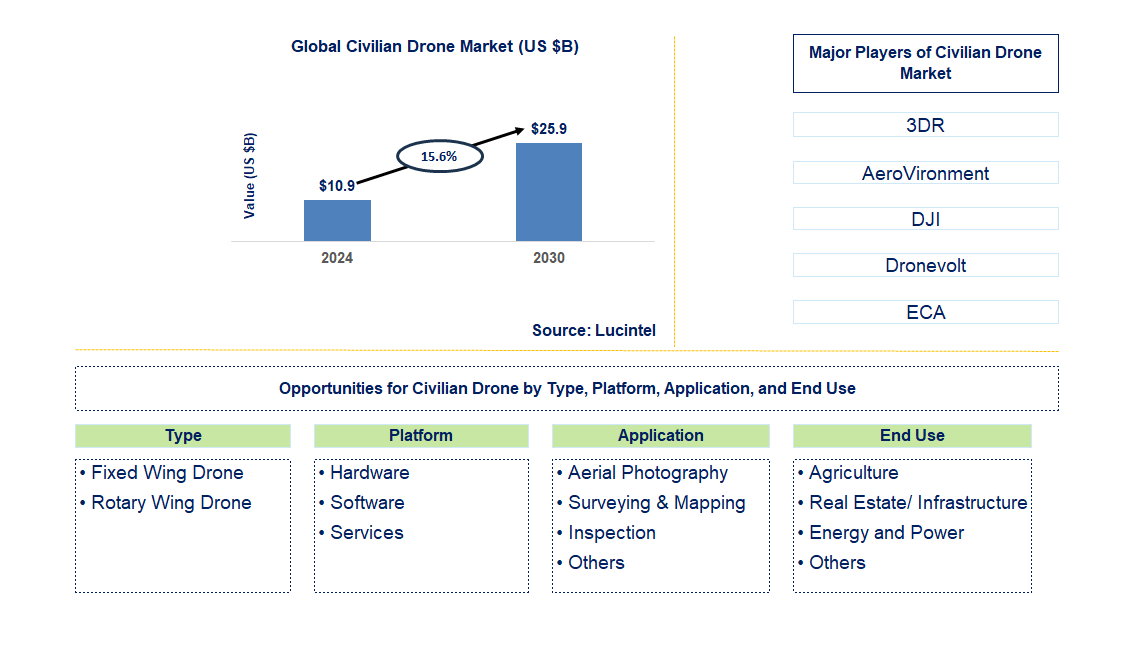
Key data points: The market size in 2030 = $25.9 billion, growth forecast = 15.6% annually for the next 6 years. Scroll below to get more insights. This market report covers trends, opportunities, and forecasts in the global civilian drone market to 2030 by type (fixed wing drone and rotary wing drone), platform (hardware, software, and services), application (aerial photography, surveying & mapping, inspection, and others), end use (agriculture, real estate/ infrastructure, energy and power, and others), and region (North America, Europe, Asia Pacific, and the Rest of the World)
We'll send your sample report shortly.
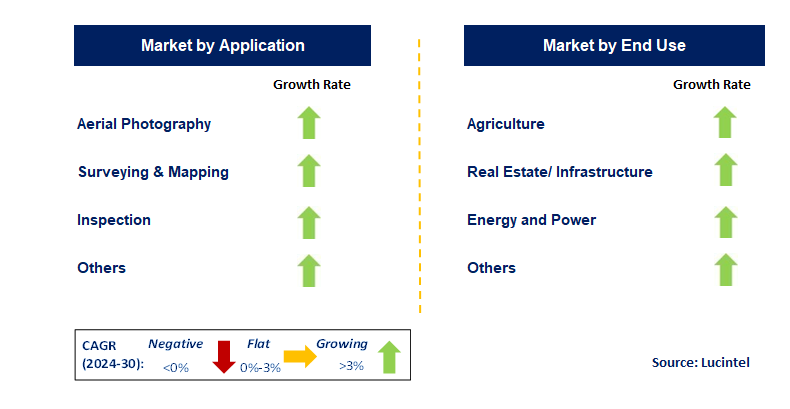
• Lucintel forecasts that, within the application category, surveying & mapping is expected to witness the highest growth over the forecast period because the drones provide a significantly faster and more cost-effective alternative to traditional land-based surveying methods.
• In terms of region, APAC is expected to witness the highest growth over the forecast period due to high adoption rates of advanced technologies and growing disposable income in the region. Gain valuable insights for your business decisions with our comprehensive 150+ page report.
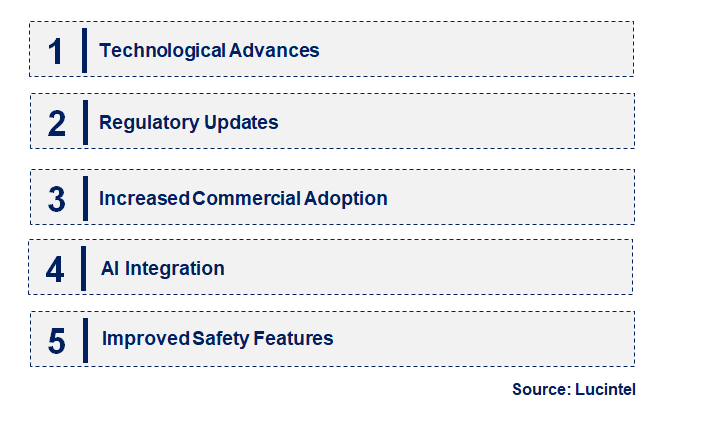
• Technological Advances: Longer-life batteries, autonomous flight capabilities, and sensor-related technologies continue to improve. These advances permit longer flight times, more precise operations, and broaden the uses of the technology across industries.
• Regulatory Updates: Governments around the world are revising regulations to manage the increasing number of drones. Changes aim to ensure safety, privacy, and management of airspace while supporting innovation and commercial utilization.
• Increased Commercial Adoption: Drones are increasingly used commercially for delivering services, infrastructure inspection, and crop monitoring. This trend is driven by the need for efficiency and cost reduction across various industries.
• AI Integration: Artificial Intelligence integrated into drones enhances their navigation, obstacle avoidance, and data analysis capabilities. AI-powered drones are becoming autonomous, with the ability to execute more complex tasks.
• Improved Safety Features: The design of safer and more robust drones involves better engineering, the incorporation of collision avoidance systems, and proper training for operators. These factors are crucial for integrating the devices into busy airspace and ensuring safe operations. These emerging trends are defining the civilian drone market, as its application base continuously expands, safety features are integrated, and innovation flourishes. As technology advances and regulations evolve, drones will play a larger role in industries, leading to more significant adoption and the opening of new avenues. Emphasis on AI and safety will further enhance capability and reliability, driving future growth.
• Technological Advances: Improved drone performance and capability result from upgraded sensor technology and longer battery life. Such technological innovations range from taking aerial photos to responding to disasters.
• Regulatory Updates: Conforming to increased usage, governments are revising regulations regarding drones. Recent updates include stricter guidelines for commercial operations and better airspace management, which are intrinsically connected to enabling safe and effective drone flights.
• More Commercial Usage: Drones are increasingly being used in various fields of commerce, such as delivery services and infrastructure monitoring. This increase in usage is driven by the demand for cost-effective and time-saving methods for carrying out these tasks.
• Full Integration of AI: The integration of artificial intelligence into drones enhances their capabilities and facilitates improved autonomous flights, data processing, and obstacle avoidance. With AI, drones can handle more versatile and complex assignments.
• Improved Safety: Increased attention is being paid to the safety of drones through design enhancements, collision avoidance systems, and better training for operators. These improvements are vital for integrating drones into urban environments and busy airspaces. Key developments shaping the civilian drone market include enhanced technology capabilities, improved regulatory frameworks, and expanded commercial applications. Safety features, such as AI, are among the innovations in the industry that make the use of drones safer and more efficient. As these developments continue to evolve, they will shape the future of the drone industry and its applications.
• Agricultural Applications: The potential of drones in agriculture, particularly in crop monitoring, precision farming, and pest control, is high. This helps maximize productivity by effectively using modern farming methods.
• Delivery Services: Over the last few years, there have been increasing applications of drones for delivery services. Firms continue to evaluate ways to reduce delivery time and costs. Drones are expected to provide faster, more efficient methods of delivery, especially in congested areas and other out-of-the-way locations.
• Infrastructure Inspection: This involves using drones to inspect infrastructure, including bridges, power lines, and pipelines. They are effective in accessing areas that are difficult to reach or view, providing highly detailed imagery; therefore, they are ideal tools for maintenance and safety assessments.
• Disaster Response: Drones provide real-time aerial vision in disaster response and can be helpful for search and rescue operations. They support first responders with valuable data and enhance the management of disasters.
• Surveillance: Currently, drones are used in a wide range of surveillance and security activities, including monitoring public spaces and border territories. Their capability to collect high-resolution imagery and transmit data in real time enhances security effectiveness and significantly improves situational awareness. These strategic growth opportunities are causing the civilian drone market to expand and find new applications, thereby improving the utility value of drones across a wide range of industries. The growing applications of drones in agriculture, delivery services, infrastructure inspection, disaster response, and surveillance are opening up new business avenues and fueling innovation in the industry.
• Technological Advancements: Over the years, civilian drone technology has advanced at a rapid pace, including better sensors and increased battery life. These technological improvements have further enhanced the capabilities of drones, increasing their value proposition in various applications.
• Increased Commercial Utilization: Market growth has been driven recently by increased utilization in various commercial sectors, such as delivery services and infrastructure inspection. Drones provide cost-effective and efficient solutions for several business needs.
• Cost Reduction: Continuous evolution in technology and manufacturing processes continues to reduce the cost of drones. Affordable pricing allows for greater penetration into an expanded user base, leading to higher adoption rates and, subsequently, better market growth.
• Increased Data Capabilities: The incorporation of advanced data processing with AI boosts the utility and performance of drones. Improvements in data functionalities enable drones to perform even the most complex tasks and deliver key insights. Challenges in the civilian drone market are:
• Regulatory Challenges: Despite supportive regulations, airspace management is problematic, privacy concerns arise, and operational limitations persist. Thus, it is challenging to address these regulatory challenges, which may negatively affect market growth.
• Safety Concerns: Safety considerations for drone operations, particularly in urban environments, remain a significant challenge. The development of reliable collision avoidance systems is necessary for market acceptance.
• Limitations of Technology: While there are advancements in technology, certain limitations related to battery life, payload capacity, and weather resistance still exist. These limitations must be overcome to enhance the performance and application of drones. These drivers contribute significantly to the growth of the civilian drone market through capability extension, cost reduction, and fostering adoption. However, these challenges represent real barriers that need to be addressed to ensure safe and efficient drone operations. The expectation will, therefore, be how technological advancements will balance with regulatory compliance and safety measures for the continued growth and development of civilian drones.
• 3DR
• AeroVironment
• DJI
• Dronevolt
• ECA
• INSITU
• Intel
• Parrot Drones
• PrecisionHawk
• Yuneec
• Fixed Wing Drone
• Rotary Wing Drone
• Hardware
• Software
• Services
• Aerial Photography
• Surveying & Mapping
• Inspection
• Others
• Agriculture
• Real Estate/ Infrastructure
• Energy and Power
• Others
• North America
• Europe
• Asia Pacific
• The Rest of the World
• United States: The US drone market is marked by rapid innovations, with considerable focus on AI and machine learning integrations to support further autonomous capabilities. Recently, developments have focused on improving collision avoidance systems and extending flight durations. The Federal Aviation Administration has also rolled out more accommodating regulations to facilitate commercial drone use; significant increases have been recorded in delivery and surveying applications.
• China: The Chinese drone market continues to develop at full speed, with constant innovations from major players like DJI. Developments over the years have included the release of higher-performance, more affordable models and improvements in battery technology. Meanwhile, the Chinese government has started to impose more stringent regulations to ensure safety and control within urban areas, aiming to balance innovation with public safety.
• Germany: While Germany is eager to implement drones in its commercial sectors, including logistics and infrastructure inspection, recent developments focus on increasing drone safety features and enhancing the data provided by drones. The German government is also working on regulatory frameworks to support drone use in urban environments and commercial operations.
• India: Growth segments in the Indian drone market include agriculture and surveillance. Recent reports highlight drones equipped with crop monitoring equipment and precision farming tools, ultimately contributing to productivity enhancement. The Indian government is working on policies to regularize and promote the use of drones, aiming to enhance agricultural efficiency and security.
• Japan: The Japanese drone market is innovative in terms of technology and is making progress in regulations. Many recent advances have focused on designing drones for better maneuverability and increased payload capacity. Similarly, the Japanese government is updating regulations as drones find increasing use in commercial applications, such as delivering services and disaster response.


• 3DR
• AeroVironment
• DJI
• Dronevolt
• ECA
• INSITU
• Intel
• Parrot Drones
• PrecisionHawk
• Yuneec Q6. Which civilian drone market segment will be the largest in future? Answer: Lucintel forecasts that surveying & mapping is expected to witness the highest growth over the forecast period because the drones provide a significantly faster and more cost-effective alternative to traditional land-based surveying methods. Q7. In civilian drone market, which region is expected to be the largest in next 5 years? Answer: APAC is expected to witness highest growth over the forecast period due to high adoption rates of advanced technologies and growing disposable income in the region. Q.8 Do we receive customization in this report? Answer: Yes, Lucintel provides 10% customization without any additional cost.


Choose a license that fits your team. Instant PDF delivery.
Prices exclude taxes. Instant delivery. Custom licensing available on request.
Market Report · July 31, 2026
Market Report · July 31, 2026
Market Report · July 31, 2026
Trusted partner for strategic intelligence and business growth


Receive a complimentary market analysis tailored to your industry. Our analysts will identify key growth opportunities and competitive dynamics specific to your business.

Market size, growth rate, and key trend analysis for your specific sector.

Top competitor positioning and market share analysis.

Strategic recommendations backed by data-driven insights.
Get curated market intelligence and competitive moves straight to your inbox.
By subscribing, you agree to receive our monthly insights. Unsubscribe anytime.
Receive a complimentary market analysis tailored to your industry. Our analysts will identify key growth opportunities and competitive dynamics specific to your business.
Market size, growth rate, and key trend analysis for your specific sector.
Top competitor positioning and market share analysis.
Strategic recommendations backed by data-driven insights.
Get curated market intelligence, emerging trends, and competitive moves straight to your inbox each month.
By subscribing, you agree to receive our monthly insights. Unsubscribe anytime.
We'll send your sample report shortly.