
Market Report · July 16, 2026

Key data points: The growth forecast = 9.1% annually for the next 7 years. Scroll below to get more insights. This market report covers trends, opportunities and forecasts in children's hardware programming education market to 2031 by type (robots, building blocks, and uav), application (online and offline), and region (North America, Europe, Asia Pacific, and the Rest of the World)
We'll send your sample report shortly.
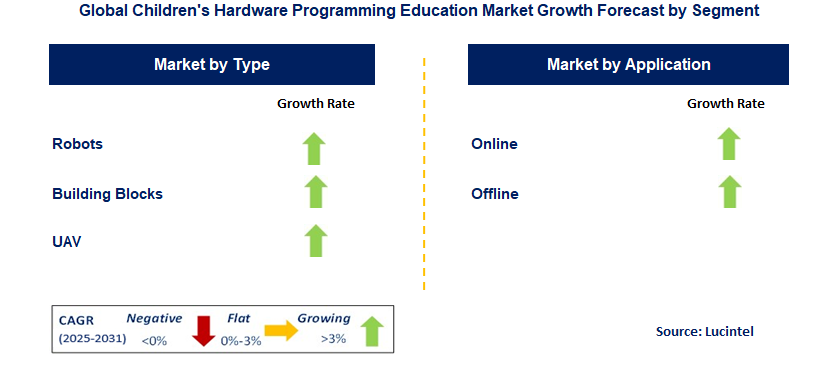
• Lucintel forecasts that, within the type category, building blocks will remain the largest segment over the forecast period.
• Within the application category, online is expected to witness the highest growth.
• In terms of region, APAC is expected to witness the highest growth over the forecast period.
Gain valuable insights for your business decisions with our comprehensive 150+ page report. Sample figures with some insights are shown below.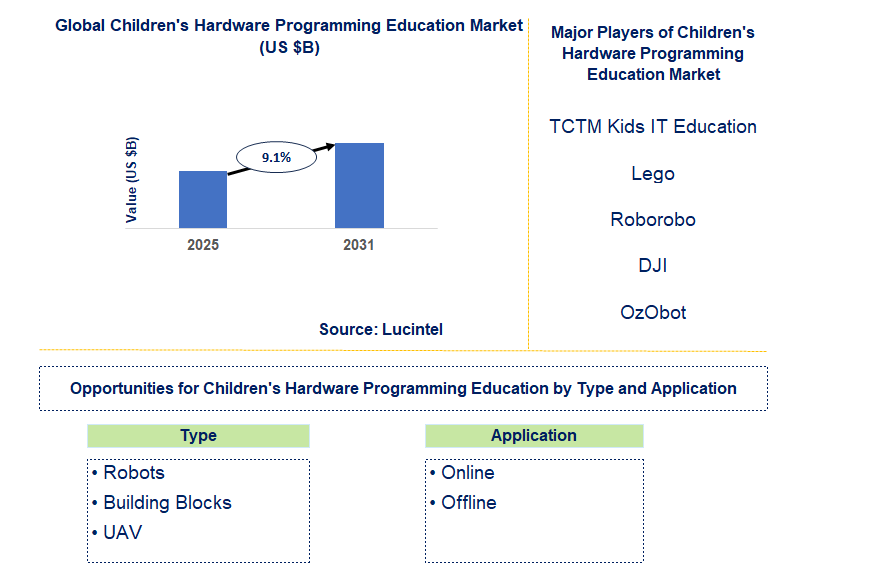
• Integration of AI (Artificial Intelligence) into Educational Software: AI is actively fine-tuning the personalization of educational tools. The pace of a student's engagement and real-time feedback are streamlining the speed at which information is absorbed. With this trend, school students grasp the concepts of hardware programming more easily and develop a greater interest in coding and robotics.
• Cross-cultural Integration: Numerous educational institutions are now incorporating hardware programming alongside subjects such as mathematics, physics, and World Art History. The multidisciplinary nature of this approach enables children not only to implement programming in practice but also enhances their reasoning capabilities as problem solvers. It diversifies subjects taught at schools and inspires children's imaginations while building professional skills.
• Gamified Learning: The increase in the number of products for hardware programming that employ platforms with gamified learning systems, where students are tasked to build and program virtual robots or other devices, is significant. Learning becomes much easier with platforms that work as games, honing children's skills through "trial and error" while simultaneously boosting their confidence.
• Expanding Online and Hybrid Learning Platforms: The availability of schooling and learning materials is more flexible and accessible due to advanced online platforms. With many schooling systems going hybrid, students can now access hardware programming lessons from home. This makes it easier for students worldwide to access this burgeoning field.
• More Affordable Hardware Kits for Kids: New customization options are making more affordable hardware kits tailored for children available. With easier access to hands-on learning, children can now build circuits, program robots, and grasp fundamental concepts of hardware development.
These trends are making the learning and designing process much easier and more interesting, helping align with modern-day technologies, and transforming the children's hardware programming education market.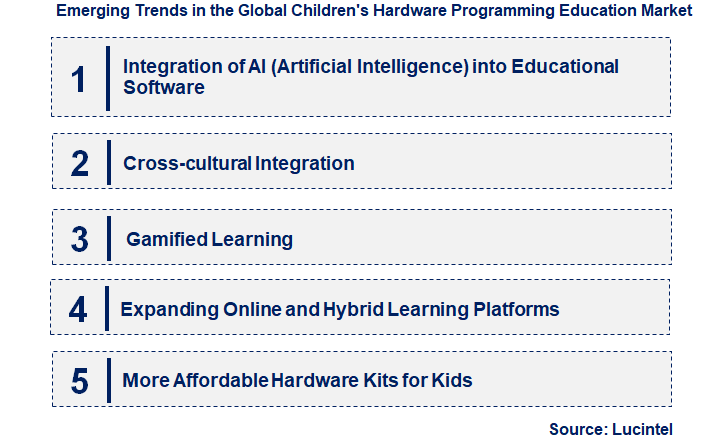
• The Rise of Online Learning: Tools like TinkerCAD, Scratch, and CodeCombat are giving students the opportunity to explore hardware programming with virtual tools. These platforms help children embark on their coding and hardware development journeys by offering an accessible and engaging environment.
• Partnership with Tech Companies: Partnerships between schools and tech companies such as Microsoft, Apple, and LEGO have fostered the production of engaging programming instruction hardware kits. These collaborations usually result in the creation of exciting educational resources that are readily available to schools and after-school programs.
• Nations Supporting STEM Policies: Several countries, including the US, China, and India, are beginning to formally integrate STEM programs into the national curriculum. Education policies have been developed to help schools embed basic-level hardware programming into their educational frameworks so children can be future-ready.
• The Adoption of Modular Learning Systems: Children can now learn hardware programming incrementally due to the increasing popularity of modular and flexible learning systems. These approaches to education allow students of different ability levels to build their knowledge progressively.
• The Importance of Coding and Robotics Competitions: Global and regional competitions such as FIRST Robotics and VEX Robotics allow children to demonstrate their knowledge of software and hardware skills. These competitions serve to motivate students, foster innovation, and instill a sense of healthy competition among learners.
These advancements are strengthening the children's hardware programming education ecosystem, preparing for future developments, and creating more dynamic learning frameworks.• Advent of Online and Blended Learning Models: The rising need for online education presents great potential for platforms teaching hardware programming, allowing them to reach a worldwide audience. These services enable children to access coursework from home or their classrooms, which makes it easier for learners from diverse backgrounds.
• Collaborations with Educational Institutions: Partnerships with educational institutions integrate hardware programming with education at various levels, including the design of hardware kits for classroom use. This may include sponsoring student hardware kits and offering instructional materials to assist teachers.
• Localized Educational Tools for Global Markets: A major untapped opportunity for business growth is the design of hardware programming tools with localized languages and cultures appropriate for various regions. This would make it easier to break linguistic barriers in educational programming.
• Gamification and Educational Software Development: The acquisition of children and teenagers can also be achieved through the development of hardware programming software games that are interesting and fun to interact with. Educational games make the acquisition of programming less rigorous.
• Development of Specialized Kits for Different Age Groups: More specific, lower, and upper age hardware kits that suit the learner's developmental stages can be designed. For example, highly graphic kits for preschool children or more sophisticated toys that challenge concepts for older children.
These strategic opportunities illustrate how fast the market for children's hardware programming education can expand and serve multiple audiences worldwide.• TCTM Kids IT Education
• Lego
• Roborobo
• DJI
• OzObot
• Sony
• Robolink
• Robots
• Building Blocks
• UAV
• Online
• Offline
• North America
• Europe
• Asia Pacific
• The Rest of the World
• United States: The US is leading in the incorporation of hardware programming in primary and secondary schools. A lot has been done through the establishment of coding clubs, online tools, and collaborations between non-profits and tech corporations to create affordable educational resources. Organizations like Code.org and programs spearheaded by the National STEM Education Coalition have greatly championed coding and robotics for early education.
• China: In China, STEM education reforms have been heavily supported by policy, leading to the inclusion of hardware programming in the national education framework. There is now wide access to hardware programming resources due to the development of localized hardware kits for children by companies like Makeblock and the rise of online coding classes like Baidu's Xiaodu.
• Germany: The German schools have recognized the need for early software and hardware literacy alongside critical thinking and problem-solving skills. This led to the development of the "School 4.0" initiative, which integrates robotics and coding into the curriculum with assistance from local government and technology companies.
• India: The hardware programming market for children is expanding rapidly in urban centers in India. Tinkerly and STEMpedia are leading the way by providing self-learning modules along with hardware kits that enable children to learn important skills in robotics and coding. The Atal Tinkering Labs is another initiative by the government to inspire creativity in children.
• Japan: Japan has always been a powerhouse in technology, and now its educational institutions are starting to adopt hardware programming. Child-friendly robotics kits and educational platforms are being launched by companies like Sony and Toshiba, empowering children to not only learn programming but also understand the hardware that drives technology.


• TCTM Kids IT Education
• Lego
• Roborobo
• DJI
• OzObot
• Sony
• Robolink
Q5. Which children's hardware programming education market segment will be the largest in future?

Choose a license that fits your team. Instant PDF delivery.
Prices exclude taxes. Instant delivery. Custom licensing available on request.
Market Report · July 16, 2026
Market Report · May 18, 2026
Market Report · May 18, 2026
Trusted partner for strategic intelligence and business growth


Receive a complimentary market analysis tailored to your industry. Our analysts will identify key growth opportunities and competitive dynamics specific to your business.

Market size, growth rate, and key trend analysis for your specific sector.

Top competitor positioning and market share analysis.

Strategic recommendations backed by data-driven insights.
Get curated market intelligence and competitive moves straight to your inbox.
By subscribing, you agree to receive our monthly insights. Unsubscribe anytime.
Receive a complimentary market analysis tailored to your industry. Our analysts will identify key growth opportunities and competitive dynamics specific to your business.
Market size, growth rate, and key trend analysis for your specific sector.
Top competitor positioning and market share analysis.
Strategic recommendations backed by data-driven insights.
Get curated market intelligence, emerging trends, and competitive moves straight to your inbox each month.
By subscribing, you agree to receive our monthly insights. Unsubscribe anytime.
We'll send your sample report shortly.