
Market Report · July 15, 2026

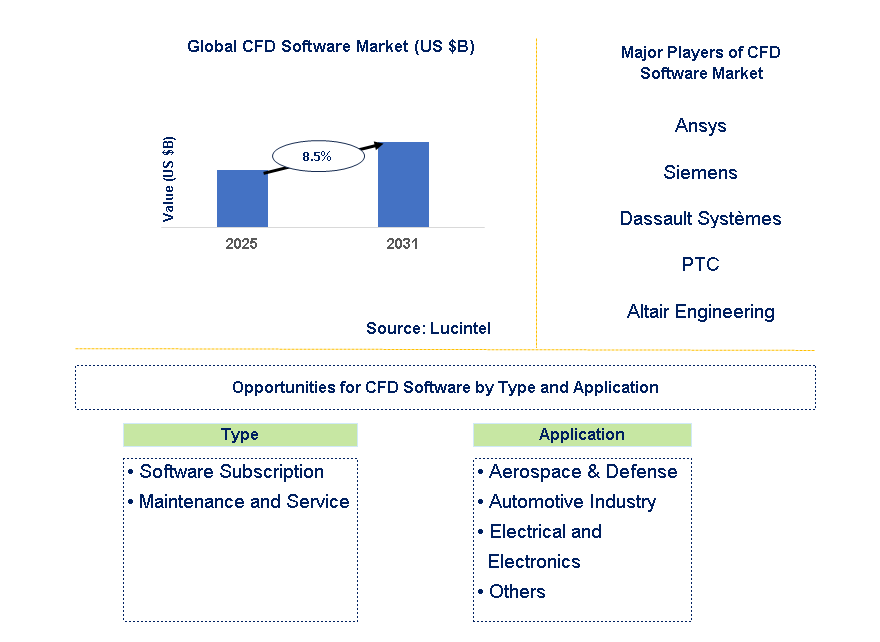
Key data points: The growth forecast = 8.5% annually for the next 7 years. Scroll below to get more insights. This market report covers Trends, opportunity and forecast in CFD software market to 2031 by type (software subscription and maintenance and service), application (aerospace & defense, automotive industry, electrical and electronics, and others), and region (North America, Europe, Asia Pacific, and the Rest of the World)
We'll send your sample report shortly.
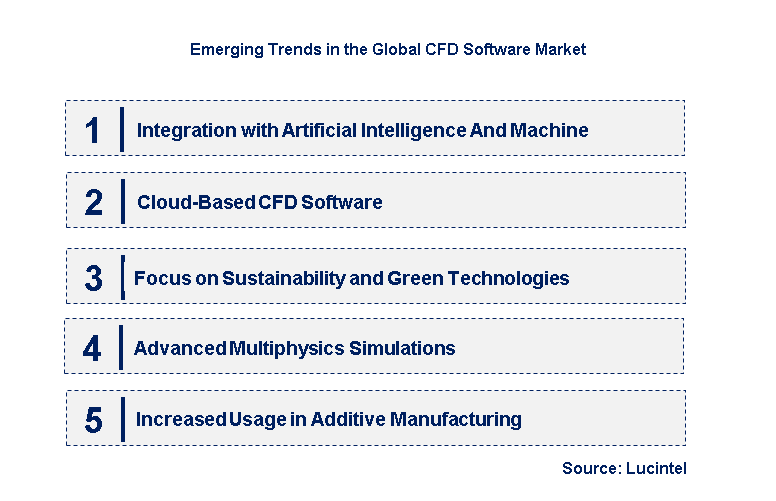
• Integration with Artificial Intelligence And Machine: AI and machine learning are being increasingly integrated into CFD software to boost the accuracy, speed, and efficiency of simulations. AI algorithms can analyze vast amounts of simulation data to identify patterns, optimize designs, and predict outcomes more accurately than traditional methods. This integration allows for faster iterations in the design process, reducing time-to-market and improving the overall quality of simulations. As AI continues to evolve, its impact on the CFD software market will become even more pronounced, enabling more intelligent and adaptive simulations.
• Cloud-Based CFD Software: Cloud-based CFD software is revolutionizing the industry by making high-performance simulations more accessible to companies of all sizes. The scalability of cloud computing allows users to run large-scale simulations without the need for expensive on-premise hardware. This trend is democratizing access to advanced CFD tools, particularly for small and medium-sized enterprises (SMEs). In addition, cloud solutions allow real-time collaboration and sharing of data for teams working together from various locations. The increasing improvement of cloud-based CFD solutions will lead to it being an important resource for companies trying to reduce simulation processes while decreasing costs.
• Focus on Sustainability and Green Technologies: Sustainability is a major driving force in the CFD software market, with industries increasingly using CFD simulations to design energy-efficient products and systems. The demand for green technologies, such as electric vehicles (EVs), renewable energy systems, and energy-efficient buildings, is pushing the development of more advanced CFD software solutions. For instance, CFD is used to optimize wind turbine designs, improve solar panel efficiency, and achieve energy consumption reduction within automotive as well as manufacturing processes. With increasing environmental concerns, the emphasis on sustainability will be a leading trend within the CFD software market for years to come.
• Advanced Multiphysics Simulations: As industries push toward simulating more practical, real-world scenarios that involve multiple interacting physical phenomena, the demand for advanced multiphysics simulations has been increasing. Modern CFD software can now combine multiple physics models, such as fluid dynamics, heat transfer, and structural analysis, into a single simulation. This means more accurate and integral simulations lead to better, designed products and systems. Advanced multiphysics CFD tools are being pushed forward by the means of simulating complex interactions in various application areas - such as aerodynamics automotive/aerospace design, energy systems, etc.
• Increased Usage in Additive Manufacturing: Additive manufacturing, or 3D printing, is an emerging field where CFD software is increasingly being used. CFD simulations are being used to optimize the design of 3D printed parts, ensuring they are both functional and efficient. For example, CFD is used to analyze heat distribution during the printing process and to optimize material flow for better structural integrity. The increasing adoption of additive manufacturing in industries like aerospace, automotive, and healthcare is projected to increase the demand for CFD software solutions targeted at 3D printing applications in the future. These new trends in the CFD software market are transforming the way industries approach design, optimization, and efficiency. Integration of AI, cloud computing, sustainability, advanced multiphysics simulations, and additive manufacturing is driving innovation in the market to allow companies to produce more efficient, environmentally friendly, and high-performance products. As these trends continue to grow, the CFD software market will play a growing role in many industries.
• AI and Automation in Simulation Processes: AI and automation are being integrated into CFD software to accelerate the simulation process and improve the accuracy of results. Automation in mesh generation, boundary condition assignment, and post-processing is reducing the manual effort involved in simulations. AI is helping to identify optimal designs by analyzing simulation results and offering real-time design recommendations. This development is improving the efficiency of CFD simulations, and companies are achieving better results in less time.
• Growth of Cloud-Based Simulation Solutions: Cloud-based CFD software is becoming popular because of its scalability and flexibility. Using cloud computing, firms can conduct massive simulations without necessarily investing in high-end hardware. Cloud-based CFD solutions also facilitate the possibility of collaborative teamwork, because the simulation data is accessible and can be shared from anywhere in the world. With the democratization of cloud-based solutions, the access of sophisticated CFD tools to small and medium-sized enterprises is expanding the market further.
• Advances in High-Performance Computing: The continuing advance in high-performance computing enables the simulation of more complex and detailed CFD simulations. As a result of its ability to process large data volumes at fast speeds, HPC is expanding the boundaries of what can be simulated. Increased availability of powerful computing resources and optimized software enables engineers to simulate increasingly realistic, high-fidelity models. HPC is particularly important in industries like aerospace and automotive where detailed simulations are required to optimize designs.
• Rising Need for Simulation in Renewable Energy: The focus on renewable energy sources is creating demand for CFD software solutions in optimizing wind turbine designs, efficiency of solar panels, and other energy systems. CFD is being used to simulate fluid flow, heat transfer, and other relevant physical phenomena to make renewable energy technologies perform better and with greater efficiency. The demand for CFD software in the energy sector is expected to be up due to increasing pressure for green technologies.
• Multiphysics Simulation capabilities integrated into CFD: With multiphysics capabilities being integrated into CFD software, the ability to simulate complex systems becomes more accurate. Multiphysics simulations combine different physical phenomena, such as fluid dynamics, heat transfer, and structural analysis, into a single unified simulation. This development is particularly important in industries like aerospace, automotive, and manufacturing, where systems often involve multiple interacting processes. By enabling more comprehensive simulations, multiphysics capabilities are enhancing the design and optimization of products and systems. These key developments are transforming the CFD software market, making simulations faster, more accurate, and more accessible. The integration of AI, cloud computing, HPC, and multiphysics simulations is enabling companies to optimize designs and improve product performance. As demand for sustainable solutions and complex simulations grows, these developments will continue to shape the future of the CFD software market.
• Growth in Electric Vehicle Development: As electric vehicles (EVs) are becoming more popular, significant growth opportunities arise for CFD software, particularly in the fields of aerodynamics, thermal management, and battery efficiency. Electric drivetrains, cooling systems, and aerodynamics are optimized using CFD simulations for enhanced performance and energy efficiency. The demand for advanced CFD tools will rise as the EV market expands.
• Aerospace and Defense: CFD plays a significant role in aerospace and defense industries, mainly in enhancing the design of aircraft for optimum fuel efficiency and safety features. Thus, it is a large untapped opportunity in the development of sophisticated CFD software for complex simulations for these highly innovative sectors. Many factors drive the adoption of lightweight materials, improved fuel efficiency, and noise reduction to be achieved through aircraft design, hence making this market area a catalyst for growth.
• Growth in Renewable Energy Systems: With the world turning towards renewable sources of energy, the demand for CFD software in the energy sector is on the rise. CFD simulations are crucial to optimize the design and performance of wind turbines, solar panels, and other renewable energy systems. Companies in the energy sector are increasingly adopting CFD software to enhance the efficiency of these systems, thus creating new growth opportunities for software providers in this market.
• Integration of CFD with Additive Manufacturing: With the increase in the usage of additive manufacturing (3D printing), this opens up new opportunities for the applications of CFD software. The design of 3D printed parts is optimized using CFD simulations, which ensure efficient performance under diverse conditions. Increasing adoption of additive manufacturing in the aerospace, automotive, and healthcare sectors will continue to drive up the demand for CFD software in support of these processes.
• AI-Driven Simulation Tools: The integration of artificial intelligence with CFD software is opening new avenues for growth. AI-driven tools can automate the simulation process, optimize designs, and provide real-time insights, significantly improving the efficiency of CFD simulations. As AI continues to evolve, its integration with CFD software will enable more intelligent simulations, offering significant growth potential in the market. The CFD software market has huge growth prospects due to the momentum in the EV development, aerospace, renewable energy, additive manufacturing, and AI integration markets. Both these strategic opportunities are reshaping the market, making new avenues for innovation, and thus creating demand for such high simulation tools.
• Ansys
• Siemens
• Dassault Systèmes
• PTC
• Altair Engineering
• Numeca International
• Convergent Science
• Hexagon Ab
• ESI Group
• Autodesk
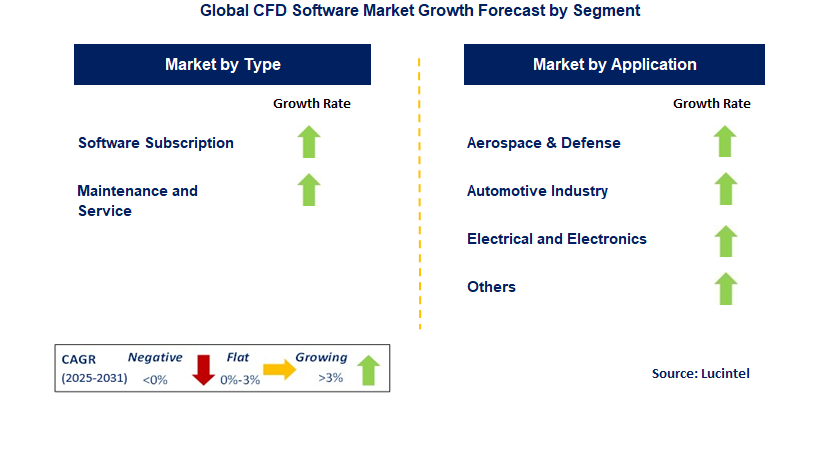
• Software Subscription
• Maintenance And Service
• Aerospace & Defense
• Automotive Industry
• Electrical And Electronics
• Others
• North America
• Europe
• Asia Pacific
• The Rest of the World
• United States: In the United States, the CFD software market is expanding rapidly, driven by the aerospace, automotive, and energy sectors. Companies are increasingly adopting CFD software for optimizing product designs, improving fuel efficiency, and reducing emissions in various industries. The U.S. is at the forefront in the development of high-performance computing (HPC) solutions that significantly enhance the capabilities of CFD simulations. Companies like ANSYS, Siemens, and Dassault Systèmes lead the market by offering state-of-the-art CFD tools for a wide range of applications from aircraft design to energy systems. In addition, AI and ML are increasingly being integrated into CFD software to enhance accuracy and speed up simulations.
• China: China's rapidly growing manufacturing, automotive, and aerospace industries are investing heavily in CFD software to improve product design and manufacturing processes. The Chinese government's focus on innovation and technological advancement has spurred the development of local CFD software solutions, in addition to international solutions. Companies in China are increasingly using CFD simulations for optimizing energy efficiency, reducing emissions, and improving manufacturing processes. The Chinese market is particularly focused on the automotive sector, where CFD software is used for aerodynamics optimization, cooling system design, and electric vehicle (EV) development. The country’s push toward green technologies and sustainable development is also driving growth in the CFD software market.
• Germany: It leads in the European market for CFD software, mainly in the automotive and manufacturing industries. Its focus on engineering superiority and innovation coupled with strong demand for high-end CFD tools has resulted from such a move. Volkswagen, BMW, and Mercedes-Benz among other German automotive companies are putting much capital in CFD simulations in order to better design vehicles, aerodynamics, and enhance the fuel efficiency of these vehicles. CFD software is also being used in industries such as energy, where it plays a key role in optimizing renewable energy systems, such as wind turbines and solar panels. Germany’s expertise in high-performance computing and the development of specialized CFD software solutions is driving its strong position in the global market.
• India: The CFD software market in India is growing due to the increasing demand for simulation tools in the automotive, aerospace, and manufacturing sectors. Indian companies are adopting CFD software to enhance product designs, optimize performance, and reduce costs. The automotive sector is one of the key drivers of growth, as companies leverage CFD simulations to improve vehicle aerodynamics, engine efficiency, and emissions. Additionally, India’s aerospace industry is benefiting from CFD software for optimizing aircraft design and performance. The increasing availability of cloud-based CFD solutions is also making it easier for small and medium-sized enterprises (SMEs) to access these advanced tools, further driving market growth.
• Japan: Japan is a significant player in the global CFD software market, particularly in the automotive, aerospace, and energy sectors. Japanese manufacturers are recognized for their precise engineering and usage of advanced CFD simulations in optimizing vehicle design, fuel efficiency, and performance. Companies like Toyota, Honda, and Mitsubishi are leaders in the use of CFD software to optimize aerodynamics of vehicles, improve safety features, and reduce energy consumption. Japan is also invested heavily in the development of CFD software in the energy sector, particularly the optimization of renewable energy systems like wind and solar power. Also, AI combined with cloud computing is speeding up innovation in the CFD software market in Japan.


• Ansys
• Siemens
• Dassault Systèmes
• PTC
• Altair Engineering
• Numeca International
• Convergent Science
• Hexagon Ab
• ESI Group
• Autodesk Q5. Which CFD software market segment will be the largest in future? Answer: Lucintel forecasts that, within the type category, software subscription is expected to witness higher growth over the forecast period. Q6. In CFD software market, which region is expected to be the largest in next 5 years? Answer: In terms of region, APAC is expected to witness the highest growth over the forecast period. Q7. Do we receive customization in this report? Answer: Yes, Lucintel provides 10% customization without any additional cost.


Choose a license that fits your team. Instant PDF delivery.
Prices exclude taxes. Instant delivery. Custom licensing available on request.
Market Report · July 15, 2026
Market Report · June 26, 2026
Market Report · June 24, 2026
Trusted partner for strategic intelligence and business growth


Receive a complimentary market analysis tailored to your industry. Our analysts will identify key growth opportunities and competitive dynamics specific to your business.

Market size, growth rate, and key trend analysis for your specific sector.

Top competitor positioning and market share analysis.

Strategic recommendations backed by data-driven insights.
Get curated market intelligence and competitive moves straight to your inbox.
By subscribing, you agree to receive our monthly insights. Unsubscribe anytime.
Receive a complimentary market analysis tailored to your industry. Our analysts will identify key growth opportunities and competitive dynamics specific to your business.
Market size, growth rate, and key trend analysis for your specific sector.
Top competitor positioning and market share analysis.
Strategic recommendations backed by data-driven insights.
Get curated market intelligence, emerging trends, and competitive moves straight to your inbox each month.
By subscribing, you agree to receive our monthly insights. Unsubscribe anytime.
We'll send your sample report shortly.