
Market Report · July 16, 2026

Key data points: The growth forecast = 9.2% annually for the next 7 years. Scroll below to get more insights. This market report covers trends, opportunities and forecasts in ceftriaxone sodium market to 2031 by product type (> 99.5 and > 99.8), application (powder injection and injection), distribution channel (direct sales and through distributor), and region (North America, Europe, Asia Pacific, and the Rest of the World)
We'll send your sample report shortly.
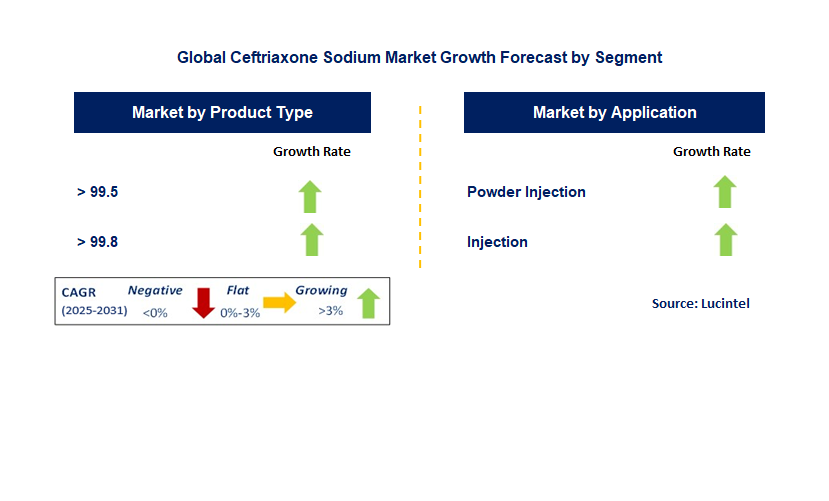
• Lucintel forecasts that, within the type category, > 99.5 is expected to witness higher growth over the forecast period.
• Within the application category, powder injection is expected to witness higher growth.
• In terms of region, North America is expected to witness the highest growth over the forecast period. Gain valuable insights for your business decisions with our comprehensive 150+ page report. Sample figures with some insights are shown below.

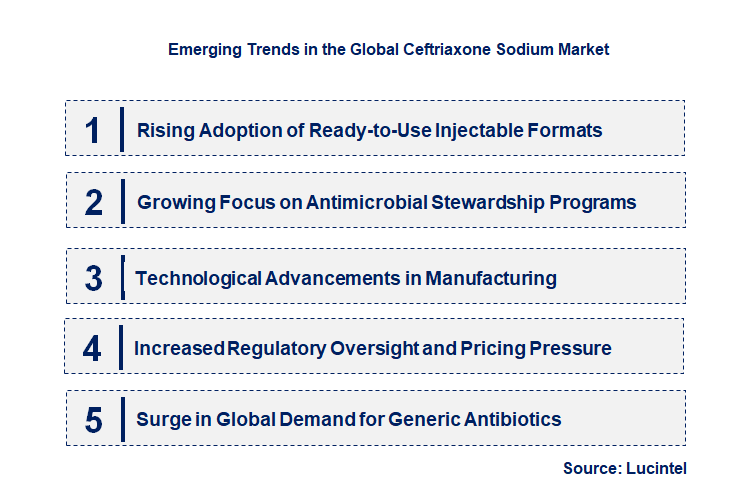
• Rising Adoption of Ready-to-Use Injectable Formats: Hospitals and clinics are increasingly favoring prefilled syringes and vials to minimize preparation time and reduce contamination risk. These formats improve administration efficiency and patient safety. Pharmaceutical companies are investing in ready-to-administer technologies, especially for emergency care settings. This trend is gaining traction in high-income countries with stringent safety standards.
• Growing Focus on Antimicrobial Stewardship Programs: Governments and health agencies are promoting rational antibiotic use to combat resistance. This is influencing prescribing practices and reducing overuse. Ceftriaxone, being a broad-spectrum antibiotic, is now more selectively used, particularly in developed countries. Pharmaceutical companies must align marketing strategies with stewardship protocols, focusing on diagnostics-driven therapies.
• Technological Advancements in Manufacturing: Continuous manufacturing, digital quality control, and sterile filling automation are becoming standard in production facilities. These innovations improve consistency, reduce contamination risk, and enhance scalability. Countries like India and China are adopting these technologies to boost output and comply with global standards, strengthening their position in international markets.
• Increased Regulatory Oversight and Pricing Pressure: National authorities are tightening quality checks and enforcing price caps on essential drugs, including Ceftriaxone Sodium. Regulatory bodies like the US FDA and Indian CDSCO are prioritizing public safety and affordability. This trend is pushing companies toward cost-effective production while ensuring compliance with evolving standards.
• Surge in Global Demand for Generic Antibiotics: The post-pandemic environment has revived interest in essential generics to meet the rising burden of infectious diseases, particularly in low- and middle-income countries. Generic ceftriaxone remains a cornerstone in international aid and procurement programs. Emerging markets are driving this trend with growing import volumes and increasing reliance on Indian and Chinese suppliers. These trends are driving a shift toward innovation, quality assurance, and sustainability in the ceftriaxone sodium market. As healthcare systems demand safer, cost-effective, and efficient antibiotic solutions, companies are compelled to adapt technologically and operationally. This transformation is expected to increase global access to high-quality ceftriaxone while supporting antibiotic stewardship efforts.
• WHO Prequalification Expansion for Global Procurement: Several manufacturers have obtained WHO prequalification, enabling bulk procurement by UN agencies and low-income countries. This improves access to quality-assured products and drives export demand.
• API Manufacturing Consolidation in Asia: Major active pharmaceutical ingredient (API) production has become concentrated in India and China. These countries are investing in expanding their API manufacturing capacity, making global supply more efficient but also more vulnerable to geopolitical risk.
• Partnerships for Rural Healthcare Access: Pharmaceutical companies are partnering with NGOs and governments to supply ceftriaxone to rural clinics in underserved regions. These programs aim to address treatment gaps in remote areas and increase brand equity.
• Dual Licensing for Biosimilar and Generic Production: Some firms have secured dual licenses to manufacture biosimilar versions alongside traditional generics, allowing them to cater to diverse regulatory environments and optimize manufacturing resources.
• Green Chemistry Initiatives: Environmental concerns are prompting companies to adopt green synthesis methods, minimizing solvent use and waste. These initiatives improve regulatory compliance and lower long-term costs while aligning with global ESG goals. The ceftriaxone sodium market is evolving rapidly through global partnerships, sustainable manufacturing, and strategic API consolidation. These developments enhance market reach, ensure compliance, and reinforce the role of ceftriaxone in global infectious disease management.
• Hospital-Acquired Infection Treatment: Ceftriaxone remains a frontline therapy for hospital-acquired infections. Rising nosocomial infection rates and pressure on hospitals to reduce morbidity are increasing demand. Investments in clinical diagnostics further support targeted ceftriaxone use in these environments.
• Community-Acquired Pneumonia Management: The drug’s broad efficacy against common pathogens makes it ideal for outpatient pneumonia treatment. With improved diagnostic tools, clinicians can promptly prescribe ceftriaxone, making it a vital option in community care settings.
• Sepsis and Critical Care Use: Sepsis treatment protocols often include ceftriaxone due to its rapid action and compatibility with ICU protocols. Increasing critical care infrastructure in developing countries is opening new application channels.
• Post-Surgical Infection Prevention: Prophylactic use of ceftriaxone in surgeries is growing, especially in orthopedics and gynecology. The rise in elective and emergency surgeries, especially in aging populations, is supporting this trend.
• Use in Pediatric and Geriatric Settings: Ceftriaxone’s safety profile makes it suitable for pediatric and elderly patients. Its once-daily dosing and injectable form reduce administration complexity, encouraging adoption in long-term care and pediatric wards. These application-focused opportunities highlight Ceftriaxone Sodium’s role across diverse medical scenarios. As healthcare systems expand and become more specialized, targeted applications will play a critical role in sustaining market growth.
• Shandong Luoxin Pharmaceutical Group Stock
• Livzon Pharmaceutical
• United Laboratories
• Sinopharm Sandwich
• Shanghai Pharmaceutical
• North China Pharmaceutical
• China Union Chempharma
• Lupin Pharmaceuticals
• Fujian Fukang Pharmaceutical
• Qilu A
• > 99.5
• > 99.8
• Powder Injection
• Injection
• Direct Sales
• Through Distributor
• North America
• Europe
• Asia Pacific
• The Rest of the World
• United States: The United States has experienced increased demand for Ceftriaxone Sodium, driven by rising cases of hospital-acquired infections and community-spread bacterial diseases. The FDA has expedited review procedures for generic versions, boosting competition. Leading domestic players have expanded manufacturing facilities to address shortages and ensure supply stability. Integration of advanced packaging technologies has enhanced drug safety and shelf life. There is a shift toward injectable formulations for better patient outcomes in outpatient settings. Strategic collaborations between hospitals and pharmaceutical firms are enabling broader distribution. These changes reflect the country’s strong emphasis on antibiotic stewardship and antimicrobial resistance containment.
• China: China’s ceftriaxone sodium market is growing due to government-led healthcare reforms and an aggressive push for domestic production. Public hospitals have been directed to prioritize generics to lower treatment costs, boosting the demand for locally manufactured ceftriaxone. Leading Chinese firms are investing in automated production lines and digital quality control systems. The government’s Zero-COVID legacy has left behind an expanded diagnostic infrastructure, indirectly raising antibiotic prescription volumes. Additionally, exports to other Asian countries have increased due to cost-competitiveness. Rising scrutiny over environmental impact has also pushed manufacturers to adopt green chemistry practices in antibiotic synthesis.
• Germany: Germany’s ceftriaxone sodium market is evolving amid rising antimicrobial resistance awareness and tighter EU regulations. The German government is supporting antimicrobial stewardship initiatives, leading to a more rationalized use of third-generation cephalosporins. Manufacturers are focusing on low-residue formulations and advanced drug delivery systems. Hospitals have adopted stricter procurement policies to ensure product quality, reducing dependency on non-EU imports. There is a rising demand for ready-to-administer injectable formats. German pharma firms are also emphasizing sustainable sourcing of raw materials and eco-friendly manufacturing to meet EU climate targets. These factors are collectively shaping a more quality- and compliance-oriented market.
• India: India remains a significant manufacturer and exporter of Ceftriaxone Sodium, with rising domestic demand due to the increasing prevalence of infectious diseases and greater public health spending. Government initiatives under the Ayushman Bharat scheme have expanded access to antibiotics in rural areas. Indian companies are boosting capacity to meet demand in both domestic and export markets, especially in Africa and Latin America. However, increasing regulatory oversight on quality and pricing under the National List of Essential Medicines (NLEM) is pressuring profit margins. Investment in continuous manufacturing and Good Manufacturing Practice (GMP) certifications is growing as firms seek global compliance.
• Japan: Japan’s ceftriaxone sodium market is characterized by a focus on precision medicine and low antimicrobial resistance rates. Healthcare institutions are using advanced diagnostic tools to prescribe antibiotics more effectively. Domestic demand is stable, but Japanese firms are investing in export-oriented production to expand in Southeast Asia. Aging population and high healthcare standards are prompting the use of safer, injectable antibiotics like ceftriaxone in geriatric care. Pharmaceutical companies are developing dual-use packaging for hospital and home-care settings. The government’s robust pharmacovigilance framework has led to higher transparency and post-marketing surveillance, improving patient safety and trust in antibiotic therapies.


• Shandong Luoxin Pharmaceutical Group Stock
• Livzon Pharmaceutical
• United Laboratories
• Sinopharm Sandwich
• Shanghai Pharmaceutical
• North China Pharmaceutical
• China Union Chempharma
• Lupin Pharmaceuticals
• Fujian Fukang Pharmaceutical
• Qilu Antibiotics Pharmaceutical Q5. Which ceftriaxone sodium market segment will be the largest in future? Answer: Lucintel forecasts that, within the type category, > 99.5 is expected to witness higher growth over the forecast period. Q6. In ceftriaxone sodium market, which region is expected to be the largest in next 5 years? Answer: In terms of region, North America is expected to witness the highest growth over the forecast period. Q7. Do we receive customization in this report? Answer: Yes, Lucintel provides 10% customization without any additional cost.


Choose a license that fits your team. Instant PDF delivery.
Prices exclude taxes. Instant delivery. Custom licensing available on request.
Market Report · July 16, 2026
Market Report · July 15, 2026
Market Report · July 15, 2026
Trusted partner for strategic intelligence and business growth


Receive a complimentary market analysis tailored to your industry. Our analysts will identify key growth opportunities and competitive dynamics specific to your business.

Market size, growth rate, and key trend analysis for your specific sector.

Top competitor positioning and market share analysis.

Strategic recommendations backed by data-driven insights.
Get curated market intelligence and competitive moves straight to your inbox.
By subscribing, you agree to receive our monthly insights. Unsubscribe anytime.
Receive a complimentary market analysis tailored to your industry. Our analysts will identify key growth opportunities and competitive dynamics specific to your business.
Market size, growth rate, and key trend analysis for your specific sector.
Top competitor positioning and market share analysis.
Strategic recommendations backed by data-driven insights.
Get curated market intelligence, emerging trends, and competitive moves straight to your inbox each month.
By subscribing, you agree to receive our monthly insights. Unsubscribe anytime.
We'll send your sample report shortly.