
Market Report · July 15, 2026

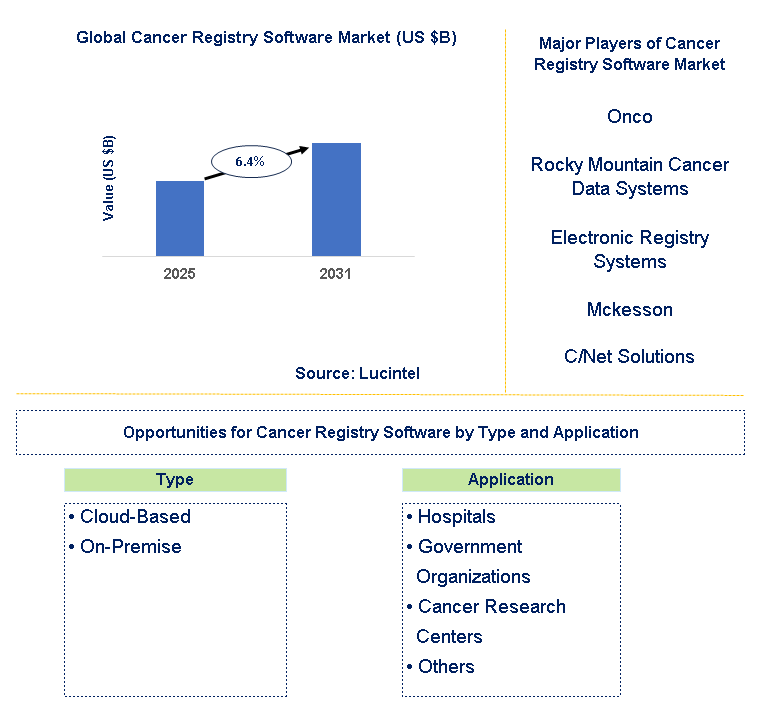
Key data points: The growth forecast = 6.4% annually for the next 7 years. Scroll below to get more insights. This market report covers trends, opportunities and forecasts in cancer registry software market to 2031 by type (cloud-based and on-premise), application (hospitals, government organizations, cancer research centers, and others), and region (North America, Europe, Asia Pacific, and the Rest of the World)
We'll send your sample report shortly.
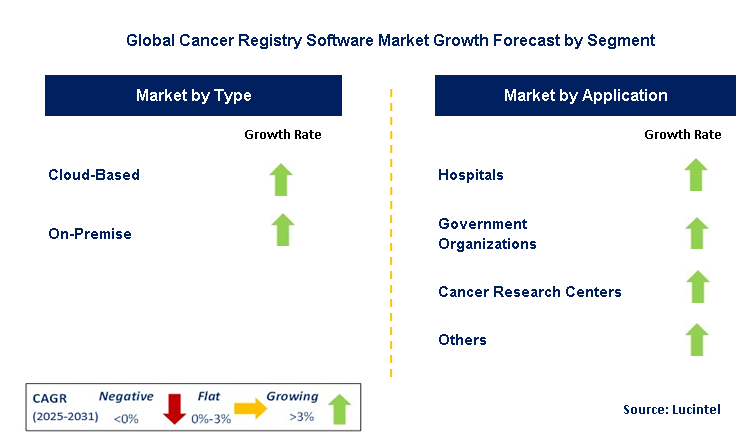
• Lucintel forecasts that, within the type category, cloud-based is expected to witness higher growth over the forecast period.
• Within the application category, hospital is expected to witness the highest growth.
• In terms of region, North America is expected to witness the highest growth over the forecast period. Gain valuable insights for your business decisions with our comprehensive 150+ page report. Sample figures with some insights are shown below.
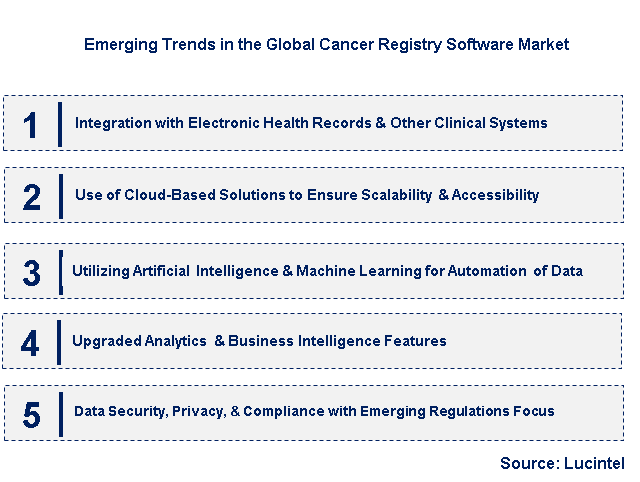
• Integration with Electronic Health Records & Other Clinical Systems: One notable emerging trend is the integration of cancer registry software more deeply with Electronic Health Records and other clinical information systems. This seeks to automate abstraction of data, minimize manual entry errors, and allow real-time flow of data. Smooth interoperability improves data accuracy, completeness, and timeliness, which are vital to effective surveillance of cancers, planning for treatment, and research, eventually enhancing the efficiency of cancer registrars.
• Use of Cloud-Based Solutions to Ensure Scalability & Accessibility: The market is experiencing a strong drift towards the mass use of cloud-based cancer registry solutions. Cloud deployment provides greater scalability, enabling registries to process growing amounts of data without substantial on-premise infrastructure investments. It enhances availability for remote data entry and analysis, facilitates collaboration among various registry sites, and allows for simpler software updates and maintenance, enhancing operational efficiency.
• Utilizing Artificial Intelligence & Machine Learning for Automation of Data: A growing trend includes the expanding use of Artificial Intelligence and Machine Learning technologies in cancer registry software. AI and ML algorithms can be used to automate the processes such as natural language processing for pulling structured data from unstructured clinical notes, enhancing case identification, and even detecting potential data inconsistencies. This improves efficiency, accuracy, and enables more sophisticated predictive analytics and pattern recognition in cancer data.
• Upgraded Analytics & Business Intelligence Features: The market is experiencing a new trend of greatly improved analytics and business intelligence features in cancer registry software. In addition to simple reporting, these programs now provide advanced dashboards, real-time visualization tools, and complex analytical models. This enables researchers, public health professionals, and clinicians to gain more penetrating insights from the data, recognize trends, measure treatment success, and guide evidence-based cancer control activities better.
• Data Security, Privacy, & Compliance with Emerging Regulations Focus: There is a growing trend of the utmost importance to data privacy, security, and compliance with changing healthcare regulations (e.g., HIPAA, GDPR). Since cancer registries deal with extremely sensitive patient health data, software vendors are heavily investing in strong encryption, access controls, audit trails, and privacy-enhancing technologies. This trend guarantees data integrity, ensures patient confidentiality, and fosters trust, which is critical for the successful functioning and growth of cancer registries. These nascent trends are significantly revolutionizing the cancer registry software market by driving it towards increased efficiency, intelligence, and security of data. The market is undergoing transformation with an explicit emphasis on integration of data without any hitch, cloud access, and the revolutionizing capability of AI for automation and complex analytics. This change is speeding up data management innovation, making possible more extensive cancer surveillance, enabling groundbreaking studies, and ultimately improving the capacity of health care systems to fight the worldwide burden of cancer more effectively.
• Increased Interoperability with Electronic Health Records: One major recent advancement is the remarkable improvement in interoperability of cancer registry software and Electronic Health Records. This enables automated or semi-automated extraction of vital patient information directly from clinical systems, decreasing manual entry, reducing errors, and enhancing the timeliness of data. This makes the workflow easier for cancer registrars and provides a richer and more accurate dataset for surveillance and research.
• Greater Use of Cloud-Based Deployment Models: Recent trends involve a significant increase in the use of cloud-based deployment modes for cancer registry software. This trend offers enhanced flexibility, scalability, and accessibility to gather and analyze data, especially useful for geographically spread-out registries or registries with minimal on-premise IT infrastructure. Cloud-based solutions also allow simpler updates and maintenance to ensure that registries with the most recent features and security measures.
• Use of Artificial Intelligence and Natural Language Processing: The market has seen an impressive growth of Artificial Intelligence and Natural Language Processing abilities integrated into cancer registry software. These technologies have the ability to analyze unstructured clinical notes to identify and abstract relevant cancer information automatically, including diagnosis codes, treatment methods, and staging data. This greatly enhances efficiency, minimizes manual abstraction, and increases data accuracy and completeness.
• Advanced Analytics and Reporting Features Development: A critical advancement is the ongoing innovation of sophisticated analytics and reporting capabilities in cancer registry software. Contemporary solutions have advanced dashboards, epidemiology tools, and adaptable reporting capabilities. This enables public health professionals, researchers, and clinicians to make detailed analyses of cancer patterns, estimate survival rates, measure treatment success, and provide actionable recommendations for cancer control programs and public health policy.
• Greater Focus on Data Security and Privacy Compliance: Current advancements highlight an increased focus on data privacy and security compliance in cancer registry software. Because cancer patient data is highly sensitive, software vendors are employing strong encryption, access controls, audit trails, and following strict rules such as HIPAA and GDPR. This protects the integrity and confidentiality of patient data, establishing trust and securing vital public health information. These new changes are significantly shaping the cancer registry software market by making it a smarter, more efficient, and secure system for cancer data management. The market is dominated by the demand for automation, cloud accessibility, high-end analytical features, and unabated dedication to data privacy. This change is imperative for maximizing the usefulness and impact of cancer registries, facilitating better cancer surveillance, facilitating breakthrough research, and ultimately helping to lead to better patient outcomes worldwide.
• Population-Based Cancer Surveillance: Increased Public Health Impact: The population-based cancer surveillance industry presents a large strategic growth opportunity. Registries get information from entire populations, which has complete information on cancer incidence, mortality, and trends. They present opportunities to develop software that facilitates data collection at a more granular level, data integration from multiple sources (e.g., pathology laboratories, vital statistics), and advanced epidemiological capabilities for real-time analysis, which can enhance public health interventions and resource allocation.
• Hospital-Based Cancer Program Management: Quality and Accreditation: The hospital-based cancer program management market is a strong growth opportunity. Hospitals need software to manage patient flows, maintain compliance with accreditation requirements (e.g., American College of Surgeons, Commission on Cancer), and assist internal quality improvement programs. Strategic expansion is based on providing integrated solutions to simplify case ascertainment, abstracting, reporting, and offer analytics for program assessment, assisting hospitals in maintaining accreditation and proving quality care.
• Clinical Research and Trials: Data for Evidence Generation: The clinical trials and research industry represents a compelling strategic growth area. Cancer registries offer the incredibly valuable real-world data required for observational studies, comparative effectiveness research, and the identification of eligible patients for clinical trials. Opportunities include creating software to enable transparent data sharing with research platforms, maintain data standardization across multi-center studies, and integrate de-identification and data linkage tools, which speed up evidence generation and drug development.
• Precision Medicine and Personalized Oncology: Integration of Genomic Data: A strategic opportunity on the rise is the realm of precision oncology and individualized medicine. As cancer care becomes more personalized based on genomic and molecular information, demand for registry software to capture and consolidate this intricate information alongside the conventional clinical data is on the rise. Opportunities include the creation of modules for genomic data management, tracking biomarkers, and supporting algorithms for recommending personalized treatments and predicting outcomes.
• Artificial Intelligence and Machine Learning Development: Predictive Analytics: The use of artificial intelligence and machine learning in cancer registry software is a major strategic growth prospect. AI and ML can make predictive analytics possible for recognizing high-risk groups, projecting cancer trends, and optimizing treatment pathways. Investment options include investing in AI-based data automation, creating predictive models for recurrence or survival, and incorporating machine learning algorithms to recognize patterns informing personalized care and public health planning. These strategic opportunities for growth are deeply influencing the cancer registry software market by driving value creation and specialization across an extensive range of end-use applications. The market is transforming towards more integrated, smart, and information-rich solutions, especially for population health, clinical quality, and advanced research in precision oncology. This application-driven approach is driving innovation, promoting customized product development, and eventually broadening its market base and establishing itself as a very adaptive and valuable tool in the world's battle against cancer.
• Onco
• Rocky Mountain Cancer Data Systems
• Electronic Registry Systems
• Mckesson
• C/Net Solutions
• Cloud-Based
• On-Premise
• Hospitals
• Government Organizations
• Cancer Research Centers
• Others
• North America
• Europe
• Asia Pacific
• The Rest of the World
• United States: In the United States, recent progress in cancer registry software is driven considerably by federal programs such as the National Program of Cancer Registries (NPCR) and the Surveillance, Epidemiology, and End Results (SEER) program. Software vendors are concerned with keeping current with changing data standards (e.g., NAACCR versions) and increasing interoperability with Electronic Health Records (EHRs). Cloud-based solutions, artificial intelligence (AI) and natural language processing (NLP) to automate data extraction, and advanced analytics to drill deeper into cancer trends and outcomes are increasingly emphasized.
• China: China cancer registry software market is witnessing accelerating developments, buoyed by its large population and growing incidence of cancer. New developments include major government funding to create and strengthen population-based cancer registries across the country. Chinese vendors are targeting developing region-specific software tools that are capable of coping with high volumes of data, interfacing with different hospital information systems, and supporting national cancer control initiatives for enhancing survival rates and monitoring patterns of incidence.
• Germany: Germany, with its strong healthcare system and strict data privacy laws, is experiencing advancements in cancer registry software that focus on high data quality, complete clinical documentation, and safe data exchange. Developments over the past few years include the successful roll-out of federal legislation requiring uniform electronic data collection, which has improved quality assurance and feedback for healthcare practitioners. German software solutions focus on extensive patient data and strong security measures to serve clinical as well as population-based studies while following GDPR guidelines.
• India: Indian cancer registry software market is expanding at a fast pace with the support of growing government-initiated cancer registry programs and growing awareness of cancer. Some recent events include the opening of new population-based registries, like the childhood oncology disease registry in Chennai in January 2025. Indian initiatives are aimed at creating cost-efficient and scalable software solutions that can handle varied regional data collection needs, monitor treatment results, and offer significant insights for public health planning and resource allocation.
• Japan: Strong regulatory support and government efforts towards utilizing registry data to support clinical research and better patient care characterize recent trends in the cancer registry software market in Japan. The SCRUM-Japan Registry, for instance, was crucial in winning approval from the regulator in December 2024 for HER2-positive colorectal oncology disease. Japanese advancements focus on how registry data can be synchronized with clinical trials and precision medicine programs, requiring very advanced software for managing, analyzing, and making regulatory submissions from data.


• Onco
• Rocky Mountain Cancer Data Systems
• Electronic Registry Systems
• Mckesson
• C/Net Solutions Q5. Which cancer registry software market segment will be the largest in future? Answer: Lucintel forecasts that, within the type category, cloud-based is expected to witness higher growth over the forecast period. Q6. In cancer registry software market, which region is expected to be the largest in next 5 years? Answer: In terms of region, North America is expected to witness the highest growth over the forecast period. Q7. Do we receive customization in this report? Answer: Yes, Lucintel provides 10% customization without any additional cost.


Choose a license that fits your team. Instant PDF delivery.
Prices exclude taxes. Instant delivery. Custom licensing available on request.
Market Report · July 15, 2026
Market Report · June 26, 2026
Market Report · June 24, 2026
Trusted partner for strategic intelligence and business growth


Receive a complimentary market analysis tailored to your industry. Our analysts will identify key growth opportunities and competitive dynamics specific to your business.

Market size, growth rate, and key trend analysis for your specific sector.

Top competitor positioning and market share analysis.

Strategic recommendations backed by data-driven insights.
Get curated market intelligence and competitive moves straight to your inbox.
By subscribing, you agree to receive our monthly insights. Unsubscribe anytime.
Receive a complimentary market analysis tailored to your industry. Our analysts will identify key growth opportunities and competitive dynamics specific to your business.
Market size, growth rate, and key trend analysis for your specific sector.
Top competitor positioning and market share analysis.
Strategic recommendations backed by data-driven insights.
Get curated market intelligence, emerging trends, and competitive moves straight to your inbox each month.
By subscribing, you agree to receive our monthly insights. Unsubscribe anytime.
We'll send your sample report shortly.