
Market Report · July 29, 2026

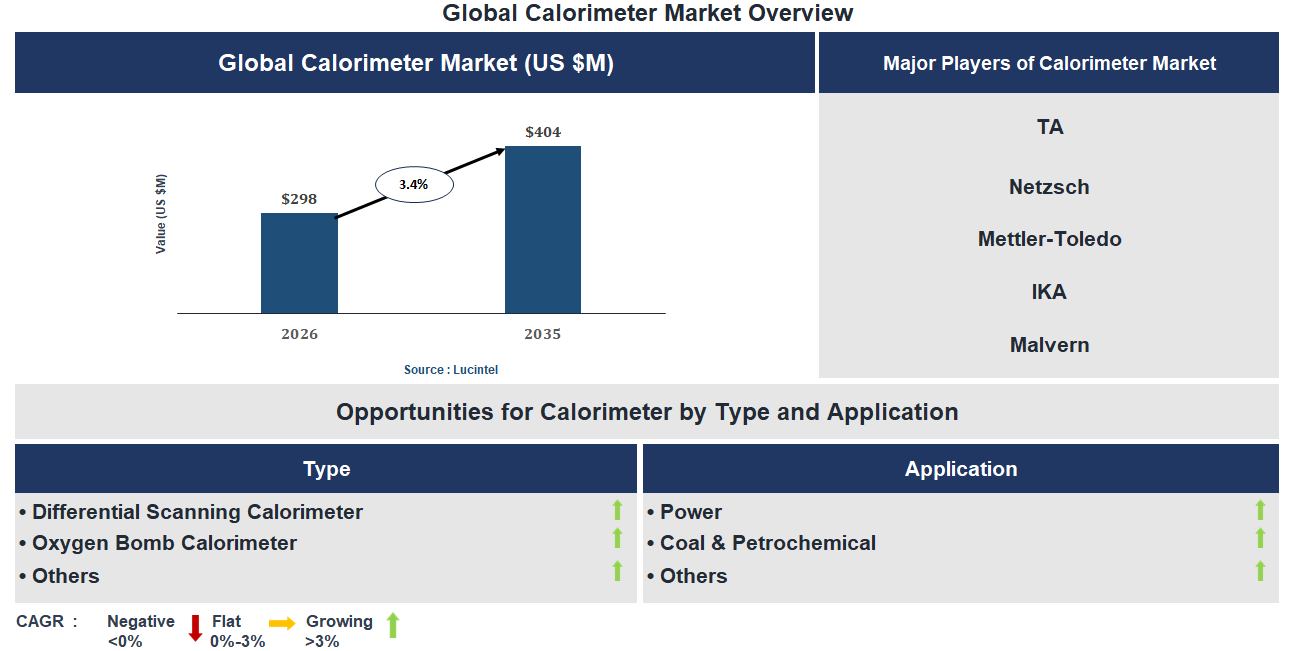
Key data points: The market size in 2035 = $404 million, growth forecast = 3.4% annually for the next 8 years. Scroll below to get more insights. This market report covers trends, opportunities and forecasts in calorimeter market to 2035 by type (differential scanning calorimeter, oxygen bomb calorimeter, and others), application (power, coal & petrochemical, and others), and region (North America, Europe, Asia Pacific, and the Rest of the World)
We'll send your sample report shortly.
• Lucintel forecasts that, within the type category, differential scanning calorimeter is expected to witness higher growth over the forecast period.
• Within the application category, coal & petrochemical is expected to witness higher growth.
• In terms of region, APAC is expected to witness the highest growth over the forecast period. Gain valuable insights for your business decisions with our comprehensive 150+ page report. Sample figures with some insights are shown below.
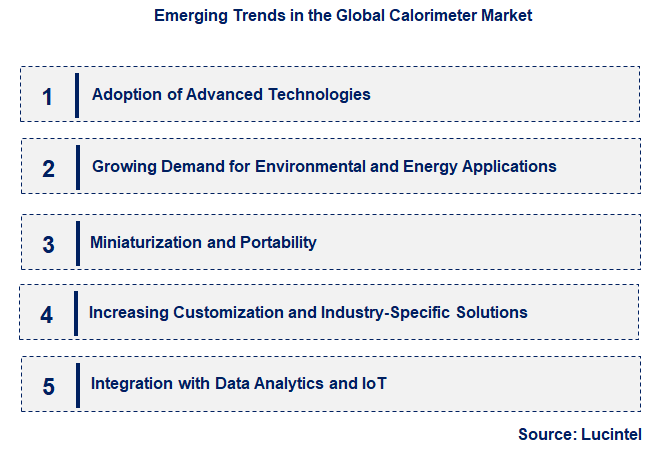
• Adoption of Advanced Technologies: The integration of digital and automation technologies is revolutionizing calorimeter design. Modern calorimeters now feature enhanced sensors, real-time data processing, and user-friendly interfaces, which improve measurement precision and reduce operational errors. Automation reduces manual intervention, increasing throughput and consistency. These technological advancements enable more complex experiments, faster results, and better data management, making calorimeters more accessible and efficient for various industries.
• Growing Demand for Environmental and Energy Applications: Increasing focus on environmental monitoring and energy efficiency is driving demand for calorimeters capable of analyzing heat flows in environmental samples and energy systems. Applications include measuring thermal properties of pollutants, analyzing renewable energy materials, and optimizing energy consumption in industrial processes. This trend reflects a broader shift towards sustainable practices and regulatory compliance, prompting manufacturers to develop specialized calorimeters suited for these critical applications.
• Miniaturization and Portability: The trend toward smaller, portable calorimeters is gaining momentum, especially for field testing and on-site analysis. Compact devices facilitate real-time measurements outside traditional laboratory settings, offering convenience and rapid results. This development is particularly impactful in industries like environmental monitoring, food safety, and quality control, where quick decision-making is essential. Miniaturization also reduces costs and expands the potential user base, making calorimetric analysis more accessible across various sectors.
• Increasing Customization and Industry-Specific Solutions: Market players are focusing on developing tailored calorimeter solutions to meet specific industry needs. Customization includes designing instruments for particular sample types, temperature ranges, or measurement sensitivities. Industry-specific solutions enhance accuracy and relevance, enabling better compliance with regulatory standards and research requirements. This trend fosters innovation and allows companies to differentiate their offerings, catering to niche markets and expanding overall market reach.
• Integration with Data Analytics and IoT: The incorporation of data analytics, cloud computing, and Internet of Things (IoT) technologies is transforming calorimeter data management. Connected devices enable remote monitoring, automated data collection, and advanced analysis, leading to improved decision-making and operational efficiency. IoT integration also facilitates predictive maintenance and real-time troubleshooting. This trend enhances the overall value proposition of calorimeters, making them smarter, more connected, and better aligned with Industry 4.0 initiatives. In summary, these emerging trends are reshaping the calorimeter market by enhancing measurement capabilities, expanding application areas, and improving user experience. Technological innovations, environmental focus, miniaturization, customization, and digital integration are collectively driving growth and competitiveness. As these trends continue to evolve, the market is poised for increased adoption, broader applications, and sustained innovation, ultimately transforming how thermal analysis is conducted across industries.
• Advances in Measurement Accuracy and Sensitivity: Enhanced calorimeter technologies now offer higher precision and sensitivity, enabling detailed thermal analysis. This improvement allows industries like pharmaceuticals and materials science to conduct more accurate experiments, leading to better product development and quality control. The increased reliability and resolution of measurements are attracting new customers and expanding market share for innovative calorimeter solutions.
• Automation and Integration in Calorimetry: The integration of automation features in calorimeters streamlines testing processes, reduces human error, and increases throughput. Automated systems facilitate real-time data collection and analysis, making calorimetry more accessible and efficient. This development is particularly impactful for high-volume industries such as food testing and chemical manufacturing, where speed and accuracy are critical for compliance and product innovation.
• Miniaturization and Portable Calorimeters: The trend toward smaller, portable calorimeters is opening new markets, including field testing and on-site analysis. These compact devices provide rapid results outside traditional laboratory settings, enhancing flexibility and convenience. Industries like environmental monitoring and quality assurance benefit from on-the-spot thermal measurements, broadening the market scope and enabling real-time decision-making in diverse environments.
• Rising Demand in Pharmaceutical and Biotech Sectors: The pharmaceutical and biotech industries require precise thermal analysis for drug development, stability testing, and quality assurance. Growing R&D activities and regulatory standards are fueling demand for advanced calorimeters. This sectors expansion offers lucrative opportunities for market players to develop specialized solutions, improve existing technologies, and capture a larger share of the rapidly growing healthcare market.
• Increasing Focus on Sustainable and Eco-Friendly Solutions: Environmental concerns are prompting the development of energy-efficient and eco-friendly calorimeter technologies. Companies are investing in sustainable materials and designs that reduce power consumption and waste. This focus aligns with global sustainability goals, attracting environmentally conscious customers and opening new avenues for market growth in green industries and regulatory-compliant testing. These developments are significantly transforming the calorimeter market by enhancing measurement precision, operational efficiency, portability, and sustainability. As industries adopt these innovations, the market is poised for substantial growth, diversification, and increased competitiveness. The evolving landscape offers numerous opportunities for companies to innovate, expand their customer base, and meet the rising demand for advanced thermal analysis solutions worldwide.
• Market Expansion Through Technological Innovation: Developing advanced calorimeters with higher accuracy, faster response times, and user-friendly interfaces can meet the growing demand for precise thermal analysis. Innovations such as microcalorimeters and portable units enable applications in research, clinical diagnostics, and field testing. Continuous R&D investments are essential to stay competitive and address emerging needs, including miniaturization and integration with digital platforms for real-time data analysis.
• Increasing Adoption in Healthcare and Medical Research: The rising prevalence of chronic diseases and the need for detailed metabolic and biochemical analysis drive the adoption of calorimeters in healthcare. These instruments are crucial for drug development, nutritional studies, and clinical diagnostics. Growing research funding and technological advancements facilitate the integration of calorimetry in personalized medicine, enabling more accurate disease monitoring and treatment efficacy assessments.
• Growing Demand in Food Quality and Safety Testing: Food manufacturers and regulatory agencies increasingly rely on calorimetry to ensure product quality, safety, and compliance with standards. Calorimeters help analyze food composition, detect adulteration, and monitor thermal properties during processing. The rising focus on food traceability and safety standards globally boosts the adoption of calorimetric techniques, encouraging manufacturers to invest in sophisticated instruments for quality assurance.
• Expansion in Industrial and Material Testing Applications: Industries such as polymers, pharmaceuticals, and chemicals utilize calorimeters for thermal stability testing, reaction kinetics, and material characterization. The need for precise thermal data to optimize manufacturing processes and develop new materials fuels market growth. As industries adopt sustainable practices and develop innovative products, the demand for advanced calorimetric solutions increases to support quality control and R&D activities.
• Strategic Collaborations and Market Penetration in Emerging Economies: Companies are forming partnerships with local distributors and research institutions to expand their presence in emerging markets like Asia-Pacific and Latin America. These regions offer growth potential due to increasing industrialization, healthcare infrastructure development, and rising research activities. Strategic collaborations facilitate technology transfer, localized product development, and increased market penetration, driving overall market expansion. These growth opportunities collectively enhance the calorimeter markets trajectory by fostering innovation, expanding application areas, and enabling global reach. Embracing technological advancements and strategic collaborations will be vital for market players to capitalize on emerging demands. As industries prioritize thermal analysis for quality, safety, and research, the market is poised for sustained growth and diversification.
• Technological Innovation: The development of advanced calorimeters with higher precision, automation, and integration capabilities is a key driver. These innovations improve measurement accuracy, reduce human error, and enhance efficiency, making calorimeters more attractive for research, industrial, and environmental applications. As industries demand more reliable data, manufacturers are investing heavily in R&D to stay competitive, which accelerates market growth.
• Growing Industrial and Research Applications: Increasing demand from sectors such as pharmaceuticals, food and beverages, chemicals, and environmental monitoring is fueling market expansion. These industries require precise thermal measurements for quality control, process optimization, and compliance with safety standards. The rise in research activities, especially in energy and environmental sectors, further boosts the adoption of calorimeters.
• Regulatory and Environmental Standards: Stringent regulations related to safety, emissions, and environmental impact are compelling industries to adopt calorimetry solutions. For example, environmental agencies require accurate heat measurements for pollution control, while pharmaceutical regulations demand precise thermal analysis for drug development. These standards create a sustained demand for reliable calorimetry equipment.
• Cost Reduction and Automation: Advances in automation and cost-effective manufacturing are making calorimeters more accessible to a broader range of users. Automated systems reduce operational costs, improve data reliability, and enable high-throughput testing. This trend is particularly significant for large-scale industrial applications and research institutions seeking efficient solutions. The challenges in the calorimeter market are:
• High Cost of Equipment: Despite technological advancements, calorimeters remain expensive, especially high-precision models. The initial investment, maintenance, and calibration costs can be prohibitive for small and medium-sized enterprises, limiting market penetration. This financial barrier restricts widespread adoption, particularly in developing regions.
• Technological Complexity: The sophisticated nature of calorimeter technology requires specialized knowledge for operation, calibration, and maintenance. This complexity can hinder adoption among users lacking technical expertise, leading to a reliance on trained personnel or service providers, which adds to operational costs and delays.
• Evolving Regulatory Standards: While regulations drive demand, they also pose challenges due to frequent updates and varying standards across regions. Keeping pace with changing compliance requirements demands continuous investment in training, certification, and equipment upgrades, which can strain resources and impact market stability. In summary, the calorimeter market is propelled by technological advancements, expanding application areas, and regulatory pressures that foster growth. However, high costs, technological complexity, and evolving standards present significant hurdles. These factors collectively influence market dynamics, requiring stakeholders to innovate and adapt strategically. The interplay of drivers and challenges will determine the pace of market expansion and the emergence of new opportunities, emphasizing the need for continuous innovation and regulatory compliance to sustain growth.
• TA
• Netzsch
• Mettler-Toledo
• IKA
• Malvern
• Shimadzu
• Setaram
• Leco
• Parr
• HITACHI
• Differential Scanning Calorimeter
• Oxygen Bomb Calorimeter
• Others
• Power
• Coal & Petrochemical
• Others
• North America
• Europe
• Asia Pacific
• The Rest of the World
• United States: The U.S. calorimeter market has seen substantial growth due to increased investments in pharmaceutical research, biotechnology, and materials science. Innovations in microcalorimetry and automation have improved measurement precision and efficiency. The adoption of digital and wireless technologies has enhanced data collection and analysis, supporting R&D activities. Additionally, regulatory requirements for drug development and quality control have driven demand for advanced calorimeters. The presence of leading market players and research institutions further accelerates technological advancements, making the U.S. a key hub for calorimeter innovation and application.
• China: Chinas calorimeter market is rapidly expanding, fueled by significant investments in healthcare, manufacturing, and energy sectors. The government’s focus on innovation and technological development has led to increased adoption of high-precision calorimeters in research and industrial processes. The growth of the pharmaceutical industry and rising demand for energy-efficient materials have contributed to market expansion. Local manufacturers are increasingly competing with international players by offering cost-effective solutions. Moreover, China’s emphasis on sustainable development and environmental monitoring has created new opportunities for calorimeter applications in pollution control and energy management.
• Germany: Germanys calorimeter market benefits from its strong industrial base, particularly in automotive, chemical, and renewable energy sectors. The country emphasizes high-quality, reliable measurement instruments, leading to innovations in differential scanning calorimetry and isothermal titration calorimetry. Germany’s focus on sustainability and energy efficiency has driven demand for calorimeters in research related to green technologies and materials testing. The presence of renowned research institutions and strict regulatory standards ensures continuous technological improvements. Additionally, collaborations between academia and industry foster the development of advanced calorimetric solutions tailored to specific industrial needs.
• India: The Indian calorimeter market is experiencing rapid growth driven by expanding pharmaceutical, food, and chemical industries. Increasing government initiatives to promote research and innovation have led to higher adoption of advanced calorimetric equipment. The rising focus on quality control and process optimization in manufacturing sectors has further boosted demand. Local manufacturers are expanding their product portfolios to include affordable, portable, and user-friendly calorimeters. Additionally, India’s growing healthcare sector and emphasis on research in biotechnology and nanotechnology are creating new opportunities for market expansion and technological development.
• Japan: Japan’s calorimeter market is characterized by high technological sophistication and innovation. The country’s focus on advanced materials research, electronics, and energy efficiency has led to the development of highly precise and automated calorimeters. Japan’s strong emphasis on environmental sustainability and renewable energy research has increased demand for calorimetric analysis in these fields. The presence of leading technology companies and research institutions supports continuous innovation. Moreover, Japan’s aging population and healthcare sector growth have driven demand for calorimeters used in medical research and diagnostics, further strengthening its market position globally.


• TA
• Netzsch
• Mettler-Toledo
• IKA
• Malvern
• Shimadzu
• Setaram
• Leco
• Parr
• HITACHI Q5. Which calorimeter market segment will be the largest in future? Answer: Lucintel forecasts that, within the type category, differential scanning calorimeter is expected to witness higher growth over the forecast period. Q6. In calorimeter market, which region is expected to be the largest in next 5 years? Answer: In terms of region, APAC is expected to witness the highest growth over the forecast period. Q7. Do we receive customization in this report? Answer: Yes, Lucintel provides 10% customization without any additional cost.


Choose a license that fits your team. Instant PDF delivery.
Prices exclude taxes. Instant delivery. Custom licensing available on request.
Market Report · July 29, 2026
Market Report · July 20, 2026
Market Report · July 20, 2026
Trusted partner for strategic intelligence and business growth


Receive a complimentary market analysis tailored to your industry. Our analysts will identify key growth opportunities and competitive dynamics specific to your business.

Market size, growth rate, and key trend analysis for your specific sector.

Top competitor positioning and market share analysis.

Strategic recommendations backed by data-driven insights.
Get curated market intelligence and competitive moves straight to your inbox.
By subscribing, you agree to receive our monthly insights. Unsubscribe anytime.
Receive a complimentary market analysis tailored to your industry. Our analysts will identify key growth opportunities and competitive dynamics specific to your business.
Market size, growth rate, and key trend analysis for your specific sector.
Top competitor positioning and market share analysis.
Strategic recommendations backed by data-driven insights.
Get curated market intelligence, emerging trends, and competitive moves straight to your inbox each month.
By subscribing, you agree to receive our monthly insights. Unsubscribe anytime.
We'll send your sample report shortly.