
Market Report · July 15, 2026

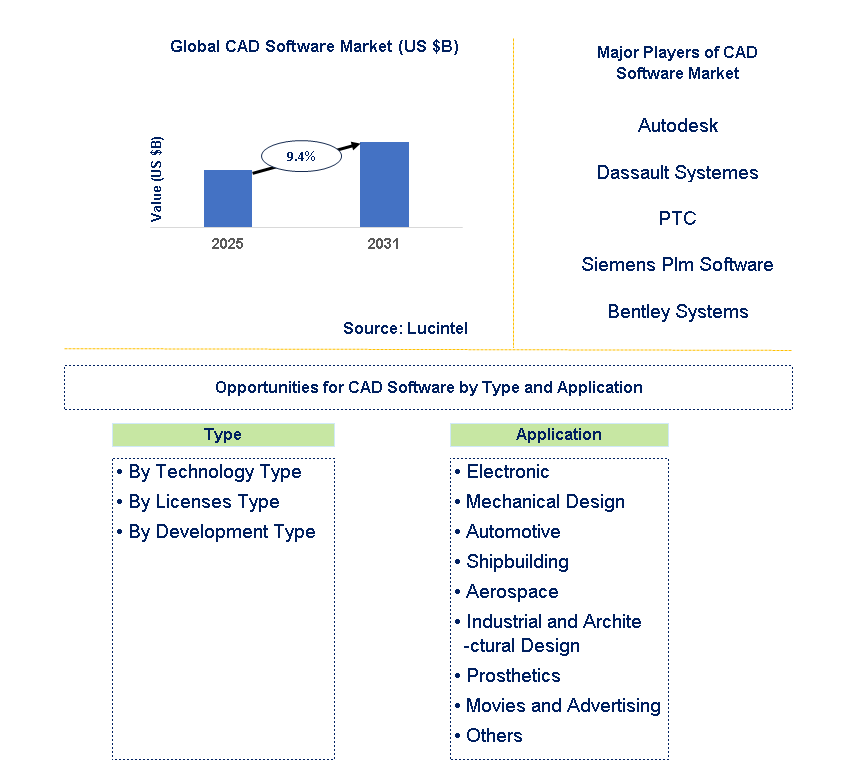
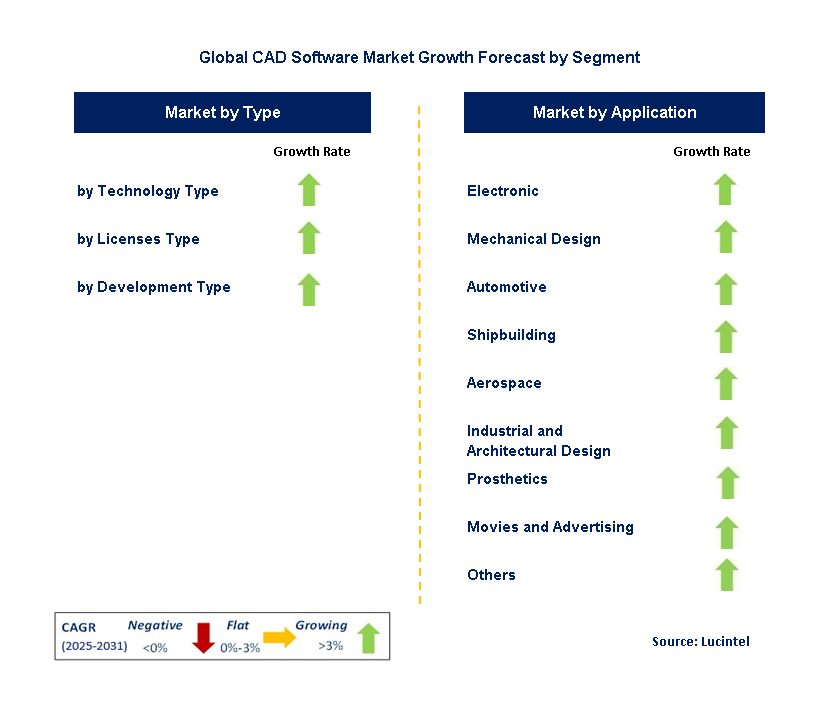
Key data points: The growth forecast = 9.4% annually for the next 7 years. Scroll below to get more insights. This market report covers Trends, opportunity and forecast in CAD software market to 2031 by type (by technology type, by licenses type, and by development type), application (electronic, mechanical design, automotive, shipbuilding, aerospace, industrial and architectural design, prosthetics, movies and advertising, and others), and region (North America, Europe, Asia Pacific, and the Rest of the World)
We'll send your sample report shortly.
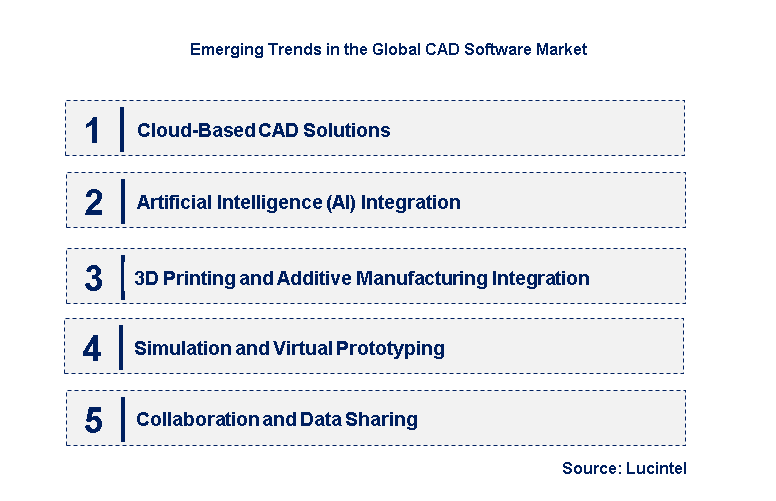
• Cloud-Based CAD Solutions: Cloud-based CAD solutions are the big hype that is changing the entire face of the CAD market. This is gaining more access for people to designing tools from any location, on any device, across dispersed teams. It can provide scalable resources, which will make business take on a large project without making heavy infrastructure investment. Real-time updates and data sharing are especially important for any global company undertaking collaborative design projects.
• Artificial Intelligence (AI) Integration: The integration of AI into CAD software is enhancing design efficiency by automating repetitive tasks, improving design accuracy, and offering predictive analytics. AI tools are helping designers identify potential issues early in the design process, which reduces errors and enhances product development timelines. Machine learning algorithms can analyze large sets of data to optimize designs and suggest modifications based on past performance, helping companies innovate faster and with greater precision.
• 3D Printing and Additive Manufacturing Integration: The integration of CAD software with 3D printing is changing the way product prototyping and production are approached. Designers can now make detailed 3D models that can be directly translated into physical prototypes using 3D printers, reducing the time and cost associated with traditional manufacturing methods. This trend is especially significant in industries like automotive, aerospace, and healthcare, where rapid prototyping and product iteration are critical. The integration of CAD with 3D printing enables more personalized, efficient, and innovative product designs.
• Simulation and Virtual Prototyping: Simulation and virtual prototyping are gaining momentum in the CAD market, allowing designers to test and validate their designs before physical production. By integrating simulation tools into CAD software, engineers can model and assess the behavior of designs under different conditions, reducing the need for costly physical prototypes. This is especially useful in the automotive, aerospace, and manufacturing sectors, where testing and validation are essential steps in the design process.
• Collaboration and Data Sharing: The emergence of collaboration and data sharing mechanisms in CAD software is creating a lot of fuss. The rise of remote work and global teams has made it more important for design teams to collaborate seamlessly. Modern CAD platforms now provide real-time editing, cloud storage, and version control, which allows teams to work on the same design at the same time. This trend is promoting greater efficiency in the design process and allowing for faster decision-making in complex projects, especially in construction, automotive, and industrial design. These emerging trends, including cloud-based solutions, AI integration, 3D printing, simulation, and enhanced collaboration, are transforming the CAD software market. These innovations are not only streamlining design processes but also enabling industries to create more innovative, efficient, and cost-effective products. As technology continues to advance, the role of CAD software in product development and manufacturing will only grow in significance.
• Adoption of Cloud-Based CAD Solutions: Cloud-based CAD adoption is game-changer for the market. Hosting CAD on cloud has enabled companies to make powerful design tools accessible without costly on-premise hardware. Cloud-based platforms allow for real-time collaboration, version control, and the ability to work from any device with access to the internet. Such factors have greatly minimized the barriers to entry for smaller companies while allowing larger organizations to scale their operations much better.
• Integration of Artificial Intelligence: The integration of AI into CAD software has been one of the most impactful developments in the market. AI-powered tools help automate design tasks, optimize designs, and detect errors early in the process. These tools can analyze historical data to offer design suggestions and predict potential issues. This development is helping industries reduce time to market and improve the accuracy of designs, ultimately leading to better products and more efficient production processes.
• Evolution of 3D Printing and Additive Manufacturing: The union of CAD with 3D printing and additive manufacturing is changing the face of industries like automobile, aerospace, and healthcare. Designers are now able to create digital prototypes and print them directly, significantly reducing the time and costs that would be required for traditional methods of manufacturing. This development has led to increased use of CAD software for designing highly complex and customized parts, now the norm in rapid prototyping and small-batch production.
• Increased Simulation and Virtual Prototyping: Simulation tools coupled with CAD help designers test their products virtually before creating physical prototypes. This has reduced the iterations of costly and time-consuming prototype development. Engineers can now simulate real-world conditions to assess how their designs would perform under various scenarios, which improves the reliability and functionality of the final product. This is particularly important in industries where testing is critical, such as in the automotive and aerospace industries.
• Increased Collaboration and Data Sharing: With remote work and distributed teams on the rise, there is a greater demand for CAD software that is able to collaborate and share data. Modern CAD platforms allow many users to work on a design simultaneously, no matter where they are located. In addition, they offer version control, ensuring that teams always have the most recent version of the design. This has made it easier for companies to manage complex projects and increase efficiency across global teams. Recent developments in the CAD software market, including cloud solutions, AI integration, 3D printing, simulation tools, and enhanced collaboration features, have ensured a new wave of changes in how products are designed and developed. Such innovations facilitate more rapid, efficient, and cost-effective design processes, thereby fueling growth in the CAD software market.
• Vehicle Design in the Automotive Industry: This is one of the significant growth areas for CAD software vendors. With electric and autonomous vehicle development set to become the future of the automobile market, the demand for advanced CAD tools is increasing. These design tools are also critical in the development of complex systems, such as electric drivetrains and self-driving technologies. In manufacturing vehicle components, CAD platforms have features such as simulation and 3D printing, which help companies produce more efficient designs. Growth of electric vehicles and autonomous systems: The growth of electric vehicles and autonomous systems is driving the demand for advanced CAD software in the automotive sector.
• Growth of Smart Cities and Urban Planning: The push for smart cities and sustainable urban planning is creating a major opportunity for CAD software providers. Governments and private developers are increasingly turning to CAD tools to design and manage urban infrastructure. From transportation systems to energy-efficient buildings, CAD software is critical for creating detailed and optimized designs. As cities grow and the demand for smart infrastructure rises, CAD software will be essential in shaping the urban landscape and driving innovation in architecture and construction.
• Advanced Manufacturing Solution Demand: Industries such as aerospace, defense, and manufacturing, which are implementing digital transformation, require CAD software that integrates other technologies like CAM (Computer-Aided Manufacturing) and CAE (Computer-Aided Engineering). This trend will create a demand for CAD software that offers end-to-end solutions for design, analysis, and production. CAD software providers are opening new growth opportunities by streamlining workflows and enhancing collaboration between design and manufacturing teams.
• Integration with Virtual Reality (VR) and Augmented Reality (AR): The integration of CAD software with VR and AR technologies is providing new opportunities for visualization and design testing. Designers can use VR and AR to interact with 3D models in real time, hence enhancing more immersive design experiences. It is beneficial for specific industries such as architecture, where designers can explore and even be able to modify designs in virtual environments. The rise of VR and AR in CAD design is creating new avenues for the growth of the software providers who are looking to innovate and enhance the entire design process.
• Cloud CAD solutions for Small and Medium Enterprises (SMEs): Cloud CAD solutions provide an excellent growth opportunity to reach small and medium-sized enterprises (SMEs). These firms are usually not in a position to afford pricey on-premise hardware or software but can better enjoy the scalability and cost savings opportunities that cloud solutions offer. This is where cloud-based CAD solutions enable SMEs to access robust design tools at a fraction of the cost of traditional systems to improve their design process and compete with market leaders. The strategic growth opportunities in the CAD software market cover several industries such as automotive, urban planning, manufacturing, and cloud-based solutions for SMEs. This has transformed the way companies design and develop products, creating a dynamic and evolving market for CAD software providers.
• Autodesk
• Dassault Systemes
• Ptc
• Siemens Plm Software
• Bentley Systems
• Altair Engineering
• Imsi Design
• Hexagon
• Ansys
• Corel Corporation
• By Technology Type
• By Licenses Type
• By Development Type
• Electronic
• Mechanical Design
• Automotive
• Shipbuilding
• Aerospace
• Industrial And Architectural Design
• Prosthetics
• Movies And Advertising
• Others
• North America
• Europe
• Asia Pacific
• The Rest of the World
• United State: CAD solutions remain very core in the industries of automotive, aerospace, construction, etc. in the United States. The fast growth of using cloud-based solutions is observed lately, and also the leaders here are Autodesk, Dassault Systems, and PTC with newer platforms. In the U.S., manufacturers utilize AI-driven solutions that speed up design cycles as well as team collaboration across diverse locations. Similarly, 3D printing and CAD software in combination are fast becoming more integrated, thus driving rapid prototyping. Digital twin technology is gradually becoming a hotspot in the country, especially across the automotive and aerospace industries in the U.S. CAD market.
• China: China's CAD software market is growing rapidly, as the country's manufacturing sector is advancing at a rapid pace. Chinese companies are increasingly adopting CAD software to enhance design accuracy and improve production efficiency. Firms like ZWSoft and GstarCAD are leading the way, offering localized solutions tailored to the unique needs of Chinese industries. Government's emphasis on manufacturing and engineering innovations has led to the increased usage of CAD technologies in automotive, construction, and electronics industries. Chinese manufacturers also are adopting integrated CAD-CAM solutions that improve the design-to-production process.
• Germany: Germany's CAD software market is defined by the strong engineering and manufacturing sectors in the country. The precision engineering sector in Germany is also known for automotive and machinery manufacturing. In recent years, the country has remained at the forefront of the adoption of CAD software. This trend is primarily supported by the central players Siemens and Dassault Systems, offering solutions that seamlessly integrate with Industry 4.0 technologies. Cloud-based and collaborative CAD platforms, which support real-time design and data sharing, are being adopted by German industries. The development of digital twins, especially for automotive and industrial design, is an emerging trend in the German CAD software market.
• India: CAD software adoption is growing rapidly in India due to increased demand from the manufacturing, construction, and IT sectors. Indian companies are using CAD software to enhance product design and reduce time to market. Autodesk and Dassault Systems have a decent presence in India, offering solutions tailored for local needs. The Indian government has many initiatives toward smart cities and infrastructure development, which are further accelerating the use of CAD software in urban planning and architecture. Moreover, the rapid growth of the Indian automotive industry is creating huge demand for advanced CAD tools to design vehicles and automotive components.
• Japan: CAD software is the largest market share of Japan, mainly in automotive, robotics, and electronics. The Japanese manufacturers integrate CAD solutions with other digital technologies, including AI, IoT, and robotics, to streamline the design and production processes. The companies that contribute to the growth of the Japanese CAD software market are Autodesk, PTC, and Fujitsu. The development of 3D CAD tools and their integration with simulation software is another key trend in Japan, helping industries improve product development and design accuracy. Japan is also increasingly adopting cloud-based CAD systems to enable collaborative design across geographically dispersed teams.


• Autodesk
• Dassault Systemes
• Ptc
• Siemens Plm Software
• Bentley Systems
• Altair Engineering
• Imsi Design
• Hexagon
• Ansys
• Corel Corporation Q5. Which CAD software market segment will be the largest in future? Answer: Lucintel forecasts that, within the type category, development type is expected to witness higher growth over the forecast period. Q6. In CAD software market, which region is expected to be the largest in next 5 years? Answer: In terms of region, APAC is expected to witness the highest growth over the forecast period. Q7. Do we receive customization in this report? Answer: Yes, Lucintel provides 10% customization without any additional cost.


Choose a license that fits your team. Instant PDF delivery.
Prices exclude taxes. Instant delivery. Custom licensing available on request.
Market Report · July 15, 2026
Market Report · June 26, 2026
Market Report · June 24, 2026
Trusted partner for strategic intelligence and business growth


Receive a complimentary market analysis tailored to your industry. Our analysts will identify key growth opportunities and competitive dynamics specific to your business.

Market size, growth rate, and key trend analysis for your specific sector.

Top competitor positioning and market share analysis.

Strategic recommendations backed by data-driven insights.
Get curated market intelligence and competitive moves straight to your inbox.
By subscribing, you agree to receive our monthly insights. Unsubscribe anytime.
Receive a complimentary market analysis tailored to your industry. Our analysts will identify key growth opportunities and competitive dynamics specific to your business.
Market size, growth rate, and key trend analysis for your specific sector.
Top competitor positioning and market share analysis.
Strategic recommendations backed by data-driven insights.
Get curated market intelligence, emerging trends, and competitive moves straight to your inbox each month.
By subscribing, you agree to receive our monthly insights. Unsubscribe anytime.
We'll send your sample report shortly.