
Market Report · July 22, 2026

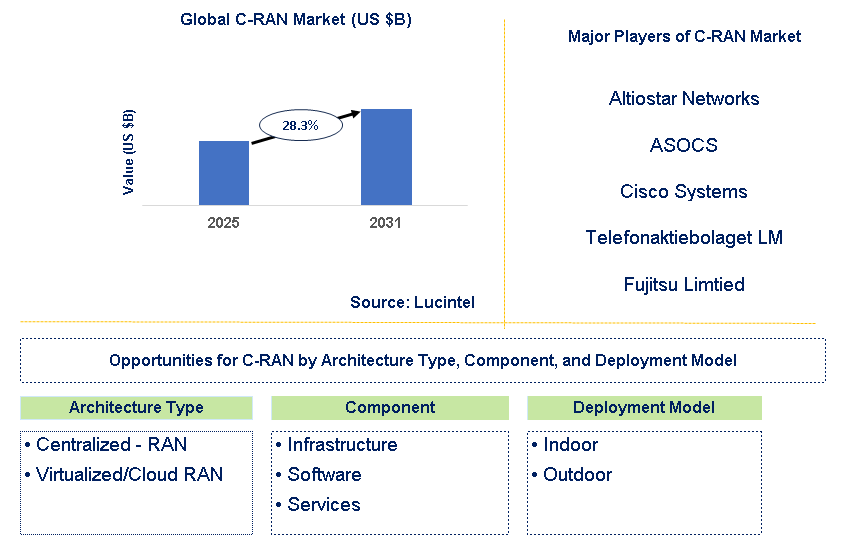
Key data points: The growth forecast = 28.3% annually for the next 7 years. Scroll below to get more insights. This market report covers trends, opportunities and forecasts in C-RAN market to 2031 by architecture type (centralized - RAN and virtualized/cloud RAN), component (infrastructure, software, and services), deployment model (indoor and outdoor), and region (North America, Europe, Asia Pacific, and the Rest of the World)
We'll send your sample report shortly.
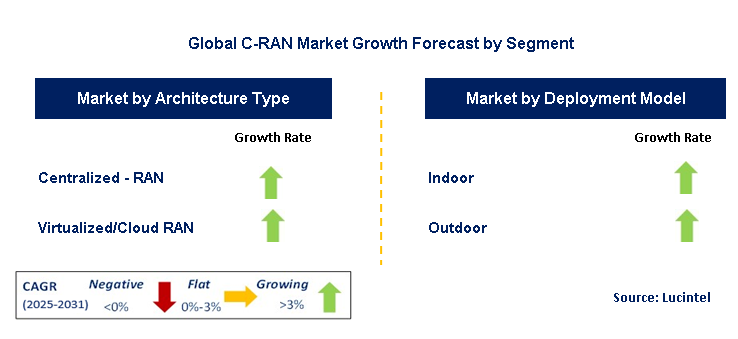
• Lucintel forecasts that, within the architecture type category, virtualized/cloud RAN is expected to witness higher growth over the forecast period.
• Within the deployment model category, outdoor is expected to witness higher growth.
• In terms of region, APAC is expected to witness the highest growth over the forecast period. Gain valuable insights for your business decisions with our comprehensive 150+ page report. Sample figures with some insights are shown below.
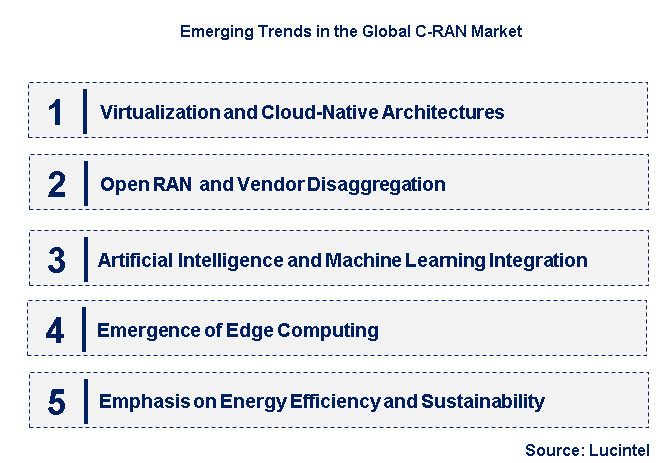
• Virtualization and Cloud-Native Architectures: One of the most important future trends is the transformation from traditional C-RAN that is centralized to a cloud-native or virtualized architecture, also referred to as varan. This entails operating baseband functions as software on ordinary, off-the-shelf servers instead of dedicated hardware. The effect is an enhanced, scalable, and cost-efficient network. Virtualization enables operators to dynamically allocate resources and to update their networks using software, minimizing the requirement for expensive hardware upgrades. The trend lies at the heart of 5G’s evolution and is a principal enabler for future 6G networks.
• Open RAN and Vendor Disaggregation: The second key trend is the trend toward Open RAN, an architecture that breaks up the hardware and software elements of the radio access network. This enables interoperability across various vendors’ equipment. The result is a more competitive and innovative environment, as operators are not tied to one vendor’s proprietary technology anymore. Open RAN is one of the major enablers for C-RAN adoption as it supports a modular and flexible architecture, which is in line with the principles of centralization and virtualization. This trend is a primary force for transforming the vendor landscape.
• Artificial Intelligence and Machine Learning Integration: The market is witnessing a shift towards AI and ML integration in C-RAN systems. AI and ML algorithms are utilized to automate network management, optimize traffic flow, and anticipate maintenance requirements. The effect is an intelligent and efficient network that can self-optimize in real-time. This trend is contributing toward decreasing operational expenses, enhancing network performance, and boosting quality of service for the end-users, which is crucial for 5G’s high-performance needs.
• Emergence of Edge Computing: The emergence of edge computing is a significant trend that is impacting the C-RAN market. Edge computing is a process of processing data near the user, which lowers latency. Centralized architecture of C-RAN, with its resource pooling capability, is a perfect companion for edge computing. The result is a network capable of providing ultra-low-latency services, including augmented reality, autonomous vehicles, and industrial IoT. The trend is building new revenue streams for telecom operators and placing C-RAN in a key technology for the next generation of applications.
• Emphasis on Energy Efficiency and Sustainability: The trend in the market is moving towards increased energy efficiency and sustainability. C-RAN’s central architecture makes hardware consolidation possible, which can lead to considerable power savings as well as lower cooling expenses compared to distributed, legacy networks. The effect is an eco-friendlier network that enables operators to achieve their sustainability objectives. This is not just a question of corporate social responsibility but also a business decision per se, since it results in a decrease in operational costs. These new trends are essentially redefining the C-RAN market by transforming it into a more open, intelligent, and sustainable one. The adoption of virtualized and Open RAN architectures is developing a more competitive and agile ecosystem. The convergence of AI and edge computing is improving network performance and supporting new high-value services. The emphasis on energy savings is rendering C-RAN increasingly economically and environmentally viable. Overall, the combined effect is a market that is smarter, more responsive to 5G demands, and better positioned to manage the sophisticated challenges of contemporary telecommunications.
• Rapid 5G Deployments: One of the recent advances is the rapid rollout of 5G deployments across the globe. As operators deploy their 5G networks, they are looking more and more to C-RAN for solutions to network densification and heavy data traffic challenges. The effect is a strong surge in the need for C-RAN solutions, as the architecture can easily support the high capacity and low-latency requirements of 5G. This trend is fueling market growth and establishing C-RAN as a cornerstone technology for next-generation networks.
• Emergence of Open RAN Alliances: The market is witnessing an evolution wherein there is an emergence of Open RAN alliances and partnerships between telecom operators and technology vendors. These partnerships are developing open and interoperable radio access network standards, which is essentially challenging the long-standing vendor-locked model. The effect is an innovative and more competitive market, where there are more vendors and options to choose from. This innovation is providing the operators with added flexibility and is alleviating the cost of overall network deployment.
• Virtualized and Cloud-Based C-RAN Adoption: The other major trend is the increasing use of virtualized and cloud-enabled C-RAN structures. Operators are shifting away from specialized hardware and instead are relying on software-defined solutions on generic servers. The result is a more scalable and flexible network that can be upgraded through software updates. This trend is lowering operators’ capital expenditure and operational expenses, and it is allowing them to bring new services to market more rapidly.
• Emphasis on Fronthaul and Fiber Infrastructure: There have been dramatic advancements in the attention being devoted to fronthaul and fiber infrastructure. C-RAN necessitates a high-capacity, low-latency link between the centralized baseband functions and the far-end radio units. The effect is an increasing investment in fiber optic infrastructure to accommodate these fronthaul needs. This trend is a key driver for C-RAN and is opening opportunities for vendors specializing in fiber deployment and connectivity solutions.
• Integration with Edge Computing: The market has witnessed an evolution in which there is a strong convergence of C-RAN with edge computing. Centralizing baseband units, C-RAN enables a more efficient means of processing data at the network’s edge. The result is a network that is capable of providing ultra-low-latency services, which are necessary for applications such as autonomous cars and industrial IoT. The evolution is broadening the reach of C-RAN to conventional mobile networks and into new, high-growth markets. The latest developments in the C-RAN market are all contributing to pushing it towards a more open, scalable, and intelligent future. The faster pace of 5G rollouts and the growth of Open RAN are fueling demand for C-RAN solutions and are making the market more competitive. The embrace of virtualization and integration with edge computing are improving network functions and opening up new revenue streams. The net effect is a more dynamic, more technologically sophisticated market, and a market that is better attuned to the future of mobile communications.
• Telecom Operators for 5G Deployment: The greatest opportunity for growth comes from offering C-RAN solutions to telecom operators for 5G deployments. C-RAN architecture is best suited for 5G’s low-latency and high-capacity needs. The value proposition is to provide integrated software, hardware, and services that facilitate smooth and economical evolution from legacy to C-RAN infrastructure. With the ability to provide solutions that optimize network performance and minimize operational expenses, companies can partner in the long term with large operators and gain a significant market share.
• Enterprises for Private 5G Networks: The market provides a big opportunity in offering C-RAN solutions to businesses for private 5G networks. Manufacturing, logistics, and healthcare sectors are implementing private 5G to support smart factories, automated logistics, and connected healthcare services. The opportunity lies in providing a customized C-RAN solution that can be simply deployed and managed in a private network. This solution enables businesses to access a high-growth market where demand is strong for a reliable, secure, and saleable wireless network.
• Urban Infrastructure and Smart City Projects: Urban infrastructure and smart city projects are a primary growth area. C-RAN is critical in developing the dense, interconnected networks needed for smart cities. The potential is to work with government and city planning authorities to develop and deploy C-RAN infrastructure that enables a broad set of smart city applications, ranging from smart traffic management to public safety and utility monitoring. This application has a high-impact, long-term potential to be associated with the fundamental technology of urbanization.
• Internet of Things and Industrial Automation: The Internet of Things and industrial automation markets offer a huge growth opportunity. C-RAN’s resource-pooling capability and support for massive connectivity make it a perfect fit to control the billions of IoT devices being rolled out in multiple industries. The opportunity is to offer a C-RAN solution that can provide low-power and high-density connectivity for IoT devices and that can be integrated with industrial automation systems. This solution enables businesses to access a high-value market where demand for a secure and scalable network is paramount.
• Edge Computing and Mobile Edge Computing: The C-RAN market has a strategic growth potential in the domain of edge computing and Mobile Edge Computing. C-RAN’s centralized architecture is a fine match for edge computing, since it facilitates efficient data processing at the network edge. The potential is to create an integrated C-RAN and MEC solution that can offer ultra-low-latency services, including augmented reality and virtual reality. This application is cutting-edge in technology and presents a high-growth opportunity for firms that can offer an end-to-end and innovative solution. Such strategic opportunities for growth are influencing the C-RAN market by increasing its applicability from traditional telecom to various industries. By targeting high-growth markets such as smart cities and private 5G, businesses can spread their revenue streams and narrow their dependence on one market segment. The possibilities offered by IoT and edge computing are driving the market toward an intelligent, connected future. Overall, the effect is a marketplace that is becoming more specialized, more diversified, and more integrated into the larger digital economy, further reinforcing the status of C-RAN as a key technology of the future.
• Altiostar Networks
• ASOCS
• Cisco Systems
• Telefonaktiebolaget LM Ericsson
• Fujitsu Limtied
• Huawei Technologies
• Intel Corporation
• HRMavenir Systems
• NEC Corporation
• Samsung Electronics
• Centralized - RAN
• Virtualized/Cloud RAN
• Infrastructure
• Software
• Services
• Indoor
• Outdoor
• North America
• Europe
• Asia Pacific
• The Rest of the World
• United States: The US market is a significant catalyst for C-RAN adoption, fueled by aggressive 5G rollouts by major telecom operators. Recent advancements are centered on a major transition towards Open RAN and Cloud RAN architectures. Major operators are working closely with vendors to create open, interoperable solutions with the aim of lowering vendor lock-in and enhancing network flexibility. The market is witnessing significant investment in next-generation C-RAN infrastructure to underpin 5G initiatives, with a focus on creating resilient, scalable networks that can meet the needs for high-speed data and low latency.
• China: China’s market is a world leader in C-RAN deployment, driven by the size of its 5G network deployment. Recent action is focused on the large-scale deployment of C-RAN architecture as a key part of its 5G commercialization strategy. Leading telecom operators are collaborating with top tech companies to roll out massive C-RAN solutions, which are needed to handle the strong data traffic in its high-density cities. The government emphasis on digitalization and smart city development is also a major propellant, adding to China’s leading role in the market.
• Germany: Germany’s C-RAN market is expanding steadily, with an emphasis on efficiency and sustainability. A recent wave of trends comes in response to a requirement to upgrade existing network infrastructure to support 5G and beyond. Operators are taking up C-RAN to lower operational expenses, especially energy consumption, and enhance the quality of the network. The market is witnessing a move to virtualized solutions, as German businesses emphasize flexible and scalable network architectures capable of responding to evolving consumer needs.
• India: India is a growing market with huge potential for growth, driven by a growth spurt in mobile subscribers and government drives for digitalization. Some of the recent developments include large-scale investments made by leading telecom operators to deploy C-RAN as part of their 5G network deployment. Domestic focus on end-to-end 5G radio and stack, especially with Open RAN, is a key development. This is providing a new source of revenue and propelling the emphasis on Open RAN, as part of a larger initiative among the government and primary industry participants.
• Japan: Japan’s market for C-RAN is advanced from a technology perspective and is highly competitive. Recent growth is fueled by an intense focus on deploying C-RAN to enhance network performance and cost savings, especially in its 5G networks. The industry is witnessing an emphasis on collaborations between technology firms and telecom operators to deploy C-RAN infrastructure, with special focus being laid on enhancing the intelligence of the network along with speed. Continuous deployment of C-RAN is a central component of the nation’s plan to continue its leadership in mobile technology and achieve increasing demand for high-speed connectivity.


• Altiostar Networks
• ASOCS
• Cisco Systems
• Telefonaktiebolaget LM Ericsson
• Fujitsu Limtied
• Huawei Technologies
• Intel Corporation
• HRMavenir Systems
• NEC Corporation
• Samsung Electronics Q5. Which C-RAN market segment will be the largest in future? Answer: Lucintel forecasts that, within the architecture type category, virtualized/cloud RAN is expected to witness higher growth over the forecast period. Q6. In C-RAN market, which region is expected to be the largest in next 5 years? Answer: In terms of region, APAC is expected to witness the highest growth over the forecast period. Q7. Do we receive customization in this report? Answer: Yes, Lucintel provides 10% customization without any additional cost.


Choose a license that fits your team. Instant PDF delivery.
Prices exclude taxes. Instant delivery. Custom licensing available on request.
Market Report · July 22, 2026
Market Report · July 17, 2026
Market Report · July 17, 2026
Trusted partner for strategic intelligence and business growth


Receive a complimentary market analysis tailored to your industry. Our analysts will identify key growth opportunities and competitive dynamics specific to your business.

Market size, growth rate, and key trend analysis for your specific sector.

Top competitor positioning and market share analysis.

Strategic recommendations backed by data-driven insights.
Get curated market intelligence and competitive moves straight to your inbox.
By subscribing, you agree to receive our monthly insights. Unsubscribe anytime.
Receive a complimentary market analysis tailored to your industry. Our analysts will identify key growth opportunities and competitive dynamics specific to your business.
Market size, growth rate, and key trend analysis for your specific sector.
Top competitor positioning and market share analysis.
Strategic recommendations backed by data-driven insights.
Get curated market intelligence, emerging trends, and competitive moves straight to your inbox each month.
By subscribing, you agree to receive our monthly insights. Unsubscribe anytime.
We'll send your sample report shortly.