
Market Report · July 15, 2026

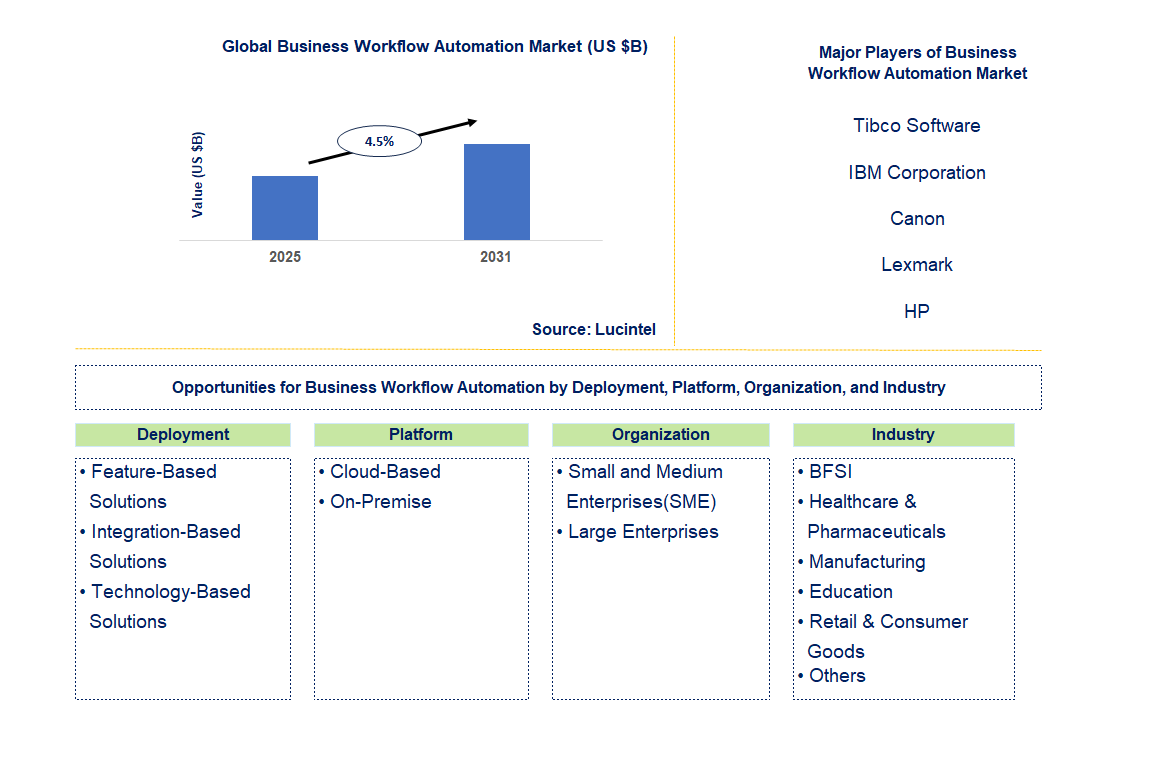
Key data points: The growth forecast = 4.5% annually for the next 7 years. Scroll below to get more insights. This market report covers Trends, opportunity and forecast in business workflow automation market to 2031 by deployment (feature-based solutions, integration-based solutions, and technology-based solutions), platform (cloud-based and on-premise), organization (small and medium enterprises(SME) and large enterprises), industry (BFSI, healthcare & pharmaceuticals, manufacturing, education, retail & consumer goods, and others), and region (North America, Europe, Asia Pacific, and the Rest of the World)
We'll send your sample report shortly.
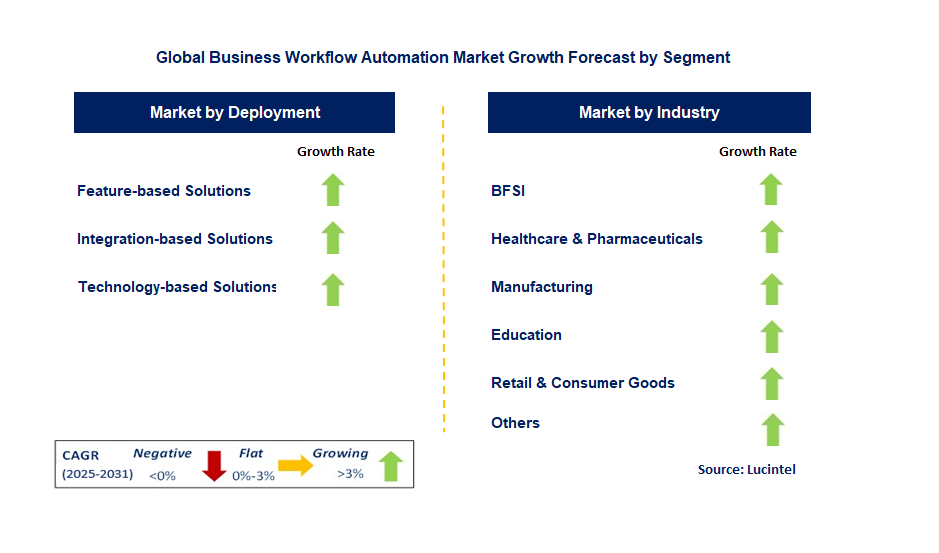
• Lucintel forecasts that, within the deployment category, integration-based solutions are expected to witness the highest growth over the forecast period.
• Within the industry category, BFSI is expected to witness the highest growth.
• In terms of region, APAC is expected to witness the highest growth over the forecast period. Gain valuable insights for your business decisions with our comprehensive 150+ page report. Sample figures with some insights are shown below.
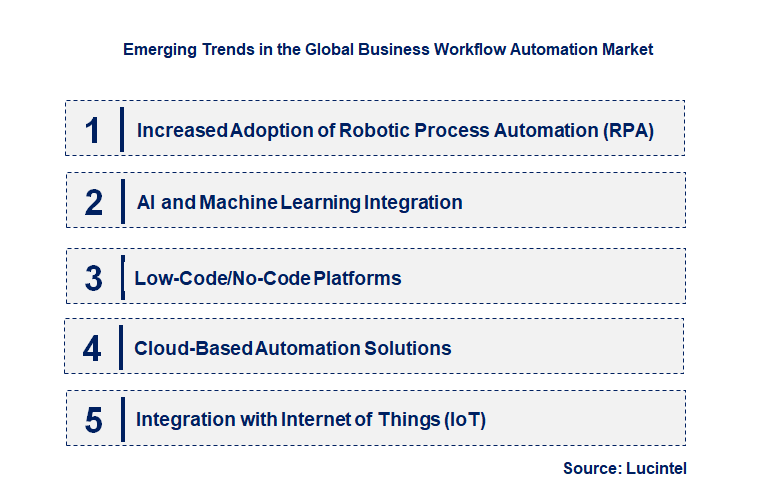
• Increased Adoption of Robotic Process Automation (RPA): RPA is one of the fastest-growing trends in the workflow automation market. Organizations are adopting RPA to automate repetitive, rule-based tasks such as data entry, invoicing, and customer service, thereby improving productivity and reducing human error. RPA’s ability to integrate with existing systems without major changes is a key factor behind its widespread adoption.
• AI and Machine Learning Integration: AI and machine learning are being integrated with workflow automation tools to enhance decision-making capabilities. These intelligent systems can learn from data, make predictions, and optimize processes in real-time. This allows businesses to automate more complex workflows, such as fraud detection in banking or predictive maintenance in manufacturing.
• Low-Code/No-Code Platforms: Low-code and no-code platforms are democratizing automation by enabling non-technical users to design and deploy automated workflows. This trend is particularly beneficial for SMEs that may lack dedicated IT teams. These platforms reduce development time and help businesses scale their automation efforts without needing deep programming expertise.
• Cloud-Based Automation Solutions: Cloud-based workflow automation tools are gaining traction due to their flexibility, scalability, and cost-efficiency. By leveraging cloud platforms, businesses can quickly scale their automation processes and integrate them with other cloud-based systems. Cloud-based automation also enables businesses to access workflow automation solutions from anywhere, enhancing remote work capabilities.
• Integration with Internet of Things (IoT): The integration of IoT with business workflow automation is enabling businesses to automate tasks based on real-time data from connected devices. This trend is particularly important in industries such as manufacturing, logistics, and retail, where IoT devices provide valuable insights into operations, helping businesses automate responses and optimize performance. These emerging trends are significantly transforming the business workflow automation market. AI, RPA, cloud solutions, and IoT integration are all driving efficiency, scalability, and innovation in business operations. As these technologies continue to evolve, businesses will have greater opportunities to automate complex workflows, reduce operational costs, and improve decision-making processes.
• Widespread Adoption of Robotic Process Automation (RPA): RPA has become one of the most important developments in the workflow automation market. Companies are increasingly deploying RPA to automate repetitive tasks such as data entry, customer service, and report generation. RPA is helping organizations reduce labor costs and enhance accuracy by minimizing human error.
• AI-Powered Automation: The integration of artificial intelligence with workflow automation tools is enabling businesses to create more intelligent and adaptive workflows. AI-powered systems can analyze data, recognize patterns, and make real-time decisions to improve process efficiency. AI is particularly useful in areas like customer support, where chatbots and virtual assistants are automating interactions.
• Cloud-Based Workflow Automation: Cloud-based solutions have become a major trend, providing businesses with scalable, flexible, and cost-effective automation options. Cloud platforms allow organizations to easily integrate automation tools into their existing IT infrastructure, reducing upfront costs and maintenance efforts. The ability to access automation tools remotely also supports remote work and business continuity.
• Low-Code/No-Code Automation Platforms: The rise of low-code and no-code platforms has made it easier for businesses to implement automation without needing extensive programming knowledge. These platforms are enabling non-technical users to create and deploy automated workflows, making automation more accessible to small and medium-sized businesses.
• Increased Focus on Security and Compliance: As businesses automate more of their operations, the need for secure and compliant automation tools has increased. Vendors are focusing on developing solutions that ensure compliance with data privacy regulations such as GDPR and CCPA. Secure automation platforms help businesses protect sensitive data while automating workflows. These developments are enhancing the capabilities of business workflow automation solutions. With RPA, AI, cloud platforms, and low-code/no-code tools, businesses are becoming more agile, efficient, and cost-effective. These innovations are driving the growth of the global business workflow automation market by enabling companies to automate complex tasks and optimize their operations.
• Healthcare Industry: The healthcare sector is adopting workflow automation to streamline administrative tasks, such as billing, patient scheduling, and medical record management. Automation tools are improving the accuracy and efficiency of patient care while reducing the administrative burden on healthcare providers. The increasing demand for healthcare services and the push for digital health transformation are driving automation adoption in this sector.
• Financial Services: Financial institutions are increasingly using workflow automation to optimize operations, improve regulatory compliance, and enhance customer service. Automation tools are used for fraud detection, claims processing, customer onboarding, and compliance reporting. The growing need for operational efficiency and risk management in the financial sector is creating significant opportunities for workflow automation solutions.
• Manufacturing and Supply Chain: Manufacturers are leveraging workflow automation to optimize production lines, streamline supply chain management, and improve quality control. The integration of automation tools with IoT devices is enabling real-time monitoring and decision-making, helping businesses reduce downtime and improve product quality. The adoption of Industry 4.0 principles is driving this trend.
• Retail and E-Commerce: In the retail and e-commerce sectors, workflow automation is being used to manage inventory, order processing, customer support, and marketing campaigns. Automation solutions are improving the customer experience by providing faster responses to queries, personalized product recommendations, and automated order fulfillment. The rise of omnichannel retailing is also contributing to the growth of automation in this sector.
• IT and Telecom: IT and telecommunications companies are adopting workflow automation to streamline operations, improve network management, and enhance customer service. Automated tools help manage IT infrastructure, monitor network performance, and resolve customer issues quickly. The increasing demand for faster and more reliable services is fueling the adoption of automation in this sector. These growth opportunities are transforming industries and driving the expansion of the global business workflow automation market. As automation technologies continue to evolve, businesses across various sectors are increasingly relying on them to improve operational efficiency, enhance customer experiences, and reduce costs.
• Tibco Software
• IBM Corporation
• Canon
• Lexmark
• HP
• Feature-Based Solutions
• Integration-Based Solutions
• Technology-Based Solutions
• Cloud-Based
• On-Premise
• North America
• Europe
• Asia Pacific
• The Rest of the World
• United States: The United States remains a leader in the business workflow automation market, with a strong focus on industries like healthcare, finance, and retail. The adoption of RPA and AI-driven solutions has been widespread, allowing businesses to automate mundane tasks such as customer support, data entry, and financial processing. Moreover, U.S. companies are integrating cloud-based solutions to enhance scalability and operational flexibility. Increasing demand for real-time decision-making, cost reduction, and compliance with regulations like GDPR and CCPA are key drivers for automation in the U.S. market.
• China: The Chinese workflow automation market is growing rapidly, particularly in manufacturing, finance, and e-commerce sectors. The government’s emphasis on digital transformation and innovation accelerates the adoption of AI and RPA technologies. In the manufacturing sector, automation is driving efficiencies and optimizing supply chains. Similarly, Chinese companies in the financial industry are automating routine transactions and customer service functions, leading to greater operational efficiency. Integrating 5G networks also enhances automation capabilities, enabling faster and more reliable data processing.
• Germany: Germany is a forerunner in workflow automation, especially in industries like automotive, manufacturing, and logistics. The country's "Industry 4.0" initiative, which promotes smart automation and digital manufacturing, has encouraged the widespread use of automation tools. German businesses are increasingly integrating AI, IoT, and machine learning into their workflows to enhance process optimization and predictive analytics. Regulatory compliance, particularly around data protection laws such as GDPR, is a major factor driving the adoption of secure, automated systems across both private and public sectors in Germany.
• India: The business workflow automation market is experiencing rapid growth, driven by the IT, telecommunications, and financial services sectors. Indian companies are increasingly adopting RPA and AI to automate repetitive tasks, reduce human error, and enhance operational efficiency. The country’s large pool of software developers contributes to the proliferation of affordable automation solutions, particularly in small and medium-sized enterprises (SMEs). The growing demand for automation in industries like banking and telecom is propelling the market, as companies look to modernize their operations to stay competitive.
• Japan: Japan has long been a leader in automation, particularly in the manufacturing and automotive industries. Recently, the focus has expanded to service sectors, including retail, finance, and healthcare. The country’s aging population and shrinking workforce have further accelerated the need for automation technologies. Japan is leveraging AI, robotics, and IoT to enhance business workflow automation, improve efficiency, and reduce dependency on human labor. The government also promotes digital innovation, incentivizing businesses to integrate automation.


• Tibco Software
• IBM Corporation
• Canon
• Lexmark
• HP Q5. Which business workflow automation market segment will be the largest in future? Answer: Lucintel forecasts that integration-based solutions are expected to witness the highest growth over the forecast period. Q6. In business workflow automation market, which region is expected to be the largest in next 5 years? Answer: APAC is expected to witness the highest growth over the forecast period. Q7. Do we receive customization in this report? Answer: Yes, Lucintel provides 10% customization without any additional cost.


Choose a license that fits your team. Instant PDF delivery.
Prices exclude taxes. Instant delivery. Custom licensing available on request.
Market Report · July 15, 2026
Market Report · June 26, 2026
Market Report · June 24, 2026
Trusted partner for strategic intelligence and business growth


Receive a complimentary market analysis tailored to your industry. Our analysts will identify key growth opportunities and competitive dynamics specific to your business.

Market size, growth rate, and key trend analysis for your specific sector.

Top competitor positioning and market share analysis.

Strategic recommendations backed by data-driven insights.
Get curated market intelligence and competitive moves straight to your inbox.
By subscribing, you agree to receive our monthly insights. Unsubscribe anytime.
Receive a complimentary market analysis tailored to your industry. Our analysts will identify key growth opportunities and competitive dynamics specific to your business.
Market size, growth rate, and key trend analysis for your specific sector.
Top competitor positioning and market share analysis.
Strategic recommendations backed by data-driven insights.
Get curated market intelligence, emerging trends, and competitive moves straight to your inbox each month.
By subscribing, you agree to receive our monthly insights. Unsubscribe anytime.
We'll send your sample report shortly.