
Market Report · July 16, 2026

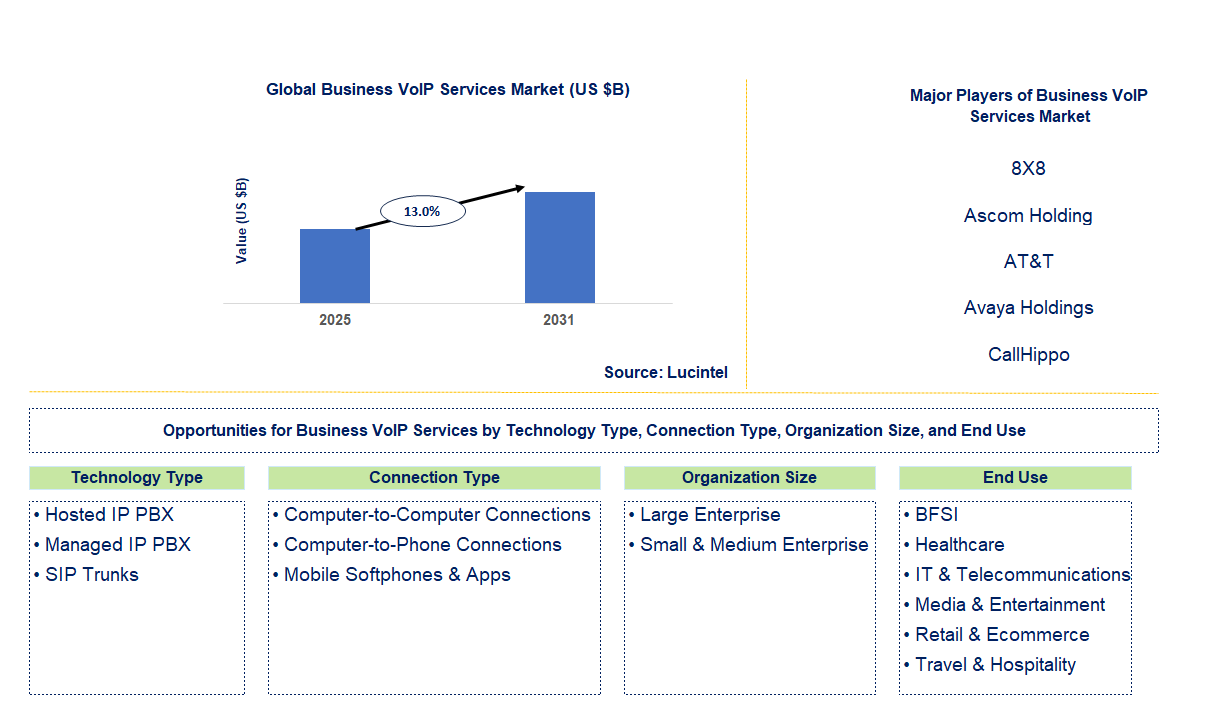
Key data points: The growth forecast = 13.0% annually for the next 7 years. Scroll below to get more insights. This market report covers Trends, opportunity and forecast in business VoIP services market to 2031 by technology type (hosted IP PBX, managed IP PBX, and sip trunks), connection type (computer-to-computer connections, computer-to-phone connections, and mobile softphones & apps), organization size (large enterprise and small & medium enterprise), end use (BFSI, healthcare, IT & telecommunications, media & entertainment, retail & ecommerce, and travel & hospitality), and region (North America, Europe, Asia Pacific, and the Rest of the World)
We'll send your sample report shortly.
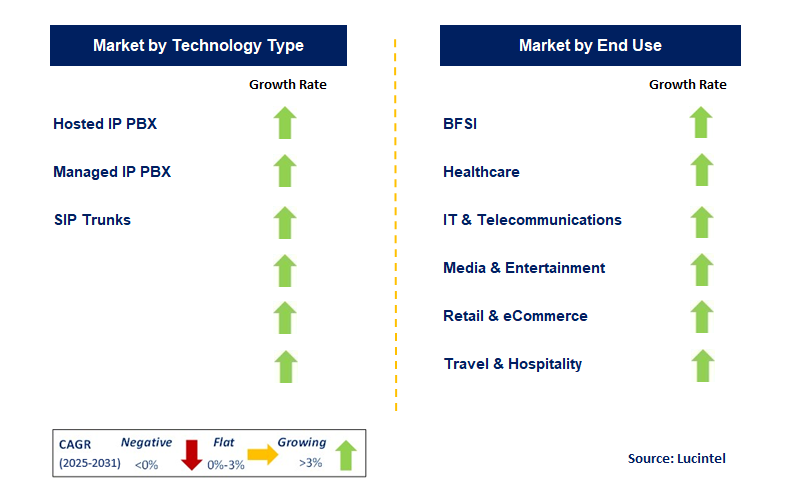
• Lucintel forecasts that, within the technology type category, hosted IP PBX is expected to witness the highest growth over the forecast period.
• Within the end use category, retail & ecommerce is expected to witness the highest growth.
• In terms of region, APAC is expected to witness the highest growth over the forecast period. Gain valuable insights for your business decisions with our comprehensive 150+ page report. Sample figures with some insights are shown below.
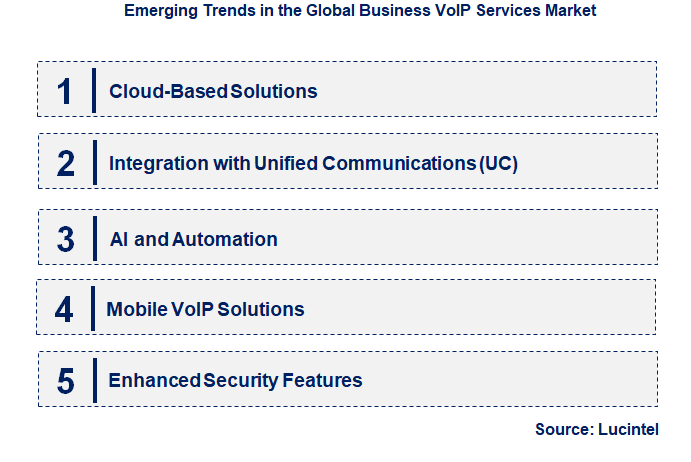
• Cloud-Based Solutions: The adoption of scalable, flexible, and cost-effective cloud-based VoIP solutions is on the rise among enterprises. Cloud VoIP enables easier management and quicker deployment while integrating smoothly with other cloud-based services. Furthermore, it reduces the need for hardware that would typically need to be set up within an organization's premises, making it suitable for businesses of all sizes.
• Integration with Unified Communications (UC): More frequently than ever before, Voice over IP is being integrated into Unified Communications systems, allowing for seamless communication, including voice calls, video chats, text messages, file sharing, and more. This trend fosters collaboration among distributed teams and simplifies IT administration by consolidating communication tools onto one platform.
• AI and Automation: Artificial Intelligence (AI) is revolutionizing business VoIP services by utilizing capabilities such as call routing, virtual assistant intelligence, transcription services, and predictive analytics. These developments enable better customer experiences, lower operating expenses, and improved decision-making by providing businesses with actionable insights from communication data.
• Mobile VoIP Solutions: As mobile workforces grow, mobile VoIP solutions have become essential. They allow staff members to make calls and access corporate communications using their smartphones, increasing productivity and flexibility. Mobile VoIP also facilitates global communication at a reduced cost, making it appealing to companies with global teams or clients.
• Enhanced Security Features: In light of escalating concerns about cyber threats, security has been given more significance by business VoIP services. Standard features now include end-to-end encryption, secure SIP trunking, multi-factor authentication, and advanced fraud detection, all of which protect businesses against eavesdropping or data breaches. These emerging trends are making the business VoIP services industry more flexible, secure, and user-centric. Cloud-based services, mobile capabilities, AI integration, and robust security are increasingly viewed as indispensable factors in enterprise telephony infrastructure as companies seek affordable and efficient communication solutions. This trend demonstrates how business VoIP services can now be more tightly integrated with enterprise voice platforms, making them more dynamic and secure than ever before, thus driving innovation in internal communication as well as customer relationships.
• Expansion of Cloud-VoIP Providers: The rising demand for adaptable and cost-efficient communication tools has led to a wider range of cloud-based VoIP providers. Many voice over IP suppliers are now offering end-to-end cloud telephony systems that serve both large organizations and small businesses, enabling firms to scale up without heavy upfront expenses on communication systems.
• Rise of 5G Integration: Alongside mobile VoIP offerings, 5G deployment across various countries is enhancing the VoIP experience. 5G provides faster internet speeds and lower latencies, improving call quality. Combining 5G networks with VoIP produces better results for mobile businesses, especially for teams working remotely in different countries.
• VoIP Adoption in Emerging Markets: The decrease in communication costs and improvement in internet infrastructure have led to increased VoIP adoption in many developing nations. As businesses in regions such as Southeast Asia, Africa, and Latin America embrace digital transformation, VoIP is being adopted rapidly due to its cost-effectiveness compared to traditional telephone systems.
• Proliferation of Video Conferencing Integration: Driven by the rise of remote and hybrid workforces, video conferencing features are now indispensable parts of VoIP service packages. Enterprises require one platform that integrates voice, video, and chat services for a streamlined communication process, reducing expenses associated with multiple service providers.
• Regulatory Developments on VoIP Standards: Governments and regulatory authorities are beginning to address issues related to the quality of service, taxation of services provided over VoIP networks, and compliance with regulations such as those governing emergency calling and customer records retention. With VoIP becoming the dominant communication method, more attention is being paid to ensuring reliability and security, resulting in stricter laws for VoIP providers, especially concerning data confidentiality and availability during emergencies. These developments are accelerating the shift to VoIP as a mainstream communication tool. The business VoIP market is expected to continue innovating as cloud technology evolves, 5G networks integrate, and emerging markets adopt VoIP. Service accessibility, user experience, and regulatory compliance are improving with these advancements, enabling businesses to communicate more effectively and efficiently on a global scale.
• Small and Medium Enterprises (SMEs): SMEs are increasingly turning to VoIP services due to their cost-effectiveness, scalability, and flexibility. They can streamline communication with ease while improving customer service without making significant investments in traditional phone systems.
• Remote and Hybrid Work Solutions: With the growing trend of remote and hybrid work models, businesses are turning to VoIP to enable seamless communication across distributed teams. The demand for VoIP platforms that offer mobile applications, integrate with UC platforms, or support multiple devices continues to rise.
• Global Communication Expansion: VoIP solutions are increasingly being adopted to enable international communication at reduced costs as businesses expand globally. VoIP allows organizations to make international calls at lower rates compared to traditional telephone systems, supporting worldwide operations and cross-border collaboration.
• VoIP-oriented Customer Support and Call Center Solutions: These VoIP services have become essential for improving customer support through features like call routing, CRM integration, and call analytics. To create more efficient and responsive customer service teams, businesses are adopting VoIP to streamline call handling, improve personalized interactions, and enhance the overall customer experience.
• Industry-Specific Solutions: VoIP providers are tailoring their services to meet the needs of specific industries such as healthcare, education, or finance. In healthcare, for example, there is a high demand for HIPAA-compliant VoIP solutions, while in education, integrated video and voice communications are being used for virtual classrooms and remote learning. The growth potential in the business VoIP services market demonstrates how valuable VoIP can be. Whether improving communication for small businesses, supporting remote work, or providing industry-specific solutions, VoIP has proven itself as an invaluable tool across sectors. Suppliers are now better positioned to meet varying market demands while promoting cost-effectiveness, efficiency gains, and enhanced customer experiences.
• 8X8
• Ascom Holding
• AT&T
• Avaya Holdings
• CallHippo
• Cisco Systems
• Citrix System
• Hosted IP PBX
• Managed IP PBX
• SIP Trunks
• Computer-To-Computer Connections
• Computer-To-Phone Connections
• Mobile Softphones & Apps
• North America
• Europe
• Asia Pacific
• The Rest of the World
• United States: The US corporate VoIP market continues to grow rapidly due to advancements in cloud technology and increasing acceptance of remote or hybrid work models. Providers focus on integrating VoIP with unified communications platforms to provide businesses with a one-stop voice, video, messaging, and more solution. Moreover, there is a strong effort to improve the security features of VoIP systems to address the growing concerns related to cyber threats. Besides being home to many small and medium-sized businesses (SMBs), the US demands cost-effective VoIP solutions with dynamic capabilities such as flexibility and mobility.
• China: Alongside its fast digitalization, China's business VoIP market is also improving. The government has begun easing some restrictions on VoIP services to encourage broad adoption, particularly by small and medium-sized enterprises (SMEs). As China moves towards becoming a global leader in AI and 5G technologies, VoIP providers are incorporating these advances into their platforms to improve service quality, call reliability, and data analytics. However, regulatory barriers persist, particularly concerning data privacy, which can inhibit the growth of international VoIP services. This forces domestic players to compete by offering highly localized solutions that perfectly match the needs of Chinese firms.
• Germany: The German business VoIP market continues to grow steadily due to strong IT infrastructure and increased demand for cloud-based communication solutions. German organizations prioritize data protection while ensuring compliance with the EU’s GDPR (General Data Protection Regulation), which results in secure, encrypted services provided by VoIP operators. Additionally, enterprises are now integrating VoIP into customer relationship management (CRM) systems, facilitating teamwork and enabling better customer care. The rise of remote working and the digital transformation of traditional industries, such as manufacturing, are further driving demand for commercial IP telephony among organizations.
• India: The VoIP business industry has experienced remarkable growth, primarily driven by the country’s expanding digital economy and the surge of small- and medium-sized enterprises (SMEs). Affordable internet, coupled with government initiatives for digitization, has contributed to the increased adoption of VoIP. Additionally, India is fast becoming a major outsourcing center. VoIP plays a key role in meeting the telecommunication needs of the BPO (Business Process Outsourcing) and IT-enabled services industries. Local providers are incorporating AI-powered analytics, multi-device support, and cloud integration into their products to address the changing needs of businesses.
• Japan: The Japanese business VoIP market is characterized by high-tech innovation and a strong demand for communication reliability. The current trend is to merge VoIP services with advanced 5G networks to offer superior voice calls with minimal latency. Furthermore, the growing concerns over Japan’s aging population are leading to increased demand for user-friendly, voice-based communication platforms, both in enterprises and the healthcare sector. This has led to several Japanese companies adopting cloud-based communication systems under government-led digitization efforts. Additionally, audio vendors are providing multilingual support and cross-border connectivity, which caters to international businesses, particularly since many SMEs cannot handle these needs independently.


• 8X8
• Ascom Holding
• AT&T
• Avaya Holdings
• CallHippo
• Cisco Systems
• Citrix System Q5. Which business VoIP services market segment will be the largest in future? Answer: Lucintel forecasts that hosted IP PBX is expected to witness the highest growth over the forecast period. Q6. In business VoIP services market, which region is expected to be the largest in next 5 years? Answer: APAC is expected to witness the highest growth over the forecast period. Q7. Do we receive customization in this report? Answer: Yes, Lucintel provides 10% customization without any additional cost.


Choose a license that fits your team. Instant PDF delivery.
Prices exclude taxes. Instant delivery. Custom licensing available on request.
Market Report · July 16, 2026
Market Report · May 18, 2026
Market Report · May 18, 2026
Trusted partner for strategic intelligence and business growth


Receive a complimentary market analysis tailored to your industry. Our analysts will identify key growth opportunities and competitive dynamics specific to your business.

Market size, growth rate, and key trend analysis for your specific sector.

Top competitor positioning and market share analysis.

Strategic recommendations backed by data-driven insights.
Get curated market intelligence and competitive moves straight to your inbox.
By subscribing, you agree to receive our monthly insights. Unsubscribe anytime.
Receive a complimentary market analysis tailored to your industry. Our analysts will identify key growth opportunities and competitive dynamics specific to your business.
Market size, growth rate, and key trend analysis for your specific sector.
Top competitor positioning and market share analysis.
Strategic recommendations backed by data-driven insights.
Get curated market intelligence, emerging trends, and competitive moves straight to your inbox each month.
By subscribing, you agree to receive our monthly insights. Unsubscribe anytime.
We'll send your sample report shortly.