
Market Report · July 16, 2026

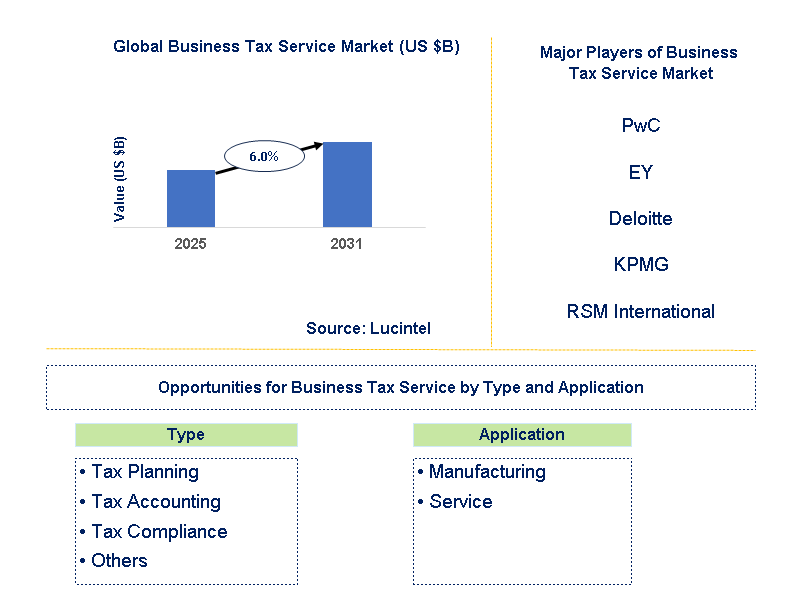
Key data points: The growth forecast = 6.0% annually for the next 7 years. Scroll below to get more insights. This market report covers Trends, opportunity and forecast in business tax service market to 2031 by type (tax planning, tax accounting, tax compliance, and others), application (manufacturing and service), and region (North America, Europe, Asia Pacific, and the Rest of the World)
We'll send your sample report shortly.
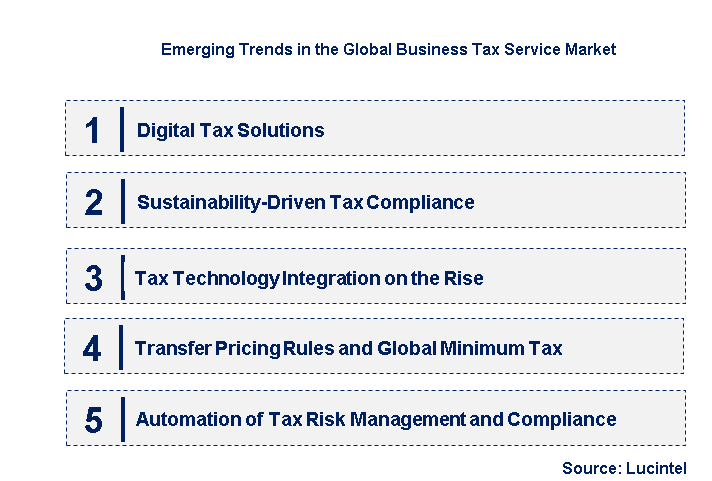
• Digital Tax Solutions: Digitization is one of the most significant trends within the BTS market. Governments worldwide have started to adopt digital platforms for filing and compliance, reducing their reliance on paper-based processes. Artificial intelligence (AI)-powered robotic process automation tools help businesses manage their tax obligations more efficiently. This trend enables accurate reporting, real-time updates on regulatory changes, and seamless audits.
• Sustainability-Driven Tax Compliance: Environmental, social, and governance (ESG) considerations are increasingly influencing tax policies, with governments introducing tax incentives for companies embracing sustainability. Many countries are currently implementing “green” tax laws that allow write-offs for renewable energy investments, carbon reduction efforts, and other sustainable business practices. Consequently, this trend is driving organizations to incorporate sustainability into their tax strategies and regulatory compliance.
• Tax Technology Integration on the Rise: Large corporations increasingly see the need to integrate their enterprise resource planning systems with tax technology tools. Cloud-based solutions are being developed by tax services providers that integrate directly into the financial systems of clients, allowing for real-time updates on tax obligations and simplified management of tax data. This application of technology reduces the complexity of tax compliance while enhancing operational efficiency.
• Transfer Pricing Rules and Global Minimum Tax: The OECD's implementation of its global minimum tax and new transfer pricing guidelines has added a layer of complexity to cross-border tax planning. Companies are now required to comply with these regulations, leading to high demand for advisory services specific to these taxes. There is a growing tendency among firms to adopt more sophisticated approaches as they strive to benefit from expertise in international taxation.
• Automation of Tax Risk Management and Compliance: The increased regulatory focus and audit exposure means businesses have shifted toward proactive management of their tax risks. Automation tools are now being used to manage these risks and ensure compliance with ever-changing international tax laws. These tools allow companies to understand and mitigate potential issues before they arise, thereby improving overall efficiency in taxation operations. In conclusion, these emerging trends are making tax compliance management different for businesses and changing the competitive environment for tax service providers. The BTS market continues to evolve due to digitization, sustainability, and globalization.
• Introduction of Mandatory Digital Tax Filing: Electronic filing requirements imposed by most countries have resulted in increased demand for digitalized tax services. Europe, in particular, has expanded e-filing to cover all firms, including SMEs (Small and Medium Enterprises). This change is forcing tax service providers to adopt new technology platforms that enhance compliance while increasing efficiency. Moreover, it presents an opportunity for companies to simplify their tax reporting procedures, thereby reducing administrative burdens.
• Global Minimum Tax Implementation: The OECD's agreement on the global minimum tax has resulted in significant changes in how transnational firms handle their taxes. Companies must ensure that they comply with these new global regulations. This has led businesses to seek professional tax advice concerning these changes. As a result, there is increasing demand for cross-border tax advisory services, especially among multinational companies.
• Focus on Tax Risk Management: Worldwide, businesses have started to focus more on tax risk management because authorities are becoming stricter and require more attention to compliance. Companies are now investing heavily in solutions to identify and address issues before they become serious problems. This shift is boosting the need for tax technology and consulting services that facilitate risk assessment and mitigation.
• Growing Importance of Sustainability-Linked Tax Strategies: As ESG regulations evolve, sustainability-linked tax incentives are becoming more promising. Governments are offering certain privileges aimed at encouraging business enterprises that satisfy specific environmental and social goals. Integrating these factors into overall taxation approaches has become a norm for corporations. In response, many firms have had to rethink their entire tax planning process to fully benefit from available sustainable-related fiscal incentives.
• Rise of AI and Automation in Tax Services: The integration of artificial intelligence and automation technologies into tax compliance processes is increasing. There is traction for tools that use machine learning to predict tax provisions, automate filing, and analyze financial data. These developments enable businesses to enhance tax accuracy, reduce errors, and save on compliance costs. Given the constant changes in the marketplace, businesses offering tax services need to incorporate these technological advancements to remain relevant. In conclusion, business tax services are undergoing major transformations. Recently, companies have turned digital, using these tools and focusing on specialized expertise to handle complex issues associated with modern taxation.
• Cloud-Based Tax Solutions: The increasing demand for cloud-based solutions presents an opportunity for tax service providers to offer scalable, efficient platforms that seamlessly integrate with clients' financial systems. Automated compliance, enhanced data quality, and reduced operational costs are the advantages of using cloud-based tax solutions. This trend is particularly beneficial for small and medium-sized enterprises (SMEs) seeking affordable and flexible taxation options.
• Tax Advisory for Cross-Border Transactions: As more businesses go global, there is an increased need for specialized tax advisory services on cross-border transactions. The complexity of international tax rules, transfer pricing regulations, and local compliance requirements has led to booming demand for skilled tax advisors. Tax firms providing worldwide consulting services are poised to gain from this growth area.
• Sustainability Tax Advisory: Due to the rise in sustainability-focused taxes, companies require advisory services regarding green energy incentives, carbon offsetting, and maintaining sustainable business practices. For corporations seeking efficient ways to reduce their tax bills through sustainability initiatives, ESG-centric tax professionals can offer valuable advice.
• Automation and AI in Compliance: The use of automation and AI tools to streamline tax compliance is an escalating market trend. Firms with AI-backed tools for tax reporting, audit, and risk management can attract businesses aiming to decrease expenditures while increasing efficiency. This is especially important for large corporations with complex tax structures.
• SME Tax Services: As global tax compliance requirements become more intricate, small and medium-sized enterprises (SMEs) require affordable and accessible tax services. There are substantial opportunities for tax providers to create specialized products targeting SMEs as they navigate the challenges of digital filing, regulatory compliance, and risk management. Strategic growth opportunities indicate a vibrant business tax service market in motion. These opportunities will continue propelling market growth as accountants adapt to new technologies such as robotics, artificial intelligence, and blockchain, as well as changing client demands and regulatory frameworks.
• PwC
• EY
• Deloitte
• KPMG
• RSM International
• Crowe
• Grant Thornton
• Tax Planning
• Tax Accounting
• Tax Compliance
• Others
• Manufacturing
• Service
• North America
• Europe
• Asia Pacific
• The Rest of the World
• United States: The U.S. business tax service market is responding to new tax legislation aimed at wealthy individuals and corporations under Biden's administration. This has led to an increased need for enhanced IRS enforcement efforts, digital filing requirements, and environmental sustainability-driven taxation policies, all driving up demand for more holistic tax consulting services provided by firms. Artificial intelligence (AI) and automation streamline the preparation of tax returns, helping firms save time. Additionally, global minimum corporate tax proposals, like the OECD’s, are changing how multinational companies deal with taxes today.
• China: China has experienced a shift toward increased digitization of its tax services, with the government improving electronic tax filing systems and strengthening enforcement through big data analytics. In recent years, China introduced various tax incentives to attract foreign investment and support domestic technological innovation, especially in areas such as green energy and the digital economy. Moreover, Chinese authorities have increased scrutiny of cross-border taxation arrangements, alongside stringent transfer pricing rules. The government’s focus on enhancing digital tax reporting has resulted in increased demand for technology-driven solutions within the BTS industry.
• Germany: Germany is witnessing robust efforts toward digitizing Business Tax Services (BTS), with e-filing and e-invoicing being made compulsory by the federal government. Germany's tax administrators are also focusing on combatting evasion and fraud using sophisticated data analytics and AI. Harmonization of tax policies within the European Union (EU) means that German companies constantly need international tax advisory services more than ever before. Consequently, tax service providers are emphasizing national/EU compliance while helping clients navigate complex issues related to international taxation.
• India: Ongoing tax reforms, including the introduction of Goods and Services Tax (GST), have led to rapid changes in India’s Business Tax Services market. The tax landscape is increasingly digital, with businesses having to adopt e-invoicing and e-filing solutions provided by tax authorities. Furthermore, the government has put in place several tax breaks for start-ups and small industries, driving their expansion. With the increasing complexity of India’s tax laws, companies are compelled to seek advanced tax advisory and compliance services. Additionally, the expanding GST network has necessitated technology solutions that facilitate smooth and timely compliance.
• Japan: Japan's business tax service market sees increasing demand for cross-border tax services due to more Japanese firms becoming internationalized. The Japanese government has focused on taxation efficiency and digitization by making electronic filing mandatory. Moreover, Japan has been quick to address global issues such as digital taxation and transfer pricing rules, especially in relation to OECD BEPS initiatives. Due to complex local and international regulations affecting professional accountants' determinations on taxes, there is a growing need for specialized tax advisors and firms, particularly in corporate tax planning, where it has impacted the market.


• PwC
• EY
• Deloitte
• KPMG
• RSM International
• Crowe
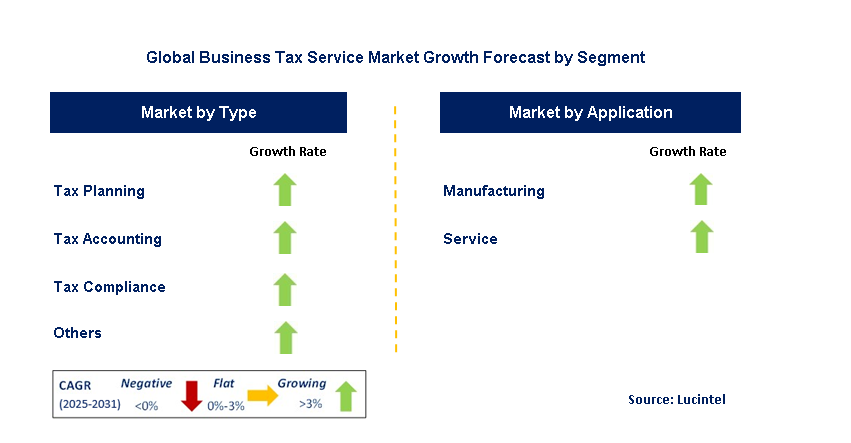
• Grant Thornton Q5. Which business tax service market segment will be the largest in future? Answer: Lucintel forecasts that, within the type category, tax compliance is expected to witness the highest growth over the forecast period. Q6. In business tax service market, which region is expected to be the largest in next 5 years? Answer: In terms of region, APAC is expected to witness the highest growth over the forecast period. Q7. Do we receive customization in this report? Answer: Yes, Lucintel provides 10% customization without any additional cost.


Choose a license that fits your team. Instant PDF delivery.
Prices exclude taxes. Instant delivery. Custom licensing available on request.
Market Report · July 16, 2026
Market Report · May 18, 2026
Market Report · May 18, 2026
Trusted partner for strategic intelligence and business growth


Receive a complimentary market analysis tailored to your industry. Our analysts will identify key growth opportunities and competitive dynamics specific to your business.

Market size, growth rate, and key trend analysis for your specific sector.

Top competitor positioning and market share analysis.

Strategic recommendations backed by data-driven insights.
Get curated market intelligence and competitive moves straight to your inbox.
By subscribing, you agree to receive our monthly insights. Unsubscribe anytime.
Receive a complimentary market analysis tailored to your industry. Our analysts will identify key growth opportunities and competitive dynamics specific to your business.
Market size, growth rate, and key trend analysis for your specific sector.
Top competitor positioning and market share analysis.
Strategic recommendations backed by data-driven insights.
Get curated market intelligence, emerging trends, and competitive moves straight to your inbox each month.
By subscribing, you agree to receive our monthly insights. Unsubscribe anytime.
We'll send your sample report shortly.