
Market Report · July 15, 2026

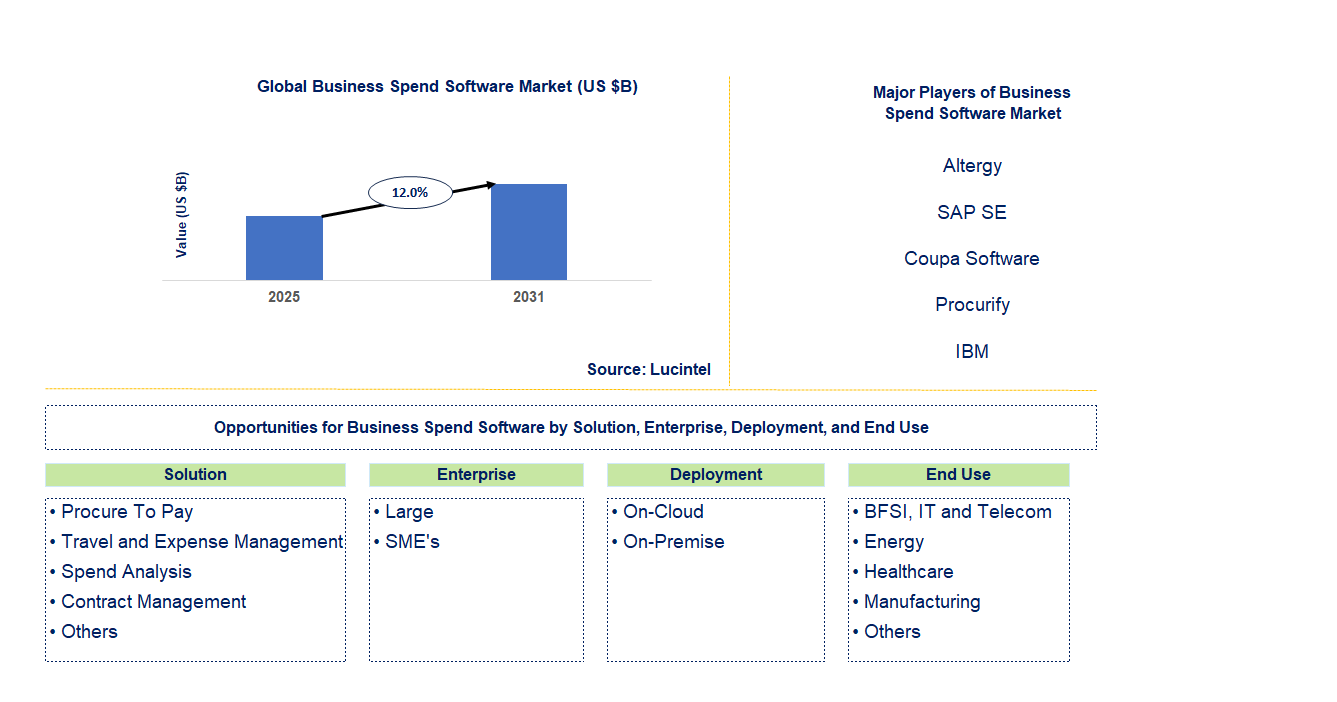
Key data points: The growth forecast = 12.0% annually for the next 7 years. Scroll below to get more insights. This market report covers Trends, opportunity and forecast in business spend software market to 2031 by solution (procure to pay, travel and expense management, spend analysis, contract management, and others), enterprise (large and SMEs), deployment (on-cloud and on-premise), end use (BFSI, IT and telecom, energy, healthcare, manufacturing, and others), and region (North America, Europe, Asia Pacific, and the Rest of the World)
We'll send your sample report shortly.
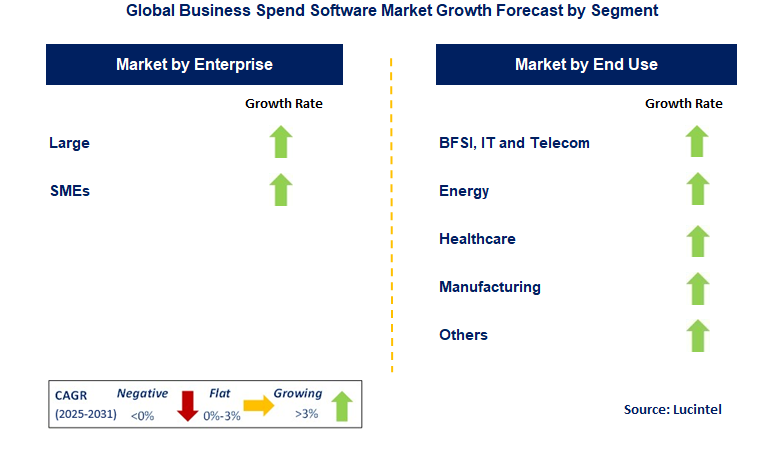
• Lucintel forecasts that, within the enterprise category, large enterprise is expected to witness higher growth over the forecast period.
• Within the application category, healthcare is expected to witness the highest growth.
• In terms of region, APAC is expected to witness the highest growth over the forecast period. Gain valuable insights for your business decisions with our comprehensive 150+ page report. Sample figures with some insights are shown below.
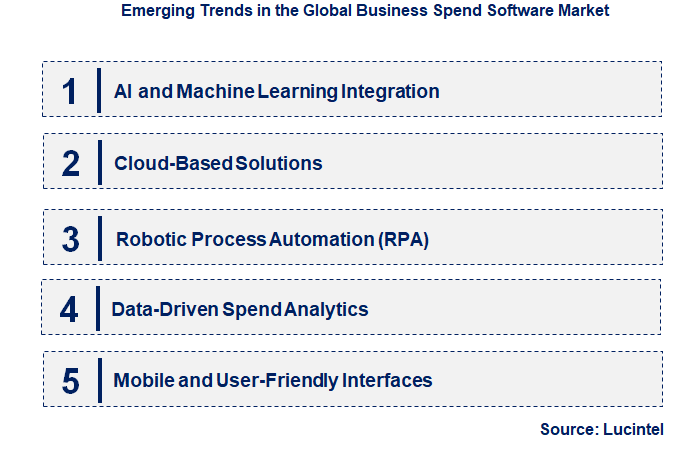
• AI and Machine Learning Integration: To optimize their procurement processes and predict spending trends and potential improvements in decision-making, companies are increasingly incorporating AI and machine learning into their enterprise spend software. Companies can also leverage AI to automate manual tasks, improve fraud detection mechanisms, and learn from large amounts of data using insights from such data. This trend is beneficial for organizations wanting to improve efficiency levels within their operations, reduce costs, or ensure that financial forecasting and budgeting have improved accuracy across various departments.
• Cloud-Based Solutions: Cloud-based business spend software solutions are highly scalable, flexible, and cost-effective, which has caused them to gain wide adoption. These solutions offer companies the ability to access spending management tools from anywhere, thus facilitating remote work, collaboration, and decision-making in real time. This means that businesses can carry out procurement operations as well as look at their purchase-to-pay chain through one platform that is integrated with other enterprise software.
• Robotic Process Automation (RPA): RPA is becoming an essential component of business spend software since it allows for automation of repetitive tasks such as invoice processing, procurement approvals, and payments. Organizations can automate workflows using RPA, reduce human errors, while freeing up resources for more strategic activities. Particularly in sectors characterized by numerous transactions such as retailing, manufacturing, or healthcare, this trend has a profound impact.
• Data-Driven Spend Analytics: There is a growing role played by data analytics tools in business spend software. Advanced analytics enable firms to identify potential areas for saving costs on their expenditure. They also help to understand how the company spends its money and optimize vendor partnerships accordingly. Companies that use real-time data can make better decisions about what they need to buy and when they should acquire it, track purchasing performance versus key metrics, and instantly observe procurement expenditure levels over time.
• Mobile and User-Friendly Interfaces: The rise of mobile and user-friendly interfaces is making business spend software more accessible to employees at all levels of an organization. Spend data can be tracked, transactions approved, and budgets followed by employees easily using their smartphones or tablets via mobile applications and intuitive interfaces. This is driving increased demand for spend management software among SMEs that require adaptable solutions that are easy to install and use. AI and machine learning, cloud-based solutions, RPA, data-driven analytics, and mobile interfaces are dramatically changing the business spend software market. These developments help businesses manage spending processes in a better way, thus enhancing efficiency, enabling real-time decision-making, and providing more scalable and flexible solutions, hence leading to cost-effective, streamlined operations
• AI-Enabled Cost Analytics: In this regard, AI-enabled cost analytics tools are increasingly being used to examine what businesses can do regarding procurement optimization and expense management. By using AI to scrutinize large volumes of data, organizations are able to discover patterns that will help them predict future spending habits better. Consequently, it becomes an opportunity for businesses because it provides them with insight into how they control costs, suppliers' relationship management, and planning budgets differently than before.
• Greater Scalability through Cloud Integration: Integrating cloud-based solutions allows organizations to scale their spend management processes more effectively. Organizations can access spending management tools wherever they are in the world via cloud platforms, hence facilitating teamwork and better decision-making on time. This advance is even more important for companies that have numerous branches or operate globally, since it supports seamless integration across regions and departments.
• Spend Management with Mobile-First Outlook: Employees can easily handle procurement and expenses on the go due to the advent of mobile-first-spending management tools. Businesses can use mobile apps with easy-to-use interfaces to streamline workflows, approve transactions, and track budgets from smartphones and tablets. This is thus especially significant for companies that have remote teams or a mobile workforce, as these businesses can manage their expenses flexibly.
• Automating Procurements: Automating procurement processes, such as supplier management, invoice processing, and approver workflows, is another big step in business spend software. This has been made possible through automated tools like Robotic Process Automation (RPA) that are helping businesses reduce manual tasks and improve accuracy, thereby speeding up procurement cycles. This has the most significant impact on industries such as healthcare, retail, and manufacturing, where procurement processes may be complicated and time-consuming.
• Integration of SRM into Business Spend Software: Collaboration and communication between businesses and their suppliers have been improved by integrating supplier relationship management (SRM) tools with business spend software. SRM systems can help firms monitor the performance of suppliers, negotiate better terms with them, and ensure timely deliveries. Through this development, the process of procuring goods has become more efficient, while companies are getting closer to their suppliers with the intention of creating openness. These recent developments—AI-powered analytics, cloud integration, mobile-first solutions, automation, and SRM integration—are revolutionizing the business spend software market. By becoming more effective at doing things like increasing efficiency in operations by improving insight into spending patterns, these changes will help organizations optimize their procurement processes, thereby reducing costs associated with them.
• Procurement Optimization: For business spend software, there is a significant potential for growth in optimized procurement processes. Businesses can enhance their supplier relationships by incorporating procurement management tools in these systems that will result in streamlined sourcing and greater visibility into spending. This has become a major area of growth with automation and AI-driven solutions enabling smart procurement decision-making by cutting down operational costs and enhancing supplier performance within organizations.
• Expense Management Solutions: Business spend software is very useful in controlling expenditure. More and more organizations are turning to expense management systems for monitoring and reporting costs electronically, which results in improved accuracy and fewer flaws. These tools help companies efficiently handle company-wide expenses, thereby achieving savings and better monetary control. This area is specifically important for sectors with significant travel or other budgetary allocations, like consulting and financial services.
• Supplier Relationship Management (SRM): In business spend software, supplier relationship management (SRM) is an emerging application. For businesses that use SRM solutions, it facilitates effective supplier touchpoints, negotiation of favorable terms, and enforcing adherence to terms of agreement. By increasing communication, monitoring suppliers’ performance, and tracking their deliveries, SRM solutions create opportunities for cost-saving and superior supplier relationships.
• Compliance and Risk Management: Business spending software must consider compliance and risk management a necessity. As regulatory frameworks become more complex for corporations, they need tools to help them follow their spending patterns accurately while minimizing malfeasance risks. Software products that provide immediate feedback on fraud, excessive expenditures, and non-compliant activities have helped companies reduce the risk associated with such actions.
• Enterprise Resource Planning (ERP) Systems Interfacing: For business spend software, the potential for growth is significant, and one way of achieving this is through embedding it within ERP systems. Businesses can consolidate their procurement management, financial reporting, and supplier relationships by integrating these spend management tools into existing ERP platforms. When workflows are streamlined through integration of this kind, organizations have more visibility into their financial issues, thus making better-informed decisions. The market growth opportunities in business spend software consist of procurement optimization, expense management, supplier relationship management, compliance, and ERP integration. In order to improve efficiency across all procurement processes, as well as financial ones, at lower costs, while at the same time making better purchasing decisions, businesses should exploit these prospects.
• Altergy
• SAP SE
• Coupa Software
• Procurify
• IBM
• TRADOGRAM
• Fraxion
• Procure To Pay
• Travel and Expense Management
• Spend Analysis
• Contract Management
• Others
• Large
• SMEs
• North America
• Europe
• Asia Pacific
• The Rest of the World
• United States: In the business spend software market, the United States remains a dominant player with an increasing number of businesses resorting to cloud-based spend management solutions. Companies like Coupa and SAP Ariba have gained popularity due to their provision of better visibility into spending activities, supplier performance, and procurement practices within businesses. Moreover, Artificial Intelligence (AI)-based analytics have contributed to enhanced decision-making capabilities, enabling real-time monitoring of spend optimization. Cost efficiency achievement through achieving regulatory compliance objectives by streamlining procurement procedures is what large firms, together with SMEs, are looking to avail for various domains, including retail, healthcare, manufacturing, etc.
• China: In China, business spend on software has been adopted on a large scale, especially in the manufacturing and logistics sectors. The country’s procurement and supply chain processes are increasingly dependent on digital technologies like AI and machine learning. Some local players, such as Alibaba and Tencent, have incorporated business spend management into their overall enterprise software solutions, giving them strong platforms for handling procurement, payments, and supplier relations. Again, the Chinese government is emphasizing automation and digital transformation, leading to increased adoption of spend software by businesses for more efficient financial operations.
• Germany: Demand for business spend software in Germany has risen sharply due to the integration of Industry 4.0 principles. Automated systems that enhance procurement processes, supplier management functions, and contract administration have become commonplace within the marketplace. As AI-driven platforms provide German companies with opportunities to streamline their spending strategies, cloud-based platforms help them optimize their expenditure management processes too. Leading German firms seek compliant software packages with the capacity to handle intricate financial data under tight regulatory frameworks, thereby enabling sustainable practices in business within the manufacturing sector, as well as in the automotive and energy industries.
• India: India is exhibiting rapid growth in its business expenditure software market as digital transformation and operational efficiency needs improve. India’s vast number of IT professionals, combined with an emerging start-up scene, is making it a key market for SaaS-based expense management solutions. The purchase of AI-driven tools by Indian corporations has automated their procurement functions, cost tracking, and invoice handling. The healthcare, retailing, and manufacturing sectors present in the largest democracy have been leveraging these technologies to improve purchasing efficiency, lower costs, and enhance decisions in a highly competitive marketplace.
• Japan: Japan has always been among the first few nations to use business spend software that emphasizes automation and AI-directed solutions. Companies operating in this country are finding answers to problems related to having an aged workforce, as well as surviving amidst stiff competition in the industry, by adopting spend management systems. Japanese firms can optimize their procurement procedures, enhance their control over expenses, and manage supplier relationships better through the employment of cloud-based platforms together with advanced analytics tools. The automotive, electronics, and retail industries, especially where cost optimization is key, are some of the rapidly growing sectors within the Japanese economy, which has a highly developed manufacturing base.


• Altergy
• SAP SE
• Coupa Software
• Procurify
• IBM
• TRADOGRAM
• Fraxion Q5. Which business spend software market segment will be the largest in future? Answer: Lucintel forecasts that large enterprise is expected to witness higher growth over the forecast period. Q6. In business spend software market, which region is expected to be the largest in next 5 years? Answer: APAC is expected to witness the highest growth over the forecast period. Q7. Do we receive customization in this report? Answer: Yes, Lucintel provides 10% customization without any additional cost.


Choose a license that fits your team. Instant PDF delivery.
Prices exclude taxes. Instant delivery. Custom licensing available on request.
Market Report · July 15, 2026
Market Report · June 26, 2026
Market Report · June 24, 2026
Trusted partner for strategic intelligence and business growth


Receive a complimentary market analysis tailored to your industry. Our analysts will identify key growth opportunities and competitive dynamics specific to your business.

Market size, growth rate, and key trend analysis for your specific sector.

Top competitor positioning and market share analysis.

Strategic recommendations backed by data-driven insights.
Get curated market intelligence and competitive moves straight to your inbox.
By subscribing, you agree to receive our monthly insights. Unsubscribe anytime.
Receive a complimentary market analysis tailored to your industry. Our analysts will identify key growth opportunities and competitive dynamics specific to your business.
Market size, growth rate, and key trend analysis for your specific sector.
Top competitor positioning and market share analysis.
Strategic recommendations backed by data-driven insights.
Get curated market intelligence, emerging trends, and competitive moves straight to your inbox each month.
By subscribing, you agree to receive our monthly insights. Unsubscribe anytime.
We'll send your sample report shortly.