
Market Report · July 16, 2026

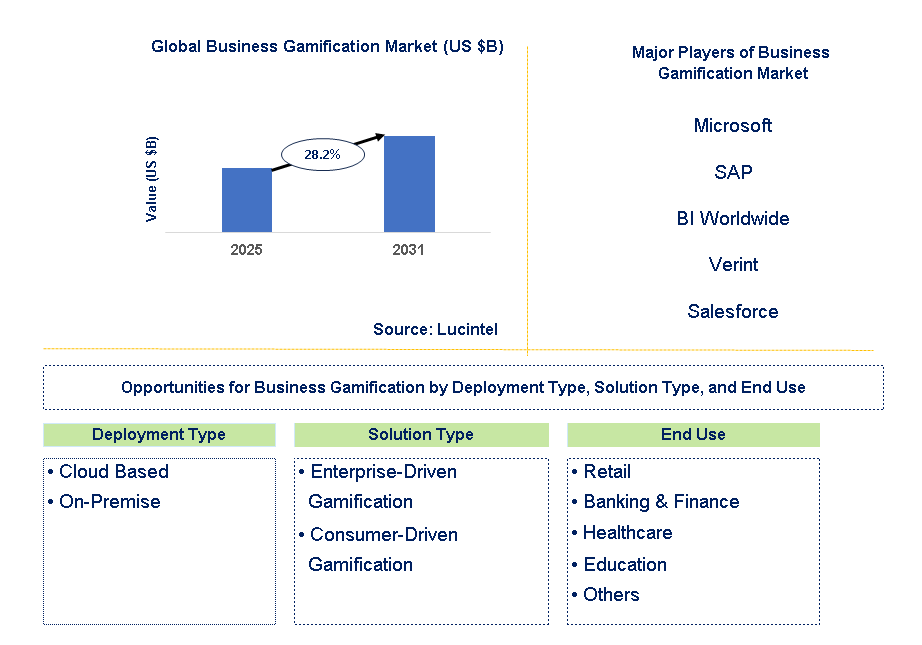
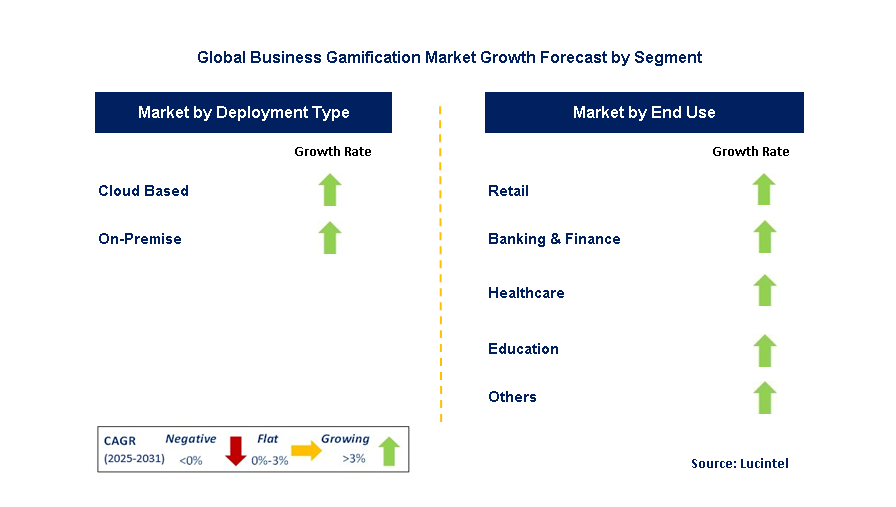
Key data points: The growth forecast = 28.2% annually for the next 7 years. Scroll below to get more insights. This market report covers Trends, opportunity and forecast in business gamification market to 2031 by deployment type (cloud based and on-premise), solution type (enterprise-driven gamification and consumer-driven gamification), end use (retail, banking & finance, healthcare, education, and others), and region (North America, Europe, Asia Pacific, and the Rest of the World)
We'll send your sample report shortly.
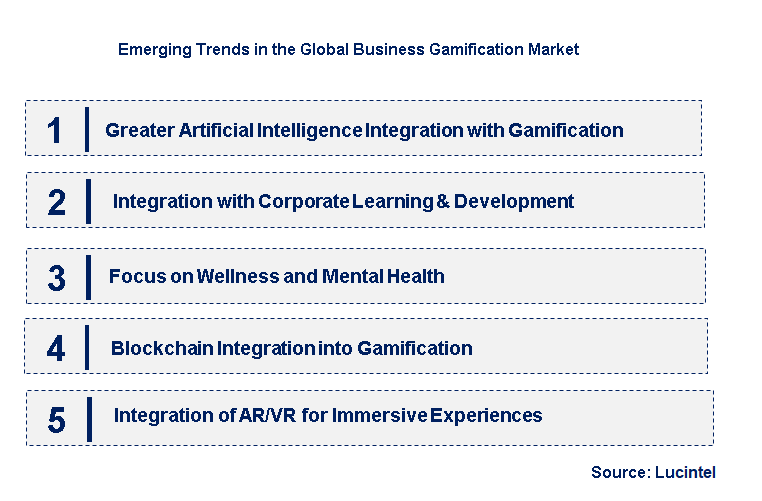
• Greater Artificial Intelligence integration with Gamification: AI’s adoption within gamification is rendering it an essential part leading towards personalized experiences through dynamic adaptation of challenges/rewards/feedback according to individual behaviors. Analyzing and giving real-time feedback on performance data can facilitate businesses adopt AI-based dynamic gamified experience which resonate more with their employees or clients. This trend increases engagement because it provides a tailored approach to gamification which improves end results whilst simultaneously encouraging users’ commitment at deeper levels.
• Integration with Corporate Learning & Development: Companies are increasingly turning to gamification as a method of improving employee training programs. By transforming learning modules into interactive, game-like experiences, employees are more active and tend to remember more information. These platforms now include progress tracking, quizzes and simulations with live feedback and rewards. Through this practice not only does the efficacy of training increase but also does the rate at which skills are developed or retained in an employee.
• Focus on Wellness and Mental Health: There is a growing focus on blending wellness and mental health programs into gamification strategies . Point systems for engaging staff in exercises that promote physical fitness , stress reduction and mindfulness among other initiatives have been set up by companies . Examples include point-based systems for completing wellness challenges or tracking mental health milestones. Here there is an escalating concern for employee well-being, even though it is also aimed at enhancing productivity levels and maintaining a positive work culture.
• Blockchain Integration into Gamification: Gamification is a new trend in blockchain where it helps in enhancing security and transparency, especially when integrated with loyalty plans. Digital currencies are the rewards used in gamified environments, like tokens or NFTs (non-fungible tokens). This change allows businesses to offer relevant compensations while making it easy for them to be moved from one place to another and also ensuring their safety as well as confirming that they are genuine. This technology enables us to trust the reward systems on which the success of any game depends.
• Integration of AR/VR for Immersive Experiences: One of the major trends is using Augmented Reality (AR) and Virtual Reality (VR) in gamification strategies which creates highly immersive and interactive experiences. They enable businesses to create virtual environments that can simulate real-life situations or improve learning through simulations. Nowadays, even though gaming industry has grown dramatically, adopting AR/VR is still important in making gamified activities more engaging and memorable especially in sectors such as real estate, retail trade and healthcare industry. The way businesses use games is being altered by emerging trends. Basic points and rewards systems are now obsolete, with sophisticated, personalized and immersive experiences taking their place. This means that businesses can engage employees and customers in new ways through AI, wellness programs, blockchain technology and AR/VR. In future, these technological advancements will transform how businesses approach gamification as they present more vibrant engagement models which are both effective and all-inclusive.
• AI-Driven Personalization: Artificial Intelligence (AI) is now being widely used for customizing gamified experiences. Such applications can apply AI analysis on information about consumer behaviors and preferences with the aim of producing real-time customized challenges, rewards and feedbacks. This enables businesses to provide better personalized experienced for their employees or customers. The importance is immense as personalized game-based learning boosts participation rate, motivation level and results positively affecting satisfaction levels resulting into improved metrics such performance rates.
• Integrating Wearable Devices with Fitness Gamification: Gamified platforms are now incorporating wearable devices such as fitness trackers since health-conscious consumers and employees are on the rise. These tools monitor activity levels and health indicators that may be rewarded by points or achievements in wellness challenges. Furthermore, this development ensures a connection between game mechanics and actions in real life which not only promotes physical well-being but also enhances meaningful engagement. This change is affecting both employee wellness programs and customer loyalty initiatives as businesses try to encourage healthy lifestyles while at the same time boosting engagement.
• Mobile Gamification Solutions: The prevalence of smartphones has given rise to mobile gamification solutions which enable gaming content to be accessed by employees and customers on the move. Applications for training, customer loyalty schemes, and employee performance monitoring have increasingly become available via mobile phones. The improvement has made gamification more accessible especially in industries where there is a mobile workforce. By giving users the opportunity to participate in gamified activities anywhere, anytime, can boost user engagement through increased reach allowing companies to broaden their audience base thereby maximizing the effectiveness of their gamification strategies.
• Gamification of D&I: Diversity and inclusion initiatives are being gamified. Gamified training programs; that use games to train employees about unconscious biases, inclusive practices, and cultural awareness have been adopted by many organizations. Such programs are usually accompanied by challenges and rewards for completing educational modules thus making learning more interactive and fun. The bottom line is that it is more impactful that the game can be used to develop sustainable learning continuously improving workplace culture in measurable ways.
• Secure Reward Systems on Blockchain: Transparency and security of reward systems in gamification can be enhanced using blockchain technology. For instance, companies can now store their gifts in secure places such as points or digital tokens through this technology. This move has profound consequences for industries depending on loyalty schemes or incentives because blockchain ensures rewards’ authenticity and traceability. Hence trust is built in gamification systems with increased levels of participation targeting sustainability in incentive models. Boundaries of engagement and interactivity in business gamification market have recently been extended. Gamification has become much more personal, secure and meaningful through integration with artificial intelligence (AI), wearable devices, mobile solutions, block chains and diversity and inclusion initiatives. These innovations are changing the way companies use gamification as a tool to increase their staff’s productivity, enhance customer loyalty or organization as a whole. In this rapidly developing technological era, such advancements will assist organizations in creating more engaging inclusive gamified experiences which will result to high level of involvement, better performance and strong brand devotion.
• Employee Engagement & Retention: Gamification has emerged as a dominant strategy to boost employee engagement. Companies create interactive environments with goals that motivate employees to perform at higher levels and achieve success. Job satisfaction can be improved significantly through gamified systems that involve challenges, rewards and performance tracking tools which can also reduce turnover rates within organizations. Creating an engaged workforce is one way for businesses to increase productivity while lowering the costs associated with employee attrition that affects organizational culture well beyond the immediate future.
• Customer Retention Programs: One of the biggest opportunities for growth in gamification is customer loyalty. Companies are using game-like loyalty schemes that reward customers for buying or interacting with their brand more often. Some of these programs incorporate customer retention techniques like badges, points and exclusive rewards. Customer loyalty, repeat business and differentiation from competitors are all benefits of using this kind of gamification; this will lead to an increase in lifetime value as well. Especially in the retail, hospitality and e-commerce segment there is a large potential to grow.
• Employee Training and Development: The use of gamification within corporate training courses has grown significantly; it offers a way for organizations to engage their staff while enhancing skill as well as knowledge retention. Simulations, challenges, leaderboards among other game based learning experiences make training more interactive and enjoyable. This approach increases employee engagement and speeds up learning through areas such as leadership development or compliance training. This can help foster continuous improvement on employees’ part hence ensuring that companies maintain a competitive workforce by incorporating gaming elements into employee education.
• Health & Wellness Programs: Organizations are using gamification in health and wellness programs to open new doors to employee well-being. For instance, companies are employing gamified fitness competitions, mental health monitoring as well as well-being incentives to encourage healthy habits among their workforce. This is a trend that is gaining momentum because businesses know how essential well-being is in relation to performance and retention. This makes staff enthusiastic about participating in wellness initiatives through making it fun while also rewarding them; hence leading to better physical and mental health, reduced healthcare costs and commitment on part of the workers.
• Marketing and Brand Engagement: The use of game elements in marketing is an excellent way to engage the target audience, enhance brand awareness, and drive sales. In this regard, firms have been incorporating gamified activities into their campaign strategies that include interactive ads, contests or challenges that foster customer involvement. Gamification can be applied on social media platforms, mobile apps or websites in order to create a lasting impression of a particular brand. Not only does this increase consumer participation but also induces word of mouth promotion, expands influence as well as strengthens existing customer relationships. Through gamification techniques, businesses can boost their marketing campaigns amid intense competition from other digital players. The ways businesses connect with employees and clients are being changed by strategic expansion prospects in the business game industry. In using gamification to achieve employee engagement, customer loyalty, training, wellness and marketing organizations can enhance results for key areas. These prospects encourage much more interaction, stronger motivation, longer term devotion which leads to overall business success. Gamification will remain an essential growth driver for certain industries as it evolves further into the future.
• Microsoft
• SAP
• BI Worldwide
• Verint
• Salesforce
• Centrical
• Mambo.IO
• Cloud Based
• On-Premise
• Enterprise-Driven Gamification
• Consumer-Driven Gamification
• North America
• Europe
• Asia Pacific
• The Rest of the World
• United States: Gamification has grown rapidly within several sectors in the US market specifically employee training; customer loyalty programs as well as corporate wellness initiatives. Salesforce, Google Microsoft among others have implemented gamified systems to foster employee collaboration and engagement. In addition to these trends AI and data analytics are increasingly being utilized to personalize feedback in real time on the gamified platforms. Furthermore, there is an increasing integration of e-learning solutions with games based learning whereby organizations are using badges leaderboards rewards etcetera for enhancing skill development among employees.
• China: In China, gamification is driven mostly by a thriving technology sector that has seen firms such as Tencent and Alibaba incorporate game mechanics into their e-commerce, financial services and social media offerings. This trend has been further reinforced by the rapid rise of digital payment systems like WeChat Pay and Alipay, which have led to an increased use of gamification in consumer involvement as well as loyalty initiatives. Education has also not been left behind with Duolingo and Mooc being among platforms offering millions of students access to gamified learning experience. Besides, employee performance management and recruitment are increasingly incorporating gamified features to enable companies tap on competitive spirit and rewards that spur talent engagement.
• Germany: For Germany, the business gamification market is focused around two areas; employee development and customer loyalty. As a result, many German firms apply gamification in training for production optimization within industries like manufacturing or engineering departments. Some major German companies such as Siemens and Bosch are using clan based simulations for skill building purposes. Additionally, Deutsche Telekom and Lufthansa have incorporated some aspects of games into their strategies to ensure greater customer interactions thus creating more brand loyalties. Furthermore this trend is informed by increasing interest in the overlap between behavioral science &gamification.
• India: In India, gamification is now a tool that has become important in education, recruitment and employee engagement. Growth for this approach remains high in the education industry where platforms such as Byju's and Unacademy are using gaming elements to improve student participation while at the same time increasing their understanding of concepts. Gamification is also applied within workplaces to increase productivity and encourage creative thinking through gamified systems hence motivating employees into participating for skill-enhancement and wellness programs. Startups as well as tech companies have embraced gamification to boost customer loyalty particularly in fintech and e-commerce sectors where consumers’ involvement is driven by rewards, competitions, social sharing.
• Japan: In Japan, consumer-facing industries such as retail, gaming and technology have largely adopted gamification. Major players like Sony, Panasonic among others use these experiences in their products as well as internally to drive innovation and creativity. Gamified health challenges promote physical activity and stress reduction which encourages work-life balance through gamifying employee wellness programs.


• Microsoft
• SAP
• BI Worldwide
• Verint
• Salesforce
• Centrical
• Mambo.IO Q5. Which business gamification market segment will be the largest in future? Answer: Lucintel forecasts that, within the deployment type category, cloud based is expected to witness higher growth over the forecast period. Q6. In business gamification market, which region is expected to be the largest in next 5 years? Answer: In terms of region, North America is expected to witness the highest growth over the forecast period. Q7. Do we receive customization in this report? Answer: Yes, Lucintel provides 10% customization without any additional cost.


Choose a license that fits your team. Instant PDF delivery.
Prices exclude taxes. Instant delivery. Custom licensing available on request.
Market Report · July 16, 2026
Market Report · May 18, 2026
Market Report · May 18, 2026
Trusted partner for strategic intelligence and business growth


Receive a complimentary market analysis tailored to your industry. Our analysts will identify key growth opportunities and competitive dynamics specific to your business.

Market size, growth rate, and key trend analysis for your specific sector.

Top competitor positioning and market share analysis.

Strategic recommendations backed by data-driven insights.
Get curated market intelligence and competitive moves straight to your inbox.
By subscribing, you agree to receive our monthly insights. Unsubscribe anytime.
Receive a complimentary market analysis tailored to your industry. Our analysts will identify key growth opportunities and competitive dynamics specific to your business.
Market size, growth rate, and key trend analysis for your specific sector.
Top competitor positioning and market share analysis.
Strategic recommendations backed by data-driven insights.
Get curated market intelligence, emerging trends, and competitive moves straight to your inbox each month.
By subscribing, you agree to receive our monthly insights. Unsubscribe anytime.
We'll send your sample report shortly.