
Market Report · July 15, 2026

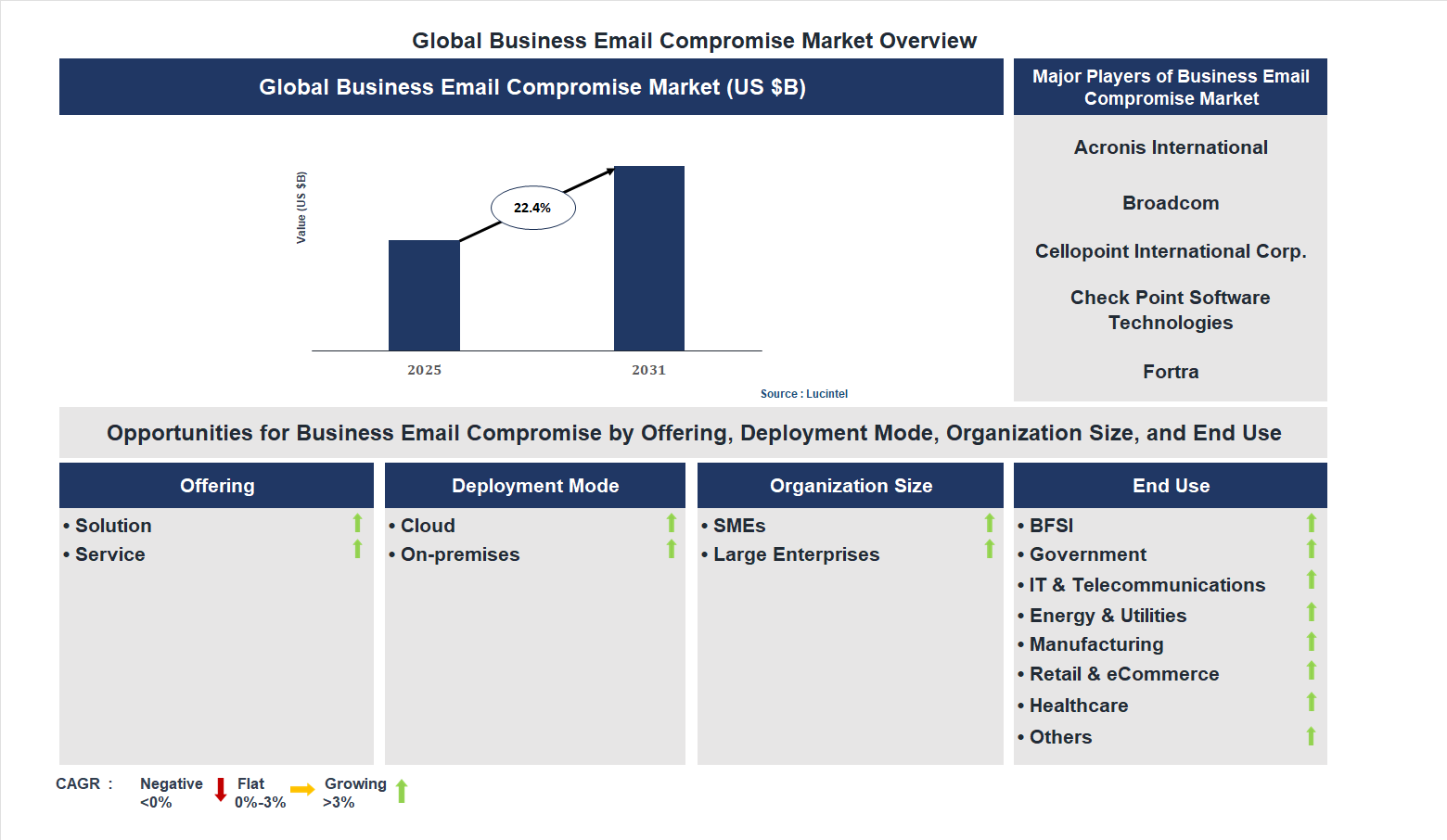
Key data points: The growth forecast = 22.4% annually for the next 7 years. Scroll below to get more insights. This market report covers trends, opportunities and forecasts in business email compromise market to 2031 by offering (solution and service), deployment mode (cloud and on-premises), organization size (SMEs and large enterprises), end use (BFSI, government, IT & telecommunications, energy & utilities, manufacturing, retail & ecommerce, healthcare, and others), and region (North America, Europe, Asia Pacific, and the Rest of the World)
We'll send your sample report shortly.
• Lucintel forecasts that, within the offering category, solution is expected to witness higher growth over the forecast period.
• Within the end use category, BFSI is expected to witness the highest growth.
• In terms of region, APAC is expected to witness the highest growth over the forecast period. Gain valuable insights for your business decisions with our comprehensive 150+ page report. Sample figures with some insights are shown below.
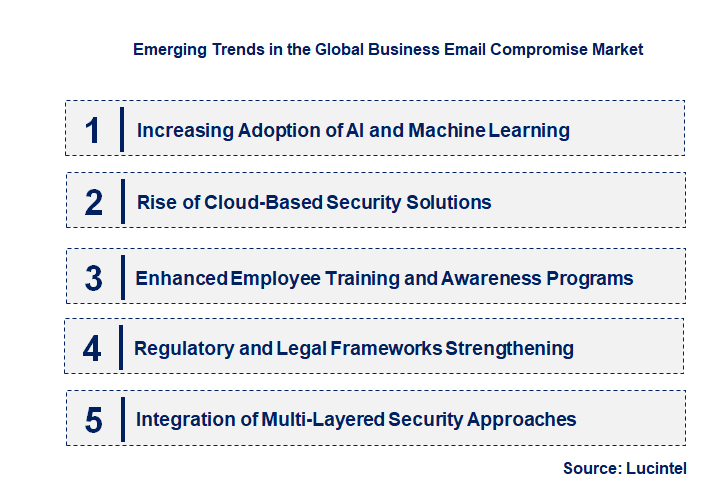
• Increasing Adoption of AI and Machine Learning: Organizations are integrating AI and machine learning to detect and prevent BEC attacks more effectively. These technologies analyze vast amounts of email data to identify suspicious patterns and anomalies in real-time, reducing false positives and enhancing response times. AI-driven solutions can adapt to evolving attack techniques, providing a proactive defense mechanism. This trend significantly improves threat detection accuracy, minimizes financial losses, and strengthens overall cybersecurity posture, making AI an indispensable component of modern BEC prevention strategies.
• Rise of Cloud-Based Security Solutions: Cloud-based email security solutions are gaining popularity due to their scalability, ease of deployment, and cost-effectiveness. These solutions offer real-time monitoring, threat intelligence updates, and centralized management, enabling organizations to respond swiftly to emerging threats. Cloud platforms also facilitate integration with other security tools, creating a comprehensive defense system. As remote work and cloud adoption increase, cloud-based security becomes essential for protecting email communications across diverse and distributed workforces, thereby reducing the risk of BEC incidents.
• Enhanced Employee Training and Awareness Programs: Recognizing that human error remains a significant vulnerability, companies are investing more in employee training and awareness initiatives. These programs educate staff on recognizing phishing attempts, social engineering tactics, and suspicious email behaviors. Interactive training modules, simulated phishing exercises, and regular updates help reinforce best practices. This trend emphasizes a human-centric approach to cybersecurity, reducing the likelihood of successful BEC attacks by empowering employees to act as the first line of defense, ultimately lowering incident rates and financial damages.
• Regulatory and Legal Frameworks Strengthening: Governments and regulatory bodies are implementing stricter laws and guidelines to combat BEC and related cybercrimes. These regulations mandate organizations to adopt specific security measures, conduct regular audits, and report incidents promptly. Compliance requirements are driving investments in advanced security solutions and fostering a culture of accountability. This trend not only enhances overall market standards but also encourages organizations to prioritize cybersecurity, reducing the prevalence and impact of BEC attacks through legal deterrents and improved security practices.
• Integration of Multi-Layered Security Approaches: The market is shifting towards comprehensive, multi-layered security strategies that combine email filtering, endpoint security, threat intelligence, and user authentication. This holistic approach addresses vulnerabilities at various points, making it harder for attackers to succeed. Technologies such as DMARC, SPF, DKIM, and biometric authentication are being integrated to strengthen defenses. The impact is a more resilient security infrastructure that can detect, prevent, and respond to BEC threats more effectively, reducing the likelihood of successful breaches and financial losses. In summary, these emerging trends are transforming the business email compromise market by fostering more sophisticated, integrated, and proactive security measures. The adoption of AI, cloud solutions, employee training, regulatory compliance, and multi-layered defenses collectively enhance organizations ability to prevent, detect, and respond to BEC threats. As these trends continue to evolve, they are reshaping the market landscape, making email security more robust and adaptive to emerging cyber threats.
• Technological Advancements: Implementation of AI and machine learning tools has enhanced threat detection capabilities, enabling real-time identification and mitigation of BEC attacks, thus reducing financial losses and improving organizational security posture.
• Strategic Partnerships: Collaborations between cybersecurity firms and financial institutions have increased, facilitating the development of integrated security solutions and awareness programs, which strengthen defenses against BEC schemes.
• Regulatory Changes: Governments and regulatory bodies have introduced stricter compliance requirements and guidelines, encouraging organizations to adopt comprehensive security protocols and report incidents promptly, thereby increasing market demand.
• Rise in Phishing and Social Engineering Attacks: The surge in sophisticated phishing campaigns and social engineering tactics has driven organizations to invest more in employee training and advanced email security solutions, expanding the market.
• Market Consolidation: Mergers and acquisitions among key players have led to a more consolidated market landscape, fostering innovation, expanding product portfolios, and enhancing service offerings to meet growing demand. These developments are collectively impacting the Business Email Compromise Market by increasing investment in advanced security solutions, fostering innovation, and encouraging organizations to adopt proactive measures. As a result, the market is expected to grow steadily, driven by the need for enhanced cybersecurity defenses and regulatory compliance.
• Financial Services: Enhanced Fraud Detection : Implementing AI-driven algorithms to identify suspicious email activities, reducing financial fraud risks, and safeguarding assets.
• Corporate Security: Employee Training & Awareness : Developing comprehensive training programs to educate employees about BEC tactics, thereby reducing successful phishing attempts.
• Legal & Compliance: Regulatory Adherence : Offering solutions that ensure compliance with data protection laws and reporting requirements, minimizing legal liabilities.
• Technology Providers: Advanced Email Security Solutions : Innovating with machine learning and behavioral analytics to detect and prevent BEC attacks more effectively.
• Insurance Sector: Risk Assessment & Coverage : Creating specialized insurance products that cover BEC-related losses, encouraging proactive risk management. These growth opportunities are significantly impacting the business email compromise market by fostering innovation, increasing investment, and enhancing organizational resilience. As companies adopt more sophisticated security measures, the overall market is expanding, leading to better protection against evolving cyber threats and reducing financial and reputational damages.
• Increasing Cyber Threats and Cybercrime Incidents: The rise in cyber threats, especially BEC scams, has led organizations across industries to seek robust security solutions. Cybercriminals exploit vulnerabilities in email systems to deceive employees and executives into transferring funds or sensitive data. The financial and reputational damages caused by these attacks have heightened awareness and urgency, fueling demand for advanced email security solutions. As cyber threats become more sophisticated, organizations are compelled to invest in proactive measures, thus expanding the market.
• Growing Adoption of Cloud-Based Email Services: The shift towards cloud-based email platforms like Microsoft 365 and Google Workspace has increased the attack surface for cybercriminals. These platforms offer convenience and scalability but also present vulnerabilities that can be exploited through BEC schemes. As organizations migrate to cloud services, they require specialized security tools to monitor, detect, and prevent email-based frauds. This trend drives the development and deployment of integrated security solutions tailored for cloud environments, boosting market growth.
• Increasing Regulatory and Compliance Requirements: Governments and industry bodies are implementing stricter cybersecurity regulations to protect sensitive data and financial transactions. Regulations such as GDPR, HIPAA, and PCI DSS mandate organizations to adopt comprehensive security measures, including email security protocols. Compliance pressures compel organizations to invest in BEC prevention tools, fostering market expansion. Additionally, regulatory penalties for data breaches motivate organizations to proactively mitigate email fraud risks, further propelling market growth.
• Technological Advancements in AI and Machine Learning: The integration of AI and machine learning into cybersecurity solutions enhances the ability to detect and respond to BEC attacks in real-time. These technologies enable behavioral analysis, anomaly detection, and predictive threat modeling, making defenses more effective against evolving tactics. As vendors incorporate advanced AI-driven features, organizations gain access to smarter, more adaptive security tools, accelerating market adoption and innovation.
• Increasing Remote Work and Digital Collaboration: The COVID-19 pandemic accelerated remote working trends, increasing reliance on digital communication channels. This shift has expanded the attack surface for BEC scams, as employees access email systems from various locations and devices. The dispersed workforce complicates traditional security measures, necessitating more sophisticated email security solutions. The growing need for secure remote collaboration drives demand for advanced BEC prevention tools, contributing to market growth. The challenges facing this business email compromise market include:
• Evolving and Sophisticated Cyberattack Techniques: Cybercriminals continually refine their tactics, employing AI, social engineering, and deepfake technologies to bypass security measures. These sophisticated methods make detection and prevention increasingly difficult, requiring organizations to invest heavily in advanced, constantly updated security solutions. The rapid evolution of attack techniques can outpace existing defenses, posing a significant challenge to market players and organizations alike.
• Lack of User Awareness and Training: Many BEC incidents occur due to human error, such as falling for phishing emails or failing to verify sender identities. Insufficient employee training and awareness programs hinder effective prevention efforts. Organizations struggle to cultivate a security-conscious culture, which is critical for identifying and avoiding BEC scams. This challenge underscores the need for comprehensive training initiatives, which can be resource-intensive and slow to implement.
• Regulatory and Privacy Concerns: While regulations promote security, they also impose compliance burdens that can hinder rapid deployment of new solutions. Data privacy laws restrict the extent of monitoring and data collection, complicating the development of comprehensive BEC detection systems. Navigating diverse regulatory landscapes across regions adds complexity and cost, potentially delaying market growth and innovation. In summary, the business email compromise market is shaped by a combination of technological advancements, increasing cyber threats, regulatory pressures, and changing work environments. While these drivers foster growth and innovation, challenges such as evolving attack methods, human factors, and regulatory complexities pose significant hurdles. The markets future will depend on how effectively stakeholders can leverage technological solutions and address these challenges to create resilient, adaptive defenses against email-based frauds.
• Acronis International
• Broadcom
• Cellopoint International Corp.
• Check Point Software Technologies
• Fortra
• GreatHorn
• Mimecast.com
• proofpoint
• Tessian Limited
• Trend Micro Incorporated
• Solution
• Service
• Cloud
• On-premises
• SMEs
• Large Enterprises
• BFSI
• Government
• IT & Telecommunications
• Energy & Utilities
• Manufacturing
• Retail & eCommerce
• Healthcare
• Others
• North America
• Europe
• Asia Pacific
• The Rest of the World
• United States: The US has seen a surge in advanced AI-based BEC detection tools, with increased adoption of multi-factor authentication and stricter regulatory frameworks like the CISA guidelines. Major financial institutions are investing heavily in employee training and cybersecurity insurance to mitigate risks. The government has also launched awareness campaigns to educate businesses about emerging threats, leading to a more proactive security posture.
• China: China has focused on strengthening its cybersecurity laws and implementing stricter monitoring of email systems used by enterprises. The government promotes the integration of AI and machine learning in BEC detection systems, enhancing real-time threat identification. Several domestic tech firms are developing innovative solutions tailored to local market needs, emphasizing data privacy and rapid response capabilities.
• Germany: Germany emphasizes compliance with GDPR and robust data protection standards, which influence BEC prevention strategies. The market has seen increased deployment of advanced encryption and secure communication platforms. Collaborative efforts between government agencies and private firms aim to develop standardized protocols for email security, fostering a more resilient digital environment.
• India: India is witnessing rapid growth in cybersecurity investments, with a focus on small and medium-sized enterprises vulnerable to BEC scams. The government has launched initiatives to improve cybersecurity awareness and training. Local startups are innovating with AI-powered email filtering and fraud detection tools, supported by government grants and international partnerships to enhance overall security infrastructure.
• Japan: Japan has prioritized integrating AI and behavioral analytics into BEC defense systems, driven by a high adoption rate of digital banking. The government encourages public-private partnerships to develop advanced threat detection solutions. Efforts are also underway to enhance cross-border cooperation and information sharing to combat sophisticated international BEC schemes effectively.


• Acronis International
• Broadcom
• Cellopoint International Corp.
• Check Point Software Technologies
• Fortra
• GreatHorn
• Mimecast.com
• proofpoint
• Tessian Limited
• Trend Micro Incorporated Q5. Which business email compromise market segment will be the largest in future? Answer: Lucintel forecasts that, within the offering category, solution is expected to witness higher growth over the forecast period. Q6. In business email compromise market, which region is expected to be the largest in next 5 years? Answer: In terms of region, APAC is expected to witness the highest growth over the forecast period. Q7. Do we receive customization in this report? Answer: Yes, Lucintel provides 10% customization without any additional cost.


Choose a license that fits your team. Instant PDF delivery.
Prices exclude taxes. Instant delivery. Custom licensing available on request.
Market Report · July 15, 2026
Market Report · June 26, 2026
Market Report · June 24, 2026
Trusted partner for strategic intelligence and business growth


Receive a complimentary market analysis tailored to your industry. Our analysts will identify key growth opportunities and competitive dynamics specific to your business.

Market size, growth rate, and key trend analysis for your specific sector.

Top competitor positioning and market share analysis.

Strategic recommendations backed by data-driven insights.
Get curated market intelligence and competitive moves straight to your inbox.
By subscribing, you agree to receive our monthly insights. Unsubscribe anytime.
Receive a complimentary market analysis tailored to your industry. Our analysts will identify key growth opportunities and competitive dynamics specific to your business.
Market size, growth rate, and key trend analysis for your specific sector.
Top competitor positioning and market share analysis.
Strategic recommendations backed by data-driven insights.
Get curated market intelligence, emerging trends, and competitive moves straight to your inbox each month.
By subscribing, you agree to receive our monthly insights. Unsubscribe anytime.
We'll send your sample report shortly.