
Market Report · July 15, 2026

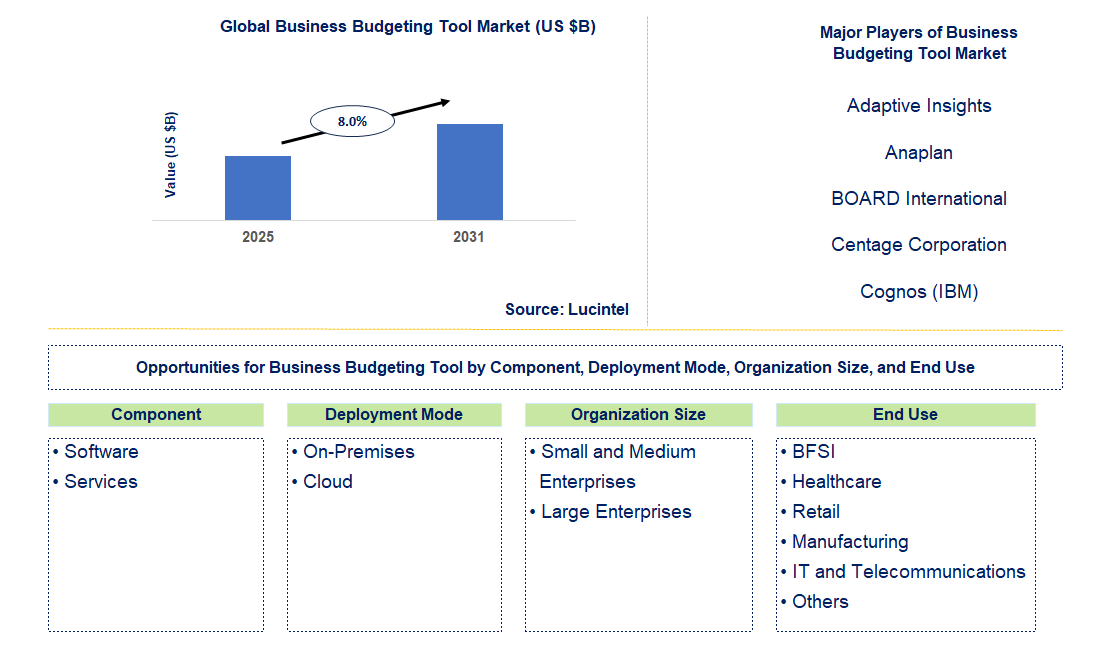
Key data points: The growth forecast = 8.0% annually for the next 7 years. Scroll below to get more insights. This market report covers Trends, opportunity and forecast in business budgeting tool market to 2031 by component (software and services), deployment mode (on-premises and cloud), organization size (small and medium enterprises and large enterprises), end use (BFSI, healthcare, retail, manufacturing, IT and telecommunications, and others), and region (North America, Europe, Asia Pacific, and the Rest of the World)
We'll send your sample report shortly.
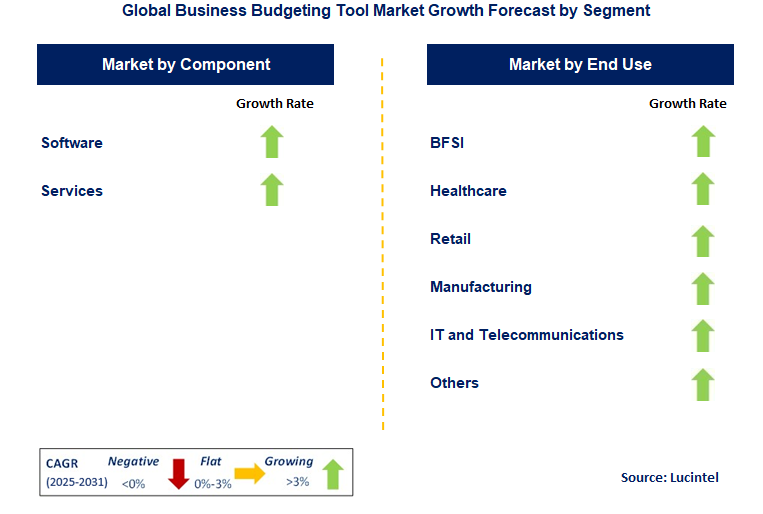
• Lucintel forecasts that, within the component category, software will remain larger segment over the forecast period.
• Within the application category, healthcare is expected to witness the highest growth.
• In terms of region, APAC is expected to witness the highest growth over the forecast period. Gain valuable insights for your business decisions with our comprehensive 150+ page report. Sample figures with some insights are shown below.
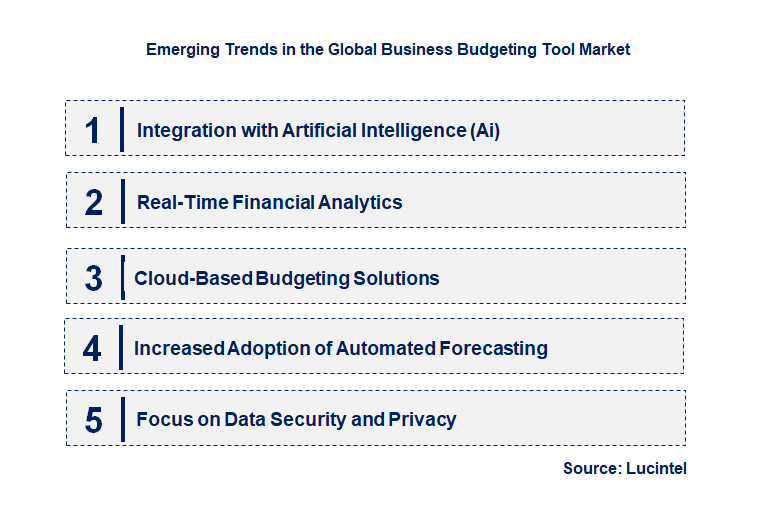
• Integration with Artificial Intelligence (AI): AI is transforming business budgeting by automating data analysis, identifying trends, and providing predictive insights. This technology helps to refine company budgets by making more accurate forecasts, enhancing decision-making, and optimizing resources. For organizations operating with complex financial structures, AI-driven budgeting tools have a high capacity for processing large data sets in short timeframes.
• Real-Time Financial Analytics: Continuous monitoring of financial health and decision-making based on real-time data are supported by real-time analytics. Advancements in cloud computing and big data analytics enable companies to track performance against budgets, adjust forecasts, and optimize resource allocation without waiting for monthly or quarterly reports. The shift toward real-time analytics offers increased flexibility and autonomy over financial decisions.
• Cloud-Based Budgeting Solutions: The transition to cloud-based solutions is accelerating, as companies are searching for scalable, accessible, and cost-effective tools. Cloud platforms enable organizations with remote teams or those needing fast scaling to support seamless collaboration, real-time updates, and integration with other business tools. Furthermore, these solutions offer better security and disaster recovery capabilities necessary to protect sensitive financial data.
• Increased Adoption of Automated Forecasting: Companies are increasingly adopting automated forecasting tools to reduce human error and improve forecasting accuracy. By utilizing historical data, AI, and machine learning algorithms, these tools assist in predicting future financial outcomes. As a result, businesses can make proactive budget adjustments and strategic decisions. For enterprises dealing with high-revenue streams that fluctuate over time, automatic prediction is crucial.
• Focus on Data Security and Privacy: As financial data increasingly migrates to digital platforms, concerns about its privacy and security grow. Budgeting tools preferred by businesses should conform to global data protection laws like GDPR and CCPA. This has led to the development of secure, encrypted platforms that guarantee the safety of sensitive financial information, especially in sectors where regulatory compliance is critical. The recently adopted business practices are changing the dynamic of the business budgeting tool market by including new features that augment productivity, collaboration, and strategic alignment. Companies are now fully adopting AI technologies, cloud-based solutions, and even more sophisticated Integrated platforms to streamline their budgeting processes and better respond to ever-changing business landscapes. Focus on ESG reporting marks the start of a new era where businesses aim to be more sustainable and socially responsible. If these trends keep emerging, then businesses will be able to adapt to financial difficulties with less complexity and ensure long-lasting success.
• Cloud Integration: One major change in budgeting tools is the integration of cloud technology. Economies of scale, adaptability, and real-time collaboration are some key characteristics of cloud-based budgets, making them suitable for enterprises of any size. Moving to the cloud allows companies to access their financial information from anywhere, enhancing remote working and providing greater visibility into finances.
• AI-Powered Budgeting: The use of AI in budgeting tools has increased in recent years to improve forecasting and budgeting activities. These predictive tools can discern future financial outcomes through machine learning algorithms and identify inefficiencies within a company’s operations while recommending cost-cutting measures. As a result, this integration helps businesses improve decision-making processes and streamline financial management.
• Automation of Financial Processes: A major trend is automating manual budgeting processes, reducing the time and resources required to prepare budgets. Automated solutions can track costs, allocate resources, and adjust forecasts with less human involvement. This innovation makes it faster to assemble accurate budgets, as there are fewer errors likely to occur during preparation.
• Focus on Financial Forecasting: Financial forecasting tools are becoming more sophisticated, incorporating real-time data, external market factors, and historical trends to improve budget predictions. These advanced financial forecasting abilities have helped businesses prepare better for economic changes and market shifts, facilitating stronger financial planning.
• Customization and Flexibility: As companies seek customized budgets, software developers are focusing on providing tailored tools that fit particular industries and organizations. Businesses can use these systems to design budgeting processes aligned with their objectives and operational requirements, giving them more control over their financial plans. In summary, the advancements in business budgeting tools are not only transforming financial planning processes but also positively impacting industries such as aviation, where efficient resource allocation and enhanced passenger experience are paramount.
• Cloud-Based Solutions for SMBs: The rise of cloud-based solutions is a promising growth opportunity for companies targeting small and medium-sized businesses (SMBs). Over time, SMBs have increasingly adopted cloud-based budgeting tools due to their affordability, scalability, and ease of use. Companies that provide tailored solutions for this segment should expect growing demand for affordable financial management tools.
• AI-Based Financial Management: Incorporating artificial intelligence into budgeting tools is an emerging growth opportunity. AI enables budget automation, financial planning optimization, and improved forecasting accuracy. Businesses that incorporate AI into their budgeting systems are better prepared to meet the needs of organizations seeking more advanced financial management capabilities.
• ERP System Integration: Growth lies in coupling budgeting tools with ERP (Enterprise Resource Planning) systems. Integration with other financial and operational systems is crucial for companies seeking comprehensive solutions. This promotes better data synchronization, increased precision, and faster decision-making across departments.
• Budgeting Solutions Designed for Mobile First: The rise of mobile computing in daily business processes creates opportunities for building mobile-first budgeting solutions. These solutions allow greater flexibility, enabling users to manage budgets and track spending from anywhere. The use of mobile devices facilitates higher adoption, especially in businesses with distributed teams or global operations.
• Real-Time Financial Insights: There is a growing demand for real-time financial insights. This feature—providing instant feedback on budget performance, expense tracking, and economic forecasting—enables quicker business decision-making. The rising need for agile financial management has led to the development of real-time analytics options by certain companies. These growth opportunities across various applications are driving the expansion of the business budgeting tool market. By addressing the unique needs of SMEs, healthcare organizations, retailers, manufacturers, and government entities, budgeting software providers can tailor solutions that enhance financial management practices. The integration of advanced technologies such as AI, cloud computing, and ERP systems further enhances the capabilities of budgeting tools, enabling organizations to make data-driven decisions and adapt to dynamic market conditions. As these trends continue to evolve, the Business Budgeting Tool market is poised for sustained growth and innovation.
• Adaptive Insights
• Anaplan
• BOARD International
• Centage Corporation
• Cognos (IBM)
• Coupa Software
• Host Analytics
• Software
• Services
• On-Premises
• Cloud
• North America
• Europe
• Asia Pacific
• The Rest of the World
• United States: The United States leads in the adoption of advanced business budgeting tools, including artificial intelligence (AI) and machine learning (ML) integration. Most American companies are focusing on budgeting software that offers real-time insights into their financials, along with predictive analysis and automated reporting. Leading applications, such as Adapted Insights and QuickBooks, have broadened their capabilities by providing cloud-based solutions applicable to both small enterprises and large corporations. Furthermore, there is an increase in demand for integration with other customer relationship management (CRM) software and enterprise resource planning (ERP) systems.
• China: In China, a rapidly changing market for business budgeting tools is being fueled by increased digitalization and the need to streamline financial services. Across sectors such as e-business, production, and science, Chinese firms are switching to cloud-based financial management solutions that help monitor spending and enhance budgets. Local providers like Kingdee and Yonyou have incorporated AI and big data analytics in their software to improve financial projections and performance tracking. Additionally, Chinese firms are increasingly focused on minimizing expenses and enhancing efficiency, driving the demand for automated budgeting tools.
• Germany: The German business budgeting tool market has a strong focus on accuracy and data security. Companies in Germany are looking for solutions that comply with strict data protection laws, such as GDPR. Local software developers focus on secure platforms with reliable budget forecasting functions. For instance, large entities, such as those using SAP’s budgetary program, differ from smaller businesses that enjoy access to more affordable systems like Planful, which support SMBs. Robust industrial sectors, such as the automotive and manufacturing industries, underpin the demand for highly specialized, scalable budgeting tools in Germany.
• India: The Indian business budgeting tool market is growing quickly, especially due to the increase in the number of startups and small businesses in need of budget management solutions. For cost reasons and availability, Indian firms are adopting online budgeting tools. Zoho Books and Tally are among the commonly used tools for financial planning and budgeting that cater to the needs of firms of all sizes. The push toward digitalization within India’s financial sector has been instrumental in driving the adoption of AI-enabled tools to enhance accuracy in budgeting, improve resource allocation, and forecast outcomes.
• Japan: In Japan, there is a shift toward automated or digitized business budgeting tools. Japanese companies now prefer software packages that combine financial planning with performance-based metrics. In large firms, Oracle’s Hyperion software has become increasingly popular, while among smaller businesses, cloud-based budgeting programs such as Freee and Money Forward are gaining popularity. There is increased demand for these manual-free tools, which minimize human interference and provide up-to-date information on financial records, facilitating smooth transactions and higher productivity in an aging workforce.


• Adaptive Insights
• Anaplan
• BOARD International
• Centage Corporation
• Cognos (IBM)
• Coupa Software
• Host Analytics Q5. Which business budgeting tool market segment will be the largest in future? Answer: Lucintel forecasts that software will remain larger segment over the forecast period. Q6. In business budgeting tool market, which region is expected to be the largest in next 5 years? Answer: APAC is expected to witness the highest growth over the forecast period. Q7. Do we receive customization in this report? Answer: Yes, Lucintel provides 10% customization without any additional cost.


Choose a license that fits your team. Instant PDF delivery.
Prices exclude taxes. Instant delivery. Custom licensing available on request.
Market Report · July 15, 2026
Market Report · June 26, 2026
Market Report · June 24, 2026
Trusted partner for strategic intelligence and business growth


Receive a complimentary market analysis tailored to your industry. Our analysts will identify key growth opportunities and competitive dynamics specific to your business.

Market size, growth rate, and key trend analysis for your specific sector.

Top competitor positioning and market share analysis.

Strategic recommendations backed by data-driven insights.
Get curated market intelligence and competitive moves straight to your inbox.
By subscribing, you agree to receive our monthly insights. Unsubscribe anytime.
Receive a complimentary market analysis tailored to your industry. Our analysts will identify key growth opportunities and competitive dynamics specific to your business.
Market size, growth rate, and key trend analysis for your specific sector.
Top competitor positioning and market share analysis.
Strategic recommendations backed by data-driven insights.
Get curated market intelligence, emerging trends, and competitive moves straight to your inbox each month.
By subscribing, you agree to receive our monthly insights. Unsubscribe anytime.
We'll send your sample report shortly.