
Market Report · May 18, 2026

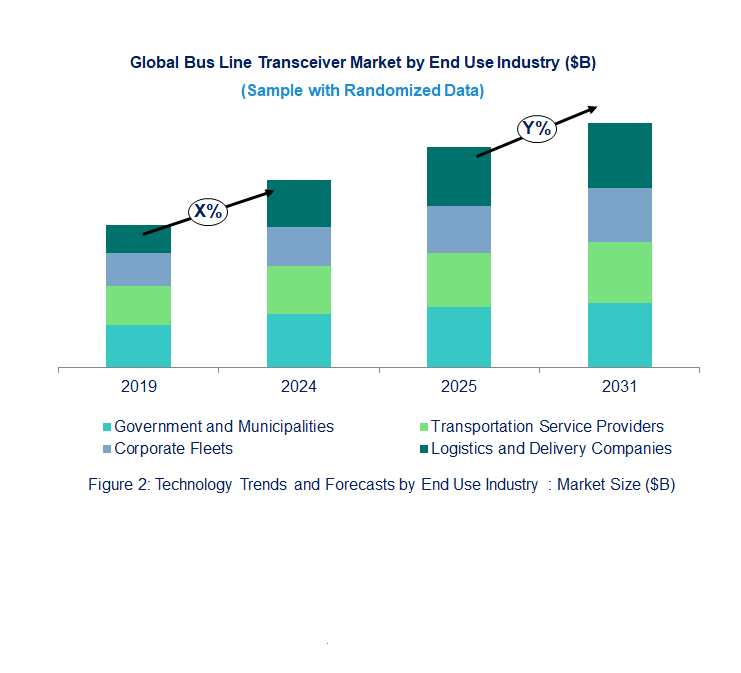
This market report covers trends, opportunities, and forecasts in the global bus line transceiver market to 2031 by technology (analog transceivers and digital transceivers), end use (government and municipalities, transportation service providers, corporate fleets, logistics, and delivery companies), and region (North America, Europe, Asia Pacific, and the Rest of the World)
We'll send your sample report shortly.
• Adoption of CAN FD (Flexible Data Rate) Transceivers The automotive industry is increasingly adopting CAN FD transceivers to support higher data rates (up to 5 Mbps) required for real-time sensor data transmission in advanced driver-assistance systems (ADAS) and electric vehicles (EVs).
• Integration of LIN Bus Transceivers in Electric Vehicles (EVs) LIN Bus transceivers are being integrated into EVs to manage communication between various electronic control units (ECUs), enhancing the efficiency and reliability of vehicle systems.
• Utilization of Mixed-Signal Integrated Circuits (ICs) Mixed-signal ICs, which combine analog and digital circuits on a single chip, are being utilized in bus line transceivers to reduce component count, lower power consumption, and improve system integration.
• Deployment of ISO-Compliant Transceivers in Industrial Automation ISO-compliant bus line transceivers are being deployed in industrial automation systems to ensure standardized communication protocols, enhancing interoperability and reliability in manufacturing processes.
• Implementation of A²B (Automotive Audio Bus) Technology A²B technology is being implemented in automotive audio systems to reduce wiring complexity and improve audio quality, contributing to cost savings and enhanced user experience. These technological advancements are significantly reshaping the Bus Line Transceiver Market. The shift towards digital transceivers, integration of advanced technologies like CAN FD and A²B, and the adoption of mixed-signal ICs are enhancing the performance, reliability, and efficiency of communication systems across various sectors. As these trends continue to evolve, they promise to deliver more intelligent, scalable, and cost-effective solutions in the Bus Line Transceiver Market.
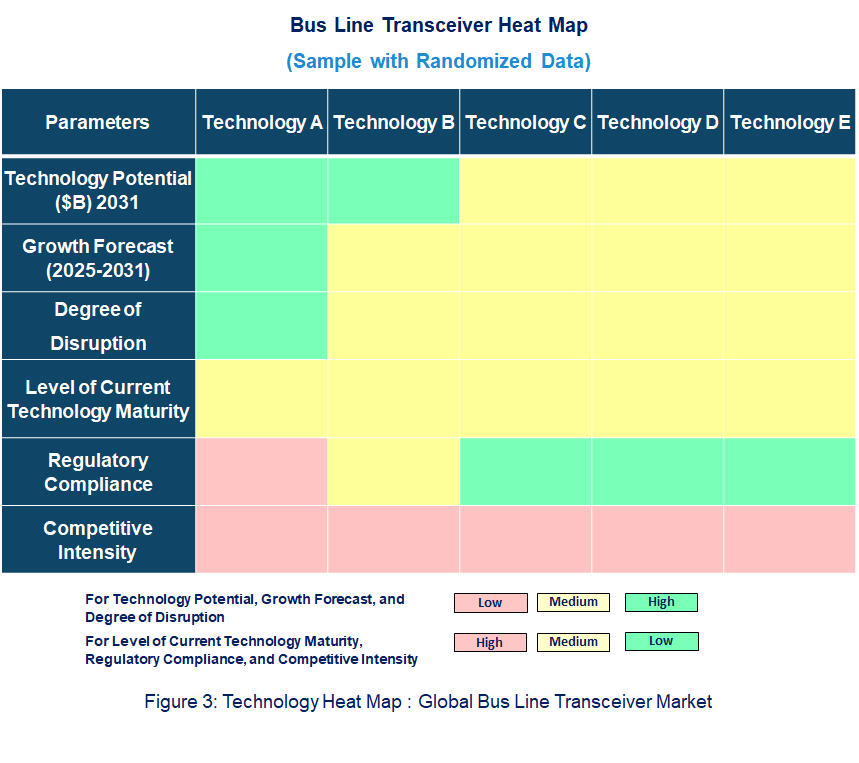
• Technology Potential: Bus line transceivers are critical components in communication systems, enabling data transmission between different parts of electronic systems, especially in automotive, industrial, and consumer electronics. The potential for these technologies lies in their ability to support high-speed, low-power, and reliable communication protocols like CAN, LIN, RS-485, and FlexRay. With the increasing adoption of electric vehicles, automation, and smart infrastructure, the demand for robust and efficient transceivers is growing steadily.
• Degree of Disruption: The bus line transceiver market is experiencing moderate disruption, driven by shifts toward higher data rates, smaller form factors, and integration with smart controllers. Emerging technologies like single-pair Ethernet (SPE) and automotive Ethernet are gradually disrupting traditional CAN and LIN-based systems. These newer transceivers enable higher bandwidth and lower latency, aligning with the needs of autonomous vehicles and real-time industrial control systems, making legacy protocols less competitive in advanced applications.
• Technology Maturity: Conventional bus transceiver technologies such as RS-232, CAN, and LIN are highly mature and widely deployed across industries. However, high-speed digital transceivers and automotive Ethernet are still evolving, with ongoing improvements in signal integrity, electromagnetic robustness, and thermal efficiency. Mature technologies continue to dominate, but innovation is shifting focus toward integration and miniaturization.
• Regulatory Compliance: Regulatory compliance in the transceiver market includes adherence to EMI/EMC standards, automotive-grade reliability (AEC-Q100), and environmental regulations such as RoHS and REACH. Automotive and industrial transceivers must meet stringent safety and interoperability standards to ensure fault tolerance and system integrity. As communication networks grow more complex, regulatory frameworks are increasingly focused on ensuring signal reliability and system security.
• Microchip Technology: Microchip has introduced the LAN867x family of Ethernet PHYs, the first to implement the IEEE 10BASE-T1S single-pair Ethernet standard. These devices enable a multidrop bus architecture, allowing multiple nodes to operate on the same bus line with high data throughput, simplifying industrial network architectures and reducing the need for expensive switches.
• NTE Electronics: NTE Electronics offers a range of bus line transceivers, including the NTE74LS245, a TTL octal bus transceiver. These components are designed to facilitate bidirectional data transfer in digital systems, supporting various applications in industrial and consumer electronics.
• Maxim Integrated (now part of Analog Devices): Maxim's MAX33072E is a CAN FD transceiver supporting data rates up to 8 Mbps, suitable for real-time sensor networks in autonomous vehicles. Its proprietary isolation technology reduces signal loss in high-noise environments, enhancing reliability in industrial automation applications.
• Analog Devices: Analog Devices' ADM3065E RS-485 transceiver outperforms industry standards, enabling communication at 16 MHz over 20 meters of cabling. Its enhanced noise immunity and faster data rates make it ideal for industrial automation and motion control systems.
• STMicroelectronics: STMicroelectronics has developed the ST60A3H0 and ST60A3H1 wireless point-to-point transceiver ICs, operating in the 60GHz V-band. These transceivers offer high-speed data exchange up to 480 Mbit/s, supporting cable-free connectivity in consumer and industrial applications.
• Integration of Advanced Communication Standards: The adoption of advanced communication standards, such as CAN FD and single-pair Ethernet, is driving the development of high-speed transceivers. These standards enable faster data transmission and improved system integration in applications like autonomous vehicles and industrial automation. Microchip Technology Incorporated
• Demand for Industrial Internet of Things (IIoT) Connectivity: The growing need for connectivity in industrial applications is fueling the demand for reliable and scalable bus line transceivers. Transceivers that support multidrop bus architectures and industrial protocols are essential for IIoT deployments.Microchip Technology Incorporated
• Miniaturization and Integration of Components: The trend towards smaller and more integrated components is leading to the development of compact transceivers with integrated features. This reduces the overall system size and complexity, benefiting applications in consumer electronics and automotive systems. Challenges:
• High Manufacturing Costs: The development of advanced transceivers with higher data rates and integrated features can lead to increased manufacturing costs. This may pose challenges for widespread adoption, especially in price-sensitive markets.
• Complexity in System Integration: Integrating new transceiver technologies into existing systems can be complex, requiring compatibility with legacy protocols and infrastructure. This can slow down the adoption of new technologies in established industries.
• Regulatory and Spectrum Allocation Issues: The allocation of communication spectrum, especially in emerging technologies, can present challenges. Different regions may have varying regulations regarding spectrum availability, impacting the deployment and adoption of transceiver technologies.
• Microchip Technology
• Nte Electronics
• Maxim
• Analog Devices
• Stmicroelectronics
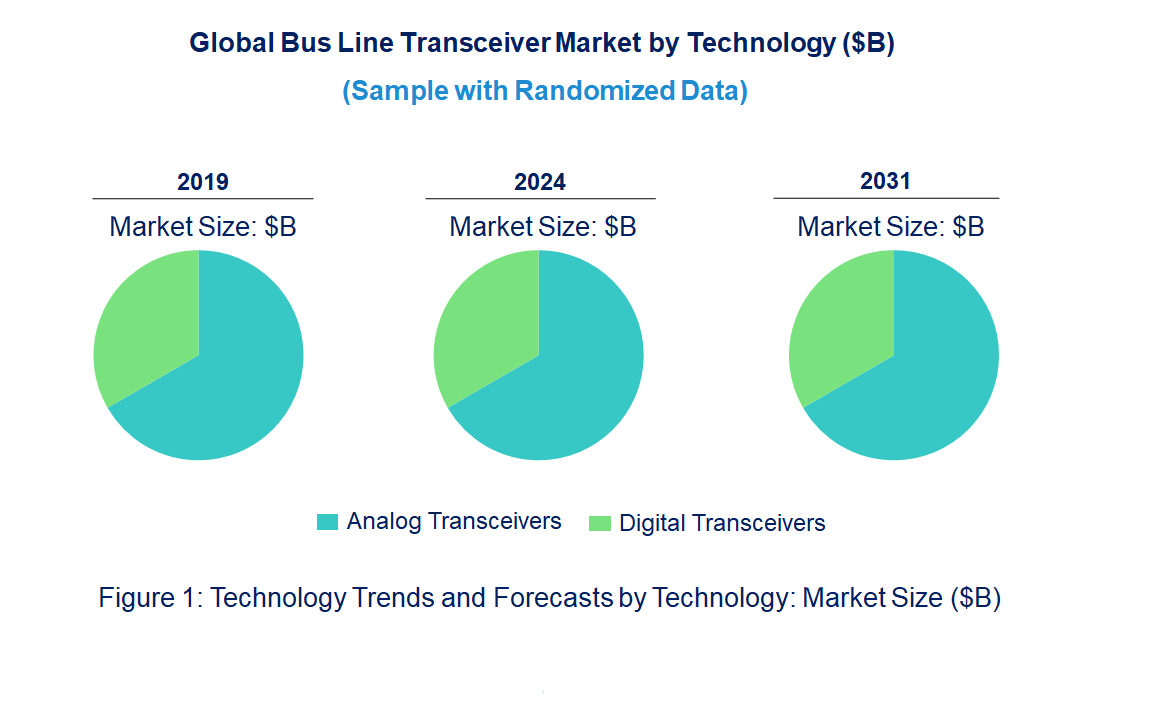
• Technology Readiness by Technology Type: The technology readiness of analog and digital transceivers in the bus line transceiver market varies depending on the application. Analog transceivers, being older technology, are widely available and ready for use in applications where simplicity and cost are prioritized, such as in legacy communication systems. Digital transceivers, while more complex, have reached a high level of readiness, offering superior performance for modern applications in IoT, automotive, and high-speed data transfer. The competitive level for digital transceivers is higher, with several leading companies pushing for faster and more reliable solutions, while analog transceivers face lower regulatory pressure but are increasingly seen as outdated in most cutting-edge sectors. Both technologies have their niches, with analog transceivers being used in lower-speed, cost-sensitive markets and digital transceivers dominating high-performance sectors.
• Competitive Intensity and Regulatory Compliance: The competitive intensity of analog and digital transceivers in the bus line transceiver market varies greatly. Digital transceivers face higher competition due to the rapid evolution of technology, with multiple players innovating to capture market share. Analog transceivers, though fewer in number, still maintain a competitive edge in cost-sensitive and legacy markets. Regulatory compliance is more stringent for digital technologies, as they require adherence to advanced communication standards and protocols, whereas analog systems have fewer regulatory hurdles, primarily focusing on basic electrical standards. The overall market is becoming more competitive as digital transceivers gain traction across industries such as automotive, telecommunications, and industrial automation.
• Disruption Potential by Technology Type: The disruption potential of analog and digital transceivers in the bus line transceiver market is significant, with digital transceivers offering advantages in terms of higher data rates, improved signal integrity, and lower power consumption. Analog transceivers, though well-established, face limitations in scalability and speed, making them less disruptive in the long term. Digital transceivers are poised to disrupt the market due to their ability to support advanced communication protocols and adaptability to modern digital infrastructures, positioning them for higher adoption in industries requiring high-speed data transfer and reliability. However, analog transceivers continue to serve niche applications where simplicity, cost, and legacy systems are crucial.
• Analog Transceivers
• Digital Transceivers
• Government and Municipalities
• Transportation Service Providers
• Corporate Fleets
• Logistics and Delivery Companies
• North America
• Europe
• Asia Pacific
• The Rest of the World
• Latest Developments and Innovations in the Bus Line Transceiver Technologies
• Companies / Ecosystems
• Strategic Opportunities by Technology Type


Choose a license that fits your team. Instant PDF delivery.
Prices exclude taxes. Instant delivery. Custom licensing available on request.
Market Report · May 18, 2026
Market Report · May 18, 2026
Market Report · May 18, 2026
Trusted partner for strategic intelligence and business growth


Receive a complimentary market analysis tailored to your industry. Our analysts will identify key growth opportunities and competitive dynamics specific to your business.

Market size, growth rate, and key trend analysis for your specific sector.

Top competitor positioning and market share analysis.

Strategic recommendations backed by data-driven insights.
Get curated market intelligence and competitive moves straight to your inbox.
By subscribing, you agree to receive our monthly insights. Unsubscribe anytime.
Receive a complimentary market analysis tailored to your industry. Our analysts will identify key growth opportunities and competitive dynamics specific to your business.
Market size, growth rate, and key trend analysis for your specific sector.
Top competitor positioning and market share analysis.
Strategic recommendations backed by data-driven insights.
Get curated market intelligence, emerging trends, and competitive moves straight to your inbox each month.
By subscribing, you agree to receive our monthly insights. Unsubscribe anytime.
We'll send your sample report shortly.