
Market Report · July 16, 2026

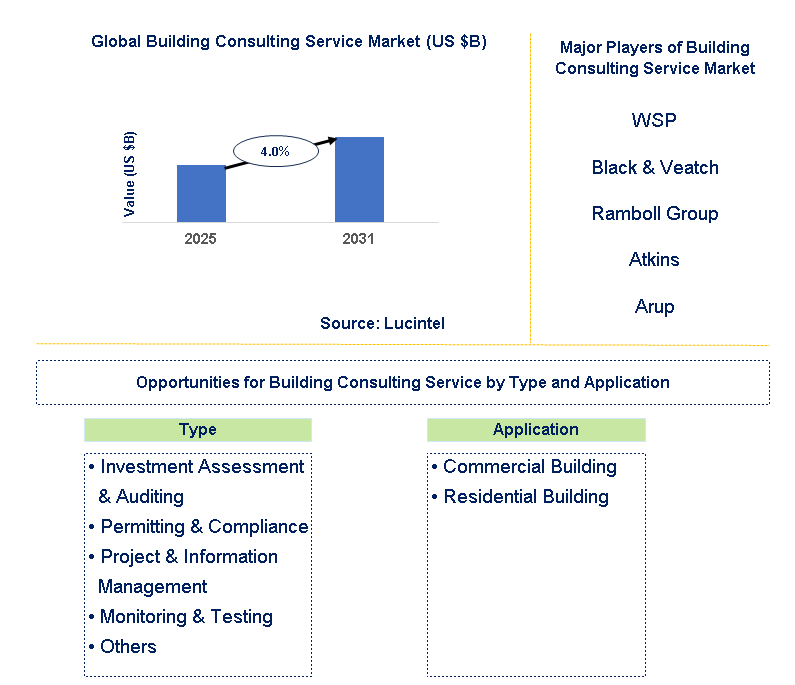
Key data points: The growth forecast = 4% annually for the next 7 years. Scroll below to get more insights. This market report covers trends, opportunities and forecasts in building consulting service market to 2031 by type (investment assessment & auditing, permitting & compliance, project & information management, monitoring & testing, and others), application (commercial building and residential building), and region (North America, Europe, Asia Pacific, and the Rest of the World)
We'll send your sample report shortly.
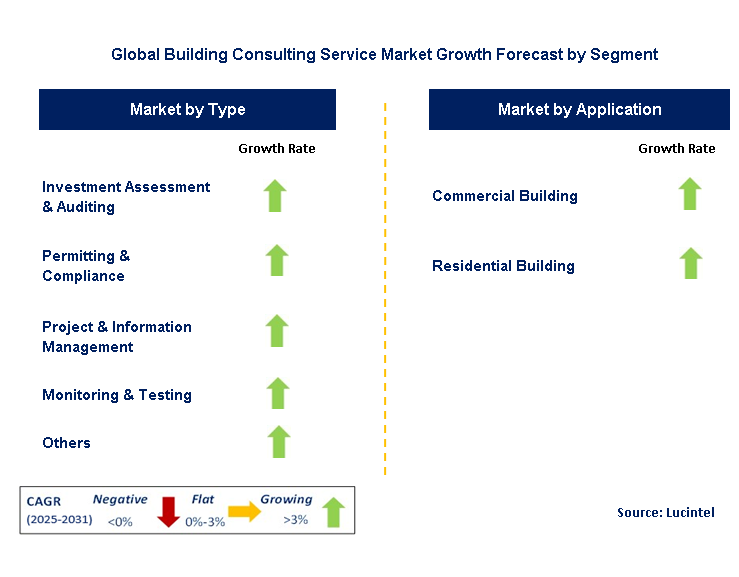
• Lucintel forecasts that, within the type category, investment assessment & auditing is expected to witness the highest growth over the forecast period.
• Within the application category, commercial building is expected to witness higher growth.
• In terms of region, North America is expected to witness the highest growth over the forecast period. Gain valuable insights for your business decisions with our comprehensive 150+ page report. Sample figures with some insights are shown below.
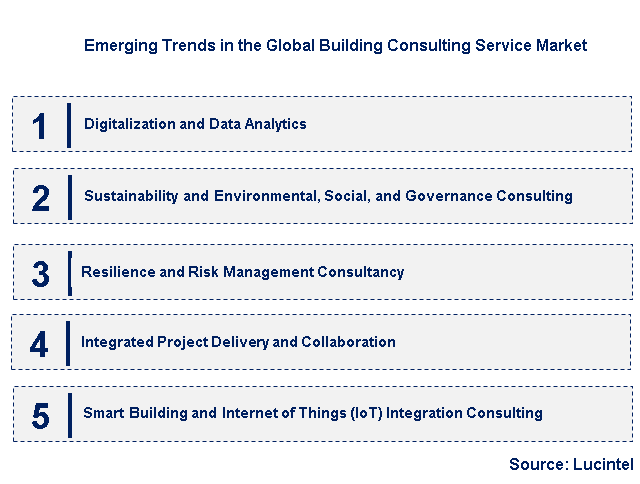
• Digitalization and Data Analytics: This trend means using sophisticated digital tools like Building Information Modeling (BIM), Artificial Intelligence (AI), machine learning, and data analytics to maximize building design, construction, and operation. Consultants more and more use these technologies to deliver predictive insights, enhance project efficiency, and automate mundane tasks. The result is a shift from reactive problem-solving to proactive, data-driven strategies, resulting in lower costs, expedited project delivery, and better-quality outcomes throughout a building's lifecycle.
• Sustainability and Environmental, Social, and Governance Consulting: Tied to increasing environmental awareness, increasing regulation, and investor scrutiny, there is a strong demand for sustainability and ESG advisory. Building consultants are guiding clients to get green building certifications (e.g., LEED), executing energy-efficient solutions, creating net-zero carbon plans, and embedding circular economy values. This trend assists clients to reduce their environmental impact, improve corporate image, and meet changing environmental requirements, such that sustainability becomes an integral part of building projects.
• Resilience and Risk Management Consultancy: With rising climate risks and geopolitical instability, there is a greater need for consulting services aimed at creating resilience and overall risk management. This means evaluating exposures to natural disasters, cyber attacks, and supply chain disruptions. Consultants deliver knowledge on creating resilient building systems, emergency preparedness plans, and business continuity. The result is a safer, flexible, and resilient built environment, able to withstand unexpected challenges and reduce operational downtime
• Integrated Project Delivery and Collaboration: The industry is seeing a move towards integrated project delivery (IPD) models, focusing on cooperation among all parties from preliminary design phases. Building consultants are leading the charge in enabling this collaboration, offering experience in structuring contracts, conflict management, and technology incorporation to create fluid workflows. This wave is intended to dismantle the entrenched silos, facilitate greater communication, and align incentives throughout the project team, which results in more streamlined project delivery and improved overall results.
• Smart Building and Internet of Things (IoT) Integration Consulting: With buildings increasingly intelligent, the demand for specialized consulting on the integration of IoT devices, smart sensors, and sophisticated building management systems is growing. Consultants are recommending methods of taking advantage of real-time information provided by these systems to maximize energy use, predict maintenance, improve security, and enhance occupant comfort. The result is the development of intelligent, responsive buildings that provide better performance, reduced operating expenses, and a more comfortable and productive environment for occupants. These nascent trends are deeply transforming the building consulting service market by moving it from standalone advisory services to connected, technology-enabled, and end-to-end solutions. Consultants are increasingly taking center stage in advising customers on navigating digital transformation, sustainability objectives, resilience, collaboration, and smart building technologies. This transformation places building consulting as a strategic collaborator in the making of future built environments: intelligent, sustainable, and resilient.
• Speeding Up Digital Transformation and BIM Adoption: One such development is the expedited rhythm of digital evolution in building consulting, specifically the extensive use of Building Information Modeling (BIM). Consultants are increasingly making use of BIM for enhanced project visualization, clash detection, cost estimation, and lifecycle management. This allows a more efficient and integrated design and construction process with lower errors and rework. The result is better quality deliverables, increased project predictability, and better collaboration among all stakeholders, from concept inception to facility operation.
• Uptick in Demand for Sustainability and ESG Consulting: There has also been a huge increase in demand for sustainability and Environmental, Social, and Governance (ESG) principle-based consulting services. Construction consultants are now instrumental in advising clients navigating the intricacies of green building certification, renewable energy incorporation, carbon footprint mitigation strategies, and sustainable material choices. This trend is fueled by increased regulations and corporate mandates for environmental stewardship, resulting in healthier facilities and long-term operating savings for clients.
• Growth of Smart Building and IoT Advisory: The growth of smart building technologies and Internet of Things (IoT) has triggered growth in advisory services in this space. Consultants are currently advising clients on strategic deployment of IoT sensors, data analytics platforms, and integrated building management systems to maximize energy usage, improve security, and enhance occupant comfort. This evolution allows buildings to be more responsive and effective, resulting in reduced operating expenses and enhanced occupants' and facility managers' user experience.
• More Emphasis on Disaster Preparedness and Resilience: Recent international experience has emphasized the utmost need to develop resilience. Consequently, building consulting services have experienced an evolution in providing specialized services in disaster readiness, seismic construction, climate change adaptation, and building systems cybersecurity. Consultants are evaluating risks and adopting measures to make buildings resilient to withstand and rapidly recover from different interruptions to offer clients enhanced security and business continuity in a world of uncertainty.
• Holistic Lifecycle Costing and Value Engineering Approach: One significant trend is the move towards more integrated lifecycle costing and value engineering in the consulting world. In addition to upfront construction expenses, consultants are offering detailed examination of long-term operating costs, maintenance, and future upgrade possibilities. This allows clients to make better choices regarding building materials, systems, and designs that provide the best long-term value, going beyond immediate cost savings to maximize the entire asset lifecycle. These advances are having a deep influence on the building consulting service market by making consultants a vital partner in finding their way through the complexity of contemporary construction. The focus on digital technology, sustainability, resilience, smart technology, and long-term value is revolutionizing consulting as a reactive service to become a proactive, strategic activity that drives innovation, efficiency, and sustainability throughout the built environment.
• Commercial Real Estate Development: This segment holds significant expansion prospects based on continuing commercial and mixed-use development all over the world. Strategic expansion includes providing end-to-end consulting services from feasibility studies and site selection to design optimization, permitting, and construction management. Consultants may specialize in optimizing space efficiency, incorporating smart building technology, and obtaining green building certifications for office towers, retail centers, and hospitality facilities, responding to investor requirements for high-performance and environmentally friendly assets.
• Sustainable and Green Building Projects: As more environmental laws and corporate pledges to net-zero create a strong demand for building more sustainably and green, the sustainable and green building projects present a high-growth opportunity. Strategic prospects are in offering specialized consulting to meet green building certifications (e.g., LEED, BREEAM), energy audits, renewable energy integration consulting, and applying circular economy models. Material selection, waste management strategies, and carbon footprint reduction can be helped with by consultants, targeting clients who prioritize environmental stewardship and long-term operating cost savings.
• Healthcare and Life Sciences Facilities: The healthcare and life sciences industry offers special growth potential because of its strict regulatory compliance demands, sophisticated operational requirements, and ongoing technology innovations. Strategic expansion entails providing specialized consulting services in cleanroom design, protocols for sterile environments, medical gas systems, and hospital, laboratory, and pharmaceutical plant resilient infrastructure. Specialized knowledge of infection control, patient flow optimization, and health care-specific codes is extremely prized in the critical application.
• Data Centers and Critical Infrastructure: The explosive growth in digital data and cloud computing fuels strong demand for data center and other mission-critical infrastructure consulting services (for instance, telecommunication facilities, utility control centers). Strategic opportunities exist through highly specialized expertise in power redundancy, cooling system efficiency, fire suppression, and physical security for these mission-critical facilities. Consultants can assure continuous operation, energy efficiency, and adherence to strict uptime standards, which are critical to such sensitive environments.
• Existing Building Modernization and Adaptive Reuse: As cities evolve, modernization, retrofitting, and adaptive reuse of existing structures become an increasingly viable application. Strategic development includes advising on energy-efficient upgrades, structural evaluations for new functions, historic preservation, and infusing smart technologies into older facilities. This entails advising on enhancing indoor air quality, improving accessibility, and repositioning underused space as lively, contemporary assets, appealing to a market concerned with extending the life and value of existing real estate. These strategic growth prospects are profoundly influencing the building consulting service market by promoting specialization and innovation in different areas of application. By creating customized expertise for commercial, sustainable, healthcare, critical infrastructure, and retrofit building projects, the consulting firms can fulfill individual client needs, generate value through specialized expertise, and dramatically increase their market presence, leading to a more efficient, resilient, and sustainable built environment around the world.
• WSP
• Black & Veatch
• Ramboll Group
• Atkins
• Arup
• Construction Market Consultants
• Penstein Group
• ORIEL
• Cunningham Lindsey Global
• Mott MacDonald
• Investment Assessment & Auditing
• Permitting & Compliance
• Project & Information Management
• Monitoring & Testing
• Others
• Commercial Building
• Residential Building
• North America
• Europe
• Asia Pacific
• The Rest of the World
• United States: In the US, the market for building consulting services is dominated by the use of digital transformation such as Building Information Modeling (BIM), data analytics, and supply chain optimization. Sustainability consulting is in high demand, fueled by increasingly stringent environmental regulations and the need for green building certifications such as LEED. Consultants are playing a significant role in assisting clients in incorporating smart building technologies for energy efficiency and predictive maintenance. The market also experiences growing demand for compliance consulting to manage intricate building codes and regulatory compliance, making infrastructure resilient and efficient.
• China: The building consulting service market of China is growing strongly on the back of huge investments in infrastructure and a big thrust for green projects. Even while residential construction is facing challenges, the market is propelled by huge projects in transportation, energy, and industrial sectors. Consultants are more and more offering expertise in environmentally sustainable building practices, city smart developments, and incorporating cutting-edge technologies such as Building Information Modeling (BIM) to make construction more efficient and save money. The government's ambitious 2060 net-zero emissions goals are also more and more driving demand for specialist environmental consulting.
• Germany: The German building consulting service market is defined by a very strong focus on accuracy, quality, and compliance with strict European Union standards. Current trends show emphasis on how to manage the intricacies of decarbonization and meet net-zero ambitions in the building and construction industry. Consultants are offering services on sustainable infrastructure construction, consulting on maximizing value chains, changing the way buildings are constructed, and reducing carbon footprint. In spite of a recent dip in aggregate construction activity owing to inflation and high prices, there is unabated requirement for consulting services for transport, energy, and industrial projects with a view to ensure long-term growth and modernization.
• India: The market for building consulting services in India is witnessing strong growth, largely due to accelerated urbanization, large investments in real estate, and government initiatives such as the Smart Cities Mission. Current trends indicate a high level of demand for consulting in Building Management Systems (BMS) for increased energy efficiency and operational performance in the commercial, residential, and manufacturing industries. There is a significant rise in the uptake of smart building technology, BIM, and increased emphasis on green construction practices such as green building certifications. Consultants play a crucial role in navigating the multifaceted regulatory environments and moving project timelines forward.
• Japan: Japan's market for building consulting services is changing with a high focus on smart building technologies, energy efficiency, and occupant comfort. New trends involve rising demands for consulting on integrating Internet of Things (IoT), Artificial Intelligence (AI), and automation in buildings. There is a heightened emphasis on creating "Digital Twin" technology to model building operations and performance. Consultants are advising clients to implement Building Information Modeling (BIM) and other digital solutions for increased productivity and safety.


• WSP
• Black & Veatch
• Ramboll Group
• Atkins
• Arup
• Construction Market Consultants
• Penstein Group
• ORIEL
• Cunningham Lindsey Global
• Mott MacDonald Q5. Which building consulting service market segment will be the largest in future? Answer: Lucintel forecasts that, within the type category, investment assessment & auditing is expected to witness the highest growth over the forecast period. Q6. In building consulting service market, which region is expected to be the largest in next 5 years? Answer: In terms of region, North America is expected to witness the highest growth over the forecast period. Q7. Do we receive customization in this report? Answer: Yes, Lucintel provides 10% customization without any additional cost.


Choose a license that fits your team. Instant PDF delivery.
Prices exclude taxes. Instant delivery. Custom licensing available on request.
Market Report · July 16, 2026
Market Report · May 18, 2026
Market Report · May 18, 2026
Trusted partner for strategic intelligence and business growth


Receive a complimentary market analysis tailored to your industry. Our analysts will identify key growth opportunities and competitive dynamics specific to your business.

Market size, growth rate, and key trend analysis for your specific sector.

Top competitor positioning and market share analysis.

Strategic recommendations backed by data-driven insights.
Get curated market intelligence and competitive moves straight to your inbox.
By subscribing, you agree to receive our monthly insights. Unsubscribe anytime.
Receive a complimentary market analysis tailored to your industry. Our analysts will identify key growth opportunities and competitive dynamics specific to your business.
Market size, growth rate, and key trend analysis for your specific sector.
Top competitor positioning and market share analysis.
Strategic recommendations backed by data-driven insights.
Get curated market intelligence, emerging trends, and competitive moves straight to your inbox each month.
By subscribing, you agree to receive our monthly insights. Unsubscribe anytime.
We'll send your sample report shortly.