
Market Report · July 22, 2026

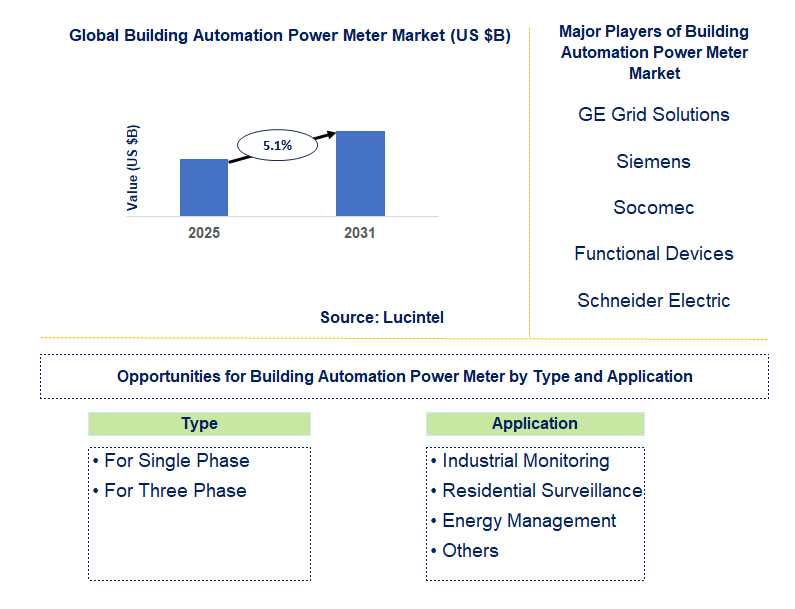
Key data points: The growth forecast = 5.1% annually for the next 7 years. Scroll below to get more insights. This market report covers Trends, opportunities and forecasts in building automation power meter market to 2031 by type (for single phase and for three phase), application (industrial monitoring, residential surveillance, energy management, and others), and region (North America, Europe, Asia Pacific, and the Rest of the World)
We'll send your sample report shortly.
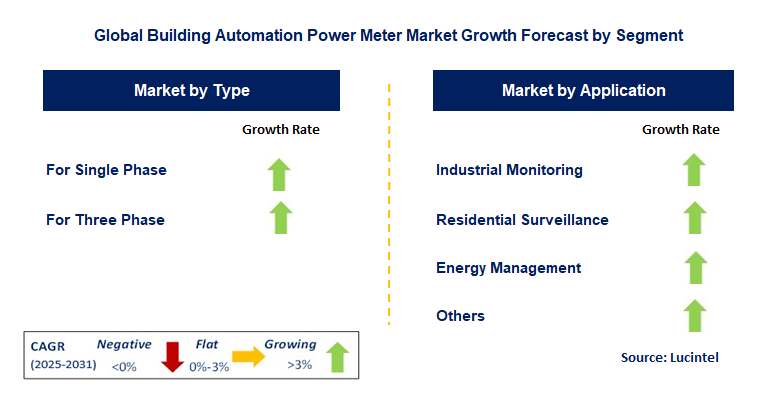
• Lucintel forecasts that, within the type category, for three phase is expected to witness higher growth over the forecast period due to their capacity to handle higher loads.
• Within the application category, energy management is expected to witness the highest growth due to rise in commercial and industrial sectors.
• In terms of region, APAC is expected to witness the highest growth over the forecast period due to growing demand for smart buildings in this region.
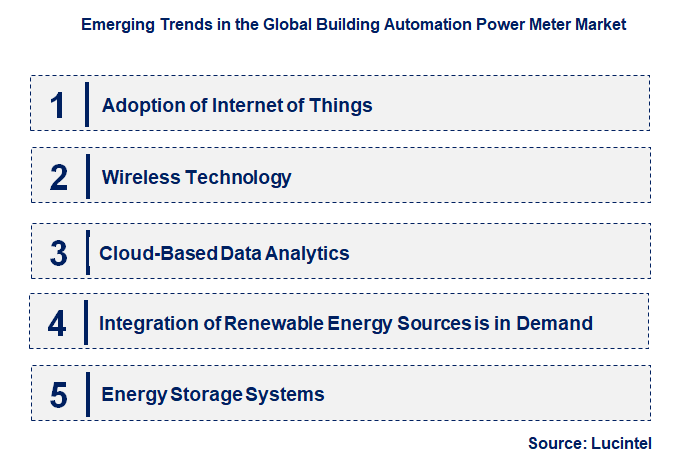
• Adoption of Internet of Things: Integration of IoT with power meters facilitates energy data collection and management in real-time. IoT-enabled meters provide information on energy consumption behavioral patterns which can be used to improve energy optimization, consequently saving some money. With IoT integration, remote monitoring and control is made possible for building efficiency.
• Wireless Technology: The installation of wireless power meters is on the rise due to the ease of installation and the lessened maintenance expenses. These meters eliminate excessive wiring which reduces building retrofitting time and expenses. Smart sensors, which are crucial for energy monitoring and management, are also enabled by wireless technology.
• Cloud-Based Data Analytics: Cloud-based analytics are becoming important in building automation because they allow the collection and processing of huge volumes of energy consumption data. This makes it possible to perform predictive maintenance and energy allocation optimization, which ultimately makes businesses more efficient while lowering costs. It broadens and improves users’ decision-making by making user data more retrievable.
• Integration of Renewable Energy Sources is in Demand: There is an increasing demand for the use of wind and solar energy in automation systems. Sophisticated power meters, which can track and manage energy consumption from renewable sources, are becoming popular. This trend is beneficial for sustainability objectives as it decreases the dependency on fossil fuel power grids and reduces carbon footprints.
• Energy Storage Systems: The trend of adopting renewable energy correlates with the increased demand for their energy storage. Now, sophisticated power meters are being manufactured to work with energy storage systems and assist buildings in storing renewable energy. This innovation helps in avoiding energy wastage and ensures that the stored energy can be utilized when needed most, such as during peak hours or power outages. All of these trends work towards improving the underlying structures, or integrating technologies such as innovation, efficiency, and cost efficiency in the BAPM market. Power meters are expected to be an integral part of smart building infrastructure as the technology further progresses, making future smarter buildings more eco-friendly and energy-efficient.
• Real Time Energy Utilization Advanced Smart Meters: The introduction of meters that track energy use in real time has transformed the market. This enables accurate insights into consumption, thus facilitating effective energy management decisions. Businesses can use automation to minimize energy waste by integrating these meters with building automation systems.
• Collaboration with Renewable Energy Systems: Association of building automation power meter with renewable energy systems is increasing globally for sustainability purposes. These meters enable efficient energy monitoring and management from solar panels, wind turbines, and other sources, thereby promoting a cleaner environment and reducing dependence on grid energy.
• Existing Structures Improvements: Due to the constant need to upgrade buildings, replacing older power meters with advanced versions is one of the most common practices. Older existing structures can be improved with the latest energy monitoring technologies, thereby enhancing their efficiency without needing extensive renovations.
• Enhanced User Interfaces and Analytics: Advanced user-friendly interfaces and analytic features are being included in new power meters. These tools offer valuable insights for managers with regards to energy utilization and consumption. Additionally, advanced predictive maintenance analytics helps avert issues before they occur.
• Government Regulations and Standards: Growing government focus on environmental standards and regulations have caused a shift in energy efficiency requirements for buildings. Modern automation systems require power meters and other energy efficient technologies to be installed or substituted. Consequently, most building operators in need of complying with environmental laws and reducing their carbon footprints have begun using such systems. Innovation in energy management is being fueled by the major changes in the building automation power meter market. The evolution of smart technologies suggests that these power meters will, in the future, be more embedded into the industry’s processes of energy optimization and sustainability.
• Smart Building Automation Solutions: The integration of advanced power meters into building automation systems offers smarter solutions as the demand for smart buildings increases. The enhanced energy efficiency, real-time monitoring, and control of various building operations makes these systems irresistible to building managers and owners.
• Retrofit Market: There is marked growth potential in the retrofit segment of the power meter market for building automation systems, especially for older buildings. The initiative of lowering energy consumption in buildings opens the door to significant savings from power meter upgrades. In newer regions with aging infrastructure, the cost effectiveness of retrofitting systems is fueling the growth of this market.
• Transformations in Integration of Renewable Energy: The transition to using renewable energy sources provides new market opportunities for power meters which are used for monitoring and managing energy from solar panels, wind turbines, and other renewable sources. Incorporation of these meters into the energy systems of buildings will enable optimization of renewable energy usage and ensure maximum efficiency from these sources.
• Changes in Energy Management Services: As businesses have become more conscious about the energy they consume, there is a notable rise in the demand for energy management services. Offering comprehensive energy management solutions will enable corporations to assist building owners and operators in monitoring and optimizing energy usage in their facilities, thus creating new growth opportunities in the power meter market.
• Initiatives for the Development of Smart Cities: The increase in the development of smart cities is happening with great speed throughout the world, providing significant market development for building automation power meter . These meters assist in the management of energy consumption in urban locations, enabling more efficient and environmentally friendly cities which makes them highly important. Companies that specialize in smart city infrastructure can take advantage of this market. Building automation power meter market has strategic growth opportunities due to technological improvements and sustainability initiatives. Focusing on these areas can help businesses refine their product portfolios and increase their market coverage, thus improving the entire sector.
• GE Grid Solutions
• Siemens
• Socomec
• Functional Devices
• Schneider Electric
• Delta Electronics
• FLEXIM
• Carlo Gavazzi
• Accuenergy
• ABB
• For Single Phase
• For Three Phase
• Industrial Monitoring
• Residential Surveillance
• Energy Management
• Others
• North America
• Europe
• Asia Pacific
• The Rest of the World
• United States: The smart meter the U.S. is advanced with has been growing at a rapid pace due to federal and state policies toward energy reduction. Government policies and the need for energy-efficient buildings has resulted in high consumer spending toward building automation systems. Real-time powered advanced energy meters that are integrated with renewable systems are increasingly adopted by the consumers. There are also new innovations stemming from the focus on building energy management especially with the push towards net-zero emissions.
• China: Innovations in energy-efficient technologies adoption in China is further driven by industrialization and urbanization. The government has put into place various green building guidelines and energy conservation programs which has created a need for the automation of power meters in buildings. In addition, China is investing heavily in smart cities which are now using power meters for effective resource allocation. The fusion of the IoT with building systems is one of the major developments on the Chinese market.
• Germany: Germany has always been in the forefront of sustainable architecture together with energy efficiency. Germany has incorporated smart meters in the automation of buildings to control and optimize energy use. German companies are very proactive in applying new energy sources such as solar and wind in automating the buildings and have stringent policies on energy expenditure as well as carbon fumes. The rise of the so-called smart homes is adding to the proliferation of modern power meters.
• India: As urban centers continue expanding and the Government of India pushes toward developing smart cities, the country’s building automation market is growing rapidly. In particular, the demand for energy-efficient buildings is on the rise, leading to increased adoption of automation systems including power meters. Still, the power grid’s affordability and infrastructure capabilities are a challenge. Regardless, energy management solutions are becoming more common in commercial buildings, and there is a greater focus on sustainability targets.
• Japan: Japan is a leading provider of innovation around the globe, and this is no different for the building automation industry. Currently, the market focuses on the new generation of power meters that have an accurate record of energy consumed during the different times within the day. This is especially true given the country’s energy shortages and growing environmental concerns. There is also a growing need to incorporate modern meters that allow for effective energy monitoring and management to support the government’s smart cities and green technology initiatives.


• GE Grid Solutions
• Siemens
• Socomec
• Functional Devices
• Schneider Electric
• Delta Electronics
• FLEXIM
• Carlo Gavazzi
• Accuenergy
• ABB Q5. Which building automation power meter market segment will be the largest in future? Answer: Lucintel forecasts that, within the type category, for three phase is expected to witness higher growth over the forecast period due to their capacity to handle higher loads. Q6. In building automation power meter market, which region is expected to be the largest in next 5 years? Answer: In terms of region, APAC is expected to witness the highest growth over the forecast period due to growing demand for smart buildings in this region. Q7. Do we receive customization in this report? Answer: Yes, Lucintel provides 10% customization without any additional cost.


Choose a license that fits your team. Instant PDF delivery.
Prices exclude taxes. Instant delivery. Custom licensing available on request.
Market Report · July 22, 2026
Market Report · July 22, 2026
Market Report · July 17, 2026
Trusted partner for strategic intelligence and business growth


Receive a complimentary market analysis tailored to your industry. Our analysts will identify key growth opportunities and competitive dynamics specific to your business.

Market size, growth rate, and key trend analysis for your specific sector.

Top competitor positioning and market share analysis.

Strategic recommendations backed by data-driven insights.
Get curated market intelligence and competitive moves straight to your inbox.
By subscribing, you agree to receive our monthly insights. Unsubscribe anytime.
Receive a complimentary market analysis tailored to your industry. Our analysts will identify key growth opportunities and competitive dynamics specific to your business.
Market size, growth rate, and key trend analysis for your specific sector.
Top competitor positioning and market share analysis.
Strategic recommendations backed by data-driven insights.
Get curated market intelligence, emerging trends, and competitive moves straight to your inbox each month.
By subscribing, you agree to receive our monthly insights. Unsubscribe anytime.
We'll send your sample report shortly.